Collect Fallen Leaves Before Winter

Fallen leaves can clog drainage.

The problem with all the colorful foliage that adorns so many of the deciduous trees in autumn is that it does not stay in the trees too long. Combined with all the other less colorful deciduous foliage, as well as whatever evergreen foliage happens to fall this time of year, it will become quite a mess by winter. Rainy and windy winter weather will only make it messier by bringing down even more foliage!

Contrary to popular belief, many evergreen trees are just as messy as deciduous trees are. Instead of dropping all their foliage in autumn or winter, most evergreens drop smaller volumes of foliage throughout the year. The mess is less obvious since it sneaks up slowly, but can accumulate over a few months. Only a few evergreen trees drop much of their foliage in more obvious seasonal phases.

Debris from evergreen trees is actually more likely to be a problem for plants below. Pines, cypresses, firs, spruces, cedars, eucalypti and many other evergreen trees produce natural herbicides that inhibit the emergence of seedlings of plants that would compete with them in the wild. In landscape situations, this unfortunately interferes with lawns, ground covers and annuals. Besides walnuts and deciduous oaks, not many deciduous trees use this tactic.

Regardless, any foliar debris can be a problem if allowed to accumulate too long. Large leaves, like those of sycamore, can accumulate and shade lawn, ground cover and some dense shrubbery, and can eventually cause mildew and rot. Finely textured foliage, like that of jacaranda or silk tree, can sift through most ground covers to the soil below, but can still make a mess on lawn.

Before rainy weather, debris should be cleaned from gutters and downspouts. Because some foliage continues to fall through winter, gutters will likely need to be cleaned again later. Flat roofs and awkward spots that collect debris, such as behind chimneys, should also be cleaned.

Gutters at the street are more visible and accessible, so do not often accumulate enough debris to be a problem, but may need to be cleaned if they become clogged with debris washed in by the earliest rains. Fallen leaves should be raked from pavement so that it does not get dangerously slippery, or stain concrete too much.

Gardens Show Their True Colors

California gets autumn foliar color too.

Contrary to popular belief, good autumn foliar color, or ‘fall color’, is possible on the West Coast. Mild weather only limits the options for trees, shrubs, vines and perennials that color well. Besides, autumn foliar color simply is not a popular priority in western gardening.

Boston ivy must be the best climbing vine for color in autumn. Unfortunately, it is too aggressive for refined urban gardens, and clings with ‘holdfast discs’ that damage the surfaces that it climbs. It is better for freeway soundwalls and interchanges. Grapevine is a more docile option, and also produces grapes, but most cultivars (cultivated varieties) are not too remarkably colorful. Wisteria can turn an appealing shade of soft yellow where well exposed, but its best asset is still the colorful and fragrant bloom in spring.

Eastern redbud, crape myrtle, smoke tree and currant are some of the better shrubbery for autumn foliar color. Of these, Eastern redbud develops the most subdued shade of yellow; and crape myrtle develops the most brilliant shades of yellow, orange and red. Both are incidentally considered to be small trees. Smoke trees that have purplish foliage in summer are typically less colorful in autumn than those with green summer foliage. Some of the Japanese maple trees that display good color in autumn are smaller than some of the larger shrubbery.

The North American and European maples that are so colorful where autumn weather is cooler are not so impressive here. Even if the color is good, the foliage does not linger very long, but instead falls as soon as the weather gets breezy or rainy. Silver maple and box elder (which is actually a maple) which are so pretty and green through summer can actually look rather dingy as they yellow for autumn. Fruitless mulberry, tulip tree, black walnut and the various poplars and locusts can color well if the weather is just so, but display only bright yellow without orange or red. Maidenhair tree impresses with the same limited color range only because it is so reliable, and the yellow color is so very brilliant.

Really, the best trees for autumn foliar color are still sweetgum, Chinese pistache and flowering pear. They do not need much cool weather to display impressively brilliant blends of yellow, orange and red. Where the messy fruiting structures (maces) and aggressive roots are not likely to be a problem, sweetgum is a tall and elegant shade tree. Sweetgum trees innately hold their colorful foliage well, and some sheltered trees sometimes hold their foliage through most of winter. Chinese pistache is neither as messy nor as aggressive as sweetgum is, as it forms a broad and low canopy that is likely to need pruning for adequate clearance. It is becoming more popular as a street tree in many municipalities. Flowering pear is perhaps the most cooperative of the three if pruned to improve structural integrity while young, but stays smaller than the others. It is actually quite proportionate to smaller gardens of modern homes.

Fall Color To Fall For

Fall color develops with seasonal changes.

Autumn is also fall here. Actually, ‘fall’ is the more popular name. It had been the popular name in England during the Sixteenth Century. The (generally) French name of ‘autumn’ became more common there during the Seventeenth Century. Yet, both names remained in use in the American Colonies. That is why autumn foliar color is more simply fall color. 

The natural fall color in New England, the Appalachian Mountains, the Rocky Mountains and the Great North Woods is famously exquisite. So many of the native deciduous trees develop remarkable fall color in response to local weather conditions. These same trees might not get sufficient chill to develop comparable fall color in milder climates of Florida. 

In most regions of California, natural fall color is limited by the ability of native species to develop such color. Bigleaf maple and the various poplars turn bright yellow with a slight chill, but are not abundant. Even when chilled, the foliage of most other native deciduous trees simply shrivels and falls without much color. Most of the native trees are evergreen. 

Therefore, most of the best local fall color is provided by exotic (nonnative) tree species. Such trees not only develop remarkable fall color, but do so in response to minimal chill. Sweetgum, flowering pear, Chinese pistache and ginkgo are four trees that most reliably develop brilliant fall color where winter weather is mild. None are native. All are popular.

Ginkgo turns brilliant yellow. The other three display various colors that range from bright yellow, to fiery orange, to rich red and burgundy. Their colorful foliage lingers longer than that of other deciduous trees. Sweetgum and flowering pear might retain fall color until it succumbs to rain in winter. Of course, these are not the only options for reliable fall color. 

No tree is perfect. Although very colorful in autumn, sweetgum is notoriously structurally deficient, and produces obnoxiously spiked fruiting structures. Flowering pear is innately susceptible to fire blight. All deciduous trees drop leaves, which need raking. Trees must conform to their situational limitations, as well as their particular landscape applications.

New Zealand Flax

New Zealand flax provides bold texture.

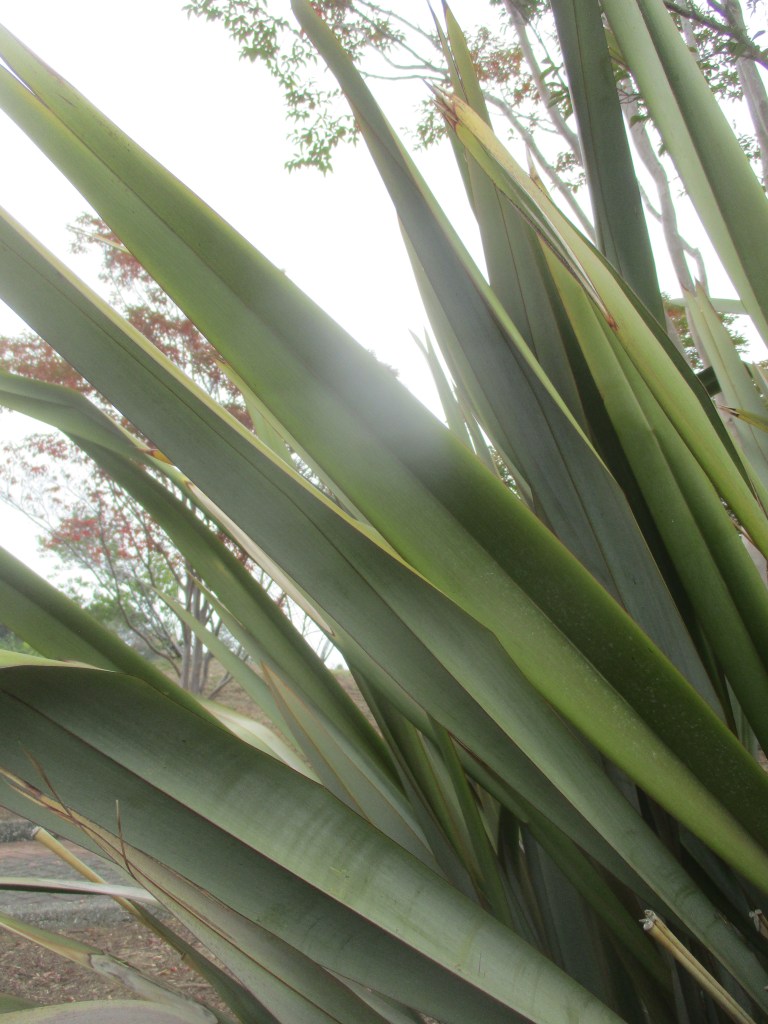
Simple old fashioned New Zealand flax, Phormium tenax, has been popular on the West Coast for as long as anyone can remember. Big specimens are prominent in old pictures of Victorian era gardens. The upright and olive drab foliage gets as high as ten feet, and as broad as fifteen feet. Bronzed and variegated cultivars stay somewhat more compact.

Modern cultivars of New Zealand flax might be Phormium colensoi, or hybrids of the two species. They are generally even more compact, with more colorful foliage. Foliage may be olive green, greenish yellow, brownish bronze, rich reddish bronze or striped with like colors. Some bronze sorts are striped with tan or pink. ‘Yellow Wave’ has floppier foliage. 

New Zealand flax is a tough evergreen perennial. Its long and narrow leaves can be too fibrous to cut without scissors. These leaves grow as tall as they do from clumping basal rhizomes. Interestingly rigid floral stalks stand slightly higher than the foliage, with yellow or red bloom. After bloom, these floral stalks can be a delightful and bold dried cut flower, and work well with pampas grass bloom.

Japanese Aralia

The bold foliage of Japanese aralia is quite striking, whether kept low and dense, or suspended on taller lanky stems.

It may not grow too rapidly, but Japanese aralia eventually gets nearly eight feet high and wide, and commands a bold presence. The deeply and symmetrically lobed leaves can get as broad as a foot and a half, on long petioles (stalks). The foliage of ‘Vairegata’ emerges with a yellow border that turns pale white. ‘Moseri’ stays quite compact.

Plants grown for their foliage can be maintained by cutting the oldest stems to the ground as they begin to deteriorate, so that newer stems can replace them. Alternatively, lower growth can be pruned away as it develops to elevate the canopy and expose interior stems. However, individual stems do not last indefinitely, and will eventually need to be replaced by any convenient watersprouts.

Ferns Are For Distinctive Foliage

Rich green ferns provide distinctive texture.

Ferns are an odd group. They lack the color or fragrance of flowers, or the branch structure of shrubbery, trees or vines. Very few turn color in autumn. They provide only green foliage. Yet, as simple as this seems, the generally evergreen foliage that ferns provide is some of the most distinctive foliage that can be found in the garden.

With few exceptions, ferns are richly deep green. Only a few are lighter green or almost yellowish. The leaves, which are known as ‘fronds’, can be soft and papery, or coarse and tough. The fronds of most ferns are pinnately divided into neatly arranged leaflets; and many ferns have leaflets that are intricately lobed. Some ferns have leaves with more palmate symmetry. A few ferns actually have undivided leaves.

(Pinnate symmetry involves a central midrib or midvein to each leaf, or a central rachis that supports lateral leaflets. Radial symmetry involves multiple midveins or rachi that radiate outward from the centers of individual leaves.)

The Australian tree fern is the largest of the common ferns. It develops a broad canopy of long fronds on top of a trunk that can launch it as high as a two story home. Both the fronds and trunk of the Tasmanian tree fern are shorter and stouter. Other tree ferns are rare. The trunks are not really stems, but are thick accumulations of roots dispersed through decomposed stem tissue.

The staghorn fern is an epiphyte that naturally clings (nonparasitically) to trunks and limbs of trees. The flared upper fronds collect foliar litter that falls from the trees above to sustain the roots within. In home gardens, it is popularly grown on wooden plaques or hung like hanging potted plants, but without a pot.

Some ferns can be grown as houseplants like the classic Boston fern, which cascades softly from a hanging pot. Maidenhair fern is popular for intricate foliage on wiry rachi (leaf stems). Squirrel foot fern has lacy foliage and interestingly fuzzy rhizomes that creep over the edge of a pot.

Since almost all ferns are understory plants that naturally live on or near a forest floor below a higher canopy of trees, they are generally quite tolerant of shade. In fact, most prefer at least some sort of partial shade. This is quite an advantage for spots in the garden that are too shady for other plants. Also, many ferns can disperse their roots into soil that is already occupied by more substantial plants, even if the more substantial plants happen to also be making the particular spot too shady for other plants. In other words, they play well with others.

However, many ferns are more demanding than other plants are in regard to soil quality and watering. They perform best with rich and well drained soil, and regular watering. Sickly ferns generally respond well to fertilizer; but too much fertilizer can burn foliage. Old leaves may need to be groomed out if they do not naturally get overwhelmed by new foliage.

Coleus

No flowers needed with this foliage!

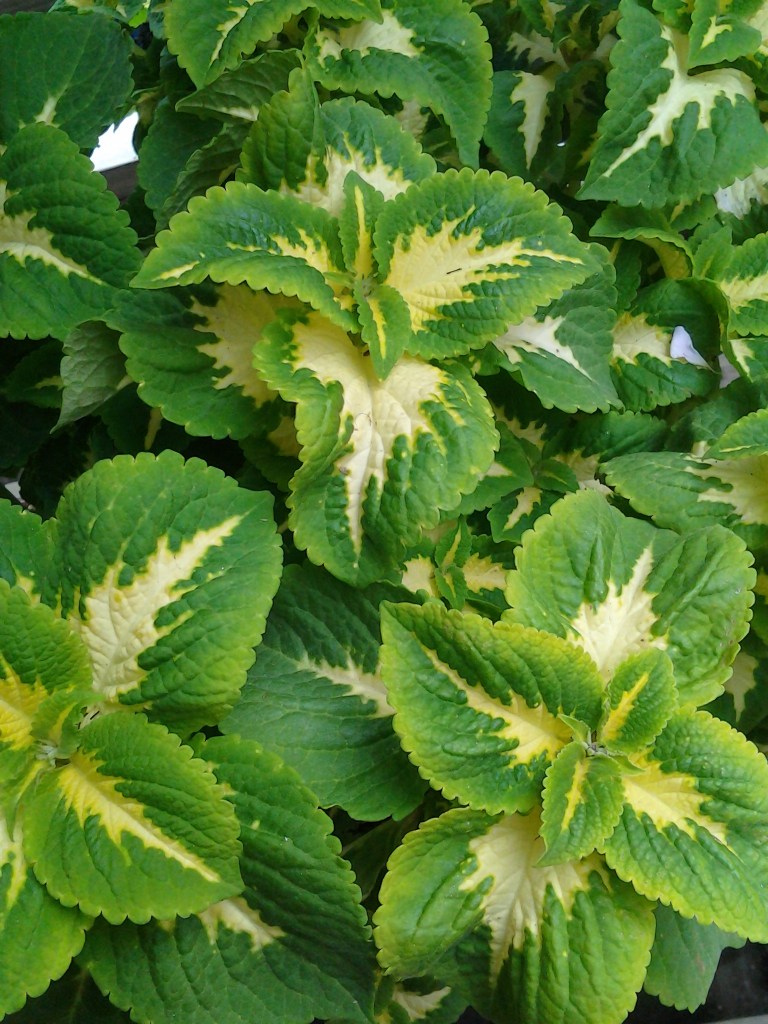
Out in the garden, coleus, Plectranthus scutellarioides, prefers partial shade where the foliage is less likely to get roasted during arid and warm summer weather. It is grown as a warm season annual instead of as a perennial, because it gets so tired through winter, and can be killed by even a very mild frost. Its sensitivity to exposure in the garden is probably why it is more familiar as a houseplant.

The flashy and sometimes deeply lobed foliage is variegated with any combination of green, chartreuse, yellow, orange, red, burgundy, pink, white, brown and almost black. Flower spikes should be snipped as they develop to keep foliage dense. The tiny purple flowers are not much to brag about anyway. Large plants can get to two feet tall and broad. Cuttings root easily in rich and regularly moist potting soil or just plain water. Seeds need sunlight to germinate, so should only be pressed onto the surface of damp potting soil without getting covered, and misted daily.

Houseplants Bring The Outdoors In

Many houseplants will not live outside.

There is someplace in the world for the brethren of each and every houseplant to grow wild. All houseplants do not originate from the same regions, and many were bred in cultivation, but all originate from somewhere. They are houseplants only because they are plants that can live in a house.

Most houseplants are from tropical regions, and many are understory plants that grow in the partial shade of taller trees. They are naturally tolerant of the mild temperatures and partial shade within the home. Not many deciduous plants will be happy without a winter chill.

Confinement is also a concern, since houseplants need to be potted, and stay below ceilings. Plants that need to disperse their roots will not work. Neither will plants that can not be pruned down as they grow. Some palms that work well in malls have leaves that get longer than the distance between the floor and ceiling in the home!

Most houseplants are grown for foliage instead of flowers, not only because a lack of seasons inhibits bloom, but also because their foliage is naturally so appealing. African violets are one of the more notable exceptions. Amaryllis is all flower with almost no foliage, but typically gets discarded when done blooming.

Coleus and caladiums have such colorful foliage that there is no need for flowers. Bloom actually compromises their foliar quality anyway, which is why flower spikes get snipped from coleus. Mauna loa lily is grown for excellent rich green foliage, but sometimes adds clear white blooms as a bonus.

All sorts of ferns are very good houseplants. However, a few, including the popular Australian tree fern, produce coarse fuzz that can be irritating to the skin. A few others, like sword fern, produce messy spores that can permanently stain fabric and carpet. Just because they can live in the home does not mean that they should.

The various ficus are excellent houseplants because they can grow quite large, but can also be pruned to fit into their particular situations. The popular weeping fig (Ficus benjamina) has an abundance of small glossy leaves. Rubber tree and fiddle leaf fig have big thick leaves. Creeping fig is even more distinct from the others, as a wiry vine that is popularly grown in hanging pots.

Perennials provide foliage and bloom

Bloom can repeat in season perennially.

Does anyone really know what a ‘perennial’ plant is? It is obvious that it is not an ‘annual’ plant that lives only a single year. A ‘biennial’ plant produces vegetative (non-blooming) growth in the first year, and then blooms, develops seed, and dies in the second year. A plant only needs to live more than two years to be a perennial plant, or simply a ‘perennial’. Well, that does not narrow the definition down much. Bristlecone pine can live for thousands of years, but is not often thought of as a perennial.

In simple home gardening terminology, a perennial not only lives for more than two years, but does so without producing significant woody stems. Yes, this also happens to include palms and trunk forming yuccas (which are known as ‘perennial trees’), but that is another topic. Some perennials live only a few years. Some can live indefinitely by replacing their stolons, rhizomes, bulbs, tubers or whatever they regenerate from as their old growth gets left behind.

For example, bearded iris spread by fleshy stems known as ‘rhizomes’. As they grow from the forward tips, the older ends that get left behind will rot away. They are constantly replacing themselves, without leaving evidence of how long they have been doing so. (In other words, it is impossible to cut one down to count the rings.)

Many plants that are known as annuals are actually perennials, but get removed and replaced during their respective dormant season. Busy Lizzy can regenerate each spring if their roots do not succumb to frost in winter. Begonia, chrysanthemum, cyclamen and primrose are just some of the many other annuals that could technically survive as perennials.

Lily-of-the-Nile, African daisy, daylily, canna, penstemon, New Zealand flax and various grasses and ferns are some of the more familiar perennials. They are too diverse to generalize about, but happen to be among the most reliable of plants for bloom and foliage. Because form and mature size is somewhat predictable, properly selected perennials are unlikely to outgrow their particular situations.

Variegation And Other Foliar Color

Bright white variegation brightens shady spots.

Foliar color is not limited to autumn. Some deciduous plants display colorful foliage from spring to autumn. Then, some of these change color for autumn. Some evergreen plants display colorful foliage through the year. Variegation of foliage can be more colorful than associated bloom. So can unvariegated bronze, purple, red, yellow, blue or gray foliage.

All sorts of plants exhibit variegation or other variations of color of their foliage. They can be annuals, perennials, shrubs, vines, trees, or houseplants. Although many are popular primarily because of their foliage, some provide appealing bloom as well. Blue and gray foliage is a natural advantage in harsh climates. Other colors are selections of mutations. 

Because variegation deprives portions of foliar surface area of the chlorophyll needed to perform photosynthesis, it inhibits growth. This can be an advantage for plants that grow too vigorously otherwise. However, many variegated plants occasionally develop growth that is not variegated. If not removed, it can overwhelm and displace desired variegation. 

New Zealand flax, dracaena palm (Cordyline australis), gold dust plant, euonymus, coral bells and hosta are some of the many plants that are more familiar with colored foliage or variegation than without. If simple unvariegated coleus, croton or caladium are available, they must be notably rare. Blue spruce is always blue. Purple leaf plum is always purple. 

Although both gold and gray junipers are popular, the most common are green. Bronzed and variegated cannas are likewise not quite as popular as those with simple lush green foliage. Pittosporum tobira is so much more vigorous without variegation than with it, that the two distinct types of this same species perform different functions within landscapes.

Golden honeylocust supposedly produces lighter shade than darker green honeylocust. ‘Ruby Lace’, a bronze cultivar of honeylocust, supposedly produces faintly darker shade. Some golden or variegated foliage is more susceptible to scorch; although sun exposure enhances foliar color and variegation. Fresh new spring growth gets the best foliar color, but is likely to fade through summer.