Pollinators Are As Busy As Bees

Flower breeding is not for pollinators.

Flowers bloom for pollination. It is that simple. Most rely on wind to disperse their pollen. They are more abundant than colorful or fragrant. More prominently colorful and fragrant flowers rely on pollinators. Their color and fragrance attract preferred pollinators, such as insects, birds or bats. Such flowers sustain their pollinators with nectar or surplus pollen.

More than pollinators appreciate their diligence. Almost everyone who enjoys gardening enjoys floral color and fragrance. Cultivation of naturally appealing bloom began several thousand years ago. Selection and breeding most likely began relatively soon afterward. Ultimately, during relatively modern history, hybridization began getting too complicated.

Pollinators were not a priority during such processes. Because most ornamental flowers produce no usable fruit, pollinators are unimportant. Because of extensive hybridization, many ornamental flowers are sterile anyway. Floral color, fragrance and various tangible attributes are more important. Modern bloom appeals more to people than to pollinators.

A few modern flowers now confound their original pollinators. Some types of insects can die of exhaustion while trying to ascertain them. These insects may recognize floral color or fragrance but not strange floral structure. A few modern flowers are too frilly for access. Some attract pollinators without providing enough nectar or extra pollen to sustain them.

Several exotic flowers with less or no breeding distract pollinators with their abundance. Lemon bottlebrush blooms very abundantly and is still common within some landscapes. Blue gum eucalyptus is naturalized in parts of California. Both attract monarch butterflies that native species rely on. Native ceanothus must instead rely more on other pollinators.

Furthermore, a few pollinators actually disrupt native ecosystems. Honey bees, although very important to local agriculture, are not native. They arrived in San Jose in 1853, from where they dispersed throughout the West. It is now impossible to assess their influence. Even seemingly beneficial influence is unnatural and therefore ecologically detrimental.

P II

Hibbertia scandens

P was for pea last Sunday. Although the spelling has not changed since then, this is a different topic now, so is not actually a sequel. P just happens to also be for the floral fragrance of Hibbertia scandens, which, to some, resembles that of what tomcats do to designate their territory. Its several common names are no more appealing. It is known as golden guinea vine, climbing guinea flower and twining guinea flower. Rather than possibly offending others of Italian descent, I refer to it simply as snake vine. Contrary to its several other common names, it is not actually from the Guinea Region of Western Africa, but is instead from Eastern Australia and New Guinea. Incidentally, New Guinea is no more affiliated with Western Africa than it is with descendents of Italian Immigrants in America, or plump rodents who identify as pigs of the Andes Mountains on the West Coast of South America. I got a few cuttings of snake vine at the end of last September. One cutting is growing quite nicely. Another took time to bloom with this single flower that looks like Carl Junior did not quite beat the train. Its floral fragrance is almost disappointingly unobjectionable. I suspect that more are necessary to be perceptibly fragrant. From my limited experience with the species, I remember than only a profusion of bloom produced merely a slightly objectionable fragrance. Like so much of what I grow here, I have no idea of what to do with these new snake vines. Fortunately, they are more docile than the white perennial pea that I mentioned last Sunday, or the cup of gold vine that I mentioned earlier. Eventually, I should be able to accommodate some within at least one of the many refined landscapes at work. If so, I will not put enough of it within the same situation to generate annoyingly objectionable floral fragrance. Nor should any individual specimen be allowed to grow large enough to do so. I would be more tolerant of a slight bit of such fragrance within my home garden only because I happen to be fond of this species now that I have reacquainted with it.

Reveille

Angel’s trumpet, Brugmansia X cubensis ‘Charles Grimaldi’

Summer has been slow to arrive. Now, some flowers that have been waiting for a bit of warmth to bloom are ready to make up for lost time.

These angel’s trumpets are fortunately silent. Even prior to full bloom, so much bloom looks silly with such minimal foliage.This picture is a few days old; so they are in full bloom by now. More foliage will develop as the summer progresses.

This particular cultivar is the common ‘Charles Grimaldi’, with splendidly fragrant single yellow flowers. Two other cultivars are blooming nearby. One is somewhat less vigorous, with single white but perhaps less fragrant flowers. The other is more compact than ‘Charles Grimaldi’, with double white and comparably fragrant flowers.

All were grown from cuttings, and have potential to grow like weeds. Six more of the cultivar with double white flowers were added to another landscape nearby. Several of both cultivars with white flowers are developing in the nursery, and will need homes either in the landscapes or neighbors’ gardens by next year. Another cultivar in the nursery may bloom with mildly fragrant single pastel orange flowers in the next few days, but we will not know until it actually does so. We have not seen it bloom yet. It could actually be another copy of ‘Charles Grimaldi’.

Daylilies are beginning to bloom now also. Like angel’s trumpet, they seem to have been waiting a bit longer than they wanted to, so are ready to bloom simultaneously in atypical profusion. I hope that such profusion does not compromise subsequent bloom, since they continue to bloom throughout summer and until frost. Also like angel’s trumpet, daylilies are so easy to grow and propagate that there has been no incentive to acquire more cultivars than the three or so that are already here.

Hall’s Honeysuckle

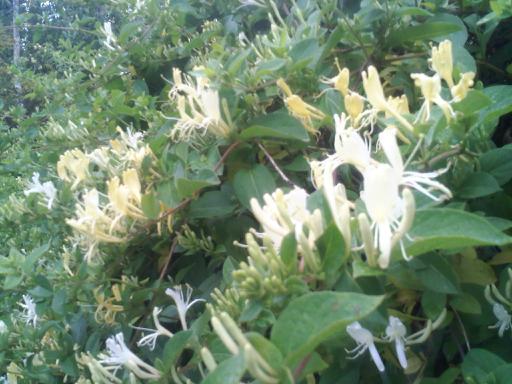
Hall’s honeysuckle climbs aggressively by twining.

The unrefined twining vines of good old fashioned Hall’s (Japanese) honeysuckle, Lonicera japonica ‘Halliana’, seem to fit in so naturally with lilacs, hydrangeas and bearded iris; the sort of plants that grow in grandma’s garden. Grandma may need help controlling it though, since it can climb more than twenty five feet, and get overgrown and invasive. It is best pruned back to main canes or to the ground annually at the end of winter. Even though it is evergreen, it drops some of its foliage and looks rather tired by the end of winter anyway.

Just as the fragrance of the earlier spring blooming flowers gets depleted, Hall’s honeysuckle begins to bloom with its own distinct sweet fragrance, attracting bees and hummingbirds. Bloom is typically most abundant in spring, and followed by sporadic bloom until autumn. Fluctuations of weather or watering can cause subsequent phases of abundant bloom during summer. The pale white tubular (and bisymmetrical) flowers fade to pale yellow that is perhaps the color of French vanilla ice cream. The simple light green leaves are about two inches long. A few leaves on the most vigorous vines may be lobed.

Undoing of Fragrance

Extensive breeding can compromise floral fragrance.

As I enjoy good friends and cheap coffee out on the deck, I am also savoring the sweet fragrance of the abundant white bloom of the black locust off in the distance. I know that black locust is a noxious weed that invades riparian environments; but they smell so good on such pleasantly warm spring days. Modern varieties are certainly better behaved and more colorful with their pink to purplish flowers, but their fragrance does not compare so well.

Earlier here on the deck, one of my friends and I discussed how modern Buicks are much safer than old classic Buicks are, but are not quite as elegant and stylish. It made me think of how decades ago, modern roses were developed for flower size, form, color and stem length, but in the process, were deprived of, among other qualities, their fragrance. Perhaps I would have been more attentive to my friend if the coffee were as potent as the fragrance of the black locust.

Modern varieties of many classic flowers are less fragrant than their ancestors were. This is because decades (and centuries) ago, fragrance generally had not been prioritized in breeding as much as were other physical characteristics, such as flower size, form, color and so on. The plants that were consequently used for breeding typically had the most visually appealing flowers, but lacked fragrance. Such disparity is actually quite natural among plants with variable flowers.

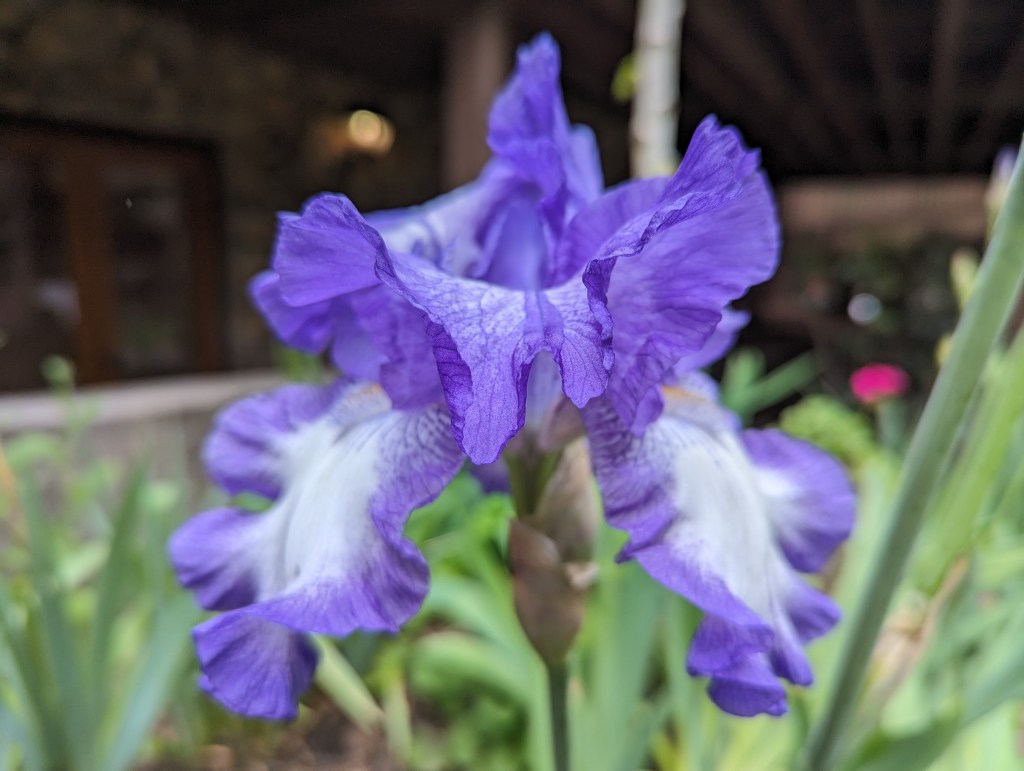
For example, most bearded iris that naturally have the biggest, fanciest and most brightly colored flowers are also the least fragrant. Their progeny that have become the modern varieties are just as flashy, and also, just as deficient of fragrance. Conversely, the relatively small and simple pale purple flowers of my favorite ‘Grandma Sheppard’ bearded iris are remarkably fragrant.

To the iris, this is all quite sensible. Their fragrance is not designed to impress us, but is merely intended to attract pollinators. If they are fragrant enough to entice the insects that bring them pollen, they do not need to waste any more effort on visual appeal. Without fragrance though, they can alternatively use color (including infrared and ultraviolet) to direct insect traffic where they need it to go in order to accomplish pollination. Almost all of the many varieties of iris prefer to specialize in one or the other; either fragrance or visual characteristics, but not both.

So many of the old classics seem to have lost some or most of their fragrance as they have ‘improved’ over the years because visual appeal has been prioritized more than fragrance. Besides flowering locusts, roses and iris, some types of honeysuckle, mock orange, sweet pea, violet, hyacinth, lily and even narcissus are less fragrant than their ancestors were. However, traditional as well as modern fragrant roses and iris seem to be gaining popularity. Fortunately, gardenia, lilac, wisteria, stock and the fragrant types of angel’s trumpet and jasmine are probably as potent as they have ever been because they have not been tampered with as much.

Lilac

Lilac is splendidly fragrant!

‘French Hybrids’ are not fuel efficient European cars. (However, if there were a French equivalent to the old Japanese Datsun ‘Z’ that was instead named the ‘S’, we could really see the ‘S car go!’) ‘French Hybrids’ are varieties of lilac with single or double flowers in various shades of lavender, pink, pale blue, pinkish red, purple and white. Some have flowers that are two-toned. ‘Primrose’ is an interesting shade of pale yellow. All are strongly but elegantly fragrant. 

Even though ‘French Hybrids’ have the advantage of being better adapted to mild winters, the original species of common lilac, Syringa vulgaris, and its older varieties seem to do just fine locally, and actually seem to be more fragrant. The only disadvantage is that almost all bloom with lavender flowers. ‘Alba’, with white flower, is rare. ‘Descanso Hybrids’ were developed for even milder winters.  

The individual tubular flowers are actually very small, but bloom in dense conical trusses that are typically about three or four inches long, and possibly twice as long. Trusses develop on year old stems, so pruning should be done right after bloom only, although dead-heading (removing deteriorating trusses) without pruning can be done at any time. The soft and sometimes light green leaves are about three inches long. Mature plants are often eight feet tall and nearly as broad, and can get twice as large.

Unlike most plants that get suckers that need to be removed, most lilacs should instead be pruned to remove older canes and to promote healthier growth of suckers. This process of ‘alternating canes’ continually replaces less productive deteriorating stems with vigorous new stems. Old fashioned grafted plants are the only lilacs that should have their suckers removed; but they are uncommon, and do not sucker as much anyway.

Aromatic Foliage Attracts And Repels

Scented geranium supposedly repels some insects.

After their invention in ancient Rome, window boxes became overly prevalent in Venice. They contained herbs and vegetables where space was limited within such urban areas. Their produce was close to kitchens, and more visually appealing than nearby buildings. Several window box herbs produced aromatic foliage for more than culinary application.

The popularity of window boxes preceded the availability of affordable window screens. Mosquitoes were a nuisance within the swampy ecosystems around Venice prior to that. Therefore, besides their obvious usages, window boxes also sustained aromatic foliage. Such foliage, which was mostly also culinary herbs, repelled some troublesome insects.

Just as flowers attract pollinators with fragrance, some foliage repels insects with aroma. Some aromatic foliage intends to repel other large consumers, such as rodents and deer. Any potential consumers know that flavor is likely as objectionable as associated aroma. Ironically, some flavors or aromas that are unappealing to them are appealing to people.

Culinary herbs are perfect examples. Their strongly flavorful and aromatic foliage is quite repellent to insects and wildlife. However, it is an asset both for culinary and horticultural application. Some such herbs have cultivars for either culinary or landscape application. Trailing rosemary is a groundcover that has slightly milder flavor than culinary rosemary.

Several cultivars of lavender are popular for home gardens even if not for home kitchens. Their aromatic foliage is as delightful as their foliar color and bloom. The foliar texture of fennel is as striking as its foliar aroma. Thyme is both an herb and an aromatic, although irregular, ground cover. Mint and oregano are a bit more casual, but likely more aromatic.

Some of the most popular aromatic foliage has no culinary application, though. Its aroma more than justifies its cultivation. Scented geraniums and sages are remarkably diverse. Although most are quite pretty, a few are simply very aromatic. Most aromatic foliage can not disperse its aroma like floral fragrances. It requires some sort of disturbance to do so. Warmth with humidity enhance typical foliar aroma.

Garden Phlox

Garden phlox is delightfully fragrant.

In eastern North America where it grows wild as a native, garden phlox, Phlox paniculata, is modest but classic perennial that gets more than four feet tall with pinkish lavender flowers from late summer through early autumn. Modern garden varieties are mostly somewhat more compact with pink, red, light purple or white flowers. Many have fragrant flowers; and some have flowers with lighter or darker centers. Butterflies and hummingbirds dig them all.

Locally, garden phlox probably looks best with slight shade or among other lush plants, only because humidity is so minimal. Otherwise, it would be just as happy out in the open. In well watered gardens with rich soil, it sometimes self sows a bit, but rarely naturalizes continually enough to revert to a more natural (wild) state like it can in gardens on the west coast of Oregon and Washington. Garden phlox can be propagated by division of mature plants either after bloom in autumn or in spring.

Star Jasmine

Delightfully fragrant star jasmine can be either a ground cover or a climbing vine.

The strong fragrance of the inch-wide, star shaped flowers of star jasmine, Trachelospermum jasminoides, gets attention from quite a distance. Whether they bloom lightly in partial shade, or profusely enough to obscure nearly half of the foliage below, their crisp white shows up nicely against the rich waxy green of the simple two or three inch long, and inch wide leaves. Star jasmine is among the more complaisant of vines, so only climbs or creeps along the ground to about ten feet; perhaps twice as much when very mature.

Fragrance Lacks Color

Mock orange compensates for its lack of flashy color with alluring fragrance.

Remember the smell of the neighbor’s kitchen that met you on the sidewalk as you occasionally walked by when you were young? Whether it was Momma Tomeo’s gnocchi, Mrs. Panagakos’ fresh bread or Mrs. Adam’s black eyed peas, it was so alluring, even from considerable distance. Fragrant flowers may not compare to black eyed peas (mmm), but they certainly can be alluring even without being seen.

Because flowers prefer to be efficient at their work of attracting pollinators, they tend to be either colorful or fragrant, but not both. Those that attract pollinators with color do not need to also use fragrance. Conversely, those that use fragrance to impress pollinators do not need flashy colors. Most fragrant flowers are pale shades of white, and bloom for a short time. However, there happen to a few flowers that are both fragrant and colorful.

Black locust is one of the most fragrant of trees, despite its many other problems. (It is invasive and weedy.) The flowers are bright white, and abundant enough to be quite impressive. Southern magnolia has a distinctive but more subdued fragrance. The flowers are impressively large and bloom randomly through the year, but pale and not very showy among the bold evergreen foliage.

Of the many shrubs with fragrant flowers, mock orange (Philadelphus spp.) has rampant growth with a good display of elegant and remarkably fragrant white flowers. Daphne produces a strongly sweet fragrance with clusters of small pale pink flowers. Both lilac and angel’s trumpet, although very different from each other, have the advantage of impressively fragrant flowers that are quite colorful. Roses offer a better variety of color, but not many are as fragrant.

Wisteria is an aggressive vine with flowers and fragrance like those of the black locust, with all the colors of lilac. Despite the advantage of a longer bloom season, fragrant honeysuckle lacks impressive color.

Earlier in spring, bulbs like freesia, hyacinth, lily, narcissus and some iris bloomed with some of the most fragrant flowers available, in all sorts of colors. Alyssum and flowering tobacco are nice fragrant annuals that bloom longer than most others. Sweet pea may not last as long as weather gets warmer, but compensates with richer and more varied fragrances.