Lineage can be difficult to identify. Most popular cultivars of angel’s trumpet, Brugmansia are hybrids. Many are hybrids of hybrids. Almost all are consequently identifiable by only their genus and cultivar names. They usually lack species names. Their original species were likely native from Venezuela to Chile or southern Brazil. No one knows definitively.
Angel’s trumpet is a big bushy perennial. Its trunks may be as substantial and persistent as those of small trees. Most popular cultivars can grow higher than eight feet. A few rare cultivars should grow larger. Leaves are about six inches long and half as wide, or larger on vigorous stems. Some cultivars have slightly tomentous foliage. A few are variegated.
Bloom is sporadic while the weather is warm, and can be profuse in phases. Flowers are commonly longer than six inches and wider than three. Most are very pendulous. Double flowers are quite frilly. The floral color range includes pastel hues of yellow, orange, pink and white. Several cultivars are nicely fragrant. All parts of angel’s trumpet are toxic.
Aroma and fragrance in a garden have two very different natural purposes. Aroma, which is foliar, repels insects or animals who may otherwise eat such foliage. Fragrance, which is floral, attracts insects and animals to pollinate such flowers. Aromatic foliage ironically appeals to people, particularly as herbs. The appeal of fragrant bloom is not so contrary.
With few exceptions, fragrant bloom is an asset to a garden. Although its primary function is to attract pollinators, people enjoy it also. The few exceptions are flowers that produce fragrances that are unappealing to people. For example, several species of Arum attract flies for pollination. Therefore, they exude foul fragrances that appeal specifically to flies.
Fortunately, most pollinators prefer fragrances that people also enjoy. Many of the richest and strongest fragrances appeal to a broad range of pollinators. Some more refined and distinctive fragrances attract specific pollinators. Fragrant bloom is most fragrant when its preferable pollinators are most active. A few bloom at night for their nocturnal pollinators.
Fragrant bloom is generally not as colorful as bloom that is less fragrant. It does not need to be. Color is merely another visual means with which to attract pollinators. Flowers that are both fragrant and colorful are mostly from competitive ecosystems. Angel’s trumpet is both spectacular in bloom and splendidly fragrant. Yet, its floral color is limited to pastels.
Some of the most fragrant bloom is that of bulbs that bloomed early last spring. Hyacinth, narcissus, freesia, lily and some bearded iris are both fragrant and colorful. Wisteria and pink jasmine are vines that were also fragrant and colorful last spring. Star jasmine is not quite as colorful, but is as fragrant, and still continues to bloom. So does angel’s trumpet.
Warming summer weather will now promote more fragrant bloom, even if it is not colorful. Pittosporum undulatum exudes an almost citrusy fragrance. Pittosporum tobira is slightly buttery. Sweet osmanthus and sweet box are proportionately more fragrant while young. Night blooming jasmine might be the sweetest of all, but more so during warm evenings.
‘French Hybrids’ are not fuel efficient European cars. (However, if there were a French equivalent to the old Japanese Datsun ‘Z’ that was instead named the ‘S’, we could really see the ‘S car go!’) ‘French Hybrids’ are varieties of lilac with single or double flowers in various shades of lavender, pink, pale blue, pinkish red, purple and white. Some have flowers that are two-toned. ‘Primrose’ is an interesting shade of pale yellow. All are strongly but elegantly fragrant.
Even though ‘French Hybrids’ have the advantage of being better adapted to mild winters, the original species of common lilac, Syringa vulgaris, and its older varieties seem to do just fine locally, and actually seem to be more fragrant. The only disadvantage is that almost all bloom with lavender flowers. ‘Alba’, with white flower, is rare. ‘Descanso Hybrids’ were developed for even milder winters.
The individual tubular flowers are actually very small, but bloom in dense conical trusses that are typically about three or four inches long, and possibly twice as long. Trusses develop on year old stems, so pruning should be done right after bloom only, although dead-heading (removing deteriorating trusses) without pruning can be done at any time. The soft and sometimes light green leaves are about three inches long. Mature plants are often eight feet tall and nearly as broad, and can get twice as large.
Unlike most plants that get suckers that need to be removed, most lilacs should instead be pruned to remove older canes and to promote healthier growth of suckers. This process of ‘alternating canes’ continually replaces less productive deteriorating stems with vigorous new stems. Old fashioned grafted plants are the only lilacs that should have their suckers removed; but they are uncommon, and do not sucker as much anyway.
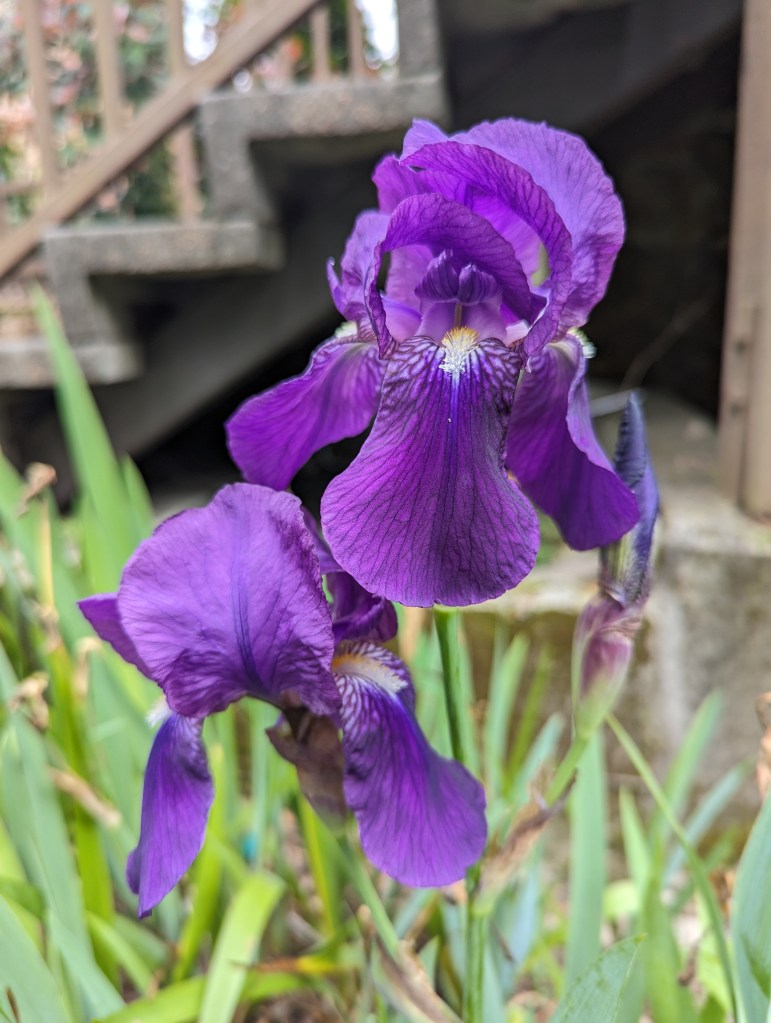
There may be no other flowers that exhibit such a diverse range of floral colors. Bearded iris, Iris X germanica, classifies as a hybrid of Iris pallida and Iris variegata. The genus of Iris derives its name from the Greek word for rainbow. As the name implies, it includes all colors of the spectrum. Floral form, height and, for some, fragrance is also quite variable.
About sixty thousand cultivars of bearded iris are supposedly documentable. It is difficult to estimate how many lack documentation. The smaller miniature cultivars are only a few inches tall. The tallest cultivars may grow four feet tall. Although they classify as summer bulbs, they are fleshy rhizomes that bloom for spring. Some will bloom again for autumn.
Bearded iris multiply whether or not anyone wants them to. Their rhizomes branch in two directions after bloom. Besides that, side shoots develop randomly from plump rhizomes. Congested rhizomes may bloom less. Division during summer promotes bloom. Division may happen annually or every few years. Bearded iris prefer sunny and warm exposure.
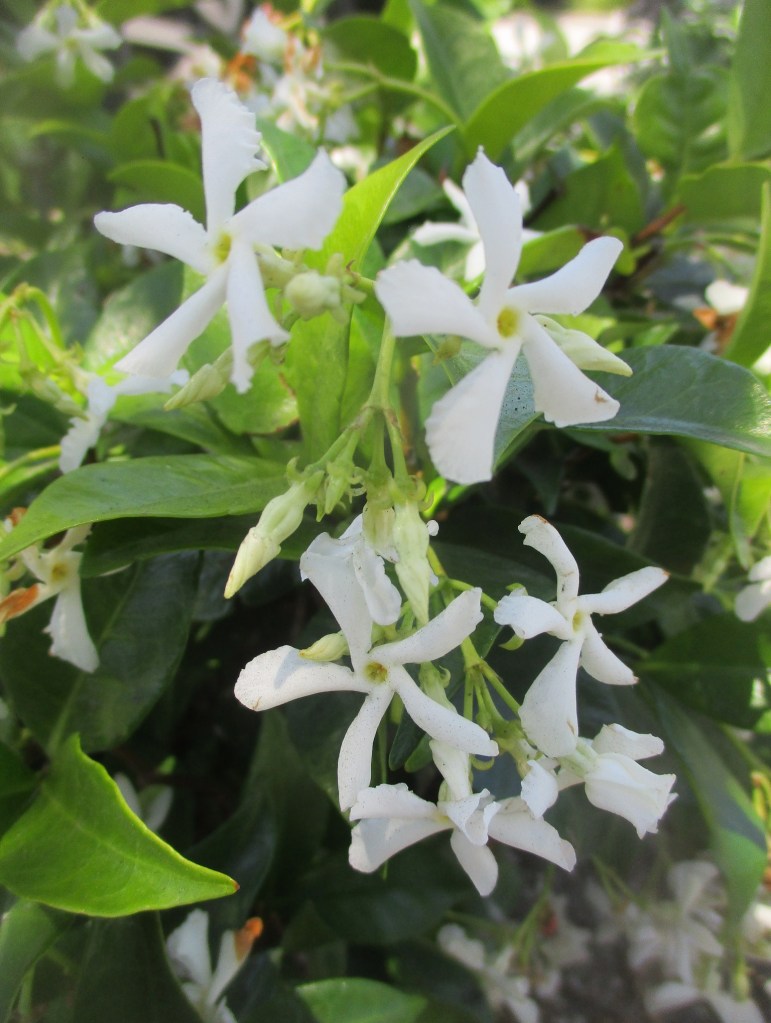
Delightfully fragrant star jasmine can be either a ground cover or a climbing vine.
The strong fragrance of the inch-wide, star shaped flowers of star jasmine, Trachelospermum jasminoides, gets attention from quite a distance. Whether they bloom lightly in partial shade, or profusely enough to obscure nearly half of the foliage below, their crisp white shows up nicely against the rich waxy green of the simple two or three inch long, and inch wide leaves. Star jasmine is among the more complaisant of vines, so only climbs or creeps along the ground to about ten feet; perhaps twice as much when very mature.
If only it were not such an invasive weed, black locust, Robinia pseudoacacia, might be appreciate for remarkably fragrant and abundant white bloom that resembles that of wisteria. The pinnately compound leaves are about five to ten inches long with rounded leaflets that individually are about one half to three quarters of an inch wide and twice as long. Autumn color is soft yellow. Trees can grow fast to more than fifty feet tall. Furrowed and fissured gray bark makes middle aged trees seem older and more distinguished than they really are. The wood is excellent firewood. All parts are toxic so should be kept out of reach of horses.
Black locust is native to a big area between Pennsylvania, Georgia and Kansas. It was brought to California both to produce firewood quickly, and because it is so appealing in gardens. Modern cultivars and other specie with purplish pink or pinkish purple flowers lack fragrance, but are not invasive.
Mock orange compensates for its lack of flashy color with alluring fragrance.
Remember the smell of the neighbor’s kitchen that met you on the sidewalk as you occasionally walked by when you were young? Whether it was Momma Tomeo’s gnocchi, Mrs. Panagakos’ fresh bread or Mrs. Adam’s black eyed peas, it was so alluring, even from considerable distance. Fragrant flowers may not compare to black eyed peas (mmm), but they certainly can be alluring even without being seen.
Because flowers prefer to be efficient at their work of attracting pollinators, they tend to be either colorful or fragrant, but not both. Those that attract pollinators with color do not need to also use fragrance. Conversely, those that use fragrance to impress pollinators do not need flashy colors. Most fragrant flowers are pale shades of white, and bloom for a short time. However, there happen to a few flowers that are both fragrant and colorful.
Black locust is one of the most fragrant of trees, despite its many other problems. (It is invasive and weedy.) The flowers are bright white, and abundant enough to be quite impressive. Southern magnolia has a distinctive but more subdued fragrance. The flowers are impressively large and bloom randomly through the year, but pale and not very showy among the bold evergreen foliage.
Of the many shrubs with fragrant flowers, mock orange (Philadelphus spp.) has rampant growth with a good display of elegant and remarkably fragrant white flowers. Daphne produces a strongly sweet fragrance with clusters of small pale pink flowers. Both lilac and angel’s trumpet, although very different from each other, have the advantage of impressively fragrant flowers that are quite colorful. Roses offer a better variety of color, but not many are as fragrant.
Wisteria is an aggressive vine with flowers and fragrance like those of the black locust, with all the colors of lilac. Despite the advantage of a longer bloom season, fragrant honeysuckle lacks impressive color.
Earlier in spring, bulbs like freesia, hyacinth, lily, narcissus and some iris bloomed with some of the most fragrant flowers available, in all sorts of colors. Alyssum and flowering tobacco are nice fragrant annuals that bloom longer than most others. Sweet pea may not last as long as weather gets warmer, but compensates with richer and more varied fragrances.
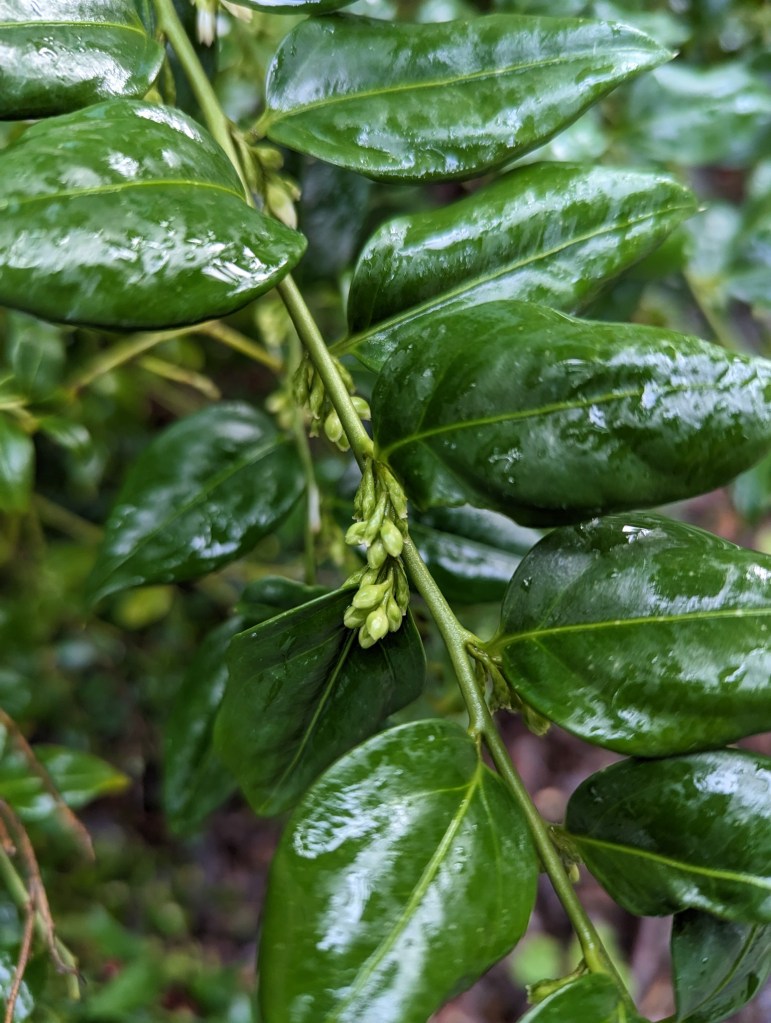
Floral fragrance is likely the primary asset of sweet box, Sarcococca ruscifolia. However, the splendidly glossy and evergreen foliage is as appealing as that of any of the various boxwoods. It is darker and richer green, with orderly arrangement on nimble and arching stems. Individual leaves are small but larger than boxwood leaves, and with pointier tips.
Sweet box blooms during winter, with deliciously fragrant but tiny pale white flowers that are not much to see. They are unlikely to get credit for their impressive fragrance without close investigation for its source. Vigorous plants may produce a few rich maroon berries that contrast delightfully with the rich green foliage. Cut stems work well with cut flowers.
Because it is naturally an understory species, sweet box not only tolerates partial shade, but actually prefers it. Harsh exposure fades its foliage. The dense foliage on wiry stems adapts to low hedging. It is better with alternating cane pruning to remove old stems and promote fresh basal growth. Overgrown specimens respond quite favorably to coppicing. They grow to three feet high.
It may not seem like much to take notice of. Sweet olive, Osmanthus fragrans, resembles glossy privet, but is neither as glossy nor quite as richly green. The dense and evergreen foliage can work about as well for a formal hedge though. It is even better as a small and billowy tree. It gets at least as high as ground floor eaves, and can reach upstairs eaves.
The primary allure of sweet olive is its delightfully pervasive and fruity floral fragrance. Its small and slender clusters of tiny pale white, yellow or gold flowers are mostly obscured by foliage. For those who are unfamiliar with it, the fragrance might be difficult to identify. Bloom is most abundant before and after summer. Sporadic bloom happens at any time.
Because sweet olive is more olfactorily appealing than visually appealing, it works quite nicely as in informal hedge behind prettier plants. It can stay narrow between windows of neighboring homes that are a bit too close together. If enough flowers are available, they might flavor tea and confectionery. A cultivar with variegated foliage is unfortunately rare.
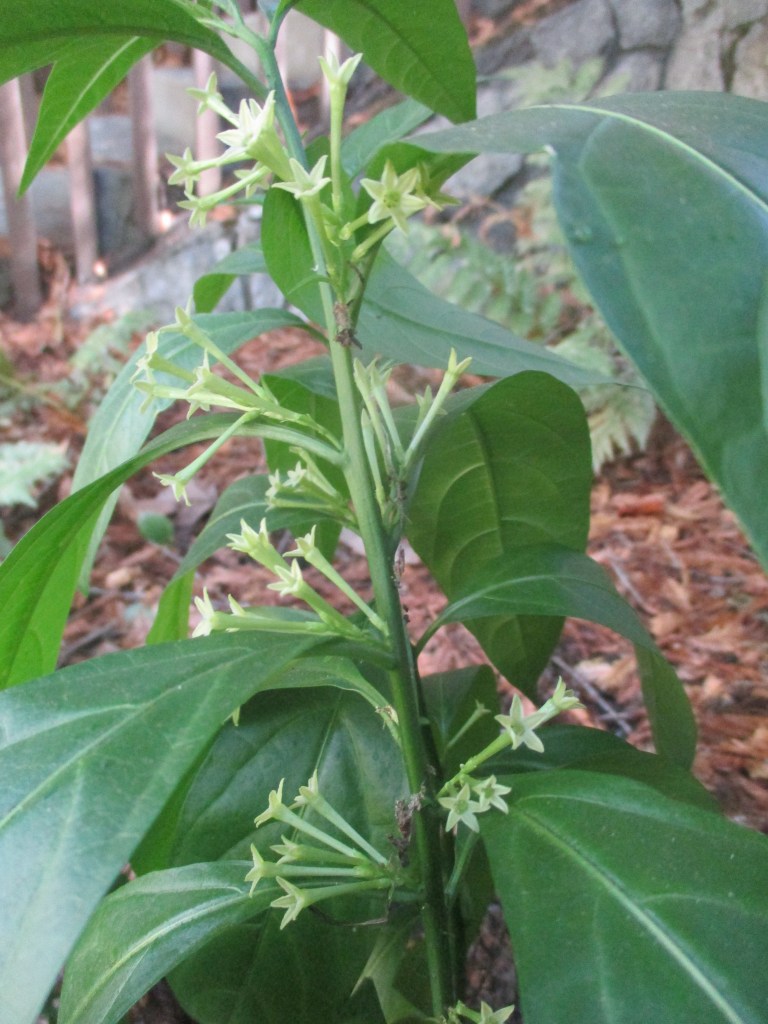
The warm nights between the dog days of summer are ideal for night blooming jasmine, Cestrum nocturnum. That is when it disperses its famously sweet fragrance to attract bat and moth pollinators. A bit of humidity, although unnecessary and locally rare, enhances the permeating nature of the fragrance. Some might find such fragrance to be excessive.
Otherwise, night blooming jasmine is quite modest. Those who experience the powerful fragrance at night may be unable to identify its source while visible during the day. Small floral trusses hold several small and narrowly tubular flowers that are about an inch long. Bloom is greenish white or pallid yellow. Simple evergreen leaves are a few inches long.
Therefore, night blooming jasmine works best in the background of more colorful bloom. It will not mind if other flowers get the credit for its fragrance. With regular watering, night blooming jasmine is happy in unseen areas between buildings, and under high windows that lack views. Aggressive pruning only in early spring promotes blooming new growth. Most plants stay shorter than ten feet. Rare white berries are toxic.





 Tony Tomeo