Several species of Phlox are native California wildflowers. Yet, the more popular garden phlox, Phlox paniculata, is native only east of Kansas. It can self sow where it gets water, and is naturalized in the Pacific Northwest. It prefers rather rich soil and sunny exposure but is not very discriminating. A bit of partial shade might promote taller stems for cutting.
Mature garden phlox can be as tall and wide as three feet. Some modern cultivars stay a bit more compact. Dense panicles of small flowers may be as wide as six inches. Bloom is most commonly white, but may be pink, red, lavender or pastel orange. It is a splendid cut flower, with an alluringly rich fragrance. Bloom might continue for a month of summer.
Garden phlox is deciduous, so all canes die to the ground for winter. Mature colonies are then easy to propagate by division. Similarly, feral specimens that appear where they are unwanted are easy to relocate. Garden phlox can perform nicely in proportionately large pots and planters. It is uncommonly available from nurseries, but grows easily from seed.
Marigold is a warm season annual that gets more popular later than earlier in its season. It is prominent for autumn but does not last for long into winter. Stock, Matthiola incana, is a cool season annual for the opposite extreme of the year. It is popular for late winter and spring but may not perform well into summer warmth. It is unreliable as a perennial here.
Stock bloom can be white, or rich shades or pastels of purple, red, pink, yellow or cream. Most bloom is double, but some is single. Floral fragrance is alluringly rich and complex. It resembles that of carnation, but is notably stronger. The narrow leaves are oblong with pastel grayish green color. Removal of deteriorating bloom promotes subsequent bloom.
Garden varieties of stock are quite different from florist varieties. For home gardens, most popular stock is relatively compact, and blooms freely. Florist stock is taller, and tends to bloom abundantly but at about the same time. In home gardens, florist stock may require staking if it grows as tall as three feet. Home garden stock may grow no taller than a foot.
If their bulbs were planted when they became available as summer evolved into autumn, Tazetta Narcissus and their hybrids should begin to bloom about now, a bit prior to related daffodil and jonquil Narcissus. In cooler winter climates, bloom must wait until early spring. The most popular variety, ‘Paper White’ blooms with about five or six small clear white flowers clustered on top of foot tall stems surrounded by vertical and somewhat rubbery, narrow leaves. Other varieties have white or yellow outer petals, known as the ‘perianth’, or orange or white centers, known as the ‘cup’. All are good cut flowers that are quite fragrant.
Because it is best to leave narcissus foliage to yellow and abscise (shed) naturally after bloom and as weather gets warmer, ground covers that are deep enough to conceal their deteriorating foliage are practical companions. (For example, deteriorating narcissus foliage can be stuffed under healthy English ivy, where it can be hidden without being removed.) Ground cover also keeps the soil from being bare during summer and autumn dormancy.
Mature clumps of narcissus bulbs only need to be dug and divided if they become so crowded that they do not bloom as much as they should. They are easiest to dig immediately after foliage dies back and lies on the ground, when they are dormant but still easy to find. Dug bulbs should then be stored in a cool dry place until it is time to plant them late in summer. Bulbs should be planted about five inches deep and about five to eight inches apart, with good sun exposure. The largest bulbs with multiple buds (known as ‘noses’) bloom most abundantly.
If they are happy in their location, narcissus easily naturalize, even if they do not get divided occasionally. They get most of the water they need from rain, since they are mostly dormant before dry weather in summer. Gophers and deer do not bother them.
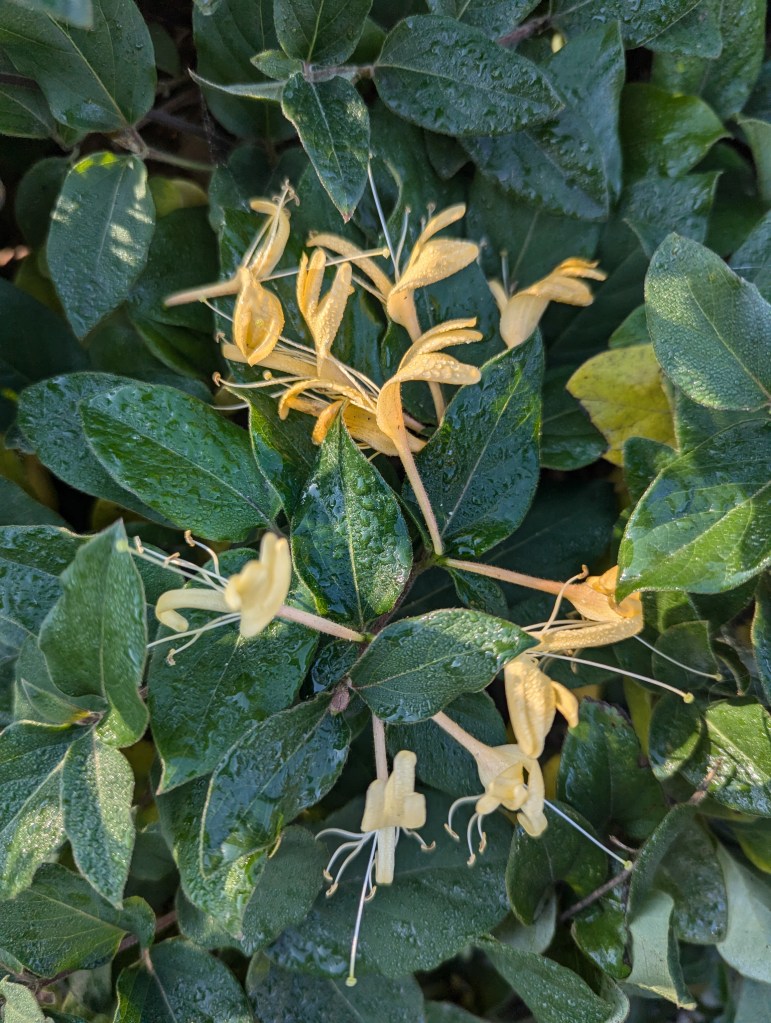
Bloom should be most abundant during late spring and summer. Within this mild climate though, it often continues sporadically through autumn. Japanese honeysuckle, Lonicera japonica, is presently blooming nicely in some areas. Its trusses of ribbony creamy white flowers fade to pale yellow. Although unimpressively colorful, they are alluringly fragrant.
Japanese honeysuckle here is almost exclusively Hall’s Japanese honeysuckle. It might be recognizable by a cultivar name of either ‘Hall’s Prolific’ or ‘Halliana’. Some botanists consider halliana to be a variety rather than a cultivar. (Variety names are neither quoted nor capitalized like cultivar names.) ‘Purpurea’, with dark but not purplish foliage, is rare.
Japanese honeysuckle, like star jasmine, is a vine that can be a ground cover. As a vine, It can climb more than thirty feet high. Unfortunately, it sometimes overwhelms shrubbery and small trees. Its twining stems can constrict the stems of other vegetation that it wraps around. As ground cover, it can get three feet deep. Leaves are two or three inches long.
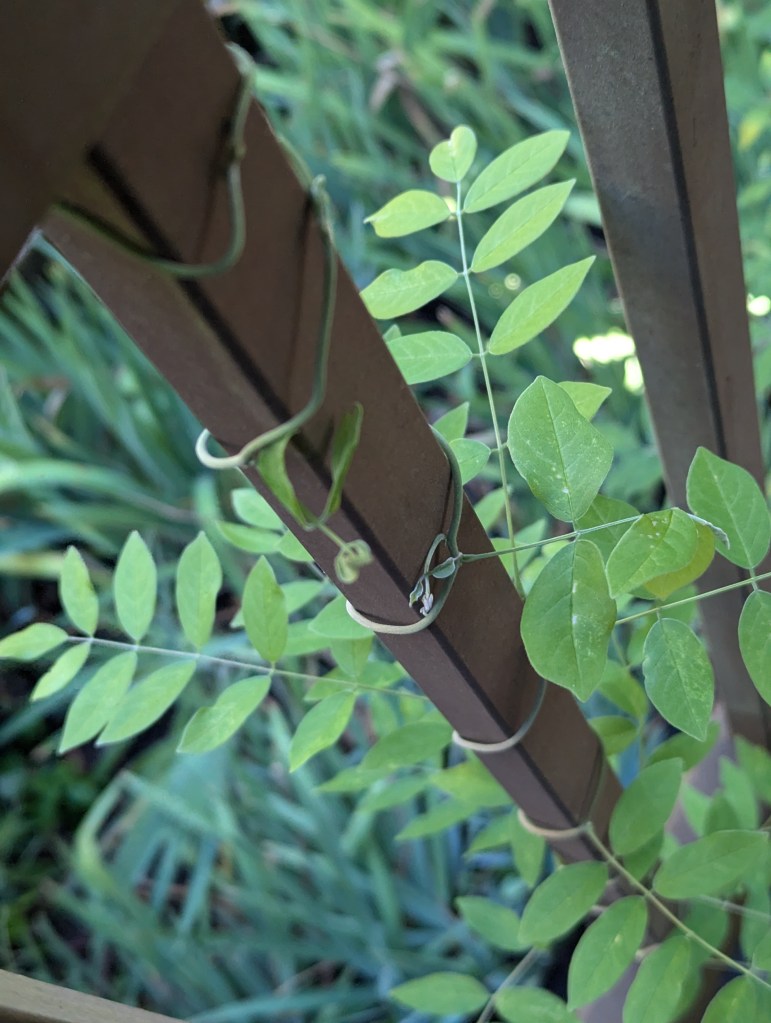
Chinese wisteria is an aggressive vine! A few that have gone wild near here have climbed high into redwoods, or spread over large areas of forest, or both. Some may have been planted intentionally, and then been abandoned. Some may be feral. Japanese wisteria may have potential to do the same, and perhaps some have already done so without being recognized as a different species from more common Chinese wisteria. Both species are spectacular while blooming within refined landscapes, but can be difficult to accommodate within the often neglected or partially forested landscapes here. That is why I am so pleased to try the much more docile American wisteria, Wisteria frutescens. I do not remember the name of this particular cultivar, but it blooms with bluish lavender floral color that is comparable to that of the more traditional Chinese wisteria. Like Chinese wisteria, other cultivars can bloom white or more purplish, and supposedly even pink, although I have yet to see even pictures of it blooming pink. It is not as spectacular, primarily because it is so much more docile, so does not grow nearly as large. Also, the floral trusses are relatively short, stout, and cylindrical in form, so protrude more rigidly outward like bottlebrush bloom, rather than more pendulously like the familiarly elongated and conical floral trusses of Chinese wisteria, or the more elegantly elongated floral trusses of Japanese wisteria. Kentucky wisteria, Wisteria macrostachya, is supposedly quite similar, but blooms later with more bluish color, rather than lavender. ‘Clara Mack’ is a cultivar that blooms white. After I see how American wisteria performs here, with its traditional wisteria colored bloom, I would also like to see how ‘Clara Mack’ Kentucky wisteria performs here. It could be a delightfully docile alternative to traditional Chinese wisteria for the White Garden.
‘French Hybrids’ are not fuel efficient European cars. (However, if there were a French equivalent to the old Japanese Datsun ‘Z’ that was instead named the ‘S’, we could really see the ‘S car go!’) ‘French Hybrids’ are varieties of lilac with single or double flowers in various shades of lavender, pink, pale blue, pinkish red, purple and white. Some have flowers that are two-toned. ‘Primrose’ is an interesting shade of pale yellow. All are strongly but elegantly fragrant.
Even though ‘French Hybrids’ have the advantage of being better adapted to mild winters, the original species of common lilac, Syringa vulgaris, and its older varieties seem to do just fine locally, and actually seem to be more fragrant. The only disadvantage is that almost all bloom with lavender flowers. ‘Alba’, with white flower, is rare. ‘Descanso Hybrids’ were developed for even milder winters.
The individual tubular flowers are actually very small, but bloom in dense conical trusses that are typically about three or four inches long, and possibly twice as long. Trusses develop on year old stems, so pruning should be done right after bloom only, although dead-heading (removing deteriorating trusses) without pruning can be done at any time. The soft and sometimes light green leaves are about three inches long. Mature plants are often eight feet tall and nearly as broad, and can get twice as large.
Unlike most plants that get suckers that need to be removed, most lilacs should instead be pruned to remove older canes and to promote healthier growth of suckers. This process of ‘alternating canes’ continually replaces less productive deteriorating stems with vigorous new stems. Old fashioned grafted plants are the only lilacs that should have their suckers removed; but they are uncommon, and do not sucker as much anyway.
Hyacinth is one of the earliest of spring bulbs, and is notably fragrant.
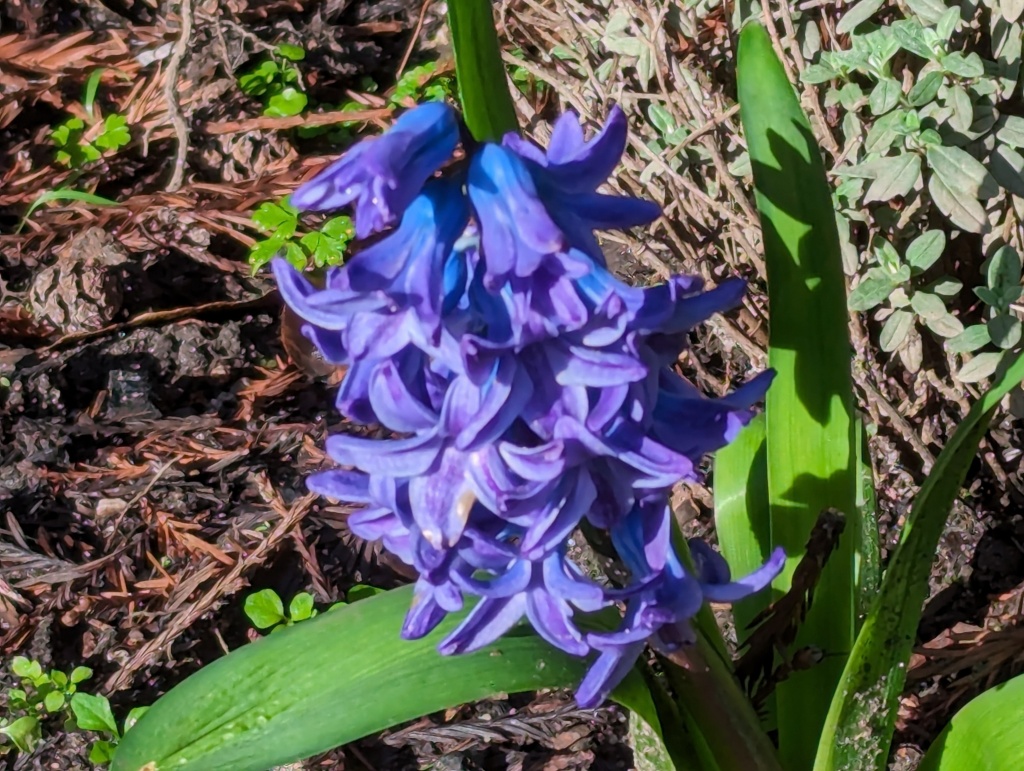
If their bulbs got into the garden early enough last autumn, Dutch hyacinth, which are hybrids of Hyacinthus orientalis, are now blooming with cartoon shades of red, blue, yellow, purple, pinkish orange, pink and white. The small, surprisingly fragrant flowers are neatly arranged on plump, bottle-brush shaped flower trusses up to eight inches tall. Their typically arching, rubbery, strap shaped leaves look like small lily-of-the-Nile leaves. Some types have more vertical foliage.
Like many bulbs and bulb like plants, hyacinth are unfortunately not reliably perennial in such mild climates. They prefer cooler winters. Consequently, they are typically grown only as annuals. However, I am aware of hyacinth that not only bloom annually, but have been multiplying nicely over the years in a few local gardens. Their flowers spikes are never as full as they were in their first season, but are appealing nonetheless. I actually prefer the less refined style of naturalized hyacinth.
French Roman or Roman hyacinth, Hyacinthus orientalis albulus, are still somewhat rare, but should be more common since they naturalize more reliably without cold winters. Each bulb produces a few flower stems with smaller and more loosely arranged pink, pale blue or white flowers.
Large hyacinth bulbs are easily forced to bloom suspended just above water by small stones in bowls, or individually in hyacinth glasses (vases that hold bulbs just above water). Forced bulbs should be kept in the dark until rooted, and can be moved out as foliage appears. They are as colorful as tulips and as fragrant as narcissus; but sadly, are not likely to survive after being forced.
They may seem to be unseasonable now. Their flowers will not bloom until early spring. It is getting to be about time to install their dormant bulbs, though. Daffodil and all related Narcissus enjoy chilling under damp soil through winter. In fact, established bulbs bloom better after unusually chilly winters. Plump bulbs of some types are conducive to forcing.
The names for daffodil and Narcissus seem to be interchangeable. Narcissus is actually the Latin name of daffodil. It mostly applies to those with smaller but more abundant and fragrant flowers. Most with bigger but fewer and scentless flowers are daffodil. Narcissus are mostly white, but may be yellow. Daffodil are mostly yellow, but may be white or pink.
Some of the fancy varieties of daffodil bloom with billowy double flowers with two colors. Simpler Narcissus are more likely to naturalize though. Taller varieties of both can bloom nearly a foot and a half high. Their narrow and bluish green leaves stay somewhat lower. Foliage deteriorates after bloom, but lingers to sustain new bulbs until summery warmth.
In eastern North America where it grows wild as a native, garden phlox, Phlox paniculata, is modest but classic perennial that gets more than four feet tall with pinkish lavender flowers from late summer through early autumn. Modern garden varieties are mostly somewhat more compact with pink, red, light purple or white flowers. Many have fragrant flowers; and some have flowers with lighter or darker centers. Butterflies and hummingbirds dig them all.
Locally, garden phlox probably looks best with slight shade or among other lush plants, only because humidity is so minimal. Otherwise, it would be just as happy out in the open. In well watered gardens with rich soil, it sometimes self sows a bit, but rarely naturalizes continually enough to revert to a more natural (wild) state like it can in gardens on the west coast of Oregon and Washington. Garden phlox can be propagated by division of mature plants either after bloom in autumn or in spring.
Mock orange compensates for its lack of flashy color with alluring fragrance.
Remember the smell of the neighbor’s kitchen that met you on the sidewalk as you occasionally walked by when you were young? Whether it was Momma Tomeo’s gnocchi, Mrs. Panagakos’ fresh bread or Mrs. Adam’s black eyed peas, it was so alluring, even from considerable distance. Fragrant flowers may not compare to black eyed peas (mmm), but they certainly can be alluring even without being seen.
Because flowers prefer to be efficient at their work of attracting pollinators, they tend to be either colorful or fragrant, but not both. Those that attract pollinators with color do not need to also use fragrance. Conversely, those that use fragrance to impress pollinators do not need flashy colors. Most fragrant flowers are pale shades of white, and bloom for a short time. However, there happen to a few flowers that are both fragrant and colorful.
Black locust is one of the most fragrant of trees, despite its many other problems. (It is invasive and weedy.) The flowers are bright white, and abundant enough to be quite impressive. Southern magnolia has a distinctive but more subdued fragrance. The flowers are impressively large and bloom randomly through the year, but pale and not very showy among the bold evergreen foliage.
Of the many shrubs with fragrant flowers, mock orange (Philadelphus spp.) has rampant growth with a good display of elegant and remarkably fragrant white flowers. Daphne produces a strongly sweet fragrance with clusters of small pale pink flowers. Both lilac and angel’s trumpet, although very different from each other, have the advantage of impressively fragrant flowers that are quite colorful. Roses offer a better variety of color, but not many are as fragrant.
Wisteria is an aggressive vine with flowers and fragrance like those of the black locust, with all the colors of lilac. Despite the advantage of a longer bloom season, fragrant honeysuckle lacks impressive color.
Earlier in spring, bulbs like freesia, hyacinth, lily, narcissus and some iris bloomed with some of the most fragrant flowers available, in all sorts of colors. Alyssum and flowering tobacco are nice fragrant annuals that bloom longer than most others. Sweet pea may not last as long as weather gets warmer, but compensates with richer and more varied fragrances.





 Tony Tomeo