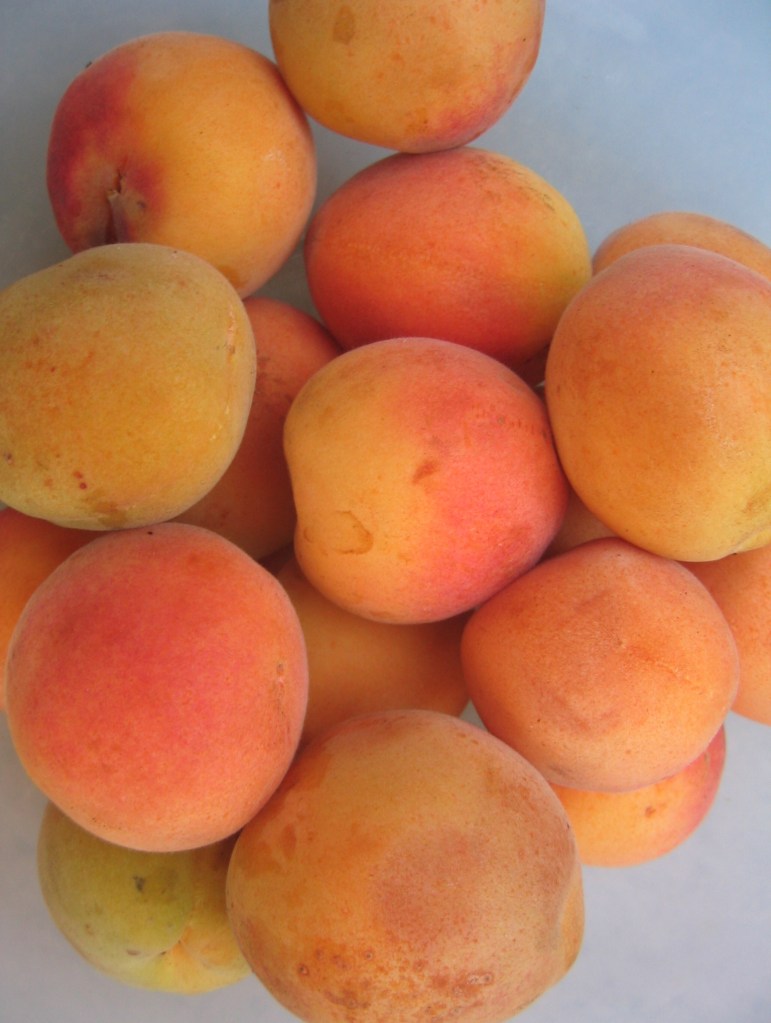
Apricot trees, which are mostly of the species Prunus armeniaca, have history here. Vast apricot orchards formerly inhabited the Santa Clara Valley. Many remain as a significant industry of the San Joaquin Valley. Apricot trees are both famously reliable and famously productive here. If they can not inhabit orchards, they can be as happy in home gardens.
Home garden apricot trees are not quite the same as orchard trees. Most are grafted onto dwarfing rootstock to stay more compact than orchard trees. More cultivars are popular in home gardens than in orchards. Regardless, even relatively compact home garden trees need dormant pruning in winter. Otherwise, they provide more fruit than they can support.
Apricot trees change with the seasons. They are strikingly bare while dormant for winter. Their profuse white bloom is spectacular for early spring. Their rich green foliage mostly obscures their fruit as it ripens through early summer. It then turns cheery yellow before it defoliates in autumn. Home garden trees should be about ten feet tall with good pruning. Fruit is difficult to reach in overgrown trees.
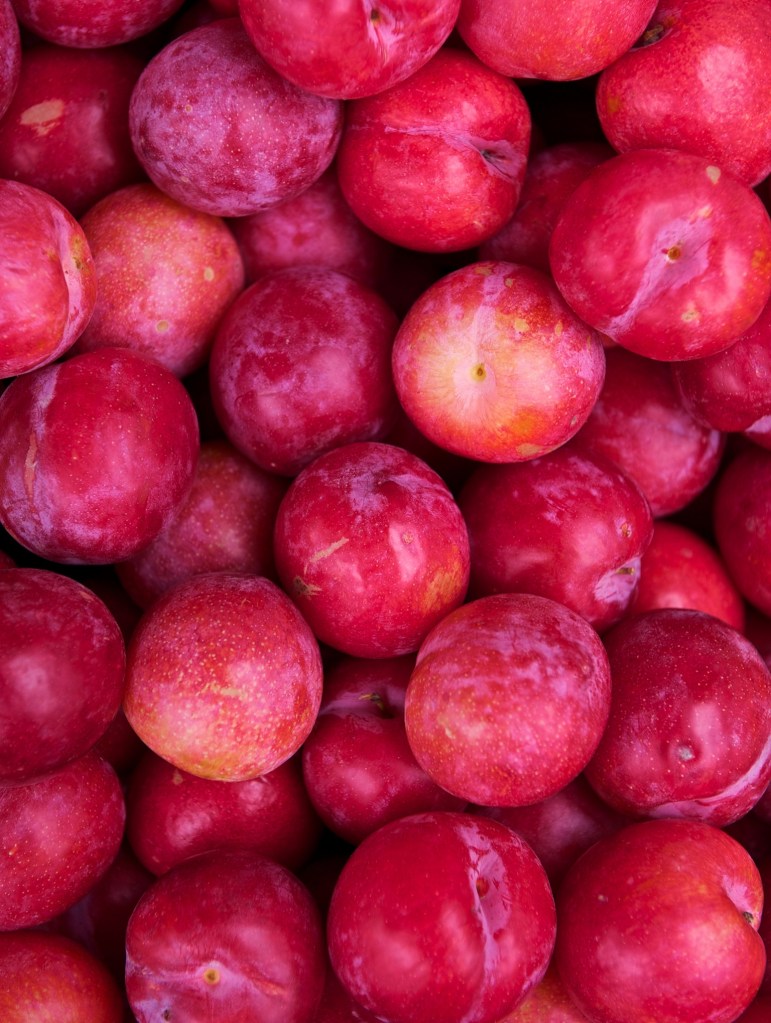
Prunes are not merely dried plums. They are European fruits which, although very edible fresh, are also popular for drying. Their significant sugar content inhibits mold during the drying process. Plums, Prunus domestica, are of the same species, but are of Japanese origin. They are quite popular fresh, but are more likely to mold than dry like prunes can.
Besides their lower sugar content, plums are a bit bigger and rounder than most prunes. Prunes are ‘freestone’, so their flesh separates from their seeds when ripe. Old fashioned plums are ‘clingstone’, so their flesh adheres to their seeds when ripe. The most popular plums are maroon or purple. Others are red, yellow, orange, green, blue or almost black.
Almost all plum trees within home gardens are semi dwarf. Although they do not grow as big as orchard trees, they can grow twenty feet tall. They require specialized aggressive dormant pruning during winter. Otherwise, they become shabbily overgrown with most of their fruit out of reach. Their prolific and bright white bloom is spectacular for early spring.
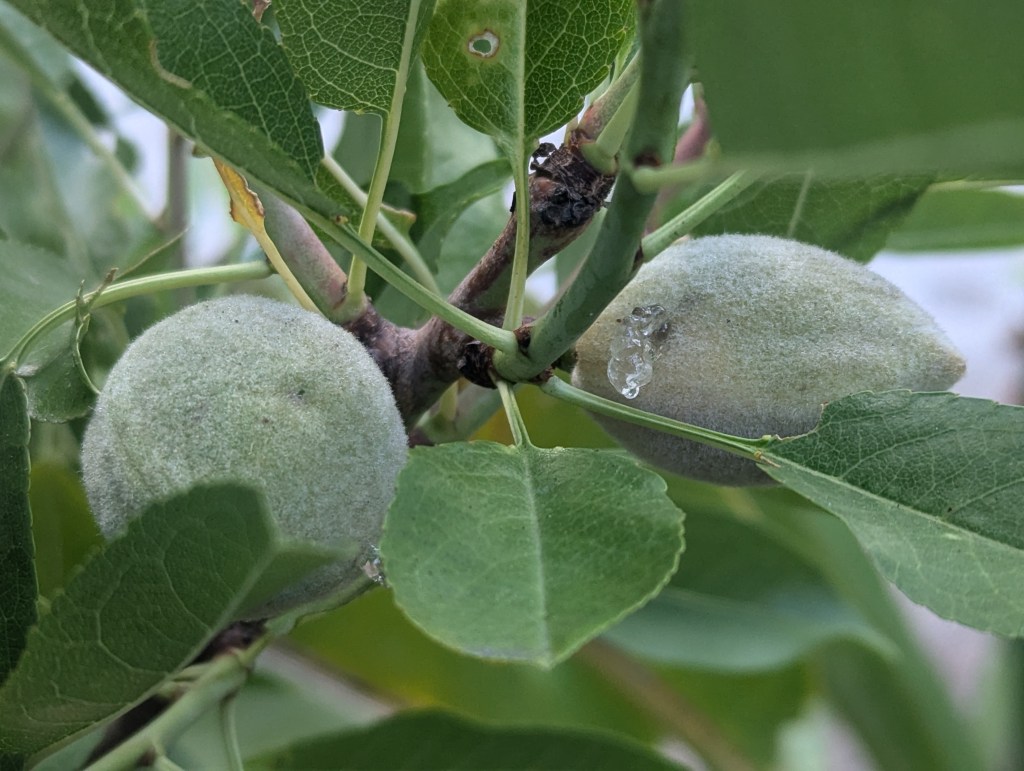
Pote-8-o or pote-aht-o? Tome-8-o or tome-aht-o? Ape-ricot or app-ricot? Pee-can or pi-kahn? What about “almond”? This is different from the distinction of plums and prunes. It is a matter of pronunciation. Is “almond” pronounced like “salmon” or “common”? Those who grow them, and likely know better than the rest of us, commonly pronounce it like “salmon”. Most of the rest of us pronounce it like “common”. The nuts are harvested by machines that shake them from their trees, which supposedly shakes the ‘ell out of them, which sort of makes sense. Although the “l” is silent within both pronunciations, it might be slightly more so within the “common” pronunciation. Everything associated with almonds prior to harvest, such as their orchards, trees, bloom, unharvested nuts and their collective industry, commonly employs the “salmon” pronunciation, in which the “l” may be slightly less silent. Everything associated with harvested and processed nuts and their products, which are what most of us are familiar with, more commonly employs the “common” pronunciation. For the pair of trees in my garden, I use the “salmon” pronunciation. For their nuts, I use the “common” pronunciation.
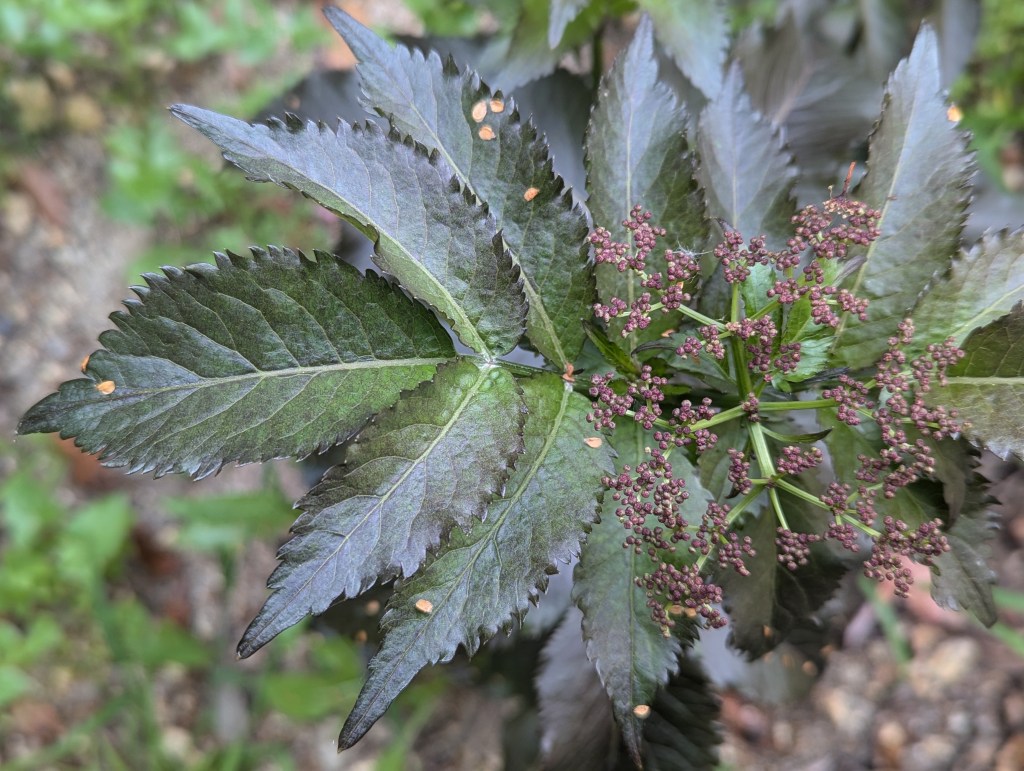
‘Black Tower’ European black elderberry is not very black yet.
Perhaps my explanation of the elderberry glut here was a bit brief last Saturday. Allow me to explain.
Sambucus caerulea, blue elderberry is native and grows wild here, so was innately the first on the scene.
Sambucus nigra ‘Black Lace’ European black elderberry arrived next. I do not know who procured it or why, but it was left here in a can before my time. I put it into a landscape just to get it out of the storage nursery. In other words, I was none too keen on it, so I just wanted to make it go away. Instead, because it was so popular with those who saw it in the landscape, I learned to appreciate it. Then, I figured that it would be even more appealing if it produces berries for birds, so I sought a mate for it.
Sambucus nigra ‘Madonna’ European black elderberry was almost the perfect mate. I would have preferred ‘Albomarginata’, but did not want to pay for it. ‘Madonna’ in a #1 can was available for only a few dollars because it looked so shabby two winters ago.
Sambucus racemosa, red elderberry was a gift from Tangly Cottage Gardening shortly afterward. They were a group of four seedlings, so needed no mate for pollination. Although they are supposedly native here, I had never seen them before, but want to grow them.
Sambucus nigra ‘Albomarginata’, ‘Atropurpurea’ and ‘Black Tower’ European black elderberry, and Sambucus racemosa ‘Lemony Lace’ red elderberry unexpectedly became available for a few dollars each just last winter because, like ‘Madonna’ European black elderberry two years prior, they were shabby while dormant. Without a plan, I procured all of them. ‘Lemony Lace’ red elderberry, the only red elderberry of the four, could be pollinated by the red elderberries that already came from Tangly Cottage Gardening. As I mentioned, ‘Albomarginata’ was the cultivar that I would have preferred to ‘Madonna’ that I procured earlier.
Sambucus canadensis ‘Nova’ and ‘York’ American black elderberry were the last acquisitions at the end of bare root season last winter. They are for fruit production in my home garden.
I would have been pleased with only ‘Black Lace’ and one other pollinator cultivar for it within the landscapes at work. For my home garden, I wanted only blue elderberry, red elderberry and American black elderberry. I would have preferred wild American black elderberry, but can not complain about the cultivars that I got. Collectively, we got much more than we bargained for.
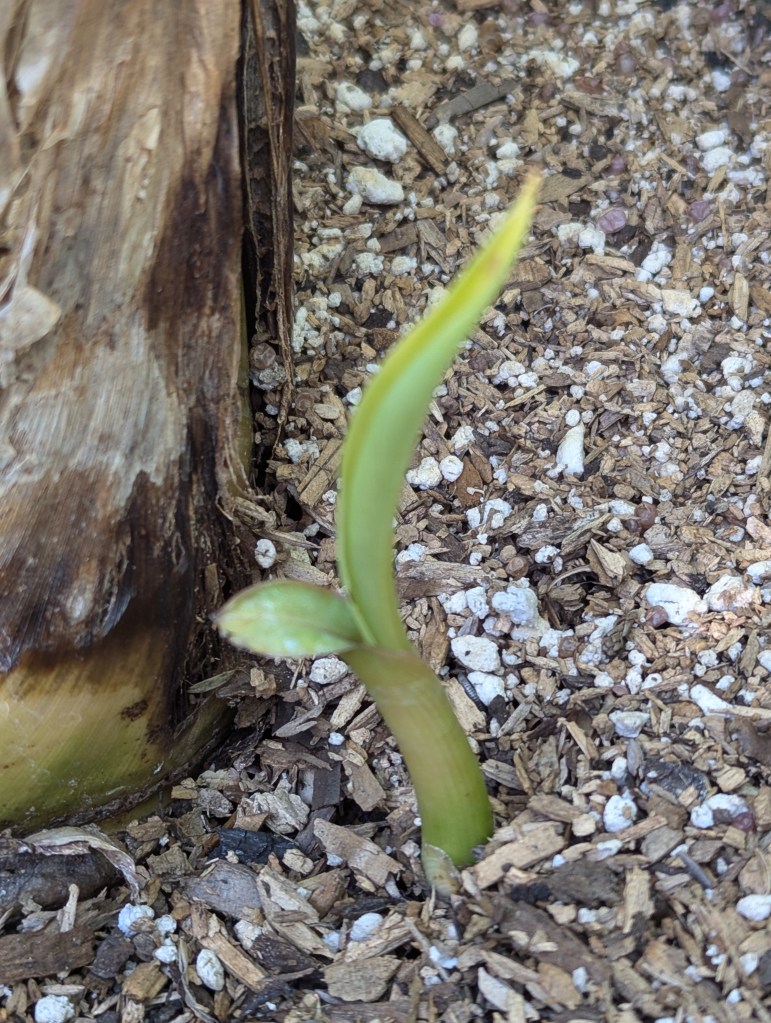
Oem is beginning its third spring here. Fortunately, it has not yet grown too big to stay. That could change soon now that the weather is warming. I still do not know what to do with it as it grows. It is the largest species of banana in the World, Musa ingens. The foliage of the original pseudostem was frosted enough last winter to get trimmed away, leaving only an unsightly bare trunk. It is only beginning to replace its foliage for this season. Just as readily though, it produced two pups, which will likely grow faster than the original pseudostem did during the last two seasons. They are growing from a larger rootbase. Meanwhile, there are several other cultivars of banana growing here also. There were about fourteen last year. There are about two dozen this year! Only a few will remain compact enough to inhabit the landscapes at work, but even fewer will be appropriate there. Banana trees are not exactly comparable with the style of a redwood forest. Most, including the oem, will likely inhabit a riparian area of my home garden, which is also in a redwood forest. Goodness! I really should have planned this better.
‘Meyer’ lemon was never my favorite lemon. However, when I grew citrus trees in the early 1990s, it was the most popular of forty or so cultivars. There really is nothing else like it. Relative to other lemons, its fruit is distinctively less acidic, more richly flavored, and sometimes ridiculously abundant. All other lemons are more sour but less flavorful. Besides ‘Meyer’ we grew ‘Lisbon’, ‘Eureka’, ‘Variegated Pink’ and ‘Ponderosa’. Of these four others, only ‘Ponderosa’ is not a mutant of ‘Lisbon’, although its comparably mild flavor and robust acidity suggest that it is. All four grow as small but upright trees. Only ‘Meyer’ naturally grows broader than tall, sort of like shrubbery.
‘Eureka’ lemon inhabits one of the landscapes at work, where it produces enough average lemons for those of us who know about them. I grew cuttings from it for my own garden, but am concerned that, since they are not grafted onto dwarfing understock, they could eventually grow quite large. I also grew an ungrafted cutting of ‘Ponderosa’ lemon for the same landscape at work that the ‘Eureka’ lemon already inhabits, because it happens to be at the Ponderosa Lodge. ‘Ponderosa’ lemon grows with an upright form, but because it naturally stays smaller than ‘Eureka’ lemon and its relatives, I am not too concerned about it growing too large.
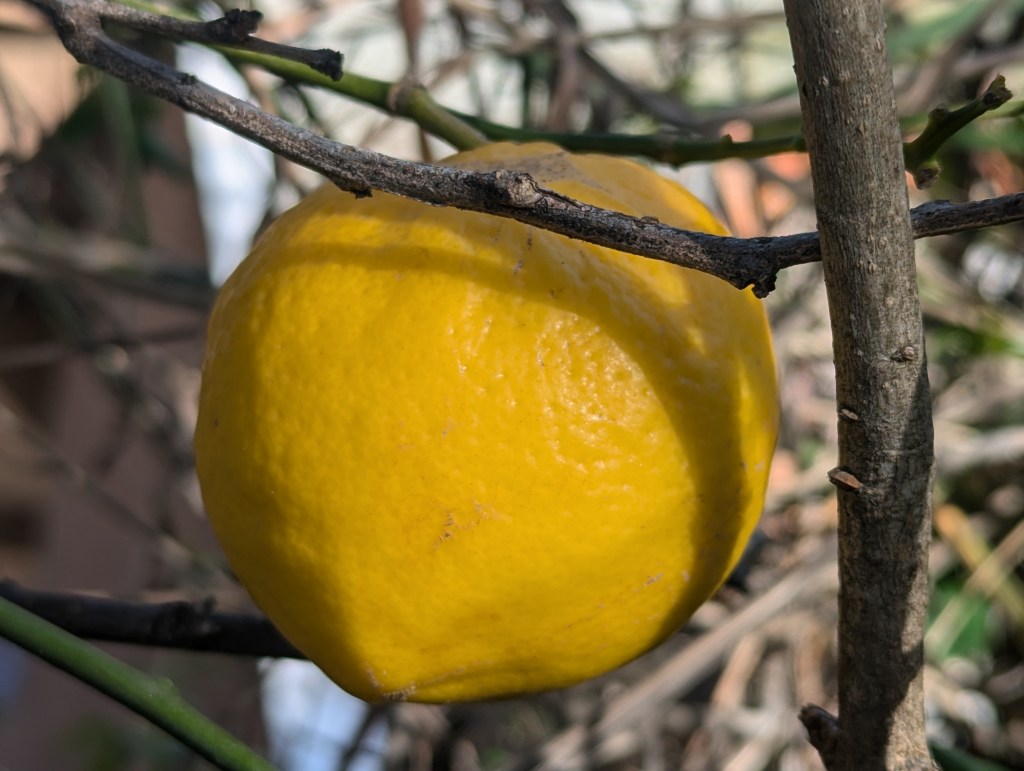
‘Meyer’ lemon came to my garden like a stray cat. Well, it is a bit more complicated than that, but it involved about as much planning. The history of how it came to its previous home is too extensive to describe here. To be brief, I installed it into a garden a few years ago because someone wanted it there after previous unsuccessful attempts to grow the same. Then, it needed to be removed prior to the sale of the home. I did not know what to do with it, so brought it here. I canned it and set it aside until space becomes available for it. I really did not expect it to do much until then. I sort of hoped that someone else would want it for their garden, but after we had been through so much together, I also sort of hoped that it would stay here. Anyway, while I was busy ignoring it in its partly shady and less than ideal situation, I noticed that it had produced this single lemon for me over winter. Well, I suppose that it will be a permanent feature of my garden now.
Spring bulbs, with prechilling, were conducive to the technique of forcing bloom earlier. A few summer bulbs might still be responsive to it, although it is getting late for most. Now, it is about time for forcing bloom with certain dormant deciduous stems. Most are already beginning to bloom. Forcing bloom merely accelerates this process for cut flower stems.
Forcing bloom for dormant deciduous stems is actually simpler than for bulbs. It involves merely cutting stems that are about to bloom and bringing them indoors. The warmth of a home interior is what accelerates profuse bloom. Aridity of home interiors may accelerate the deterioration of this bloom. However, homes also provide shelter from wind and rain.
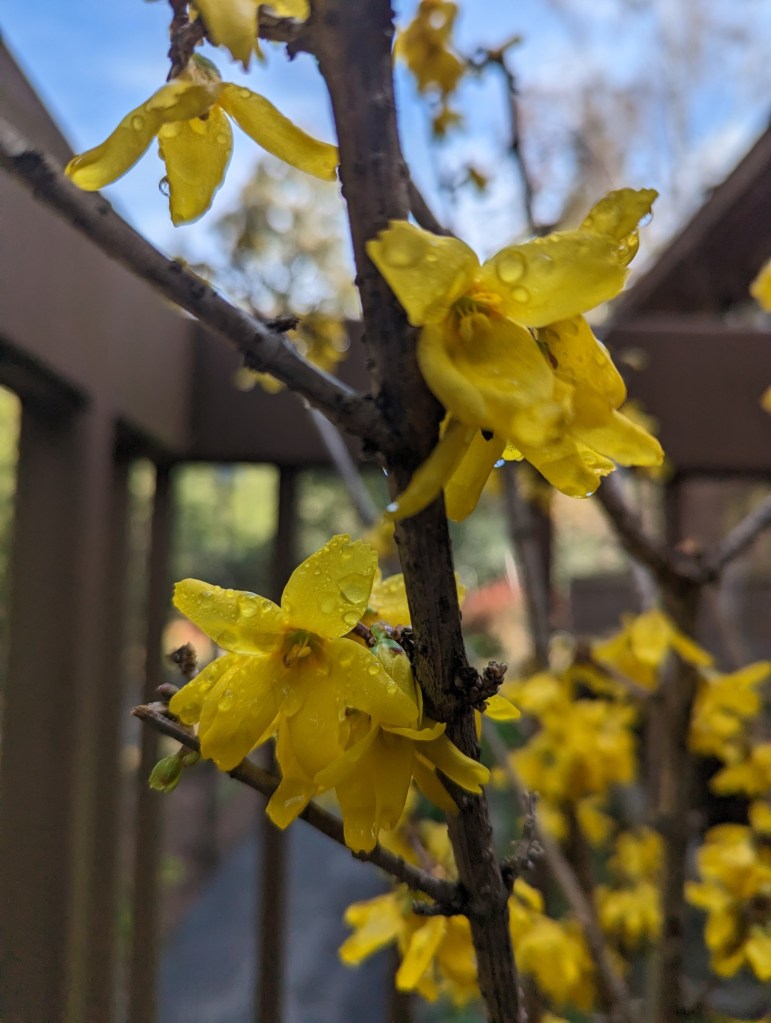
Witch hazel, flowering quince and forsythia are mostly done blooming locally. Otherwise, they are conducive to forcing bloom, and will be available next winter. Several flowering cherries and flowering plums are now about ready for forcing bloom. Redbuds are ready also, though some will be later. Flowering crabapples should bloom later in their season.
Several fruit trees are as conducive to forcing bloom as their fruitless flowering relatives. Their floral color and profusion are less extravagant only because of their breeding. Fruit is, after all, the priority. With planning, dormant pruning can involve leaving a few surplus stems to cut later. Then, cutting them about now should not compromise fruit production.
With precise timing, wisteria and lilac are conducive to forcing bloom. Technically, so are dogwood and several deciduous magnolias. They bloom relatively slowly though. A few flowers should therefore be blooming before collection of their stems. Evergreen species are less striking in bloom. Fringe flower and Oregon grape can perform elegantly though.
Forcing bloom is more popular where winters are cooler. This is partly because gardens lack floral color for so long through winter. Those who enjoy flowers are in more of a rush to bring some into their homes. Also, dormant vegetation is more reactive to warmth after colder winters. Warmth might not stimulate bloom as effectively after locally mild winters.
‘Minneola’ tangelo fruit is slightly tart like a grapefruit, but richly flavored like a Mandarin orange.
Of all the citrus that ripen about now in winter and early spring, oranges, lemons, limes, grapefruits and mandarin oranges (or mandarins or tangerines) are the most familiar. (A tangerine is merely a mandarin that was developed in the Americas.) Kumquats, blood oranges, sour oranges, citrons and many of the odd citrus hybrids that are less common are becoming more popular as their fruit becomes more available in markets, and their trees become available in nurseries. Except for the very popular ‘Meyer’ lemon, which is actually a hybrid of an orange and a lemon, the most popular citrus hybrid is likely the ‘Minneola’ tangelo, which is a hybrid of a grapefruit and a mandarin orange. Other tangelos remain somewhat rare.
Like all citrus, ‘Minneola’ tangelo has appealingly glossy evergreen foliage and fragrant flowers. They can be grown in containers if their roots are dug, pruned and planted again every five years or so. They like regular watering, good drainage and mulch. Aphids, mites or scale can become problematic. Suckers from below the graft should be rubbed off as they appear. (The graft union can be identified by the change in bark texture and color on the main trunk just a few inches above the roots.)
‘Minneola’ tangelo trees get a bit larger than mandarin orange trees, but not as large or quite as full as grapefruit trees. The bright reddish orange fruit has all the flavor of mandarin oranges, and is just as easy to peel, but unlike the majority of mandarin oranges, has few seeds, and can be left on the tree through spring. The fruit is a bit smaller than that of ‘Valencia’ orange, and has a distended bump where the stem is attached. Flavor develops best in warmer parts of the garden, particularly after warm summers.
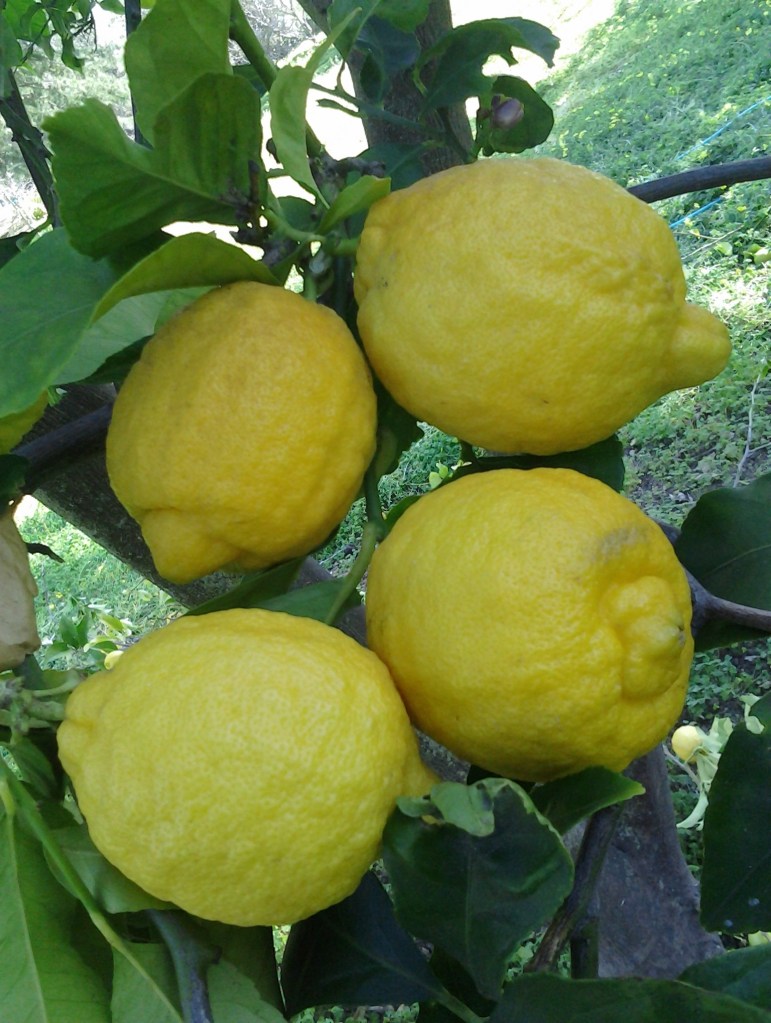
‘Eureka’ and ‘Lisbon’ lemons are indistinguishable.
‘Lisbon’ lemon was the original. It is still a common cultivar for orchard production of fruit for lemon products. Because almost all of its fruit ripens in winter, it can not provide fresh fruit continuously. ‘Eureka’ lemon, which is a mutant of ‘Lisbon’ lemon, may compensate. It is not as productive in season, but only because it also provides lemons out of season.
This complicates orchard harvest, but is justifiable by prolonging the supply of fresh fruit. It is more ideal for home gardens where only a few lemons are needed at a time anyway. Besides, seasonal abundance within home gardens can become too much of a surplus. ‘Eureka’ lemons are not as richly flavorful as ‘Meyer’ lemons, but are more acidically tart.
‘Eureka’ lemon trees, even on dwarfing understock, can eventually grow fifteen feet high. They are generally not quite as wide as they are tall. Their nastily sharp thorns are stout. Vigorous stems develop much longer and potentially dangerous thorns. Foliar fragrance is mild, but can be delightful during warm weather. Glossy evergreen foliage is aromatic when disturbed by lemon collection.
Citrus trees are not like deciduous fruit trees. They are not marketable as bare root stock. They do not need winter pruning. Actually, winter pruning might initiate premature growth that is vulnerable to frost. Deciduous fruit trees remain dormant so can only dream about fruiting for next summer. Citrus trees are happily evergreen, and fruiting abundantly now.
Citrus somehow seem to be more summery than fruit that actually ripen for summer. Iced lemonade is so traditional for warm summer weather. Oranges for Christmas might seem to be out of season when they really are not. Although Mandarin oranges are perishable, other ripe citrus last for weeks or months. Several ripen sporadically throughout the year.
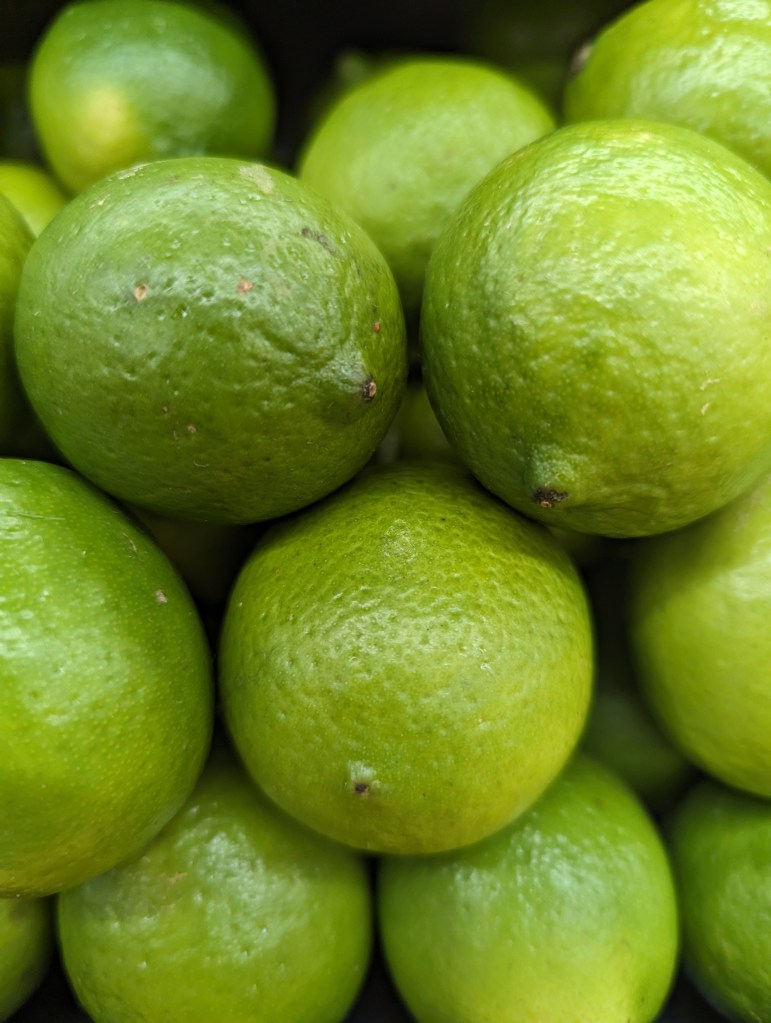
‘Valencia’ oranges, which are the traditional juicing oranges, might last through summer. They may sustain the belief that orange juice is a summery beverage. Several grapefruit cultivars can last about as long. ‘Eureka’ lemon is mostly seasonal, but also generates a few fruits throughout the year. ‘Bearss’ lime may be even more productive out of season.
With only one exception, all species and cultivars of citrus are of the same Citrus genus. Kumquats are of the Fortunella genus, but typically qualify as Citrus for simplicity. Citrus fruit is sweet, sour or bitter. Most familiar oranges are sweet. ‘Seville’ is a sour orange for marmalade. ‘Bouquet de Fleur’ is a bitter orange for infusing with Grand Marnier cognac.
Oranges, lemons, limes, grapefruits, kumquats and Mandarins are all very familiar. All of these fruits are available from grocery markets. Their trees grow in many home gardens. Tangerines are simply Mandarins or Mandarin oranges of the Americas. Pomelos, which are larger ancestors of grapefruits, are still uncommon. So are tiny and tart calamondins.
They are not the most unusual, though. Blood oranges provide tangy red juice. ‘Rangpur’ lime is a sour Mandarin orange that is as acidic as a ‘Eureka’ lemon. Tangelos combines the tartness of grapefruits with the sweetness of Mandarin oranges. Sweet limes lack the acidity of typical limes, so are for eating like oranges. These are merely a few examples.

 Tony Tomeo