Learn How To Prune Dormant Deciduous Fruit Trees Properly

(This article is recycled from 2010, so includes outdated information. It is deferred from yesterday because Wi-Fi was not operational.)

Deciduous fruit trees require very specialized pruning.

            So many of the kids I grew up with now have an apricot tree in their own back yard, even though not many of us actually like the fruit. We all remember the remnant orchards, mostly apricots, which were scattered about the Santa Clara Valley when we were young. We also remember how we consumed vast volumes of apricots in every form imaginable; including fresh, dried, canned and stewed, and in jams, jellies, compotes, syrups and pies. I could go on, but it would ruin my appetite.

            Deciduous fruit and nut trees are certainly not ‘low maintenance’. Most need to be pruned annually, while dormant in winter. If not pruned correctly, they become overburdened with their own fruit. Also, the process of selecting from the many different cultivars of the many different types of fruit is quite a chore. There are many more cultivars to choose from for home gardens than for orchards, particularly with the many modern cultivars introduced during the past few decades.

            Because those who maintained the orchards are now as nearly extinct from the Valley as the orchards are, we need to know how to care for our own trees. This is why Friends of Guadalupe River Park and Gardens has scheduled the Dormant Fruit Tree Pruning Class with Sean McGrail in only a few days, on January 23, from 9:30 to 11:30 a.m.. Tools, techniques and basic pruning concepts will be explained and demonstrated among the many fruit trees, including apricots, cherries, prunes, apples and others, of the Historic Orchard of Guadalupe Gardens. Participants will then get to participate in pruning some of these trees. The Historic Orchard is located just south of Taylor Street in San Jose, adjacent to the Guadalupe River Park Trails. Admission is $15. 

            A week later, on January 30 from 9:00 a.m. to noon, the Best of the Best class, also with Sean McGrail, as well as Nancy Garrison and the California Rare Fruit Growers, will discuss many of the best fruit cultivars for the Santa Clara Valley. Afterward, planting, site selection, drainage and pruning of new trees will be demonstrated in the Historic Orchard. Admission is $30. Required registration can be arranged by telephoning 298 7657. Information about both classes can be found online at www.grpg.org.     

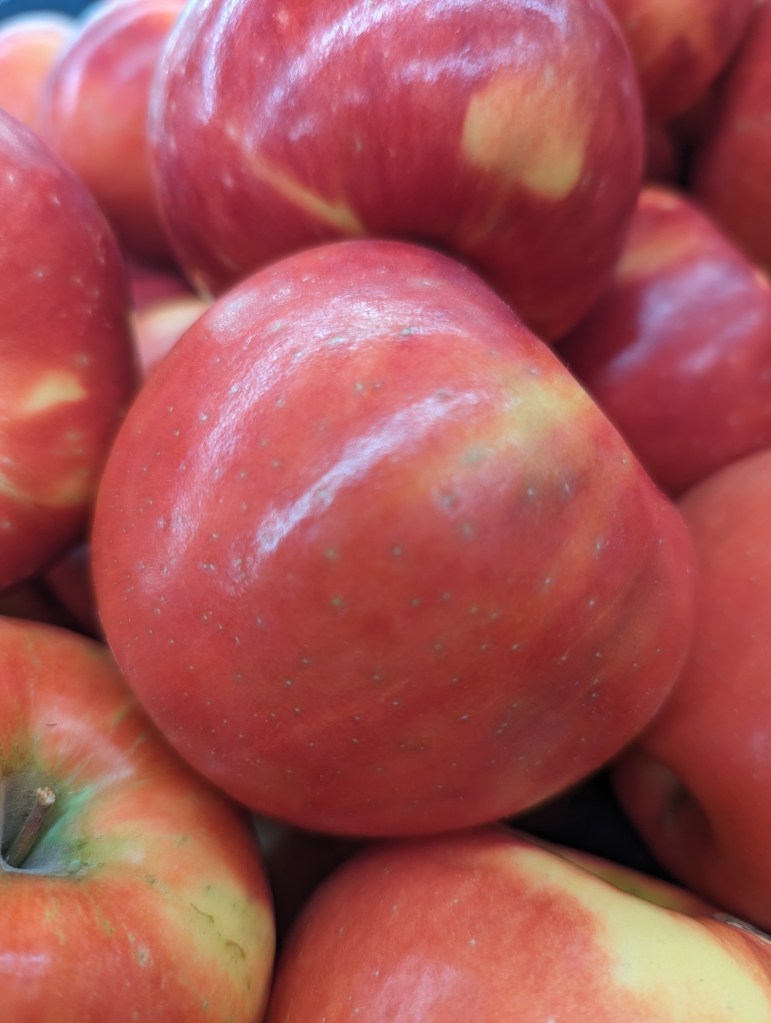
Apple

There are countless varieties of apple.

Apples are amazingly diverse. They have been in cultivation for thousands of years. Too many cultivars to document developed during that time. Some ripen as early as summer, while others ripen for late autumn. Some are best for eating fresh, while others are better for cooking, baking or juicing. Some are sugary sweet, while others are impressively tart.

Malus domestica is the general botanical name for most domesticated apples. However, this classification includes countless hybrids of a few species. Some are products of very extensive breeding. Most can grow as large as small shade trees. Grafting onto rootstock limits their size accordingly. Most ‘semi dwarf’ home garden trees are relatively compact.

Apple trees bloom with small but profuse and brilliant white flowers for spring. Flowering crabapple trees generally bloom pink or reddish pink, but produce dinky fruit. Otherwise, apples are about as big as baseballs. Some are significantly bigger or smaller. They can be variable shades of red, yellow or green. Some are striped or blushed with two colors. Their deciduous foliage turns yellow through autumn, and defoliates through winter.

Dormant Pruning Exploits Winter Dormancy

Fruit trees become congested without pruning.

Bare root season begins as the year ends for a simple reason. That is when deciduous plants are dormant. They are unaware of the otherwise distressful process of relocation. This is also why winter is the season for dormant pruning. Such pruning would be very distressful at any other time of year. While dormant, deciduous plants are unaware of it.

Dormant pruning of fruit trees is also important for a simple reason. Extensive breeding has increased reliance on horticultural intervention. In other words, deciduous fruit trees now generate more fruit than they can support. Their fruit is both unnaturally abundant and unnaturally large. It is both too heavy and too consumptive for its unpruned stems.

Dormant pruning enhances the quality of fruit by concentrating resources. Although less copious, fruit is bigger and better. Also, dormant pruning enhances structural integrity of supportive stems. Although more vigorous, vegetative growth is more compact. Stouter stems endure less leverage from fruit weight. As a bonus, more fruit is easier to reach.

Almost all deciduous fruit trees require very specialized dormant pruning. This includes some nut trees, as well as grapevines, kiwi vines, cane berries and roses. However, it does not include evergreen fruit trees, like citrus and avocados. They do not need such aggressive pruning. Besides, pruning stimulates new growth that is vulnerable to frost.

Unfortunately, dormant pruning is too specialized to describe in a few paragraphs. For most deciduous fruit trees, it is quite aggressive. Peach and nectarine trees may benefit from removal of half of their stem growth! Apricot and plum trees need a bit less pruning. Cherry and almond trees may need only minor pruning. Yet, all six are stone fruit trees.

Apple, pear and quince are all pomme fruits. Their trees require similar dormant pruning. Their many varieties require various degrees of such pruning though. Fig, mulberry and persimmon trees all require particular types of dormant pruning as well. Deciduous fruit trees are certainly not low maintenance. This should be considered before planting any.

Bareroot Season Begins With January

Bare roots are dormant for winter.

Christmas trees and associated items are no imposition for nurseries. They are seasonal while not much else is appealing to a retail market. They occupy retail area that summer and autumn commodities relinquished earlier. Then, they relinquish their same space as bareroot stock becomes seasonable. The chronology is very coincidentally very efficient.

Bareroot season is not actually contingent on the end of Christmas tree season. It begins with winter dormancy of bareroot stock. This dormancy merely and fortuitously coincides with Christmas. It is as effective as anesthesia for surgery. Basically, dormant stock goes to sleep on a farm, and awakens in a new home garden. Timing of the process is critical.

Bareroot stock initially grows in the ground rather than within nursery cans. Separation of its roots from the soil they grew is harmless during dormancy. Both roots and stems need simultaneous pruning. Then, stock is ready for transport without soil. Some gets packing of moist sawdust in plastic bags. Most awaits resale from bins of moist sand at nurseries.

Bareroot stock has several advantages to more familiar canned nursery stock. It is much less expensive. It is also much less cumbersome. So, not only are more items affordable, but also, more fit into a car at the nursery. Their relatively small roots systems are easy to install. More importantly, without binding, their new roots disperse much more efficiently.

Deciduous fruit trees are the most popular bareroot stock. This includes stone fruits such as apricot, cherry, plum, prune, peach and nectarine. Also, it includes pomme fruits such as apple, pear and quince. Roses and cane berries are likely the second most popular of bareroot stock. Persimmon, pomegranate, fig, mulberry, and nut trees are also available.

Some of the more unusual bareroot stock is available only from online catalogues. More variety seems to become available locally though. Elderberry has only been available in California for the past several years. Currant and gooseberry are variably available here. Artichoke, asparagus, rhubarb and strawberry are perennials that are available bareroot. Cultivars of blueberry and grapevines are available.

Village Harvest Distributes Surplus Fruit (outdated)

Fruit trees are famously productive here.

(This is an old article with outdated information.)

The vast orchards that formerly inhabited the Santa Clara Valley were here because this is among the best places on Earth to grow apricots, cherries, prunes, almonds and walnuts. Actually, there are not many fruit trees that would prefer to be somewhere else. Home gardens continue to produce the many traditional fruits, as well as many other types of fruit that were not so common in the orchards; such as citrus, figs, apples, pears, persimmons, avocados, peaches, nectarines and too many more to fit into a brief list.

Those of us who enjoy growing fruit trees do not need to be reminded of how well they do here. Some trees produce too much and  can become overwhelming. It is not always possible to can, dry, freeze or share with friends and neighbors all the fruit from the more productive trees. Leaving the fruit out in the garden is not only wasteful, but also bad for the garden, attractive to vermin, very messy and smelly.

Besides, there are other people in the community who could use it. During this past year, Village Harvest has harvested from local gardens, and distributed to those who can use the produce, approximately 156,000 pounds of fruit. The record for distribution of produce may be exceeded this year after apples, persimmons and citrus are harvested.

Volunteers make Village Harvest possible, by collecting excessive fruit from home gardens. Some of the people with productive trees like to retain some of the fruit. Volunteers are also welcome to take some of the fruit. The vast majority of fruit gets dispersed to others in the community who can use it.

The next apple harvest event in the Cupertino orchard on October 22 may no longer be able to accommodate additional volunteers; but the next major apple harvest in the Woodside Orchard on October 29 may still be in need of volunteers. Harvests take about three and a half to four hours, between 9:00 a.m. and 12:30 p.m.. Volunteers must be at least sixteen years old.

Volunteers can register for harvest events, or get more information at villageharvest.org. Early registration is recommended since space is limited. Volunteer instructions, including meeting location addresses will be e-mailed to volunteers a few days prior to each event. Those of us with excessively productive fruit trees who happen to be within range of harvest events can possibly make arrangements to get fruit harvested.

The next few neighborhood harvests will be on October 25 in Central San Jose, October 31 in Sunnyvale, November 1 in Central San Jose, November 6 in Mountain View, November 8 in Central San Jose, and November 14 in Sunnyvale. Sunnyvale harvests begin at 8:00 a.m.. Some harvests are repeated. For example, the Central San Jose harvests are weekly on Tuesday.

PruneYard

No more prunes.

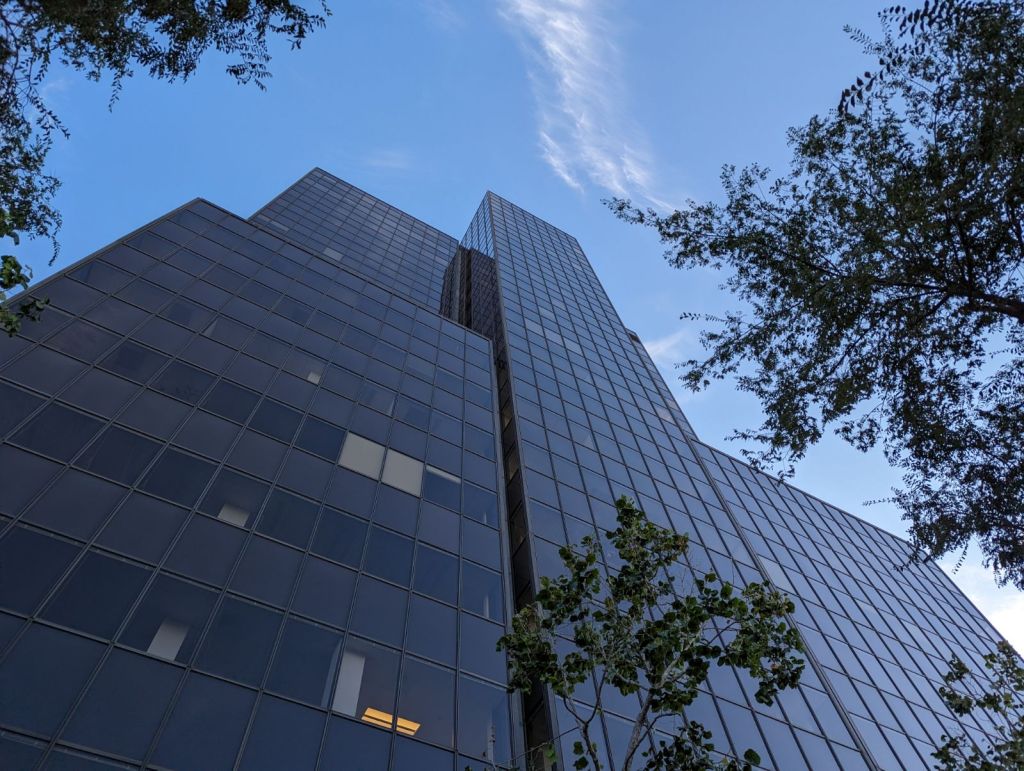
Ulmus parvifolia, Chinese elm extends most prominently into the picture from the right, with another bit from the left of the upper margin. Platanus X acerifolia, London plane extends into the picture from the right of the lower margin, with another minimal bit from the upper left. Otherwise, no other vegetation is visible. This is not exactly a horticultural topic.

The PruneYard Tower 1 is the big and dark skyscraper above the elms and planes. For a few years, it was the tallest skyscraper between San Francisco and Los Angeles. Like many major urban developments, it and its associated complex of buildings is named for what it displaced.

The PruneYard really was what its name describes, a large yard for drying prunes, as well as apricots, from the formerly vast orchards that surrounded it. Because the primary PruneYard complex of buildings is almost as old as I am, I can not remember it not being there. However, I can remember the ruins of some of the associated facilities nearby, as well as abandoned remnants of orchards. The stouter PruneYard Tower II was added in about 1976. The PruneYard Place was added in the early 1990s.

Nowadays, the name of the PruneYard must seem silly to those who are unaware of its history. Few are aware of the difference between prune and plum. Even those of us who can remember the last scraps of orchards find it difficult to believe that, not only were orchards here, but that they were formerly much more vast, and occupied most of the Santa Clara Valley. Just as tourists go to see the fall color of New England, tourists formerly came here to see the spring bloom. It is no wonder that the Santa Clara Valley was also known as the Valley of Heart’s Delight.

What Is This?! III

Could it be lychee?

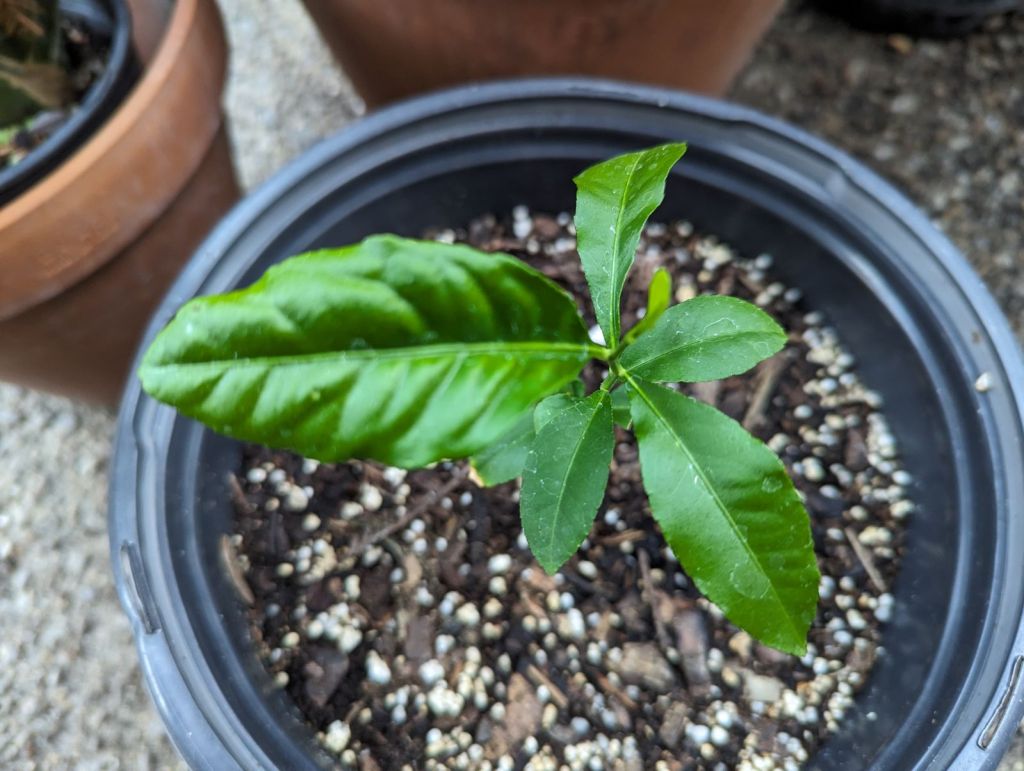
Prior to the identification of Hibbertia scandens last week, another mystery arrived. I probably should have mentioned it earlier, but as with the previous mystery, I thought that I would have identified it before I felt compelled to mention it here. Unlike the previous mystery though, I did not recognize it as something that I had encountered in the past.

Someone with whom I work, who is not so horticulturally oriented, brought it from one of the homes that he was working at. It had been left by a former tenant. Initially, I thought that it was merely a can of otherwise unused media in which a common bay laurel seed had germinated. However, it is not a bay laurel seedling. Also, contrary to how it appears in the picture, it is remarkably centered within the can, as if intentionally plugged there.

Initially, I thought that it resembled coffee, Coffea arabica. However, coffee exhibits opposite leaf arrangement, and these leaves are alternately arranged. Besides, viable unroasted coffee seed is not exactly common. Now, I sort of suspect that it could be lychee, Litchi chinensis. Although uncommon, seeded lychee fruit are not as rare as unroasted coffee. Although their leaves are so closely paired among mature specimens that they seem to be oppositely arranged, they are technically alternately arranged, and more obviously so among juvenile growth. If this is lychee, it will not produce identifying bloom for a few years.

Realistically, immediate identification of this seedling is unimportant. I could have put less effort into discarding it than I put into writing about it. Therefore, I will merely give it what it needs until it grows enough for identification. I will not mind discarding it if I identify it as something that is useless. Otherwise, I can find it a home.

Oem

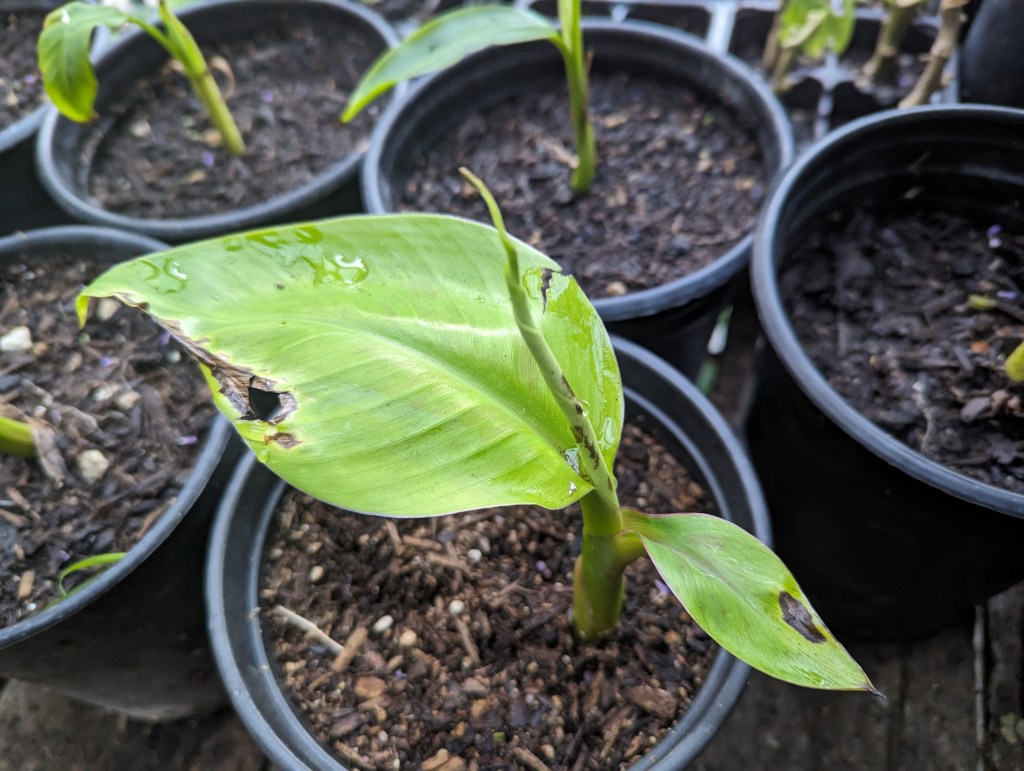
This picture is from my Six on Saturday post for this morning.

Its name is so minimalistic and blunt in the language of the indigenous people who are most familiar with it. Others might know it as the giant highland banana. It seems to me that most of us who find it to be of interest know it by its botanical name of Musa ingens.

Oem, or giant highland banana, or Musa ingens, is native to the tropical montane forests of New Guinea. Because it is endemic to high elevations, it does not perform so well in the sort of continually hot and humid tropical climates that most other species of banana enjoy. It actually prefers the weather to get somewhat cool at night. Therefore, it is more likely to be happier here than in Southern Florida, Hawaii or coastal San Diego County.

Not many horticultural enthusiasts grow it anyway. Actually, I do not know of anyone else who grows it. I have seen only a few comments online regarding germination of the very rare and expensive seed. Furthermore, no one seems to be successful with germination. This particular species does not generate pups as readily as other species of the genus, and even if it did, there are no established specimens from which to procure such pups.

However, its lack of popularity is less likely a result of its rarity and difficulty to propagate, but more likely because of its massive scale. In the wild, oem can grow to a hundred feet tall! It may be limited to about half as tall within cultivation, and without competition from other tall trees, but that is nonetheless a potential to get fifty feet tall! That may not seem like much relative to other trees, particularly the redwoods that are more than a hundred feet tall, with potential to get three times as tall. The concern is that banana trees are not actually trees. They are merely humongous perennials. Their pseudostems do not grow for very long before they begin to deteriorate and collapse. Pseudostems of smaller sorts may complete the process within two years, but are easily removed afterwards. Fifty foot tall pseudostems take significantly more time to mature and then deteriorate, but are not so easily removed from refined landscapes. Arborists can not climb them to cut them into sections. They require space to fall harmlessly. They are full of water, so are very heavy.

Now, oem lives here. It is merely a single dinky pup, but grows very efficiently. I have no idea of what to do with it. It can likely stay canned through this year, but may need to go into the ground next year. Not only does it need plenty of space, but it does not conform to the styles of any of the landscapes here. Consequently, it might eventually inhabit my home garden, regardless of its awkward appearance. This will likely get very interesting.

Quince

Quince has become a rare fruit.

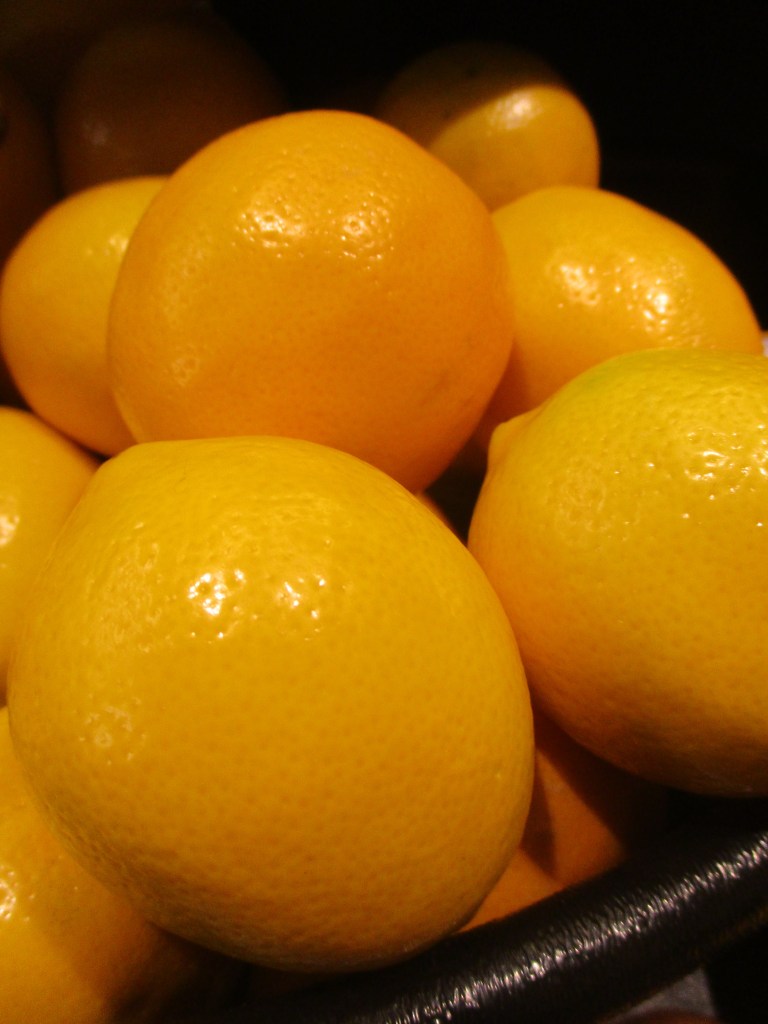
With the many slender arching trunks, quince, Cydonia oblonga, is more like a large deciduous shrub than a fruit tree. Even old trees are not much more than twenty feet tall and broad. Most of the rare trees that can be found are old, because quince is such an old fashioned fruit. The fruit is still immature and covered with white pubescence (fuzz). By late autumn, it will be remarkably aromatic and resemble golden pears, about four inches long and nearly as wide, and so hard that it should be cooked.

Date Palm

Many relocated mature date palms were recycled from date orchards.

It seems that recycled large date palms, Phoenix dactylifera, became trendy in the past few decades while vast date orchards around Las Vegas were displaced by urban sprawl. They are stately trees with airy but bold rounded canopies between twenty and thirty feet wide. Mature trees are more than fifty feet tall on single trunks. Varieties with multiple trunks are shorter and rare. The ten to twenty foot long leaves are pinnately compound with folded foot long leaflets, and nasty basal spines.

Each date palm tree is either male or female (dioecious). Orchards are almost exclusive to fruiting female trees with only a few male trees grown separately for their pollen, which gets applied manually. Without male pollinators, recycled formerly productive female trees are fruitless, and therefore not messy.

Date palms may have been in cultivation for nine thousand years! The Judean date palm was grown from seed that was lost in storage for two thousand years, which (until recently) was the oldest known viable seed!