Karpooravalli

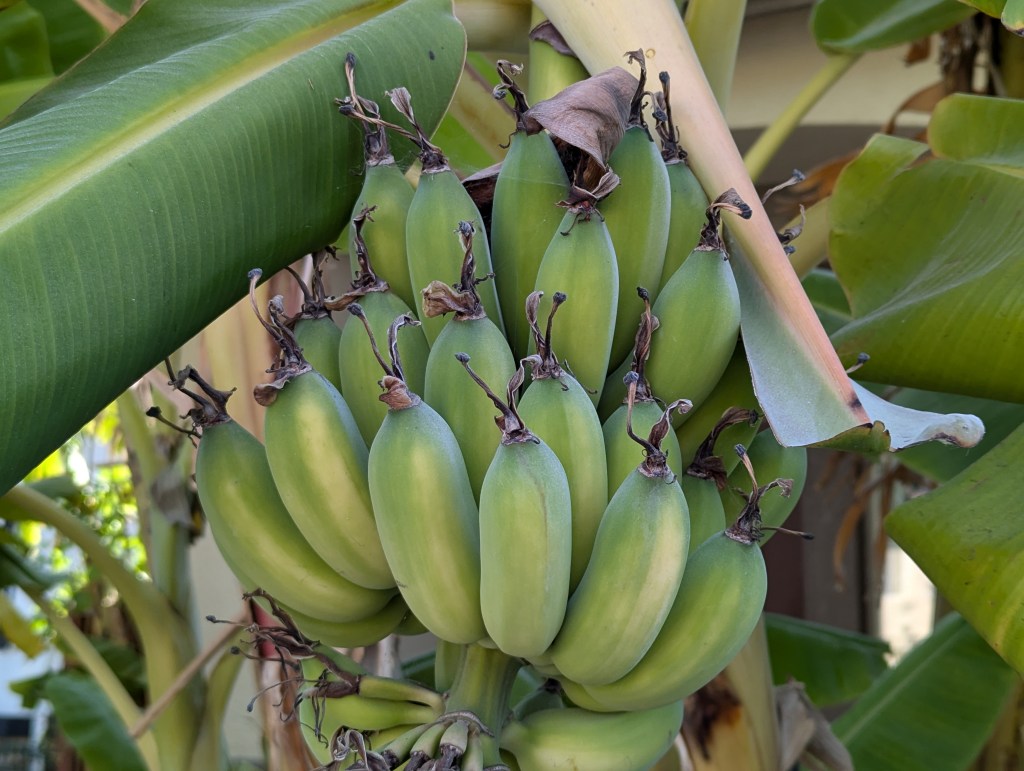
Karpooravalli bananas after removal of their edible male flowers below.

Pronunciation is only slightly easier than when I first tried to read it. Spelling still necessitates cheating, which I do not feel at all guilty about. Karpooravalli is a big name! I must get acquainted with it though, since it will likely be with me for the rest of my life.

Yes, it is another cultivar of banana, which is something else that I do not feel at all guilty about. I have no intention of retaining all of the other twenty or so cultivars that are already here. In the future, I will likely give away most of them to colleagues, without retaining pups. I actually already have plans to install at work the two that are least likely to produce edible fruit, and never grow either in my own garden again.

Karpooravalli banana pups

These four new pups of Karpooravalli arrived last Monday, just two days after eight unidentified pupping pups and a single pup of ‘Blue Java’ which is also known as the ‘Ice Cream’ banana. Like these previously most recent acquisitions, as well as another ‘Blue Java’ pup and another unidentified pup that were acquired together last year, these four pups of Karpooravalli are from a private garden. All of the other cultivars here are from nurseries, and most were tissue culture plugs that never actually grew in soil.

That is the dilemma. Cultivars from nurseries are expendable. I can give them away without retaining any copies and not miss them. However, cultivars from private gardens have history, even if I am unaware of it. They are important to someone.

I can give away the recently acquired pup of ‘Blue Java’ only because another pup of it from another important source is already established here, and I knew when I took it that it would not be staying. Also, I can give away almost all of the other unidentified pups that came with it because there are already too many to retain. However, I will retain at least one of them because I know that the cultivar was important to the person who shared it. Likewise, I will retain my first copy of ‘Blue Java’ and the unidentified pup that came with it because they are important to the person who shared them.

Karpooravalli is fortunately one of the more reliably productive cultivars here, and provides sweet fruit with remarkably rich flavor. It is gratifying to know this now because I will grow it for as long as I can tend the garden. This particular Karpooravalli is very important to the person who grew it in her garden for a few decades before sharing it with me, so it is important to me now. I know that I will eventually need to share it with others as it multiplies in the future, but I will prefer to share it with those who respect its importance.

Before I was in kindergarten, I acquired my rhubarb from my paternal paternal great grandfather, and my Dalmatian iris from my maternal maternal great grandmother. Both are growing well in my garden now, and always will. I acquired my common lily of the Nile and the first of my common zonal geranium a few years later. Much of what inhabits my garden now has been with me for many years. Yet, I acquired my first Japanese iris, persicaria and goldenrod as recently as late last winter from Tangly Cottage Gardening. Perhaps it is never too late to start another important tradition.
Karpooravalli bananas

Banana Republic

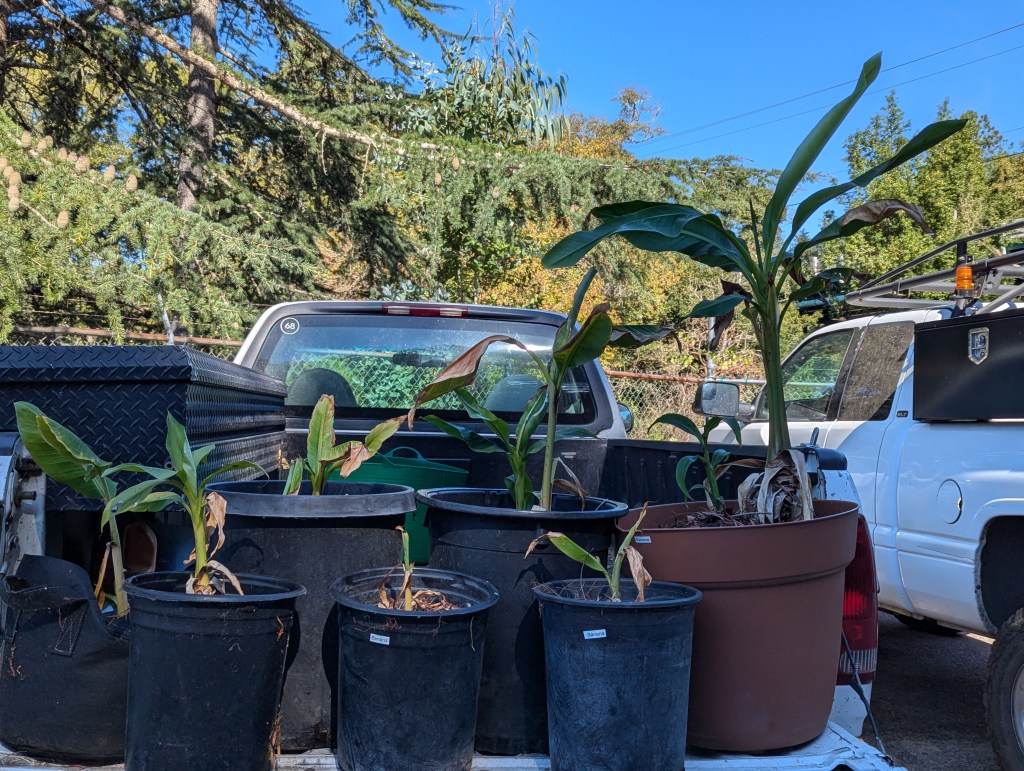
Yes! We have more bananas! I can explain. Although there are as many as twenty cultivars of banana here, almost all are individual pups or tissue culture plugs. (Of these twenty, three are unidentified. Of these three, one is likely a redundant copy of one of the other cultivars, one seems to be completely necrotic without possibility of recovery, and only one is notably distinct.) All but a few arrived earlier this year, so have not yet generated pups. ‘Double Mahoi’ has doubled by generating a single pup. ‘Golden Rhino Horn’ arrived as a pair, and one of the pair is only now beginning to generate another pair of pups. Otherwise, there are no spare pups to share. The only spare pups of ‘Double Mahoi’ and ‘Golden Rhino Horn’ (the one which lacks new pups) may be leaving in the next few days. Whatever remains of these two will most certainly go to another colleague at the end of winter. Another colleague would like to add any spares, regardless of cultivar, to his garden. However, until just now, I could not help in that endeavor. The few in the picture above just arrived from Gilroy because they were in need of a new home. The pup to the far left is ‘Blue Java’, which is also known as ‘Ice Cream’, is redundant to a copy that is already here, so can be shared with a colleague. The others, which are sufficiently numerous for all of us to get copies, are unidentified, which merely means that if they produce fruit, it will be a surprise. Even if their fruit is not palatable, their foliage is good for forage and compost. For the colleague who would like to add any spares regardless of cultivar, they can live in a riparian area of his garden that is too steep, damp and shady for gardening. These pups may not look like much in the picture, but their corms are quite plump, so will provide an abundance of foliage after they get into the ground and the weather warms after winter. Soon afterward, they will generate more pups, but we can worry about that later.

Black Chokeberry

Black chokeberry is already popular within its native range.

The recent popularity of fruits that contain antioxidants is restoring the popularity of an old classic deciduous shrub with an odd name. ‘Black chokeberry’ obviously does not sound very appetizing, so is more commonly known by its Latin name Aronia melanocarpa, or simply ‘Aronia’. It has always been popular within its native range east of the Appalachians and just north of the Canadian border, and is becoming more popular everywhere else since becoming available from mail order catalogues. Although it is not well rated for local climates since it prefers cooler winters, it can sometimes be found in local nurseries.

Shiny, black chokeberries are about half an inch wide, and ripen about now. They are purported to taste something like cranberries. Mine taste more like pithy crabapples so far; but I do not mind. I grow the three or four foot high shrubs just as much for their remarkable autumn color later in the year. The rather unremarkable inch or two wide trusses of small white flowers that bloom in spring can be slightly fragrant.

Pruning is rather simple, as long as chokeberries do not get shorn. Vigorous stems that may get considerably taller than four feet may be pruned back to promote shrubbier growth. Aging stems can be cut to the ground in winter, and will be readily replaced by new sucker growth.

Colorful Autumn Fruit Is For The Birds

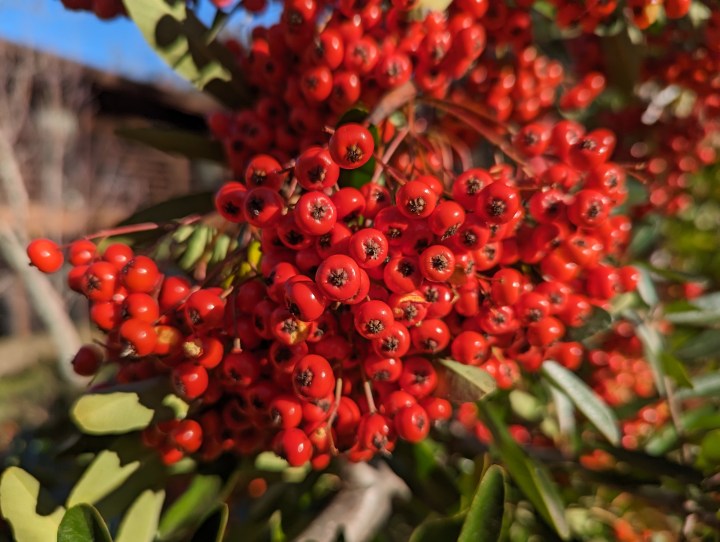
Firethorn is typically the most colorful of autumn berries.

It is hard to ignore the slight bronzing of flowering pear trees in the neighborhood. The recent warm weather after such a mild summer may detrimentally accelerate the development of autumn foliar color, as well as the ripening of some of the colorful fruit that adorns gardens through autumn and winter. Sadly, there have been reports of scorched persimmons as well.

Despite their deviation from a more typical schedule, many of the plants that provide the most colorful fruit start to do so about now, just as birds want to fatten up for winter. My favorites of these provide fruit that I like to get before the birds do. I have already harvested gooseberries, currants and grapes, and am in the process of getting to the elderberries and black chokeberries. Pomegranates will ripen later in autumn. Citrus and persimmon will be ready later in winter, followed by loquat. Natal plum produces randomly all year.

Even fruit that I do not want looks good and keeps the birds happy though. Firethorn is probably the showiest and most popular of these, since it produces such abundant bright red berries that linger into winter. Some have orange or even yellowish berries. Cotoneaster and toyon are similar, but not so flashy. English hawthorn makes similar berries, but grows into a larger tree. Fruiting crabapples were harvested in early summer; but the ornamental, albeit sparse fruit of the flowering crabapples will linger after the leaves fall. Plants that provide abundant fruit that is popular with birds may not be so desirable near where cars are parked outside though, since well fed birds can be rather messy.

I am particularly fond of persimmon, pomegranate, English hawthorn and crabapple trees for other reasons as well. Persimmon trees will provide some of the best orange and red autumn foliar color. By the time it falls, there is plenty of comparably bright orange fruit to replace it! Pomegranate blooms with few but bright reddish orange flowers in summer. English hawthorn and crabapple trees are among the most abundant of spring blooming trees. Some of the flowering crabapple trees bloom with unique shades of bright pink and nearly red. 

Heavenly bamboo, Oregon grape (Mahonia) and California pepper tree are not often grown for their colorful fruit, but sometimes like to show it off. Oregon grape is striking because the fruit is so dark purplish black. California pepper tree makes pendulous trusses of small pink berries. Snowberry is an uncommon native that makes few but striking white berries. 

Mars & Venus

It is much too early to distinguish gender of these carob seedlings.

Phoenix dactylifera, common date palm supposedly became more popular than Phoenix canariensis, Canary Island date palm during the 1990s for two primary reasons. Firstly, it is less susceptible to pink rot that was killing so many Canary Island date palms at that time, and continues to do so. Secondly, mature specimens became so readily available as their orchards were being displaced by urban development, particularly around Las Vegas and Palm Springs. Of course, fruiting date palms would have been too messy for the urban landscapes that they were recycled into. So, to prevent such mess, only female trees were recycled for such landscapes. Without their male pollinators, they are fruitless. Female trees are generally shorter, more lushly foliated, and therefore more appropriate to refined landscapes anyway. Besides, all but between one and five percent of trees in date orchards are female. Male trees were not completely wasted though. Although not as lush, they are taller and statelier, so were recycled to landscape remote desert highway interchanges, where their pollen does not reach female date palms that now inhabit more urban landscapes. It all works out well, although contrary to the original purpose of the date palms involved. It would seem silly to separate genders of most familiar dioecious species, such as kiwifruits and hollies. However, only female carob trees are available from nurseries nowadays because they would be messy with pollination, and also because male floral fragrance is horrid! Male carob trees are only available for agricultural purposes, or grow as feral males from seed. The problem that I will eventually encounter with my carob trees is that I grew them from seed, and will not know what their genders are until they are a few years old. I want a female specimen in a specific location, and a male pollinator in another specific location. I think that I will put three seedlings in each location, select one that matures to be the preferred gender for its particular location, and eliminate the other two. Alternatively, I could allow two genders to grow together in such a manner than the male grafts to the female to become a branch that I could prune to be a small but necessary portion of the collective canopy. Of course, there is a possibility that all within each group of three could be the wrong gender. I will not know until a few years from now.

Madonna & Black Lace II

Sambucus nigra ‘Black Lace’ can produce a few berries without pollination from another cultivar.

The internet never ceases to amaze with its inefficiency of providing information that should be more readily available. Old fashioned horticultural texts and even encyclopedias were more reliable. I remember reading that elderberry could be self pollinating, but that it would be more productive with another cultivar of the same species. Because I could not remember what species of the genus that information was relevant to, I more recently tried to determine the requirements of each of the few species that I grow. Ultimately, it seems to me that all are about the same in regard to both their ability to self pollinate to a minimal degree, and their ability to pollinate more efficiently with other cultivars. However, I still do not know. Furthermore, I am now confused about the identity of American elderberry, which many sources insist is merely a variety of common black elderberry of Europe.

Sambucus caerulea, blue elderberry is native and too common for me to know or care if it is more productive with other genetically distinct specimens, which, since the species lacks cultivars, are merely other wild specimens. In other words, blue elderberry specimens here can not be adequately isolated from other specimens to determine how reliant they are on others for pollination. Regardless, I will grow about four together within my garden.

Sambucus racemosa, red elderberry is supposedly native here, but I have never seen it in the wild. Consequently, I do not know if other specimens are close enough to pollinate specimens within my garden. Rather than experiment with single and potentially isolated specimens, and because there is no need to separate the four specimens here anyway, I will grow all of them together within my garden. I am considering adding ‘Sutherland Gold’ or other ornamental cultivars in the future.

Sambucus canadensis, American elderberry is not native, so could be grown in isolation here. However, I want berries more than I want to know how reliant this species is on pollination from other genetically distinct specimens. Before I grow cultivars, I will grow about four specimens within my garden from seed. I might consider cultivars in the future, but for now, would prefer to grow them as most people within their native range experience them, and as I grow blue and red elderberries.

Sambucus nigra, black elderberry is a species that I find to be less interesting than the three North American species that I actually want to grow. However, I have grown ‘Black Lace’ at work for a few years, and recently got it ‘Madonna’ as a pollinator so that the two can make berries together. Because I grew several more copies of each than we can accommodate at work, I will likely grow a pair of each within my own garden. Both are ornamental cultivars that happen to also produce berries. However, formerly without a pollinator, ‘Black Lace’ has been fruitless. This year, one of the copies managed to make these few berries in the picture above without bloom from ‘Madonna’. I suppose that this is consistent with what I read about its ability to self pollinate somewhat. Now, I want to see what it does next year if ‘Madonna’ blooms well.

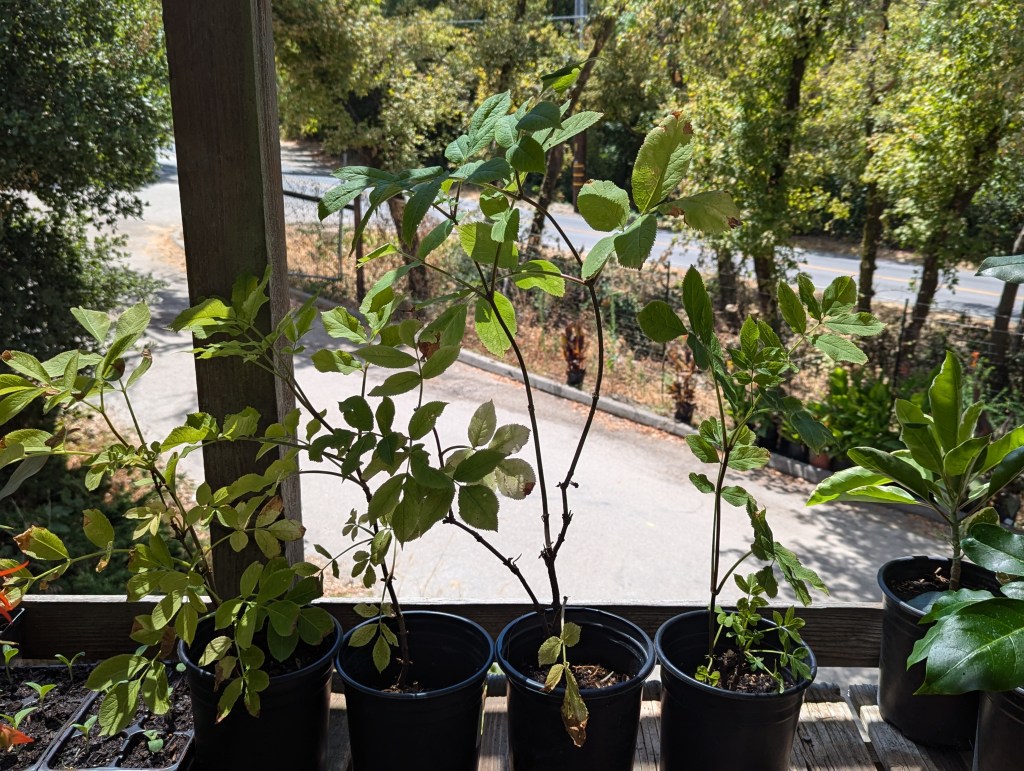
Four wild seed grown specimens of Sambucus racemosa, red elderberry that were a gift from Tangly Cottage Gardening have been canned for too long, and want to get into the garden.

Madonna & Black Lace

Sambucus nigra ‘Black Lace’ European black elderberry

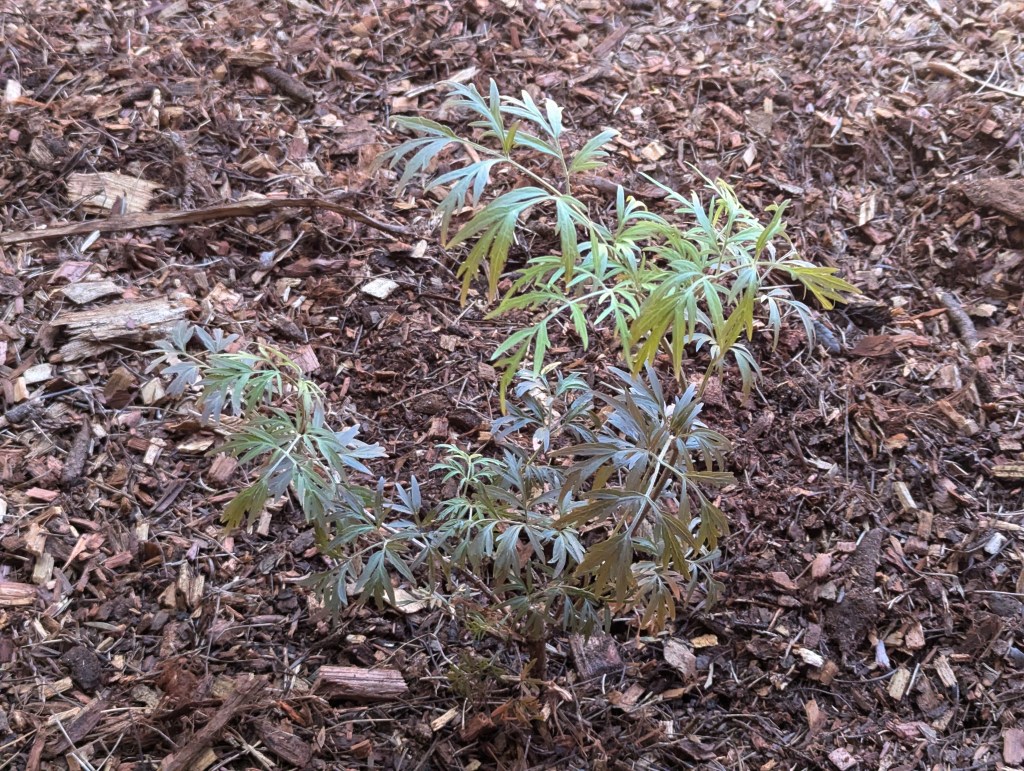
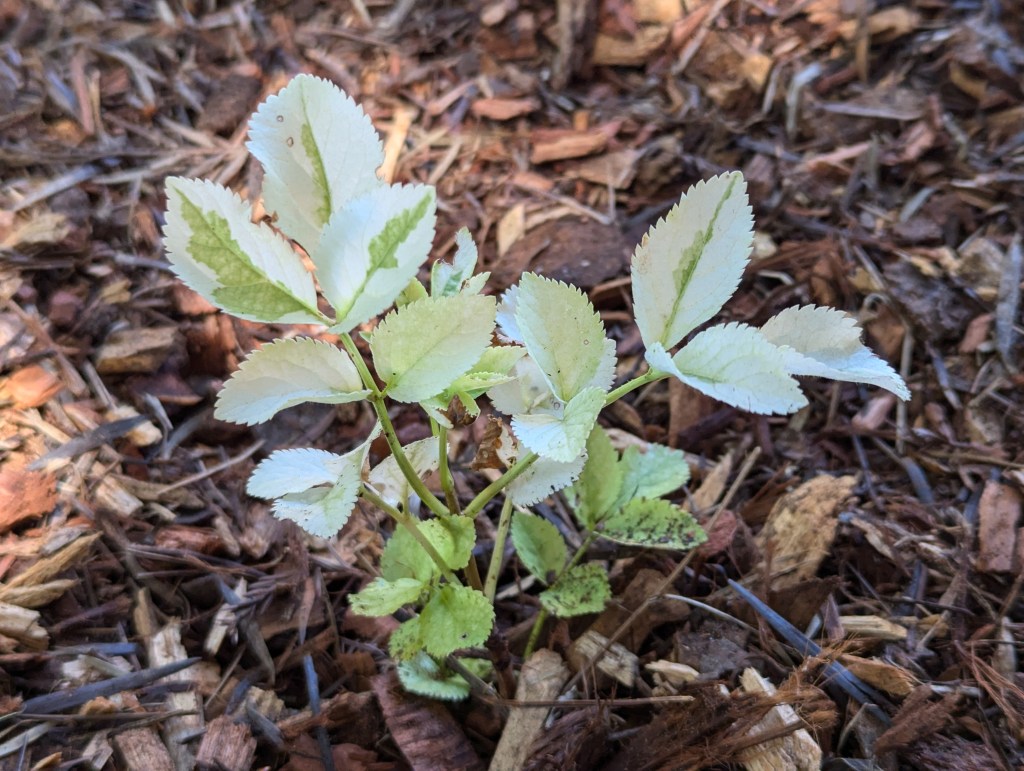
1984 was four decades ago. This is happening right now. Sambucus nigra ‘Black Lace’ European black elderberry, with intricately lacy and richly bronzed foliage, and flaring upright form, has inhabited one of the landscapes here for a few years. I was initially not so keen on it, but eventually learned to appreciate it as others who saw it expressed fondness for its distinctive texture and color. It was so popular that I grew a few too many copies from pruning scraps two winters ago, with the intention of adding a few more to other landscapes. I plugged a few more last winter, as if I did not know better. Several were shared with neighbors, but so far, only one was added to another landscape here, and only a few days ago. It may not look like much in the picture above, but should be a bit bigger and more richly bronzed next year. Sambucus nigra ‘Madonna’ European black elderberry, with simpler and yellowish variegated foliage, and somewhat more rounded form, was a more recent acquisition. Although I am not so keen on its yellowish color, it happened to become available while I was considering acquisition of a pollinator for ‘Black Lace’, which has not produced berries yet. Although each can self pollinate somewhat, different cultivars pollinate each other more effectively. Doves enjoy the resulting berries; and people enjoy seeing happy doves. The original specimen of ‘Madonna’ was thrashed when I acquired it, but provided more than sixteen rooted side shoot copies before going to live in a colleague’s garden. The first of these copies was installed adjacent to and in conjunction with the first copy of ‘Black Lace’. It may not look like much in the picture below, but it is just a dinky copy from a four inch pot.

Sambucus nigra ‘Madonna’ European black elderberry

Village Harvest redirects surplus from home gardens to those who can use it.

Surplus need not go to waste.

(This article is several years old, so some of the information within is likely outdated.)

Those who witnessed the event know that it actually happened. During citrus season a few years ago, a crew of volunteers descended upon, or should I say, ascended ladders into the legendary and monstrously large King Grapefruit Tree in a gallant but hopeless attempt to harvest the fruit. Our caravan of an assortment of smaller pickups and my full sized Ford that we drove out to confront this aberration of nature where it resided was completely full by the time we had harvested only about a third of the fruit. We left happy with our plunder, but unexpectedly defeated by the abundance left behind. I have seen many fruit trees throughout my career, but have never seen so much fruit in a single tree! 

It may have watched us leave exasperated with our mud-flaps dragging, but the King Grapefruit Tree was not solely victorious. We Village Harvest volunteers and the many beneficiaries of Village Harvest enjoyed its fruit for weeks! Village Harvest arranges for community fruit harvesting events to collect fruit that might otherwise go to waste so that it can instead be distributed to people in the community who can use it. The fruit of the King Grapefruit Tree was donated, and more was harvested later, so that it would not become an unwanted mess for the residents of the nearby home.

This is just one of many examples of how Village Harvest community fruit harvesting events benefit everyone involved. Those who donate their surplus fruit get it harvested and taken away before it becomes messy. Village Harvest volunteers get to take a bag or so of the fruit that gets harvested during the event. The clientele of the local food agencies that distribute the produce get fresh home grown fruit from the Santa Clara Valley; which is, as we all know, the best in the world.

Although citrus season is still several months away, five community fruit harvesting events are scheduled to collect summer fruit through July. On July 18 and again on August 1, two Mountain View community harvesting events will be from 9:00 a.m. to 12:30 p.m.. Two Central San Jose community harvesting events will be from 8:30 a.m. to 12:30 p.m. on both July 20 and July 27. The Sunnyvale community harvesting event will be from 8:00 a.m. to noon on July 26. Locations to meet for each event can be determined when making reservations.

Information about volunteering for any of these and other events, or how to arrange for donation of fruit, can be found at the website, www.villageharvest.org, or by telephoning 888 – 378 4841. Because admission is limited, it is advisable to make reservations for any event early, either online or by telephone. (It may be too late for the July 18 event.) Parking is also limited, so participants should carpool if possible. Pickups and station wagons to help transport fruit are very helpful. So is a grocery bag to share in the harvest afterward. Covered shoes (not sandals) are important. Layered clothing is more comfortable for cool mornings that get warmer closer to noon.  

Going Bananas!

‘Double Mahoi’ is not even a fraction of a single yet, but can grow fast.

This is not banana territory. The soil is good, and water is readily available; but the climate is a limiting factor. The weather does not get very warm for very long. When it rarely gets almost unpleasantly warm during the day, it generally gets tolerably cooler overnight. Bananas are none too keen on such comfortable weather. They want sustained warmth, with less fluctuation of temperature between night and day.

This is precisely why I should not have acquired as many as fourteen cultivars of banana. Some may never do more than generate appealingly lush foliage here. Those that produce fruit will unlikely produce fruit that is much more than marginally palatable. One of the cultivars is the oem, which is the largest banana ‘tree’ in the World. I have NO idea of how to manage it. ‘Mekong Giant’ also grows quite large and heavy. Two cultivars are unidentified, so could possibly be copies of others. ‘Kokopo Patupi’ may not have survived last winter, as it has not begun to regenerate yet. Four other cultivars were given away, but then generated pups that are now returning! I do not remember how many cultivars are here now, but I know that there are too many.

Oem is resuming growth faster than the others, but with small leaves from within pseudostems that produced larger leaves last year. ‘Double Mahoi’ is likewise regenerating dinky and pale leaves that are actually dinkier than those that emerged earlier from a shriveled carcass of a dinky pup that got frosted last winter.

I want all of the cultivars of banana to survive and thrive, but I should have planned for them better. Now, I should plan to find homes for most of them instead. Even if I could manage them all, I can not justify doing so.

Oem is the biggest banana ‘tree’ in the World!

Simple Species

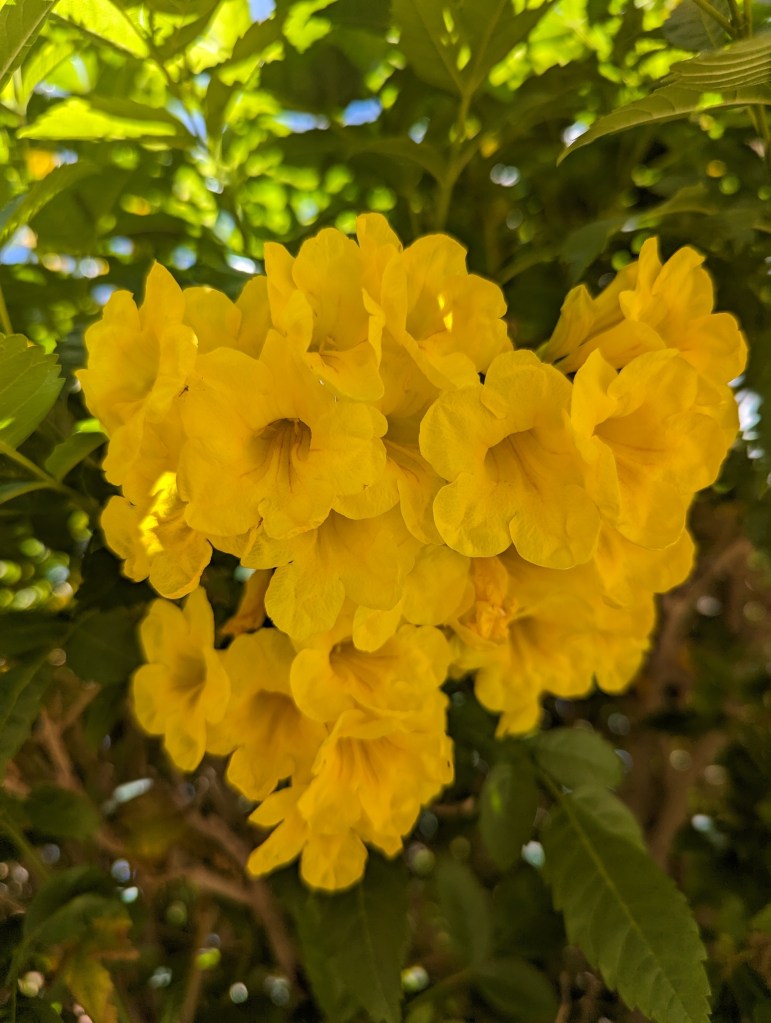
Unidentified cultivar of Tecoma stans

Tecoma stans is somewhat popular within the neighborhood where I stayed while in Arizona. It is available in nurseries also. I suppose that I could have purchased one or more for my garden. I had wanted to grow it for a long time. I refrained. I can explain.

The Tecoma stans that I can get from nurseries is an improved cultivar, or actually, about three cultivars. They are not the simple species, as it would be found growing wild. I realize that improved cultivars are known as ‘improved’ for a reason, but ultimately, I want to grow the simple species.

Crazy Green Thumbs sent me the seed for the simple species of Tecoma stans that I want to grow. That is all I need. Other colleagues have sent me seed, seedlings or cuttings for simple species of American beautyberry, American holly, American persimmon, pawpaw, red mulberry, red elderberry and perhaps too many other species to list briefly. In the future, I suppose that I could try cultivars of some of these species. I would like to get acquainted with them first though.

For most species, I suppose that I prefer cultivars. I want to grow the same ‘Moorpark’ and ‘Blenheim’ apricots that I grew up with. Eventually, I want to grow ‘John F. Kennedy’ rose. Cultivars serve a purpose also.

There are a few reasons why I want simple species rather than cultivars of some species. For American beautyberry, American holly and red elderberry, I want to grow what most other garden enthusiasts within the native ranges of these species grow merely because such species appear uninvited in their gardens. For American persimmon, pawpaw and red mulberry, I want to grow a few of the fruits that people enjoyed for culinary application prior to the development of relatively modern cultivars.