San Francisco Flower & Garden Show

(This is an old recycled article that includes very outdated information, some of which was omitted, but the website for the San Francisco Flower & Garden Show is the same.)

Bonsai, composting, palms, flower arranging and lawn alternatives, as well as rare, edible and drought tolerant plants; there will be seminars for almost every horticultural topic imaginable at “Life in the California Garden”, the 26th annual San Francisco Flower and Garden Show. Xeriscapes, contemporary garden design and water conservation; there will be something for anyone who enjoys any kind of gardening. A schedule of seminars and any other information can be found at www.sfgardenshow.com.

The most spectacular display will be the twenty gardens created by some of the most innovative local, and perhaps not so local, landscape designers and horticultural professionals. There will be everything from contemporary to traditional and functional to ‘artistic’ landscapes. Anyone who has been to a San Francisco Flower and Garden Show knows what ‘artistic’ can mean, but will be surprised nonetheless. 

Just about anything that can be done in the garden will be done at “Life in the California Garden”. Bee keeping, practical pest control and water management will all be there. “The Modern Homestead” designed by Star Apple Edible Gardens of Oakland will be a 6,000 square foot exhibit featuring aesthetic vegetable plantings and an elegant chicken coop, as well as beer and jam making demonstrations.

The Marketplace will include more than 200 vendors with all sorts of seeds, plants, tools, gifts, patio furniture, pottery and garden sculpture. Plants will range from orchids, dahlias, epiphytes, vegetable plants, cacti and succulents, to name a few. The Farmers’ Market will have flowers and produce available. Sproutopia will feature interactive gardening experiences and demonstrations for children.

Many very impressive bonsai will be exhibited by the prestigious Bonsai Society of San Francisco. Many of the bonsai subjects that are decades old have been returning to the San Francisco Flower and Garden Show for many years. There will also be bonsai demonstrations.

Horticulturists of the Western Horticultural Society will be available to discuss rare and recently introduced plants, as well as more traditional plants that are regaining popularity. Some recent introductions are not yet available in nurseries. California Garden Clubs will have representatives from many of the various horticultural associations, with information about membership.
The San Francisco Flower and Garden Show (2010)

(This article is from 2010, so contains irrelevantly outdated information, but the link to the website below is accurate.)

The big Pacific maples outside my window never seem to get enough rest through the brief winters. Not too long ago, their leaves turned yellow and fell during autumn. Their branches were bare for only a short time through the middle of winter. Now their buds are popping open to remind me that it is now early spring. Gardening can no longer be put off because the weather is too cool and rainy to go outside, or for that matter, because it is too cool for the various plants to be actively growing and in need of much attention. Gardening now becomes a rush just to keep up with all that is going on, and to not miss out on the many excellent gardening events this time of year.  

The San Francisco Flower and Garden Show, the grandest of these events, has already begun and will continue though March 28 at the San Mateo Event Center. More than 70 seminars feature topics such as sustainability in the garden, edible gardening, new plants, garden design, container gardens and water conservation. Guests can also learn how to create bonsai, build trellises, grow orchids, prune properly and how to determine what plants are best for each garden. Sproutopia has fun and educational activities and entertainment for young children.

There are also many displays exhibiting everything from garden sculpture to victory gardens. The pocket parks and container garden display shows the potential of gardening with limited space, or with little time to devote to gardening. The Bonsai Society of San Francisco is exhibiting impressively mature bonsai specimens, and demonstrating bonsai techniques. Flower Lane exhibits floral design by California Garden Clubs. Hot Plant Picks displays some of the most recently introduced or developed plants. Some are still too new to be available in nurseries yet.  

Gardens for the Future, the twenty display gardens that are the most prominent component of the San Francisco Flower and Garden Show, illustrate themes ranging from simple and refined to opulent and lush. ‘Velvet Daggers3’ may be my favorite because it “suggests that we seek out new applications of simple technology” and “demonstrates the beautiful qualities of xeric plants” (yuccas perhaps!?). ‘Pulling Up Daisies’ defies conventional thirsty lawns and consumptive landscaping, suggesting evolution of environmental compatible landscaping with natives. “The use of native plants makes ‘Native Garden 3.0’ a model of sustainability.” These are merely three of my favorite gardens. There are seventeen others that are worthy of more theatrical descriptions! 

The San Francisco Flower and Garden Show will be open from 10:00 a.m. to 8:00 p.m., except on Sunday, March 28, when it will close two hours earlier at 6:00 p.m.. It is at The San Mateo Event Center, which is located at 2495 South Delaware Street in San Mateo. Admission is $20 for all five days, or $4 for youths sixteen years old and younger. Children four years old and younger are free. Student admission is $15 with valid student identification. After 3:00 p.m., or 2:00 p.m. on the last day, half day admission is $12. More information can be found at www.sfgardenshow.com

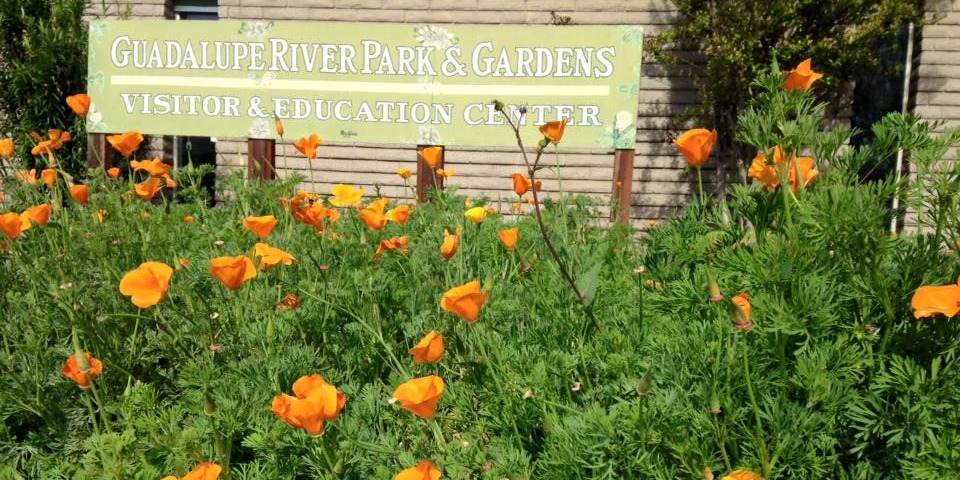
Spring in Guadalupe Gardens

(This information is now outdated.)

Spring in Guadalupe Gardens, a celebration of healthy living, gardening and the environment, will be here in little more than two weeks, on April 28! The 5 kilometer Fun Run that begins at 9:00 a.m., an hour before anything else, makes its way through the park and back to the main event, where there will be various health professionals to share information about healthy living, and for health screenings. Other exhibits will feature information about the environment and green technology, including presentations about solar energy and worm composting. Recyclable electronic waste can be dropped off free of charge. There will be all sorts of lectures, workshops, activities for children and even dancing and live bluegrass music.

But honestly, the main reason that most of us who read this column attend Spring in Guadalupe Gardens is all the gardening goodies! There will be an abundance of all kinds of plants from all kinds of specialty nurseries. Spring in Guadalupe Gardens has always been a great source of rare and unusual plants, as well as some of the more familiar plants, at reasonable prices.

Not only will there be plenty of plants to buy, but experts and some of the nurserymen who grew many of the plants will be available for advice on selection and cultivation. Representatives from the American Fuchsia Society, the John. E. Stowell Dahlia Society and the South Bay Heritage Rose Group will be there selling their plants, and sharing their expertise and information about membership. It is not too late in the season to select warm season vegetable plants, including heirloom varieties, from the extensive assortment that will be available.

Besides the shopping, Guadalupe River Park Conservancy and Greenwaste will be giving away one free bag of compost to each household. The San Jose Heritage Rose Garden, which is the most extensive public collection of old-world roses in the Western Hemisphere, will be in full bloom and open for tours.

Spring in Guadalupe Gardens will be from 10:00 a.m. to 3:30 p.m., in the Guadalupe River Park and Gardens between Taylor Street and Coleman Avenue in San Jose. There is no charge for admission or parking. More information can be found online at www.grpg.org or by telephoning 298 7657. Registration for the Fun Run, which begins an hour earlier at 9:00 a.m., can be arranged at www.grpg.org/FunRun.shtml.

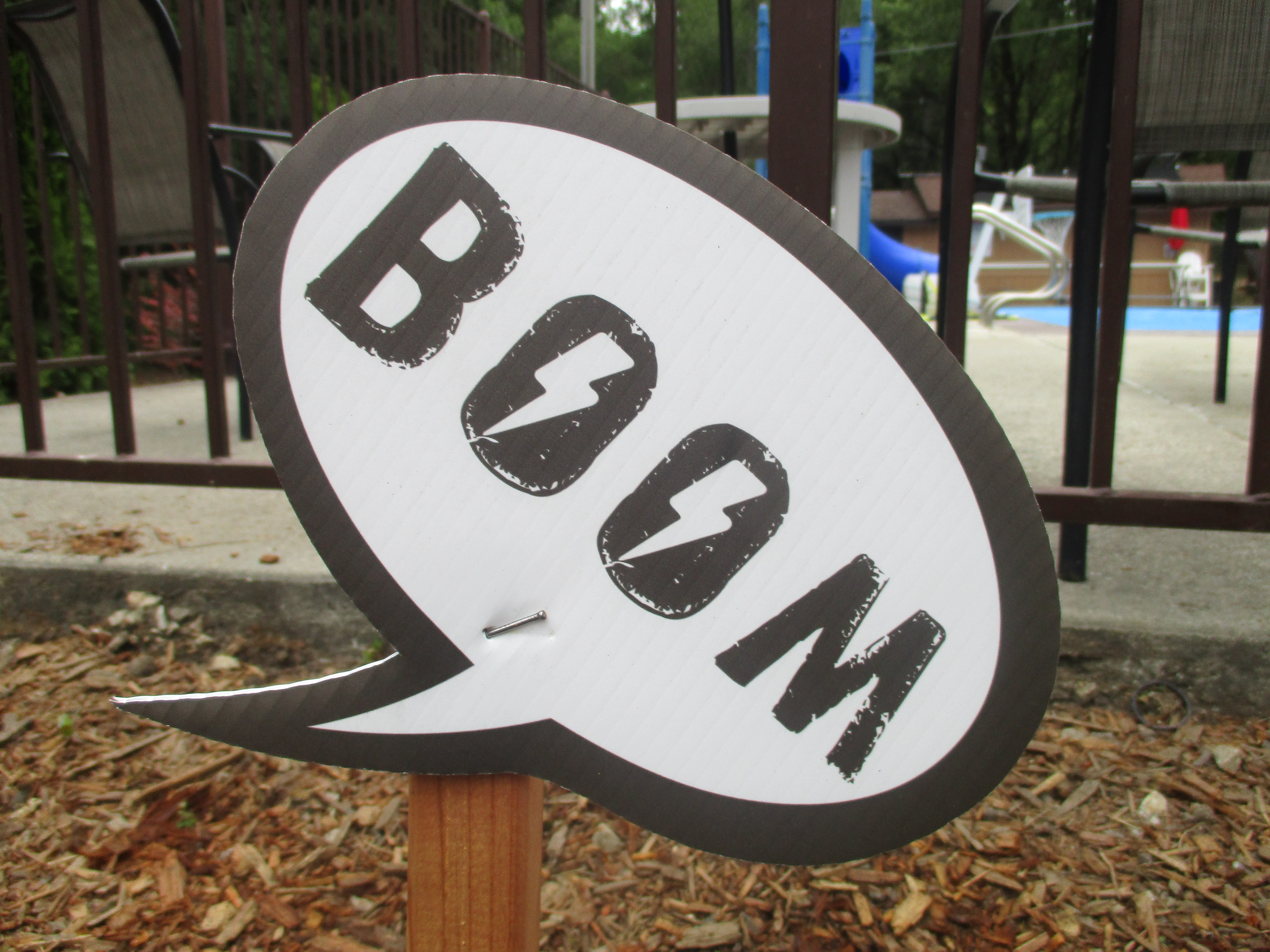
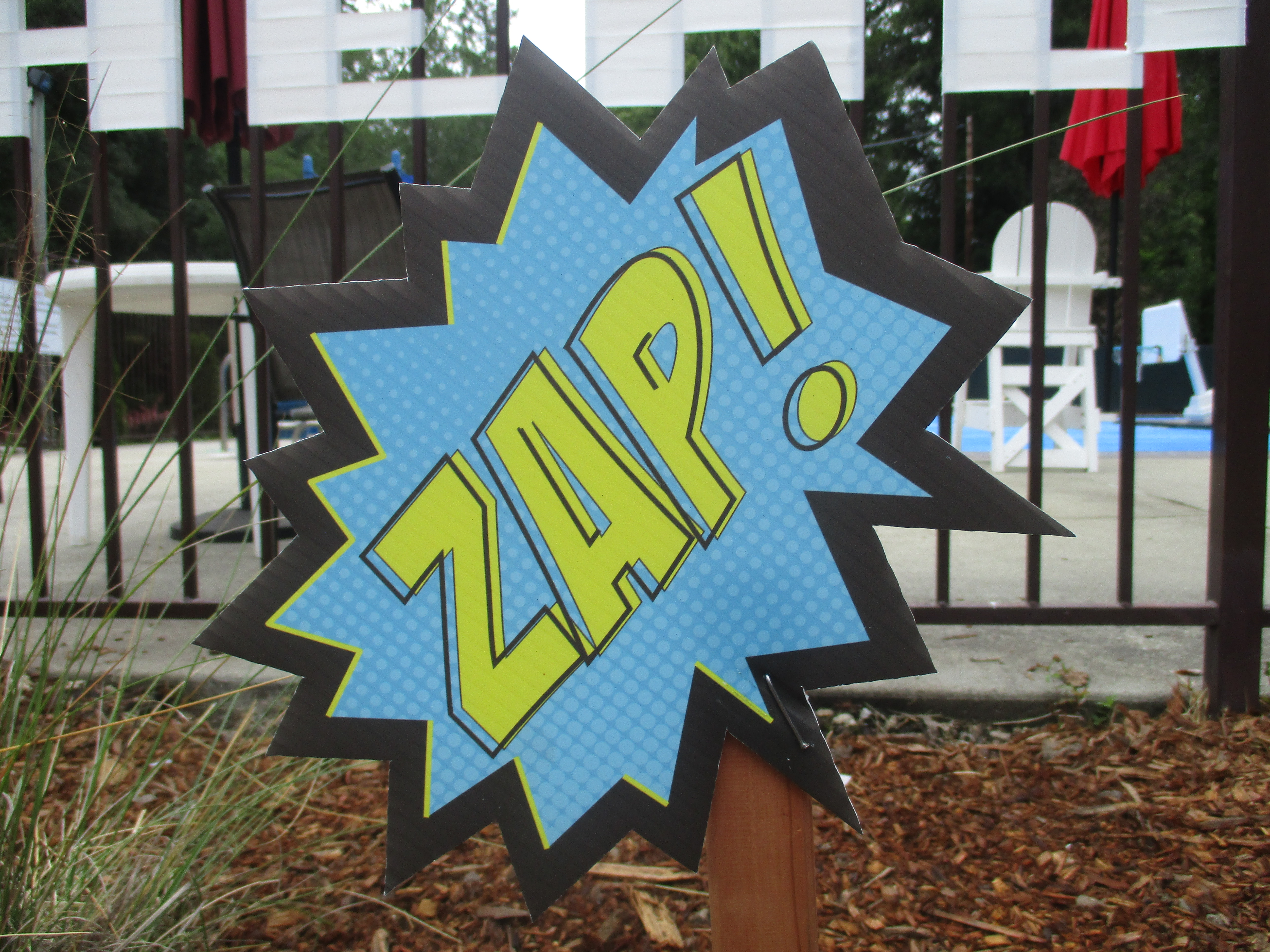
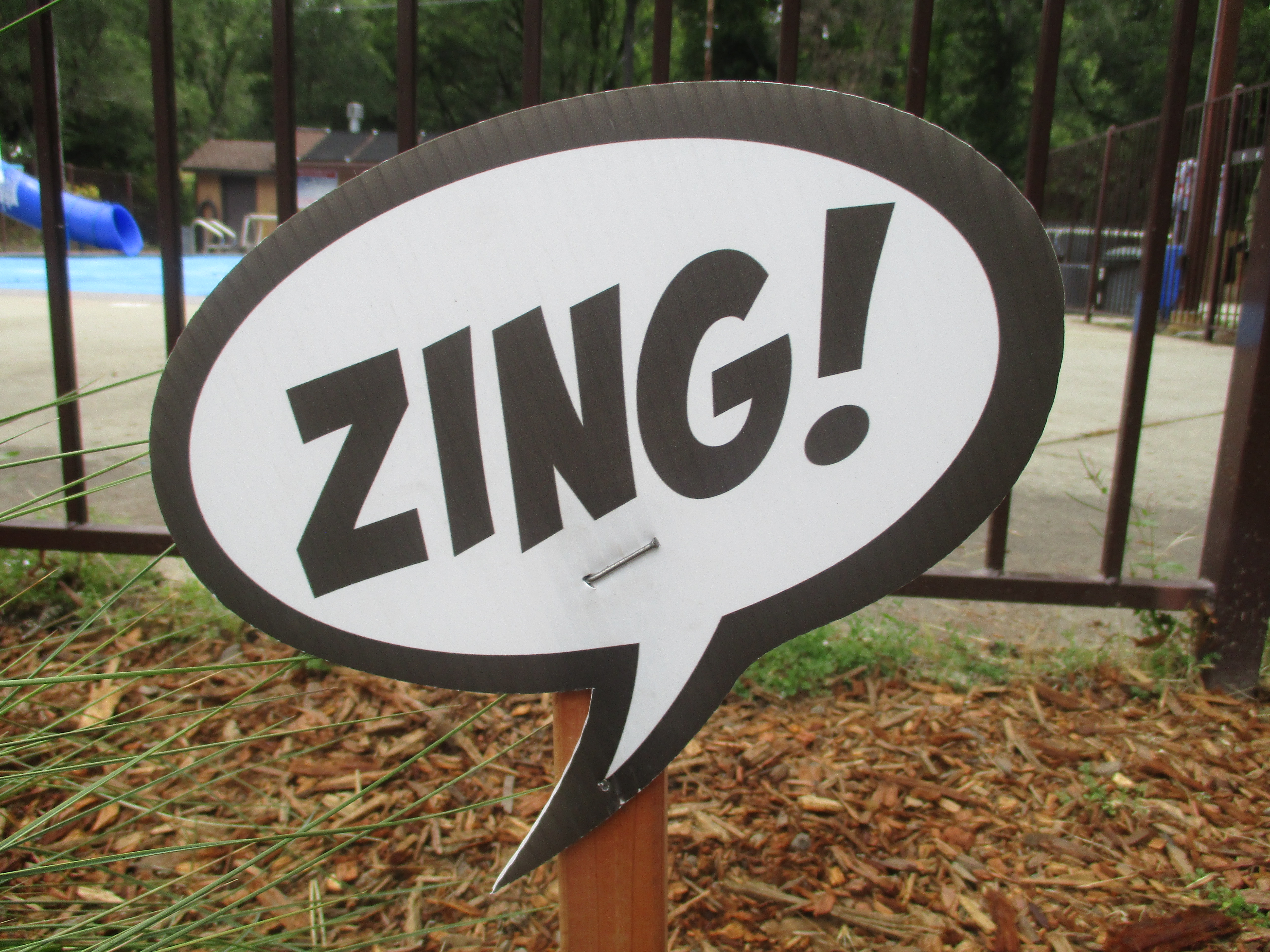
Boom! Zap! Wow! Bam! Zing!

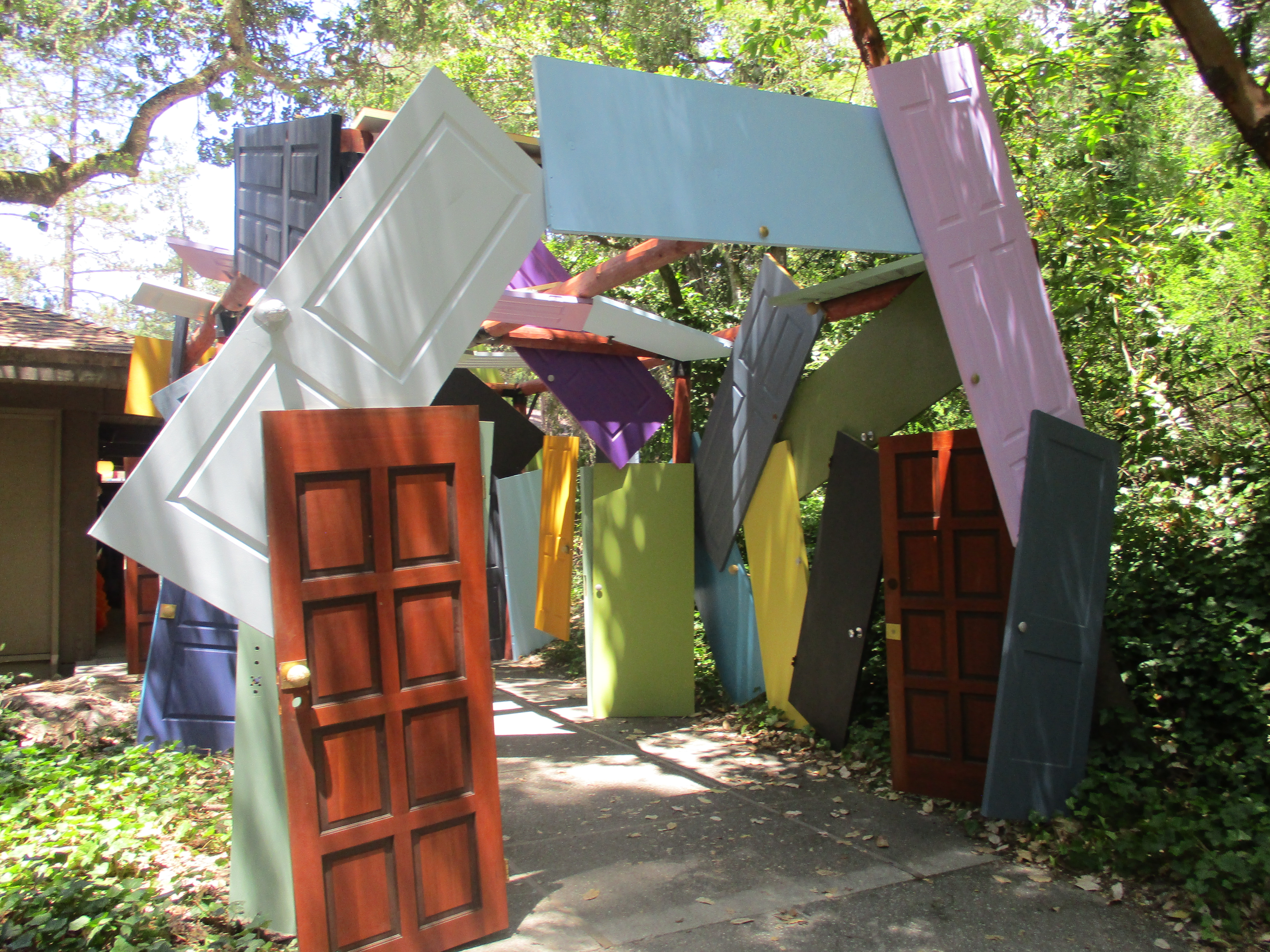
P90630P90630+P90630++P90630+++P90630++++Batman and Robin were here!
. . . well, not quite. It is decoration for summer camp. We never know what we will find in the landscapes that we maintain here. Those who work at camp arrive before guests, so that they can get ready, and of course, to decorate. Guests only started to arrive two weeks ago. It makes our work more interesting, as we try to work around the traffic and events, but it is SO gratifying to see so many guests enjoy the facilities that we maintain!
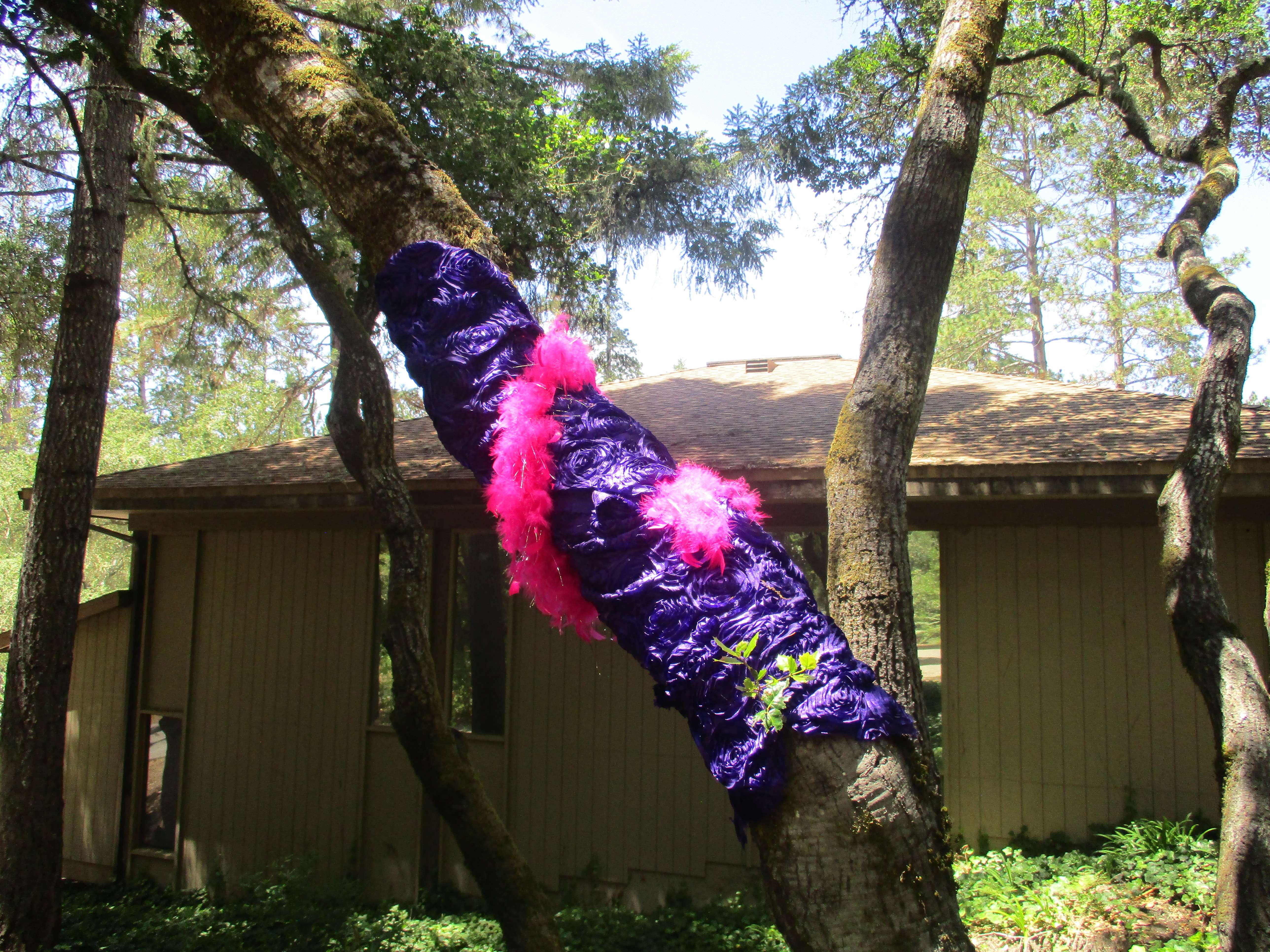
Those who work at camp enjoy being here too. It is obvious in all the work they put into preparation. It gets pretty wild and colorful, as I was reminded when I found what had been done in a grove of coast live oak just outside of one of the main auditoriums. Last year, I pruned and groomed the trees to expose their naturally sculptural trunks. I thought they were rather exemplary; but apparently, there was some room for improvement.
There is more to the wardrobe of a well rounded tree than mere ‘trunks’. One might select stylish attire such as this. Really though, I am not certain if this tree is feeling ‘Absolutely Fabulous’ or totally embarrassed.P90630+++++
This one went for an old fashioned veil.P90630++++++
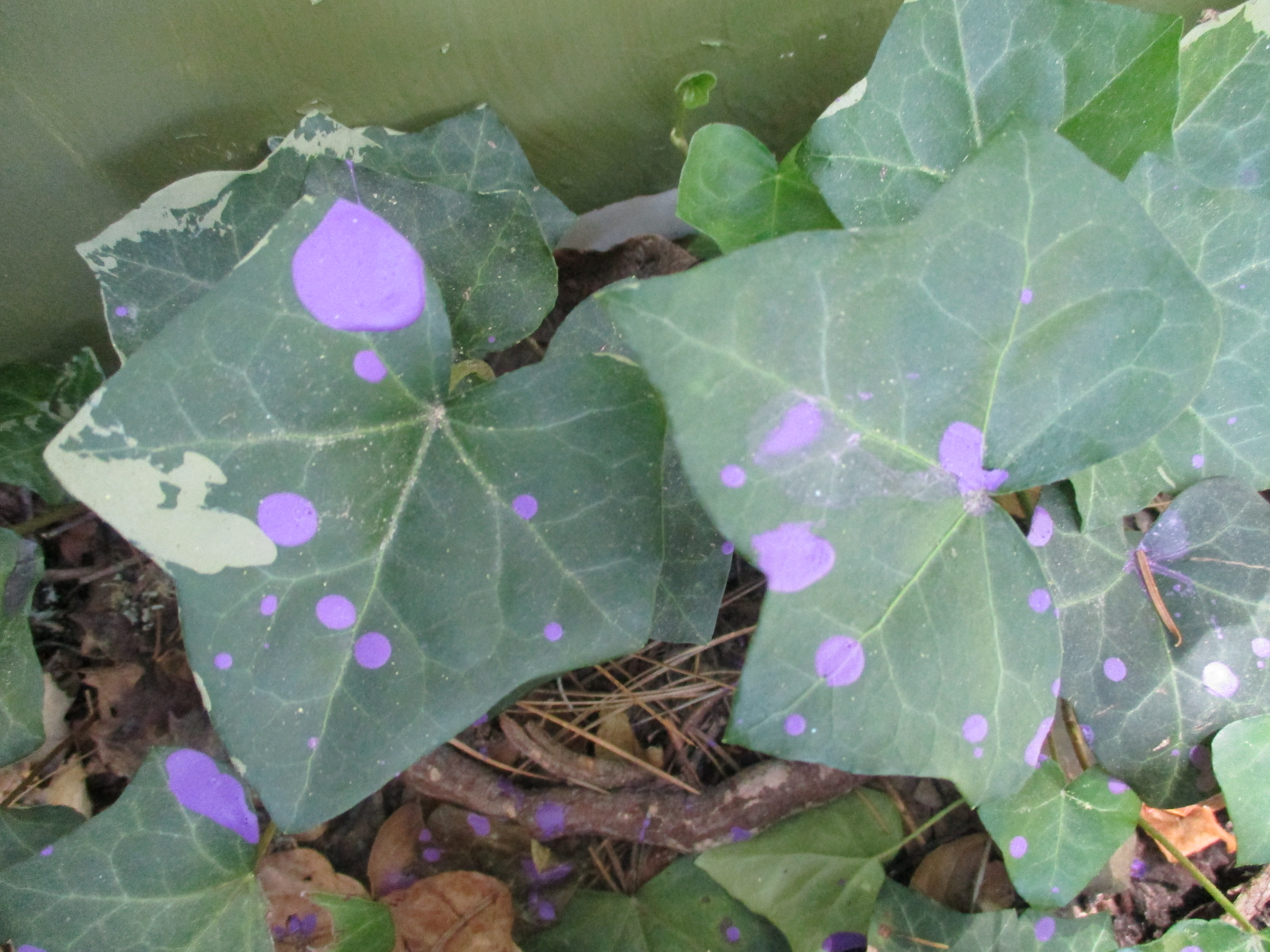
English ivy on the ground below the grove is wearing too much makeup.P90630+++++++
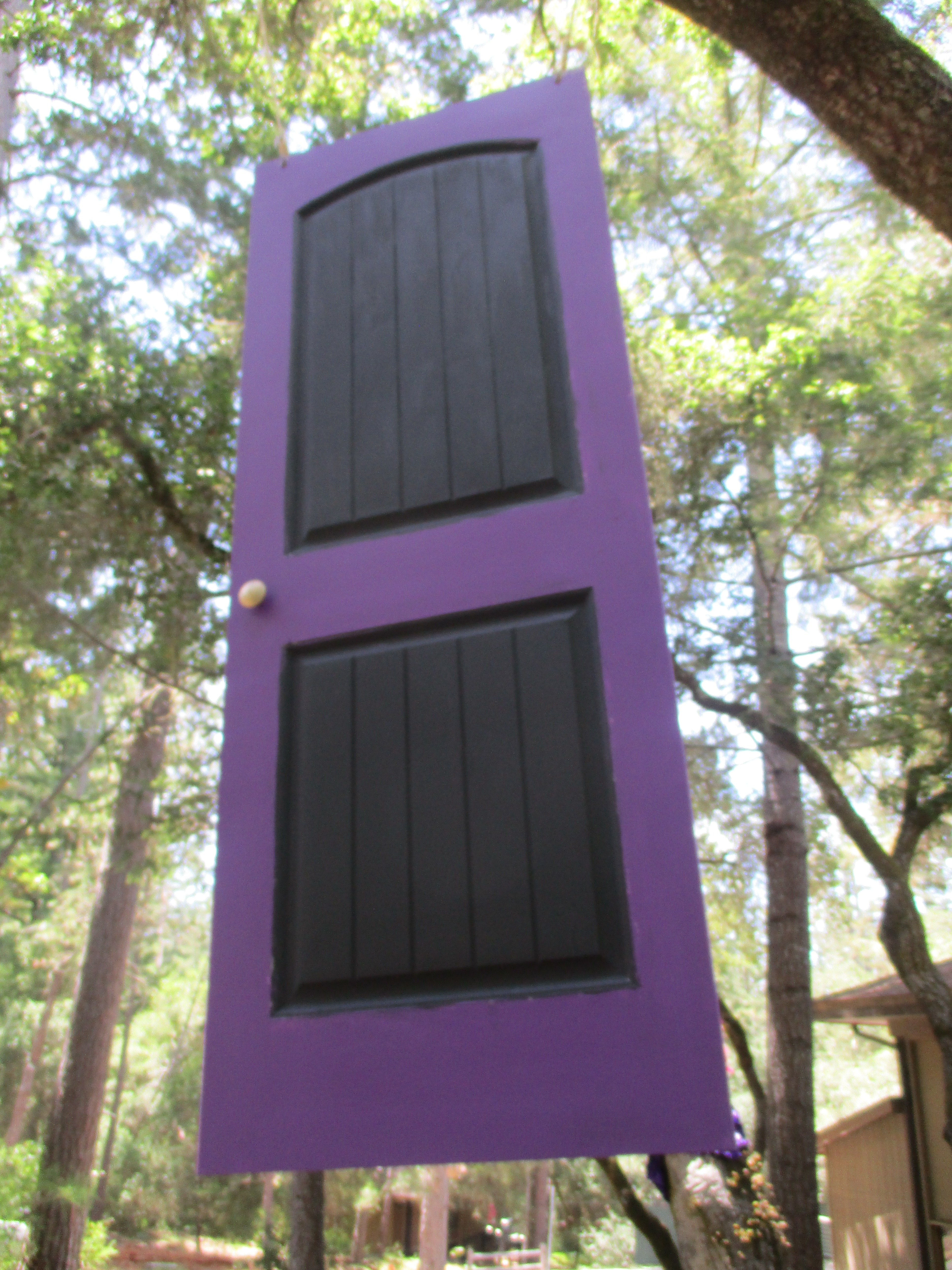
It is not really makeup of course. It is paint from this mysteriously hovering door . . . as if that somehow makes more sense. It was locked.P90630++++++++
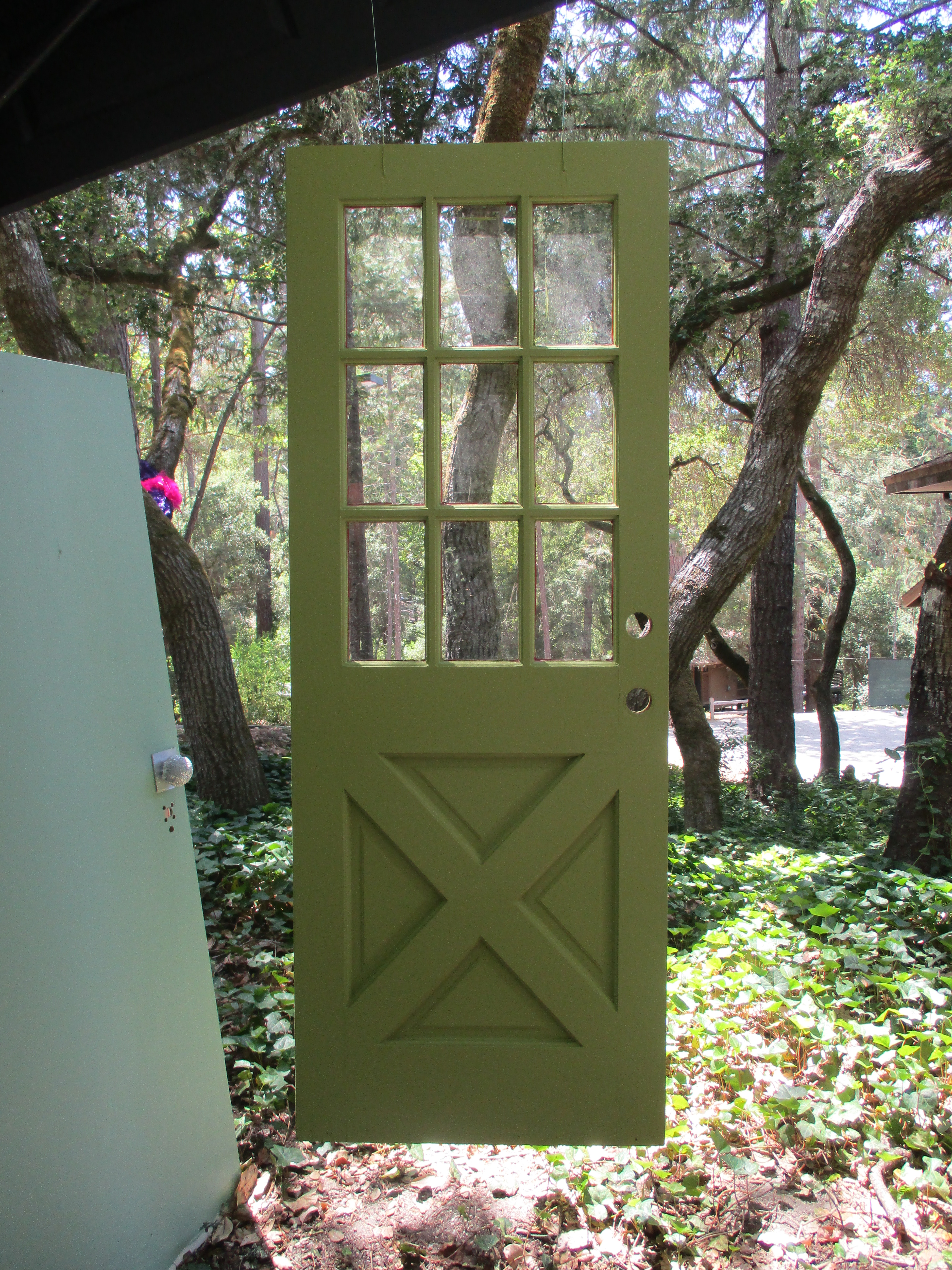
This one is more my style, and it has a window. There is no need to open it to see what is outside . . . or inside.P90630+++++++++
If neither of those are good enough, there are plenty of others to choose from.P90630++++++++++

Metallic Roses

P90203‘Sterling Silver’ and ‘Stainless Steel’ are two hybrid tea roses that were quite popular decades ago. ‘Copper’ and ‘Aluminum’ are not. However, I did happen to write a bit about the aluminum roses in the picture above on the Facebook page of Felton League on January 28, and included a link to an older article that featured a picture of copper roses. They are not at all relevant to horticulture, but are interesting nonetheless.

Felton League is an informational forum for the distinguished small group of displaced or socially outcast people and their friends in Felton, California. That is how it is described on Facebook. Those who are more directly familiar with us know us as a community group that not only advocates for the local homeless, but also provides compelling insight into homeless culture, and confronts the trend of animosity and hostility for anyone perceived to be homeless.

This is the post on Felton League from January 28:

Some of us participate in the River Cleanups here and elsewhere in Santa Cruz County. Some regularly collect trash for disposal throughout the year. One takes trash collection a step further by creating these metallic roses from some of the collected debris. They were featured in this article about garden art that was published in local newspapers between San Francisco and Beverly Hills in the summer of 2017; https://tonytomeo.com/2018/07/12/be-tactful-with-garden-art/ . (Not all of the articles used this illustration. The link is for the article as it was posted last July, about a year after it was published.) The copper roses of the original article were made from copper pipe. The newer silvery roses are made from flashing found in the San Lorenzo River. The thorny stems are made from scraps of fencing material that resembles a fine gauge of hog wire, that was found closer to Zayante Creek. The leaves are wired on with random bits of copper wire. These roses are often sold to tourists and local merchants to finance the banquets hosted by ‘Let’s Have Soup’ in Felton Covered Bridge Park.

Not My Style

P90202KThere is no shortage of artistic pictures online and within the context of gardening blogs. Some really are fascinating. I particularly like those that show the weather in far away and mythical lands like Colorado, Chicago, North Carolina, Australia, Oklahoma, New Zealand, Austin, and South Africa. Then there are the cats, dogs, hens, horses, pigs, and a few others that are not so entertaining. The close ups of flowers, fruits, leaves, mushrooms and any variety of odds and ends are amusing if they are not immediately recognizable. Yet, all these pictures are not my style. I am not the artistic sort.
I will try though. This shiny chestnut brown acorn half shell just looked like something that I should get a picture of. It was just laying there on the big sycamore leaf as if it were on display. The interior is even shinier and more richly colored than the exterior, although I did not turn it over to confirm. I am just guessing from my experience with other acorns.

The sycamore that provided the leaf is a California sycamore, Platanus racemosa.

I could not identify the species of the oak that provided the acorn. I am pretty certain that it is not from a coast live oak, valley oak, black oak or tanoak; respectively, Quercus agrifolia, Quercus lobata, Quercus kelogii or (Notho)Lithocarpus densiflorus. There are not many other options. I suspect that it could be from a canyon live oak or Shreve oak; respectively, Quercus chrysolepis or Quercus parvula ‘Shrevei’. Neither produces acorns that are typically as round as this one was.

Nor could I identify the species of squirrel, rat, raccoon, crow or whatever unknown animal dropped it.

Well, perhaps this is why I am not the artistic sort. I am instead the technical sort.

Time Travel

P81124KOne never knows what strange artifacts might be found out in public landscapes. It is amusing enough to find items discarded or simply misplaced long ago by former occupants of a home out in a private home garden. Public landscapes are even more interesting, since they collect debris and artifacts from many more people. Some landscapes have been doing so for a long time.
Besides litter, the most commonly found artifacts are sporting equipment. Frisbees, baseballs, tennis balls, soccer balls, volleyballs and such are commonly lost in dense vegetation. Golf clubs, baseball bats and tennis rackets sort of make one wonder. Chew toys are sometimes left by dogs who go after them, but then return with something they perceive to be more interesting.
Landscapes that are near roadways often feature car parts that might have fallen out of cars as they drove by, as well as a few that cars could not have driven by without. Obviously stolen items, such as purses and wallets, often surrounded by a few credit cards that they likely contained sometimes appear. Stolen mail might fit into that category.
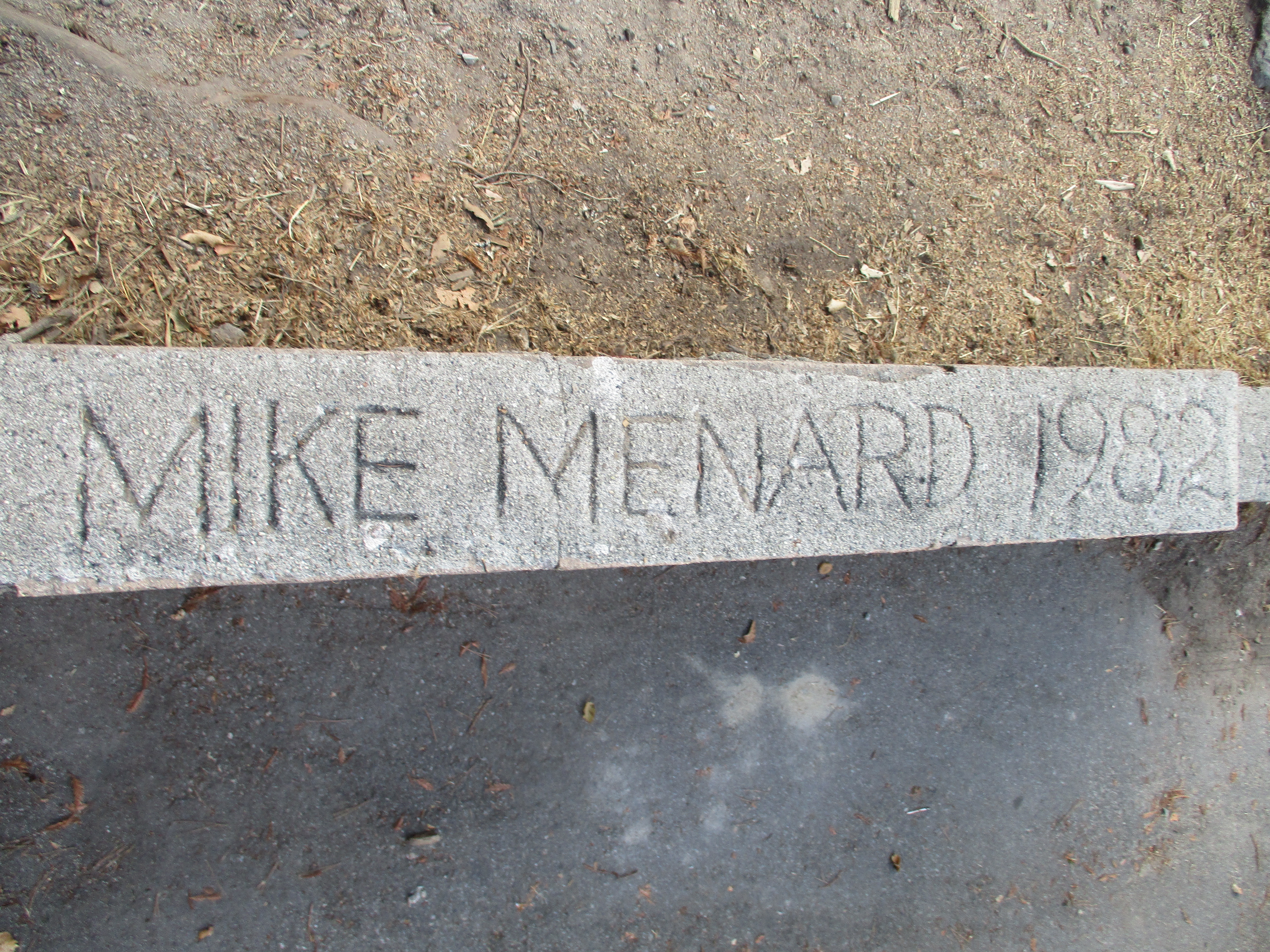
I have yet to find anything as interesting as tickets to a San Jose Sharks game, a big bag of money, Elvis, a purple dinosaur from another plant or a flying saucer that brought it here. However, I have found evidence of time travel!
A retaining wall that holds back an embankment above a parking lot at work was apparently constructed by Mike Menard in 1982, who left his name and the date inscribed into the concrete on top of the wall. That by itself is nothing too remarkable. What IS remarkable is that an adjacent retaining wall was constructed four hundred years later, and three hundred and sixty-four years from now, in 2382!P81124K+

Be Tactful With Garden Art

70712thumbSaint Francis is actually the patron saint of animals. Saint Fiacre is the real patron saint of gardening. However, statues of Saint Francis, usually accompanied by birds, and sometimes by a deer, are popular in home gardens. Has anyone ever seen even a single statue of Saint Fiacre? Statues of Snow White are more common; but her only experience with horticulture was one bad apple.
There is good garden statuary, and there is bad garden statuary. Some of the bad can be exceptionally so. It is one of the many things that back yards are for. Not much offends neighbors like a bronzed lawn mower on a pedestal in the middle of a paved front yard. Yes, it has happened. Perhaps there is beauty in the diversity of unique artistic expression. Saint Francis can not do it all.

Garden statuary and other forms of garden art work like any other household art. For many of us, it merely provide dramatic form, and perhaps color that is more permanent than flowers are. For others, there is a certain degree of self expression associated with the careful selection and display of garden art. Some of us take this even further by creating our own distinctive garden art.

Fountains and wind chimes are often incorporated into gardens to detract from less pleasant ambient sound, or simply because they sound nice. A loud fountain probably would not obscure the sound of a freeway in the neighborhood; but the sound of even a modest fountain might be adequately distracting. Wind chimes are as variable as the delicate to bold breezes that operate them.

As far as garden art is concerned, fountains and wind chimes need more maintenance than simple inactive sculpture. Chimes might sometimes need to be tied up or taken down if they get too noisy in windy weather. They can get tangled or so weathered that the strings that suspend the chimes need to be replaced. When this happens, it might be easier to simply get new wind chimes.

Fountains are more involved. Water must be added to replace what evaporates. Mineral deposits must be cleaned from some surfaces. Any aquatic plants need to be groomed like other plants in the garden. For larger fountains, fish might be employed to control mosquitoes. However, fish might attract raccoons! Small fountains with neither fish nor plants might be kept clear with bleach. So, even though garden art is not as dynamic as living and growing plants are, some of it requires significant maintenance anyway.

Six on Saturday: Cat Walk in the Kitty City

P801201. What have we here?

P80120+
2. Oh, directions.

P80120++
3. Oh my! What is THAT!

P80120+++
4. Another one!

P80120++++
5. Meet the parents.

P80120+++++
6. These must be their litter boxes.

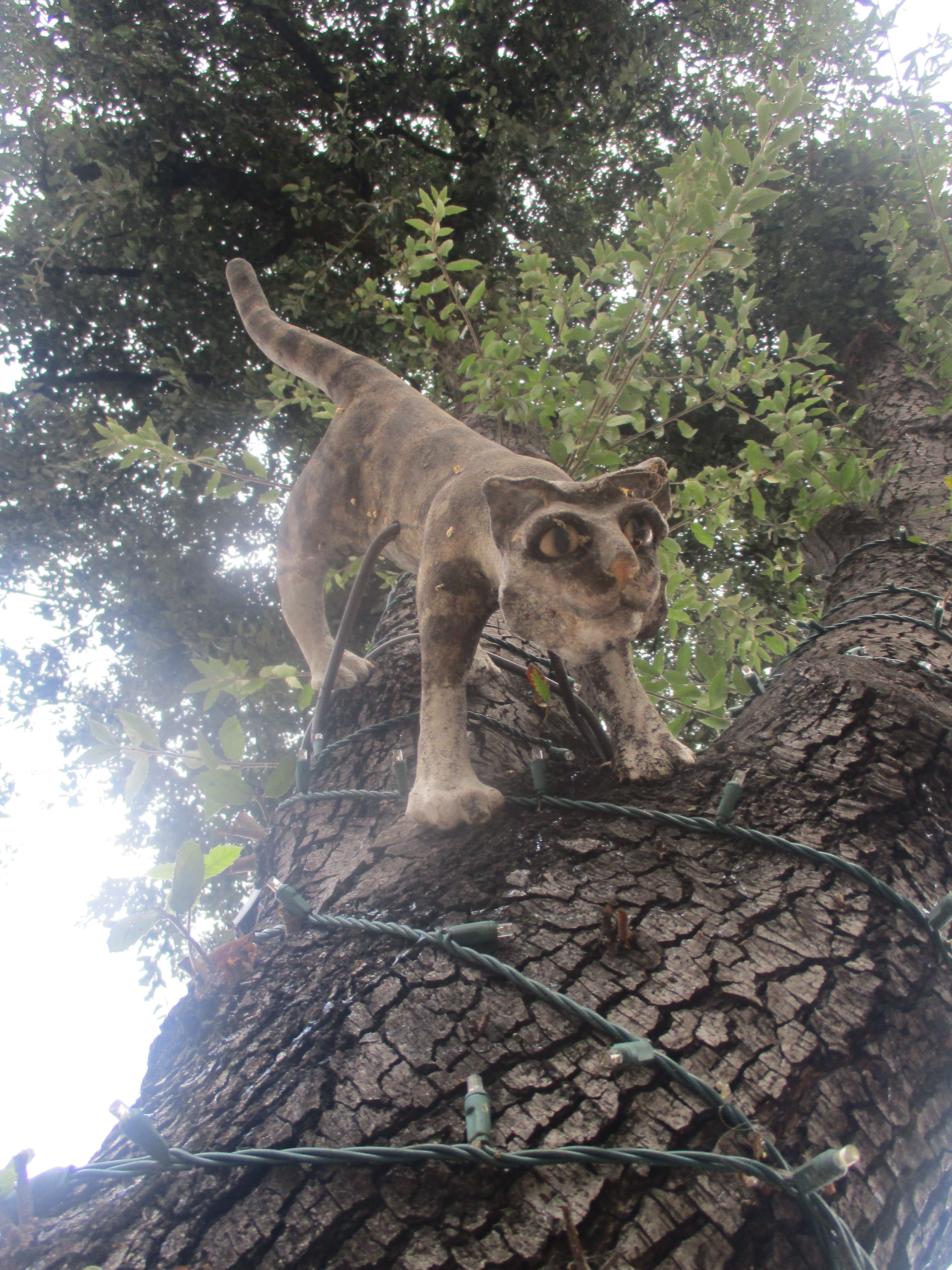
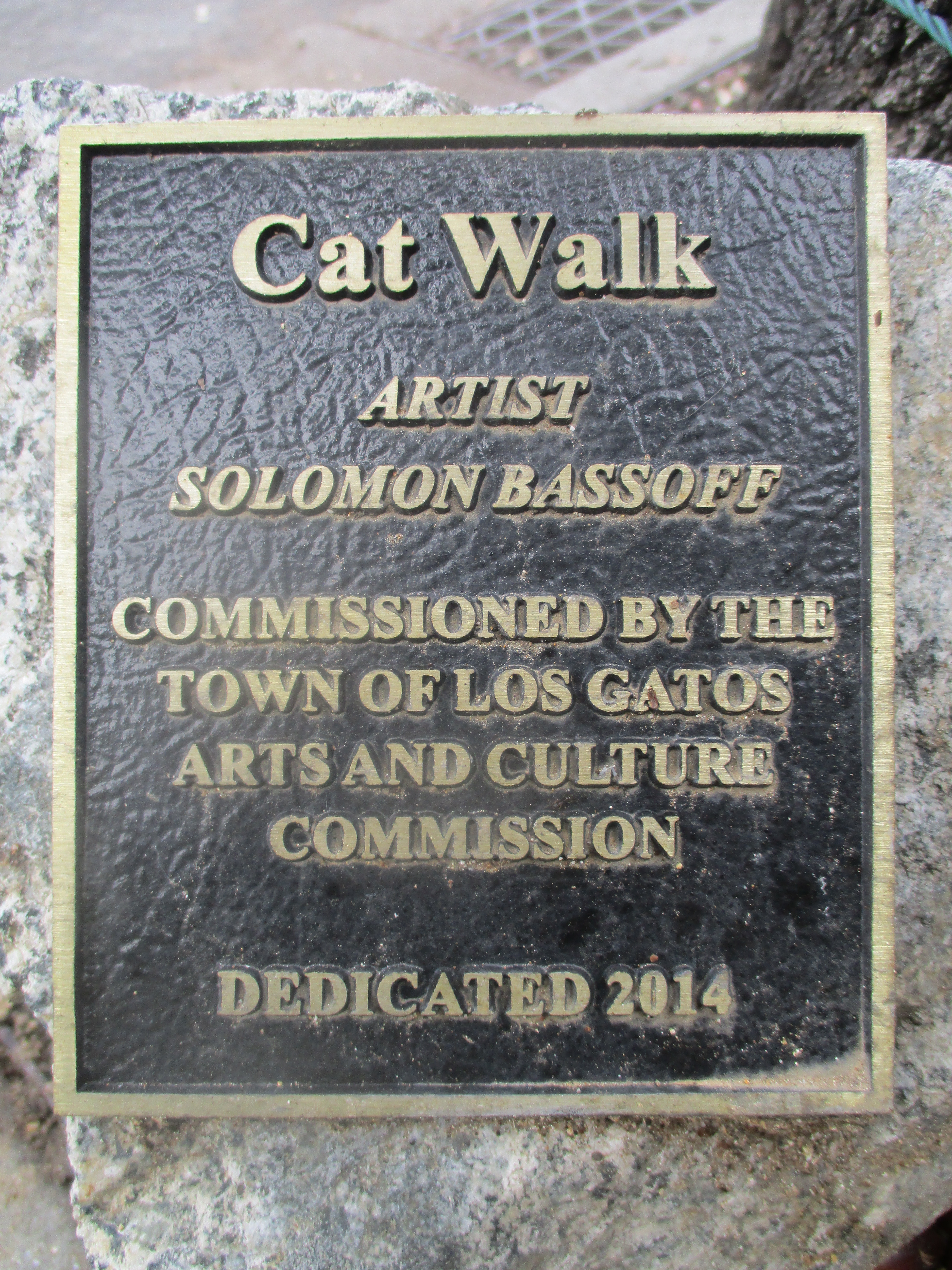
The Cat Walk is a rather ingenious exhibit of several concrete cat sculptures displayed in various street trees on the two main streets of downtown. The locations of these sculptures are cited on a map available to anyone who wants one. Most of us prefer a light duty challenge of trying to find all of the sculptures without the map. Some are hidden better than others, but all are easily visible from the sidewalk. What a fun way to utilize our otherwise unremarkable downtown street trees! Unfortunately, some of the sculptures have been dislodged from their original positions, which is why the two pictured here in opposite sides of the same holly oak seem to be be out of sorts. I am sorry for the bad quality of the pictures, especially #4.

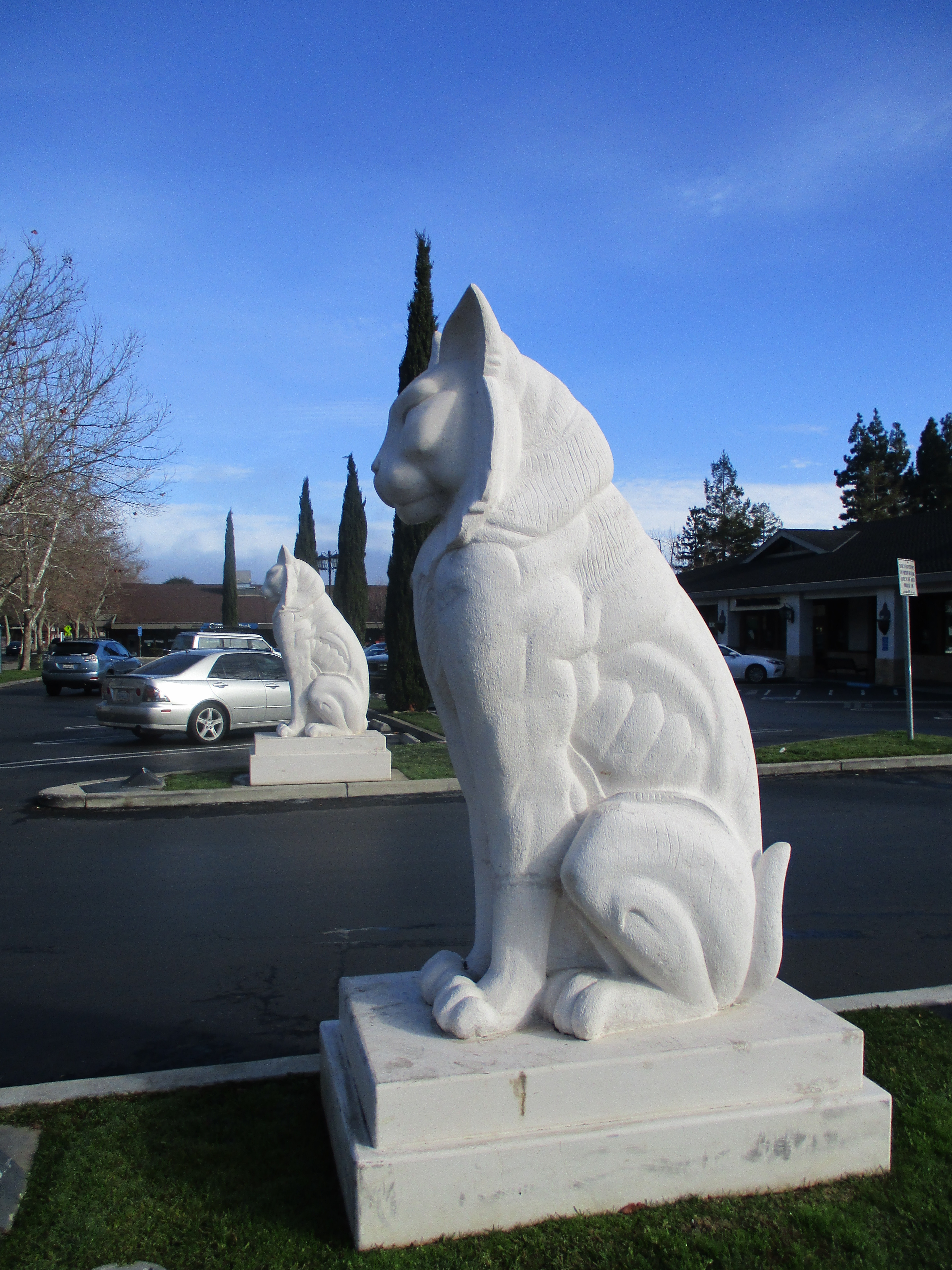
The parents are not sculptures of the Cat Walk, but are modern reproductions of the famous and historical ‘Cats’ flanking the driveway of the old Wood Residence. No one knows which one is Leo and which one is Leona. The only difference between the two is that one has his or her eyes closed, and the other has his or her eyes open. They flank the driveway of a shopping center just north of Highway 9 on North Santa Cruz Avenue.

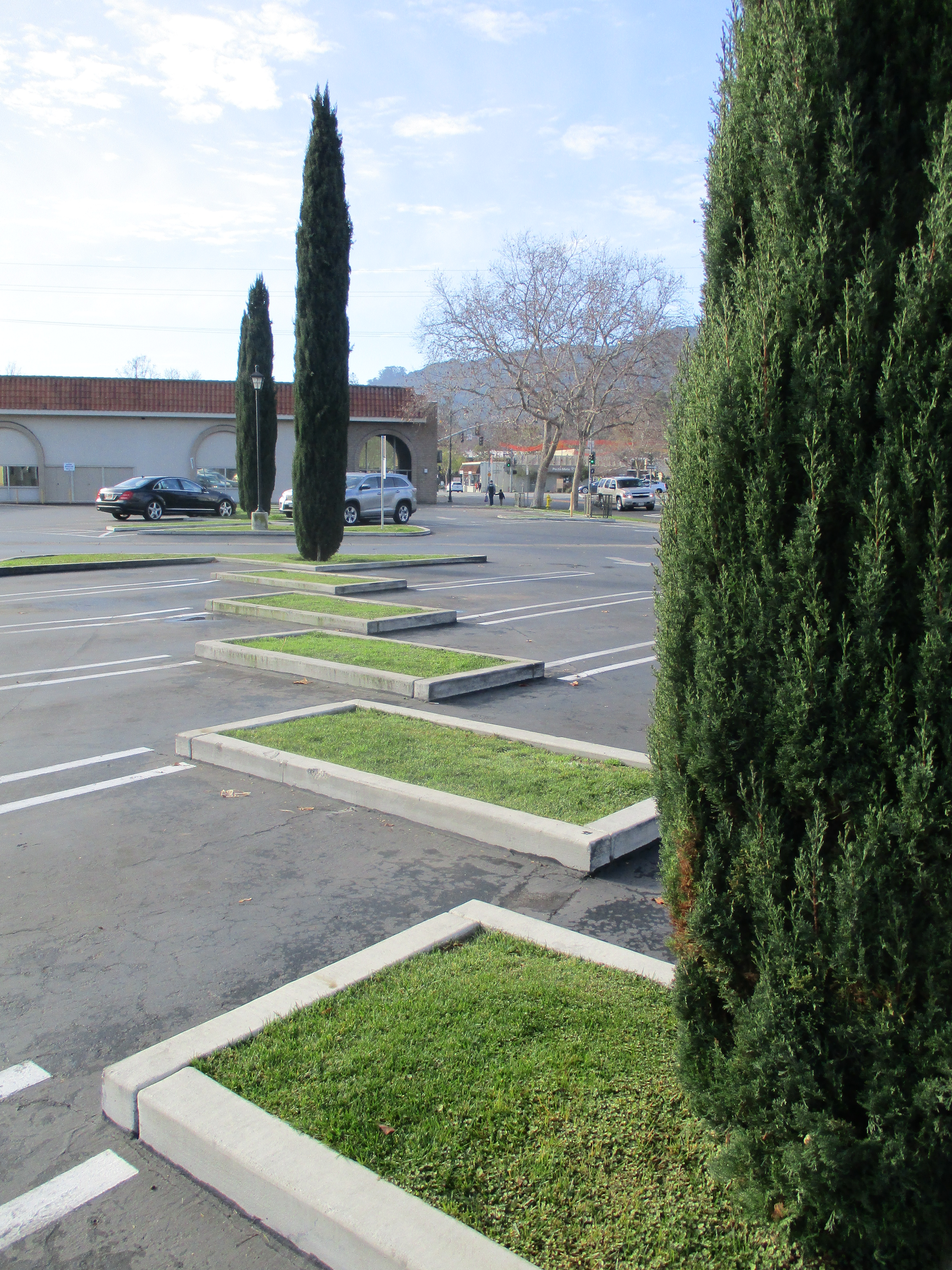
The sixth picture of the grassy ‘litter boxes’ is included as an almost funny example of really bad landscaping. They are in the same parking lot as the Leo and Leona sculptures, and formerly contained Italian cypress trees like the the one in the foreground and the two in the distance.

This is the link for Six on Saturday, for anyone else who would like to participate:

https://thepropagatorblog.wordpress.com/2017/09/18/six-on-saturday-a-participant-guide/

ROCKS!

blog12This has very little to do with gardening; but like I said in the description of this blog, anything goes when it comes to the ‘Elaborations’ category. Anyway and furthermore, I do not like to write about garden sculpture, garden art, or any of those knick-knack fads that involve putting more than plants and the necessary infrastructure to sustain them into the garden. I do happen to like certain tasteful garden statuary, like Saint Francis, or Saint Fiacre (the rarely seen ‘real’ patron saint of gardening) or any of the saints; but only if I have a suitable space for them. This is nothing like that; but is just excellent enough that I wanted to mention it.

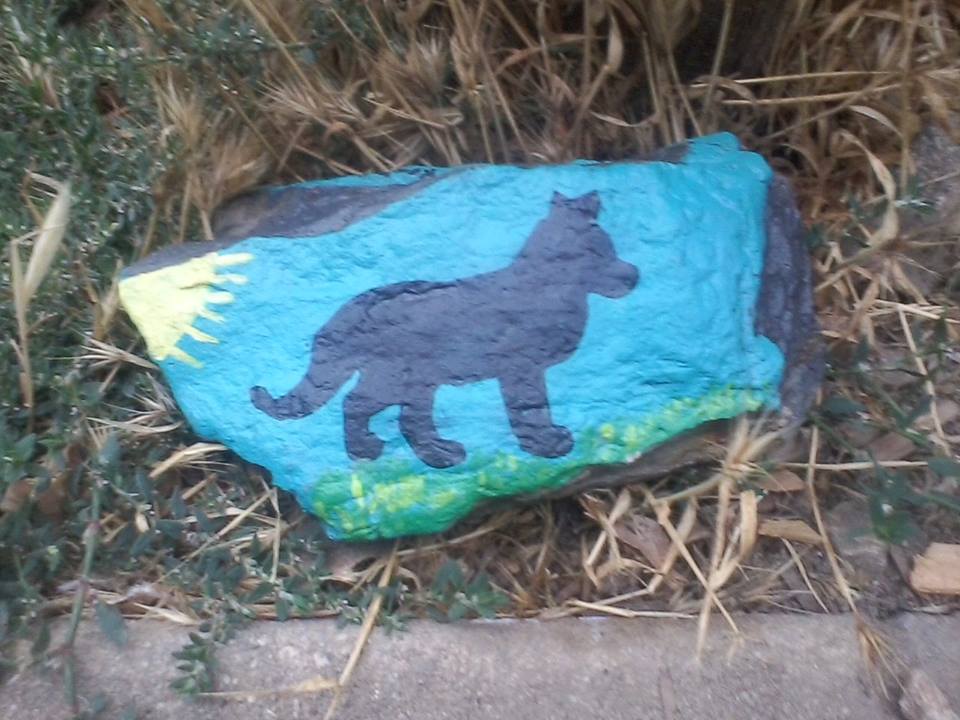
Painted rock are appearing everywhere! They are cute. They are weird. They just might cheer you up if you happen to find one. If you like, you can take them home to put in your garden for a while (if they seem to be intended for that. Please do not steal rocks from someone’s garden.). You might want to just put them somewhere else to make someone else a bit happier, or just make them . . . wonder who has time for this sort of thing. Heck, you might just want to leave them where they are.

Many rocks have directions to follow them online. You can post selfies with any rock you find. You might provide clues about where you put it for someone else to find. You might be able to see where particular rocks came from, or where they go to. Some end up far from home. If you like, you can paint your own rocks and add them to the mix. You just might see it online somewhere. You may only know that it brightened someone’s day, but never hear from it again.

There are very few common sense rules. Basic guidelines can be found at Facebook pages about art rocks in all sorts of communities. Two that I found are Santa Cruz County Rocks at https://www.facebook.com/groups/1354197601364064/?ref=bookmarks or Trona, Ca ROCKS! at https://www.facebook.com/search/top/?q=trona%2C%20ca%20rocks! (These are not actual links. You need to be logged into Facebook for them to work.)