Spring in Guadalupe Gardens

Spring is in the air.

(This article is recycled from many years ago, so contains outdated information.)

Spring in Guadalupe Gardens on April 23 is the big local gardening event of the Santa Clara Valley! Not only will it be within Guadalupe Park, surrounded by the various Guadalupe Gardens, but Spring in Guadalupe Gardens gathers together an impressive variety of local gardening clubs and vendors. There will be workshops, lectures, trail walks and garden tours, as well as fun activities for children, music and entertainment.

The Heritage Rose Garden, which is the most extensive public collection in the United States of America, designed for the preservation of the ancestors of modern roses, will be in full bloom. The Historic Orchard is a tree museum of the many fruit and nut trees that inhabited the vast orchards that once filled the Santa Clara Valley; many of which can be productive in modern suburban gardens.

Representatives of many local gardening clubs will be at Spring in Guadalupe Gardens, with information about their respective expertise, as well as membership. The John E. Stowell Dahlia Society, the American Fuchsia Society and the Master Gardeners of Santa Clara County will all be there, to name a few. I will be at the Gardening Advice Booth throughout the event, to discuss any gardening issues and questions.

When I can get away from the Gardening Advice Booth, I like to see what I can purchase from the many vendors. There will be more than forty. Most of my fuchsias, and some of my aloes and cacti were obtained at Spring in Guadalupe Gardens. It is common to find many uncommon tomato plants and roses.  There will also be garden art and paraphernalia. The Master Composters of Santa Clara County will be giving away free compost. One never knows what to expect at Spring in Guadalupe Gardens.

Earth Care Recycling will again host a free electronic waste drop off at the Visitor and Education Center, to collect all sorts of computer components, televisions, stereos, fax machines and telephones. Proceeds benefit the Guadalupe River Park Conservancy.

Spring in Guadalupe Gardens will be from 10:00 a.m. to 3:00 p.m. this April 23, just north of the Guadalupe Gardens Visitor and Education Center, which is located at 438 Coleman Avenue in San Jose.  Admission and parking are free. Just follow the signs from Coleman Avenue or East Taylor Street. More information about Spring in Guadalupe Gardens can be found at www.grpg.org or by telephoning 298 7657.

San Francisco Flower & Garden Show

(This is an old recycled article that includes very outdated information, some of which was omitted, but the website for the San Francisco Flower & Garden Show is the same.)

Bonsai, composting, palms, flower arranging and lawn alternatives, as well as rare, edible and drought tolerant plants; there will be seminars for almost every horticultural topic imaginable at “Life in the California Garden”, the 26th annual San Francisco Flower and Garden Show. Xeriscapes, contemporary garden design and water conservation; there will be something for anyone who enjoys any kind of gardening. A schedule of seminars and any other information can be found at www.sfgardenshow.com.

The most spectacular display will be the twenty gardens created by some of the most innovative local, and perhaps not so local, landscape designers and horticultural professionals. There will be everything from contemporary to traditional and functional to ‘artistic’ landscapes. Anyone who has been to a San Francisco Flower and Garden Show knows what ‘artistic’ can mean, but will be surprised nonetheless. 

Just about anything that can be done in the garden will be done at “Life in the California Garden”. Bee keeping, practical pest control and water management will all be there. “The Modern Homestead” designed by Star Apple Edible Gardens of Oakland will be a 6,000 square foot exhibit featuring aesthetic vegetable plantings and an elegant chicken coop, as well as beer and jam making demonstrations.

The Marketplace will include more than 200 vendors with all sorts of seeds, plants, tools, gifts, patio furniture, pottery and garden sculpture. Plants will range from orchids, dahlias, epiphytes, vegetable plants, cacti and succulents, to name a few. The Farmers’ Market will have flowers and produce available. Sproutopia will feature interactive gardening experiences and demonstrations for children.

Many very impressive bonsai will be exhibited by the prestigious Bonsai Society of San Francisco. Many of the bonsai subjects that are decades old have been returning to the San Francisco Flower and Garden Show for many years. There will also be bonsai demonstrations.

Horticulturists of the Western Horticultural Society will be available to discuss rare and recently introduced plants, as well as more traditional plants that are regaining popularity. Some recent introductions are not yet available in nurseries. California Garden Clubs will have representatives from many of the various horticultural associations, with information about membership.

Horridculture – High End

Gladiolus papilio from Skooter’s Garden makes my garden more special than any ‘high end’ garden.

What exactly does that mean?! Why should I care? My lack of concern seems to be directly proportionate to the intensity with which someone tries to impress upon me that I should be so concerned. A colleague from high school tried to tell me about a new television show about a so-called ‘landscaper’ in Michigan who is so extremely ‘successful’ that he also lives in a home in Florida for the winter. I suspect that both of his homes combined are worth about as much as a single home here, but I will just continue with this premise that he is successful. He does exclusively ‘high end’ work, which regularly involves moving huge boulders with old fashioned technology because that is what his ‘high end’ clients want. I needed to interrupt. The ‘high end’ nonsense annoyed me too much. So, they have huge boulders in their landscapes. Perhaps their landscapes were very expensive to install. Splendid! ‘High end’ spending is healthy for the economy. Why is this any of my business? I do not know. I am a horticulturist, not an economist. My garden contains rhubarb from the garden of my paternal paternal great grandfather, and Dalmatian iris from the garden of my maternal maternal great grandmother. That is horticulturally significant. ‘High end’ gardens seem to be more concerned with expenditure than with horticulture, as if spending more will somehow make it better. Do those who purchase ‘high end’ gardens actually work in them? Do they grow anything from the gardens of their ancestors? I know that some do, but I suspect that some do not. The primary purpose of their ‘high end’ landscapes is lavishness. I can not doubt that such landscapes serve such purposes more than adequately, but am nonetheless unimpressed by their typical lack of horticultural relevance.

Propper Gardening

Brent’s landscape style is VERY different from mine.

If you have ever seen ‘The Osbornes’ on television, you know how extravagant the work of landscape designer Brent Green of GreenArt of West Hollywood can be. He actually landscaped and has maintained the home of the Osbornes since before the Osbornes lived there, and has managed to fit a more extensive range of plants into the gardens than I have grown in my career as a horticulturist, arborist and nurseryman. His own home garden is just as bad . . . I mean ‘extravagant’, with more diversity of plants than could be found in any nursery.

Would you believe that Brent Green and I were actually college roommates in the dorms? Sometimes I do not believe it either. Nearly a quarter of a century ago, he came two hundred miles north, and I came two hundred miles south to ‘meet in the middle’ and study horticulture at Cal Poly in San Luis Obispo. He was very trendy for the time, wearing brightly colored mid ‘80’s clothes and a flat topped afro like Grace Jones. (Yes, he once had hair.) I was old fashioned for ten years earlier, just like I am now, with Levi’s, Durango’s and flannel.

As a landscape designer, Brent Green enjoys the diversity of plants, and getting them to fit into practical, functional and yet very enjoyable landscapes, gardens and outdoor rooms. Most of his favorite work is lush and tranquil, with all the fancy and artful curves, ‘meandering’ walkways, water features, extensive diversity of plants, and herds of color! Conversely, I am still a nurseryman at heart, so engage my garden as a commodity with conformity, simplicity and very basic functionality. I grow vegetables, many fruit trees, and many ‘copies’ of the same reliable plants that I propagate myself, mostly arranged in what Brent Green refers to as straight line ‘row crops’.

Yet, our gardening philosophy is the same. We both ENJOY our gardens, and agree that everyone should likewise do gardening on their own terms. Those who do not enjoy gardening should not need to. There are plenty of other things besides gardening to enjoy.

To facilitate the execution of proper horticultural techniques, we should grow only what we are able and want to take care of. What looks good in a magazine may require more attention that we can commit to or would enjoy. I still believe that the legendary horticulturist Robert Leakley was the first to say what many have copied in various forms since, “If you enjoy it, you are doing it right.”

Volunteer At Filoli

Rose gardens require significant effort.

(This article posted in 2012, so much of its information is now outdated.)

How could so many public gardens throughout the area get all the work that needs to be done in winter? There are roses to prune in both of the Rose Gardens of San Jose. Fruit trees in the Historic Orchard of Guadalupe Gardens need to be pruned. Even Village Harvest of Palo Alto needs to collect citrus fruits that ripen through winter. All this works gets done only because there are so many generous volunteers to help.

The gardens of Filoli are fortunate to get so many volunteers through the year. Nonetheless, the extra pruning that the deciduous fruit trees need in winter reminds us that more volunteers are often welcome. Not only are there big collections of modern and classic apple and pear trees at Filoli, but many are espaliered onto trellis-like supports. (‘Espalier’ trees are pruned onto trellises, fences, walls or other lateral supports, so that they can attain considerable width without much depth from front to rear, conserving space.)

The New Volunteer Recruitment Open House at Filoli is not until January 21. However, those interested in attending must register in only the next few days, before 4:00 p.m. on January 13! Registration can be arranged at volunteer@filoli.org or by telephoning 650 – 364 8300 extension 300, and leaving one’s name and daytime telephone number. The New Volunteer Recruitment Open House will be from 9:30 to 11:30 a.m. on January 21, at the Visitor and Education Center of Filoli, located at 86 Canada Road in Woodside.

Guests will learn about the many different opportunities to volunteer. More than 1,200 volunteers presently help sustain Filoli in areas such as house and garden self guided docents, member services, visitor services, the Ambassador Program, the Cafe and the Garden Shop.

Besides the sixteen acres of English Renaissance gardens that display an expansive horticultural collection, the 654 acre Filoli property includes a 36,000 square foot residence furnished with an extensive collection of 17th and 18th century English antiques, and is recognized as one of the finest remaining country estates of the early 20th century. More information can be found at http://www.filoli.org.

Utilitarian Landscape

P90505I am no designer. I am merely a horticulturist. I grow things, and I know how things should be grown in landscape situations.
My colleague Brent Green is a landscape designer, as well as a horticulturist. He knows how things should be grown in landscape situations too, but more importantly, he knows how to assemble the landscapes that they grow in. He creates the sort of landscapes that most people think that all horticulturists strive for. (A few pictures of his home garden can be found in a former article, as well as another similar article that it links to: https://tonytomeo.com/2019/04/06/six-on-saturday-brents-garden/ .)

Brent and I have two completely different sets of standards for landscape design, to say the least. His ideal landscapes are very lush and inviting, with abundant color and fragrance. Mine are very simple and structured, with abundant fruits and vegetables. He strives to bring the ambiance of wild jungles into very urban settings. I try to instill formality and structure into the forests. Yet, we both agree that landscapes must be functional.

That means that landscapes must work for those using them, whatever they are using them for. Almost all of Brent’s clients use their landscapes as extensions of their homes, so want them to function as such.

I do not design landscapes, but I do happen to work in some. Most are in public spaces, and some are comparable to athletic fields. They function very differently from those in residential situations.

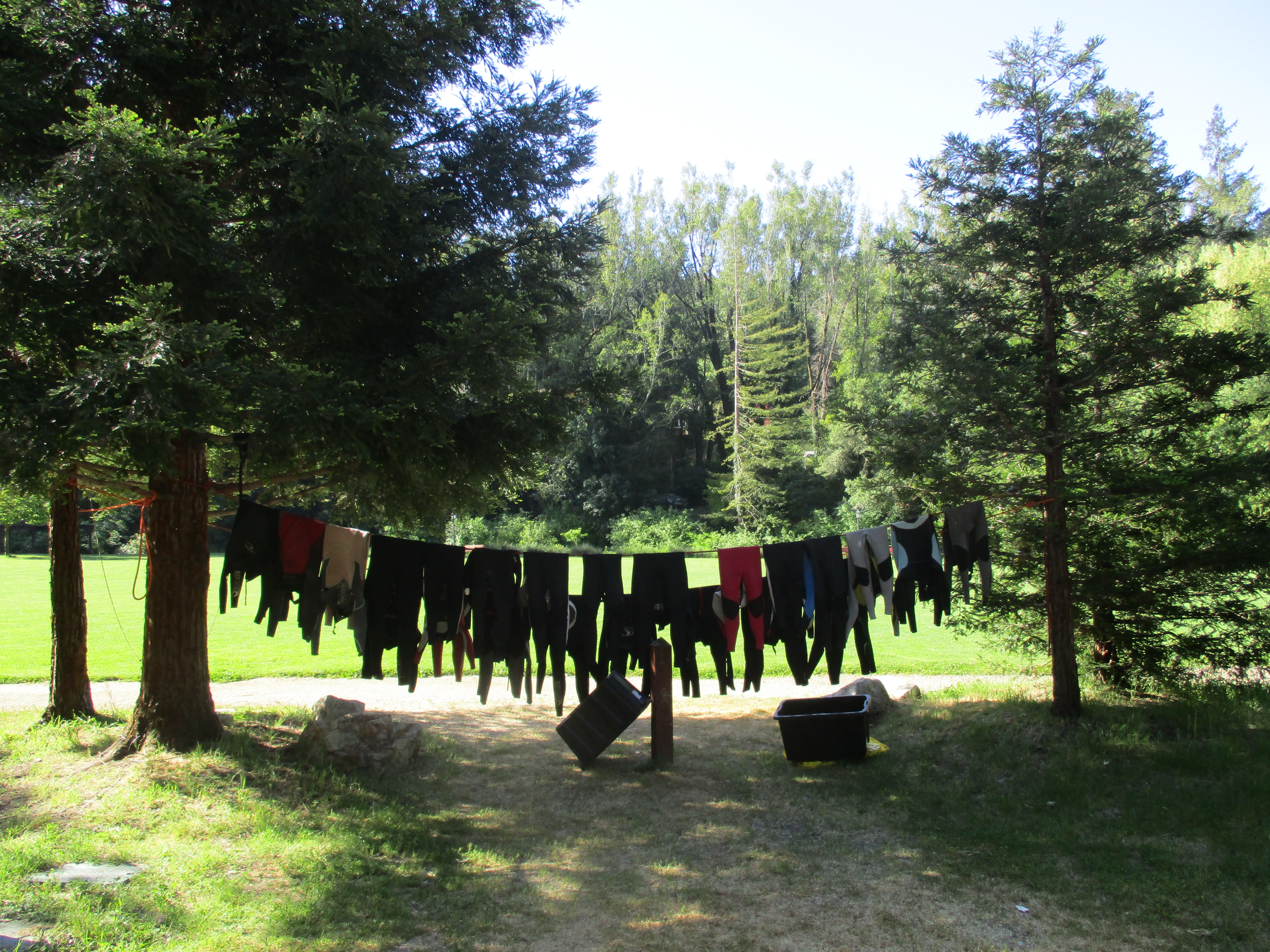
The unexpected way that these three small redwoods are functioning in this landscape was just too amusing to not get a picture of. I have no idea where all these wet suits came from, or why they are hung in this particularly prominent location, but it is the last thing I expected to encounter here.

Six on Saturday: Big League


Again, my six pictures are not from my own garden, which incidentally, is not at all interesting. Instead, these pictures are from the biggest site I work at. It is many acres, with some very big features.
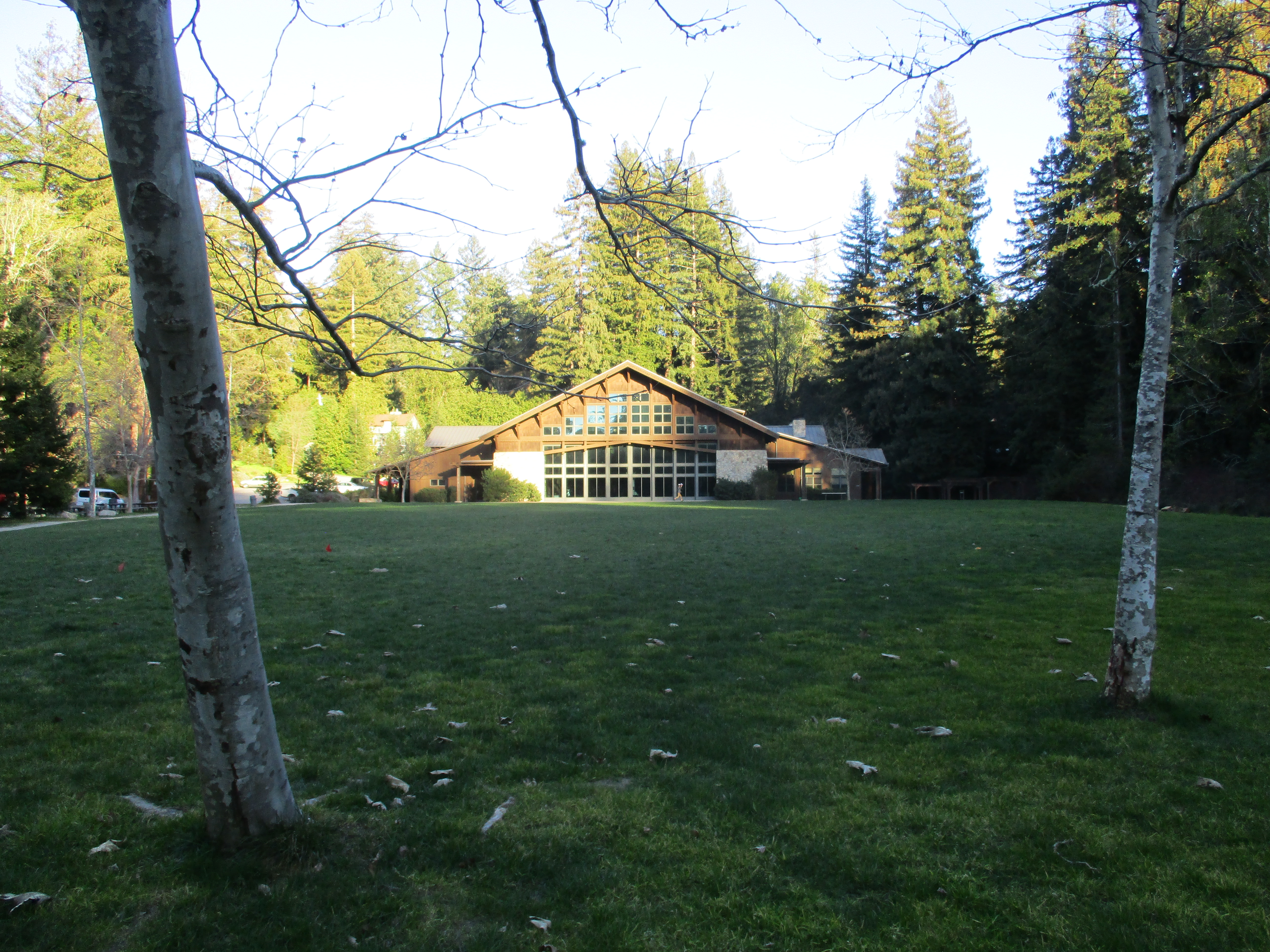
1. Big lawns are acres of turf. The kid in front of the building in the distance shows how big the building and lawn is. This is the biggest of three big lawns.P80217
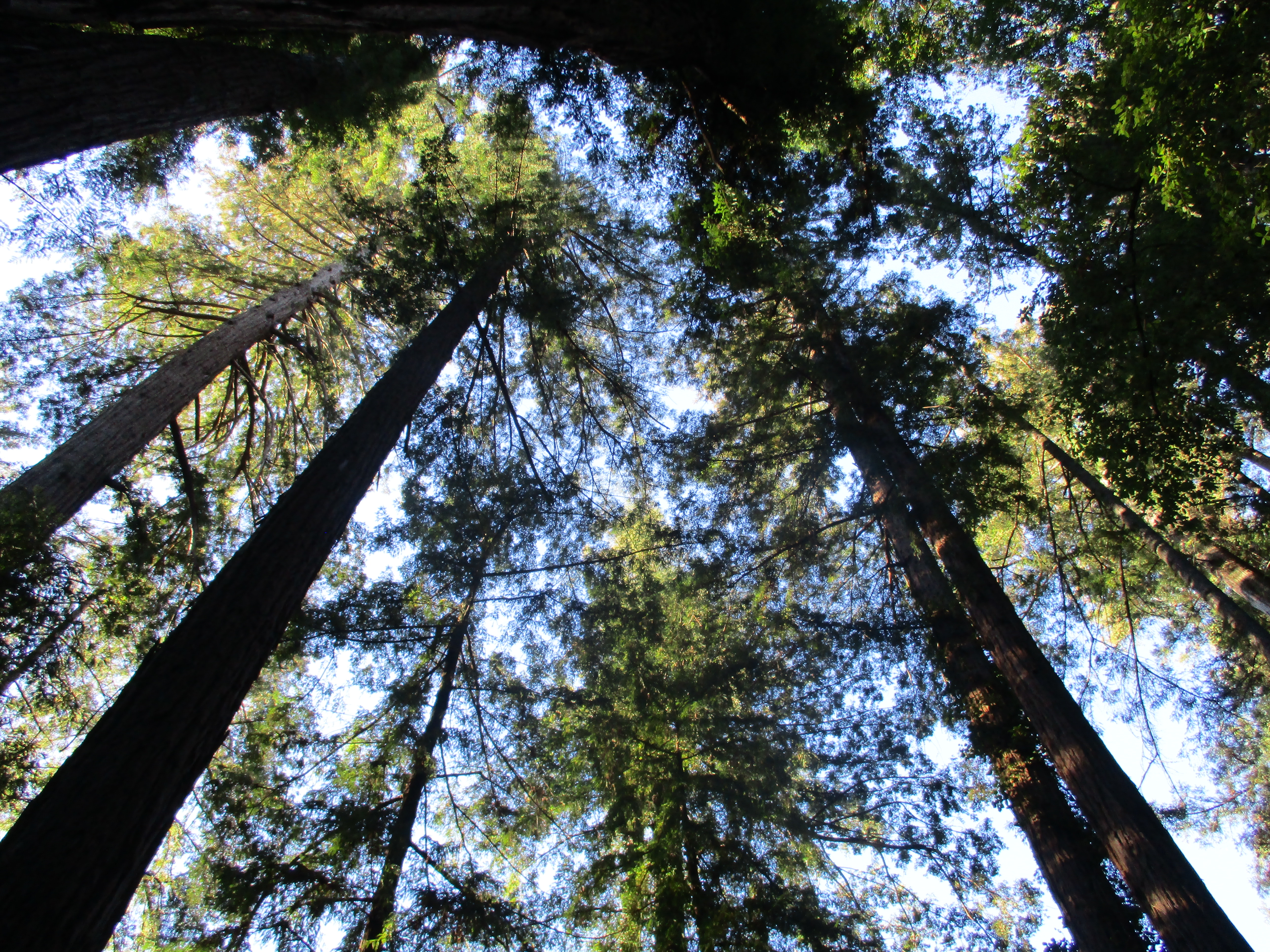
2. Big trees are very common here. These are coastal redwoods. There are also big Douglas firs and ponderosa pines.P80217+
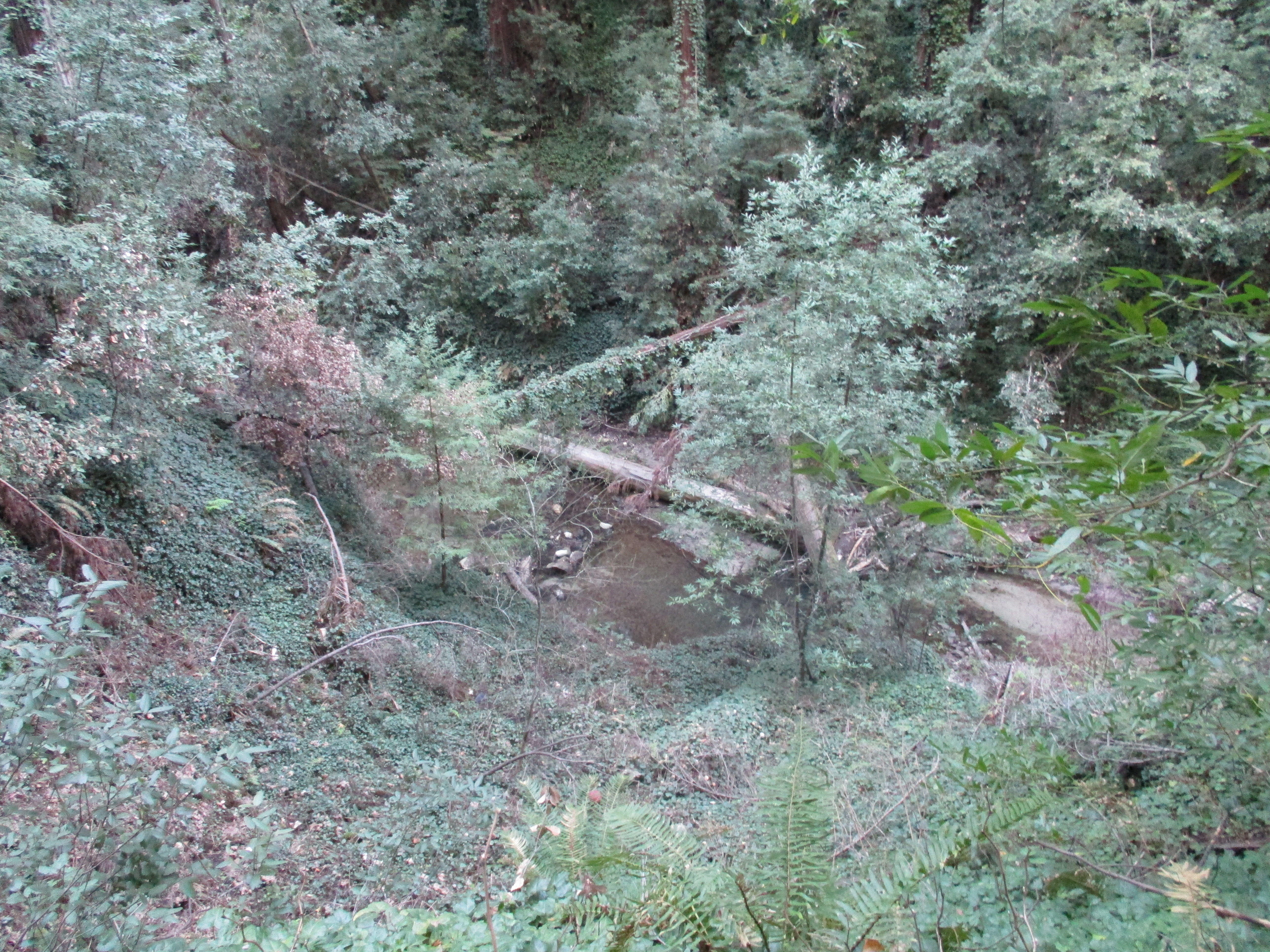
3. Big water features are not constructed backyard fountains or koi ponds. This is Bean Creek, which flows into Zayante Creek less than half a mile away. It is more than a hundred feet below where the picture was taken.P80217++
4. Big shovels are necessary for working in such big gardens.P80217+++
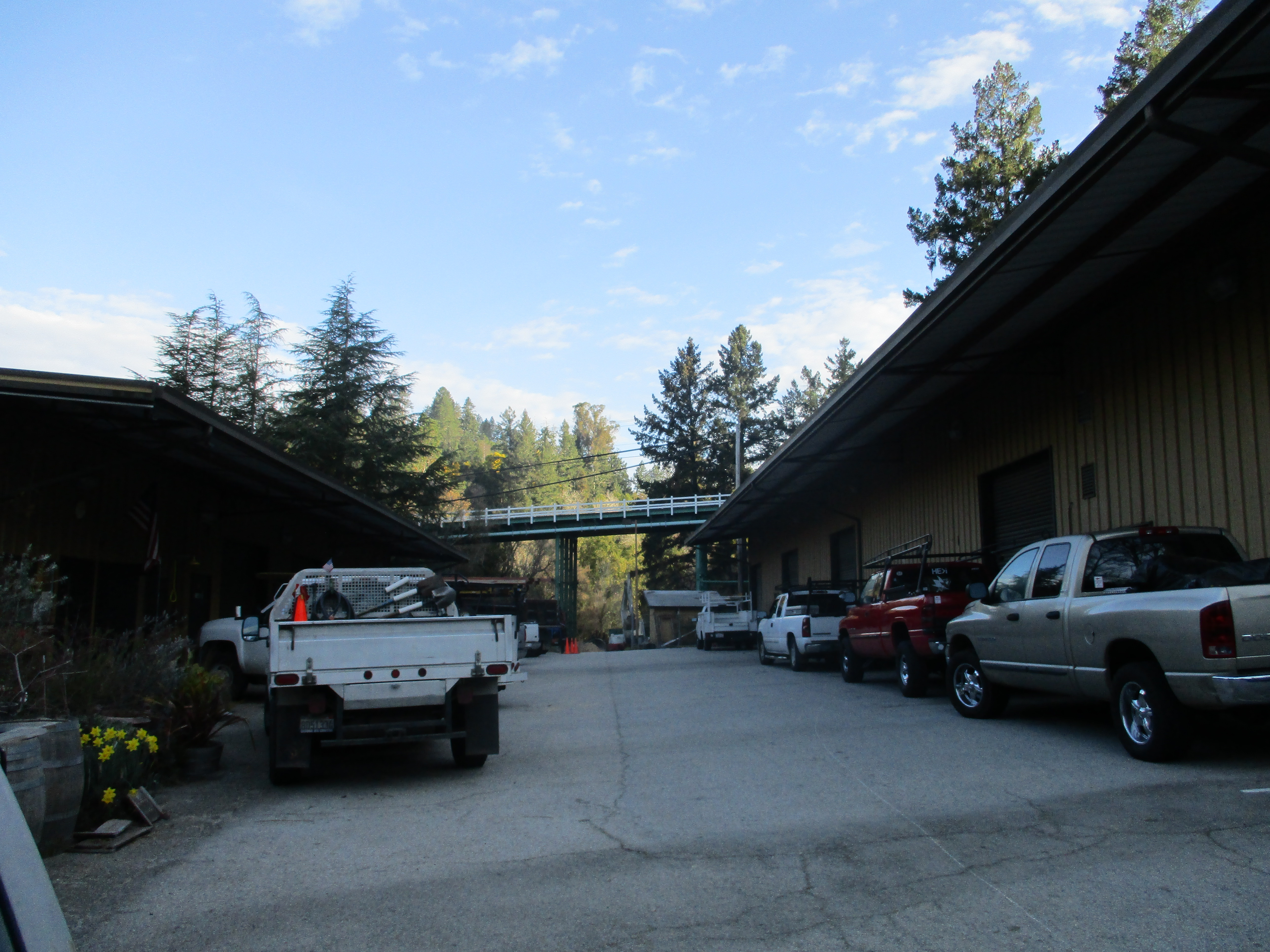
5. Big garden sheds and big garden carts made by Dodge, Ford and Chevrolet are also very important.P80217++++
6. Big insects are quite at home in such big gardens.P80217+++++
This is the link for Six on Saturday, for anyone else who would like to participate:

https://thepropagatorblog.wordpress.com/2017/09/18/six-on-saturday-a-participant-guide/

Dreamscape at the Jungalow

B80128The Jungalow is my colleague Brent’s bungalow home, surrounded by a jungle of a landscape, just about a block off of the Santa Monica Freeway in Mid City Los Angles.

This picture very effectively illustrates that Brent has no business taking pictures . . . and that he should have had a V-8.

The landscape really is spectacular though. You might have seen bits and pieces of it in Sunset Magazine or other horticultural magazines. Pictures of specific flowers and plants were used to illustrate the Sunset – Western Garden Book.

Brent likes his garden to be spectacular. He uses it to trial a few plants before using them at the homes of clients, and to demonstrate how effectively his home garden functions as a lush jungle oasis in the middle of the city. The dense hedging obscures views of neighboring homes, and muffles the sound of the Santa Monica Freeway and La Brea Avenue. Fountains obscure more of whatever outside noise that happens to get through. Although the situation is completely synthetic, and includes species that were imported from all over the World, to be pruned, groomed and trained to do unnatural things, Brent likes to think that it mimics nature. The straight lines, square corners and flat surface of the compact urban lot are invisible behind curvacious borders, terraces, lush foliage and sculptural trees. There is way too much material for such a compact space. It is all so completely contrary to the big city that surrounds it.

Three hundred and fifty miles to the northwest, on acreage in the forests of the Santa Cruz Mountains above Los Gatos, my garden could not have been more opposite. Despite the abundance of more space than I could possibly use, the area used for gardening was quite confined to less than an eighth of an acre. The hilly terrain was flattened as much as possible, and surrounded with straight retaining walls and walkways. Native vegetation was removed to allow more sunlight through. There was no need for hedging because there was nothing beyond the garden to obscure the view of. There was no need for fountains to obscure outside noise because the only outside noise was that of Zayante Creek at the bottom of the garden. For efficiency, plants were installed in rows and grids, and very evenly spaced. It was completely contrary to the surrounding forest.

That is why Brent is a landscape designer and I am just a horticulturist and nurseryman. Who is right? I am.