Not So Spicy

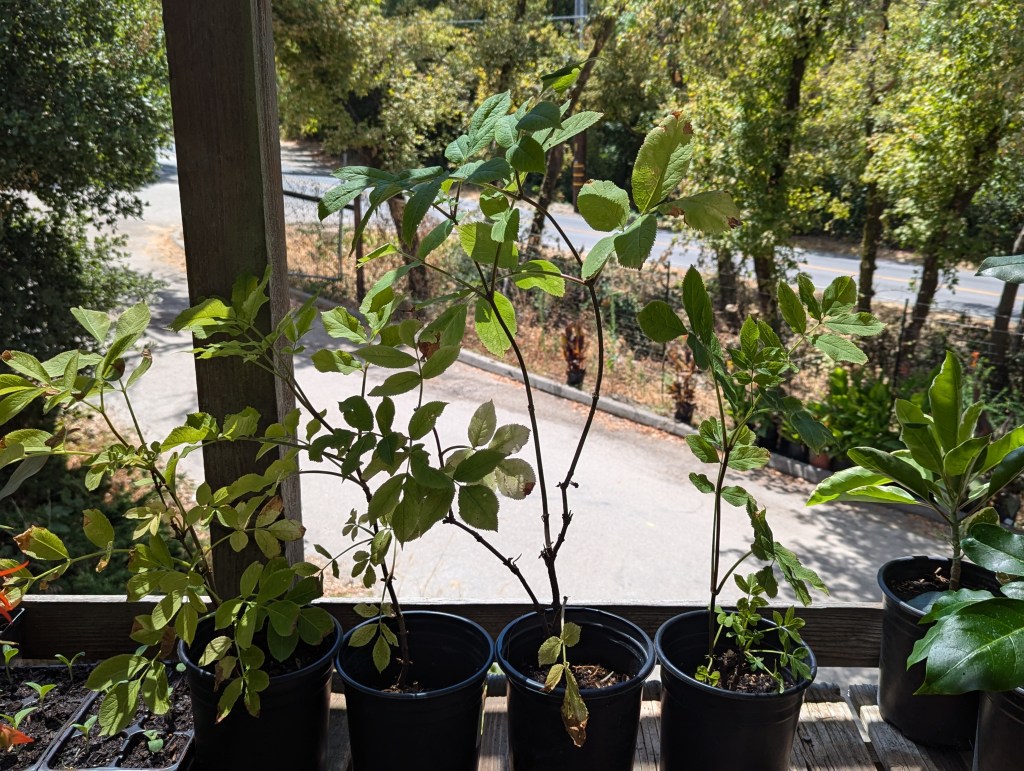
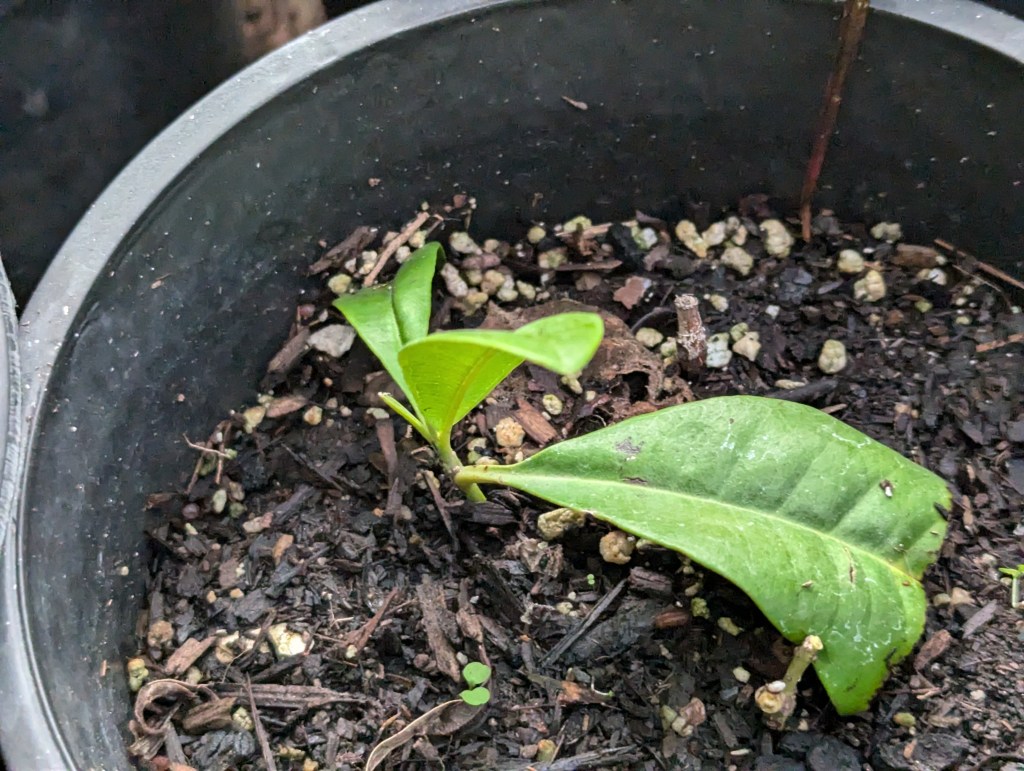
Jamaican allspice, Pimenta dioica, is rare here. I am beginning to learn why. Because it is tropical, it is vulnerable to even very minor frost. Actually, it is not so keen on chill either. It is rated for climates that are no cooler in winter than Zone 10. This is Zone 9. It seems to grow reasonably well in the Los Angeles region, where I collected my cuttings from Brent’s Jungalow Garden, but it is rare there also. That could be because it is not much to look at. Its foliage is no more interesting visually than that of common privet. Although the foliage is splendidly aromatic, only those who are familiar with the species, or become acquainted with its aroma while pruning it, would know. Its bloom is neither prominently colorful nor fragrant. What is worse is that the bloom is dioecious, with male or female flowers on different specimens. Single specimens have no problem blooming, but can not produce allspice fruits without a mate. Single male specimens are fruitless for obvious reasons. Single female specimens are fruitless without pollination. Not many people who grow the very rare single specimens are aware of this, although most are satisfied with the delightfully aromatic foliage. New specimens only very rarely become available in nurseries, and when they do, all of them were likely grown from the same stock specimen, so are genetically identical and of the same gender. Only seed grown specimens are random in regard to their respective genders, and even among them, their genders are unknown until they eventually bloom. The potential for growing both genders is proportionate to the number of seedlings. For example, one seedling will be of one gender. Two seedlings are as likely to be of the same gender as they are to be of different genders. Three are more likely to include one of another gender. Several or many are proportionately less likely to be of the same gender. All of my several cuttings were from the same specimen, so would have been genetically identical. It does not matter much now anyway, since only one survived, and even it is still rather wimpy. It has developed only two new leaves, and retains a trimmed portion of one of its original leaves. I am pleased with it regardless of its gender, and will be satisfied with only its aromatic foliage.

Off Color – Very Variable Variegation

‘Stuttgart’ canna

Reversion among vegetation is the loss of an aberrative genetic characteristic, such as variegation or bronze foliar color. Because most genetic aberrations that are susceptible to reversion are disadvantages, reverted growth generally performs more efficiently, and displaces remaining genetic aberrative growth. For example, because its variegated portions lack chlorophyll, variegated foliage is less vigorous than foliage that is not variegated. Therefore, if not removed, unvariegated reverted foliage is likely to grow faster and replace variegated foliage. This ‘Stuttgart’ canna leaf seems to have done the opposite of reversion, by exhibiting such extreme variegation that all green color is lacking. Fortunately, it is not as bad as it looks. This is merely very variable variegation. Just as a few leaves may be completely green without actually reverting permanently, a few leaves are extremely variegated, and on rare occasion, a few, such as this leaf, may lack any obvious green color. Leaves that developed after and above this leaf exhibited more typical variegation with both green and white. Otherwise, this particular cane would not survive for long without chlorophyll for photosynthesis. The flowers are unaffected because they derive their floral color from pigment rather than chlorophyll. White redwood foliage can survive without chlorophyll only because it can rely on resources provided by the normal growth with green foliage that it is attached to, almost parasitically. Such growth is considered to be albino, but because it merely lacks chlorophyll rather than pigment, it is technically not albino. Furthermore, it is technically not variegated, since it is so completely white, without any green chlorophyll. Oh, this is more complicated than it should be. It is probably better to simply appreciate appealing genetic aberrations such as white, variegated or other colorful foliage. ‘Stuttgart’ canna will not refresh its variegated foliage until the end of winter.

Madonna & Black Lace II

Sambucus nigra ‘Black Lace’ can produce a few berries without pollination from another cultivar.

The internet never ceases to amaze with its inefficiency of providing information that should be more readily available. Old fashioned horticultural texts and even encyclopedias were more reliable. I remember reading that elderberry could be self pollinating, but that it would be more productive with another cultivar of the same species. Because I could not remember what species of the genus that information was relevant to, I more recently tried to determine the requirements of each of the few species that I grow. Ultimately, it seems to me that all are about the same in regard to both their ability to self pollinate to a minimal degree, and their ability to pollinate more efficiently with other cultivars. However, I still do not know. Furthermore, I am now confused about the identity of American elderberry, which many sources insist is merely a variety of common black elderberry of Europe.

Sambucus caerulea, blue elderberry is native and too common for me to know or care if it is more productive with other genetically distinct specimens, which, since the species lacks cultivars, are merely other wild specimens. In other words, blue elderberry specimens here can not be adequately isolated from other specimens to determine how reliant they are on others for pollination. Regardless, I will grow about four together within my garden.

Sambucus racemosa, red elderberry is supposedly native here, but I have never seen it in the wild. Consequently, I do not know if other specimens are close enough to pollinate specimens within my garden. Rather than experiment with single and potentially isolated specimens, and because there is no need to separate the four specimens here anyway, I will grow all of them together within my garden. I am considering adding ‘Sutherland Gold’ or other ornamental cultivars in the future.

Sambucus canadensis, American elderberry is not native, so could be grown in isolation here. However, I want berries more than I want to know how reliant this species is on pollination from other genetically distinct specimens. Before I grow cultivars, I will grow about four specimens within my garden from seed. I might consider cultivars in the future, but for now, would prefer to grow them as most people within their native range experience them, and as I grow blue and red elderberries.

Sambucus nigra, black elderberry is a species that I find to be less interesting than the three North American species that I actually want to grow. However, I have grown ‘Black Lace’ at work for a few years, and recently got it ‘Madonna’ as a pollinator so that the two can make berries together. Because I grew several more copies of each than we can accommodate at work, I will likely grow a pair of each within my own garden. Both are ornamental cultivars that happen to also produce berries. However, formerly without a pollinator, ‘Black Lace’ has been fruitless. This year, one of the copies managed to make these few berries in the picture above without bloom from ‘Madonna’. I suppose that this is consistent with what I read about its ability to self pollinate somewhat. Now, I want to see what it does next year if ‘Madonna’ blooms well.

Four wild seed grown specimens of Sambucus racemosa, red elderberry that were a gift from Tangly Cottage Gardening have been canned for too long, and want to get into the garden.

Khartoum

‘Khartoum’ (Agapanthus orientalis ‘Khartoum’) is a blend of Blue Nile and White Nile.

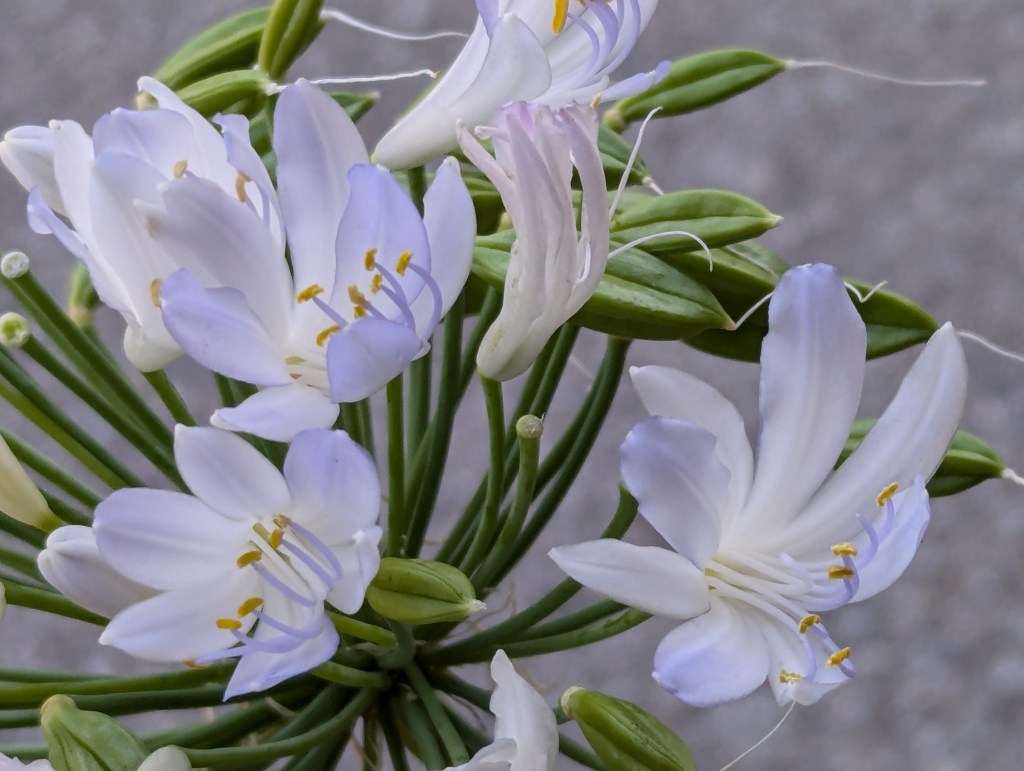
Khartoum is located where the Blue Nile River merges with the White Nile River to become the Nile River. Lily of the Nile, contrary to its name, is neither a lily nor native to any of the three Nile Rivers. It is in the Amaryllidaceae Family, and is native to Southern Africa. Coincidentally though, it naturally blooms either blue or white. It really seems like it should be native to at least two of the Nile Rivers, with those that bloom white inhabiting the floodplains of the White Nile River, and those that bloom blue inhabiting the floodplains of the Blue Nile River. Perhaps both should inhabit the floodplains of the primary Nile River. Like a few other species that bloom exclusively true blue or white, lily of the Nile sometimes exhibits sports, which are mutant growth, that bloom with the other of the two options. In other words, those that bloom blue sometimes produce a shoot that blooms white, and conversely, those that bloom white sometimes produce a shoot that blooms blue. As if genetically unstable, such sports may revert to their original floral color by the following season, and before they divide into several shoots that bloom prominently with aberrative floral color within their otherwise florally monochromatic colonies. When I noticed a single white bloom within an exclusively blue blooming colony, I did not want to wait for the following season to see what its intentions were. Then, as bloom faded and I separated it from the colony, I found that it was blushed with blue, as if already trying to revert. Because it is impossible to confirm its intentions, I canned it and set it aside to see what it does in the future. If blue, it can return to the landscapes with the random mix of blue lily of the Nile that has been accumulating as long as they have inhabited landscapes here. If white, it will be given to neighbors, because I want to maintain the genetic purity of the single white cultivar that is here. If it remains white with pale blue blush, it might get a separate but prominent position within a landscape.

Second White

How did this get in here?!

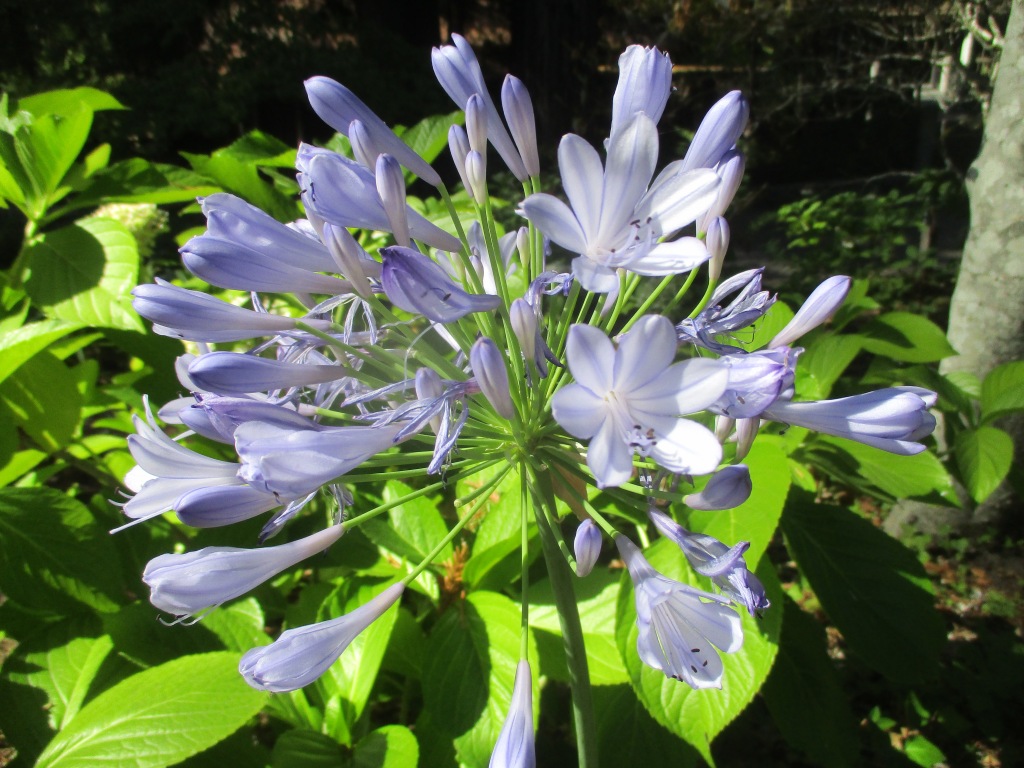
Lily of the Nile had previously been exclusively blue at work. Many from undoubtedly several different sources had been added to the landscapes for the past century or so, but, until recently, none were white. Even within a large and likely original colony, where genetic variability is evident among specimens that were added from different sources, or that grew from seed over the years, all bloomed monochromatically blue. I added the first white lily of the Nile only a few years ago. They are a significant herd of the same cultivar that I grew from only seven original pups that I acquired in the early 1990s. They are separate from the other lily of the Nile, in a neat row in front of the White Garden of el Catedral de Santa Clara de Los Gatos. They are not as fancy as they sound of course, and bloom with only a few flowers in the partial shade there, but they were supposedly the only white lily of the Nile. However, I recently found this other white lily of the Nile within the large and very established colony that provided many lily of the Nile for other landscapes. It could have grown from seed, and finally matured enough to bloom. I suspect that it merely reverted, as lily of the Nile sometimes does. I suppose that I should be pleased with it, but I am not so certain. It is almost intrusive, both to the exclusivity of the single white cultivar, and also to the exclusivity of the monochromatically blue colony. I have noticed within other old landscapes that, once one pup blooms white, others can follow its example. The same applies to a pup that blooms blue within a white colony. I may tag this particular pup for removal after bloom.

Six on Saturday: Lily Of Denial

‘Lily’ is such a vague designation. So many of the popular flowers that are known as ‘lily’ are not even remotely related to real lilies, which are of the genus Lilium. It is no wonder that many of them are confused about their obligations to the gardens that they inhabit. Some bloom unseasonably. Some develop unusual floral or foliar color. Their confusion can be contagious to flowers that are not even classified as lilies, such as #3 of these Six. Fortunately, the weird behavior of these flowers that live in denial of their true identities has been harmlessly and undeniably delightful. Such aberration is how new cultivars are sometimes discovered.

1. Lily of the Nile is in denial of its bloom season. After all others have been deadheaded, this one continues to bloom. It should be copied if its delayed bloom schedule is genetic.

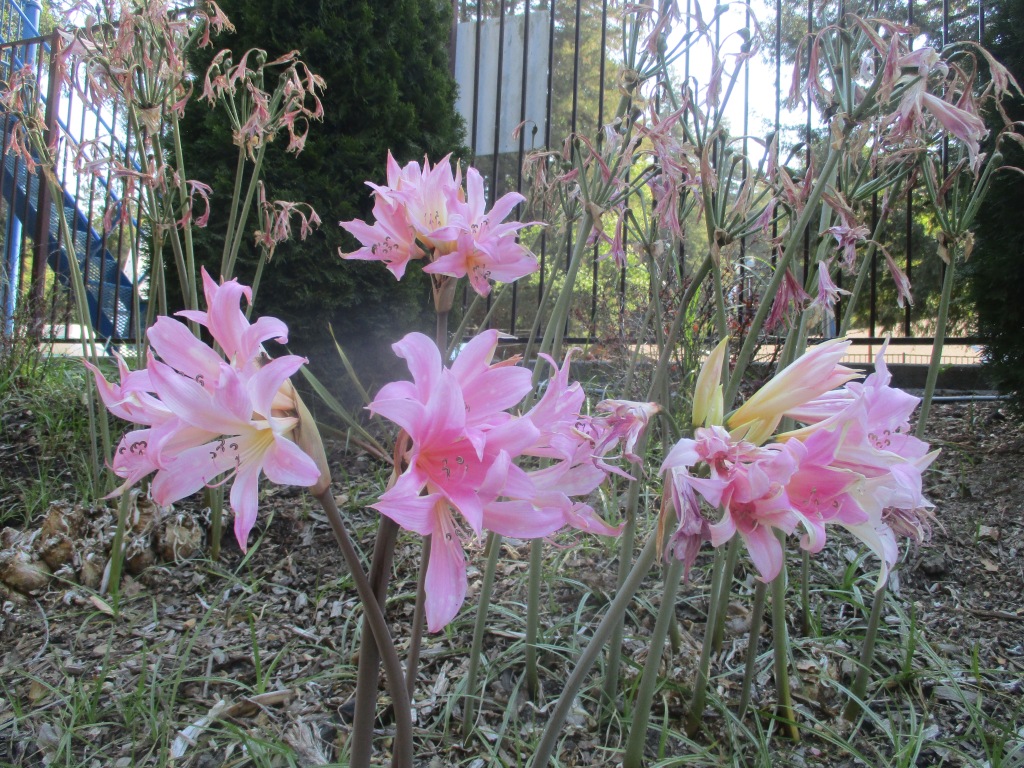
2. Belladonna lily, or naked lady, followed its lead. Mr. Stephens of Garden Ruminations explained that it may be another variety or species. Other naked ladies have gone seedy.

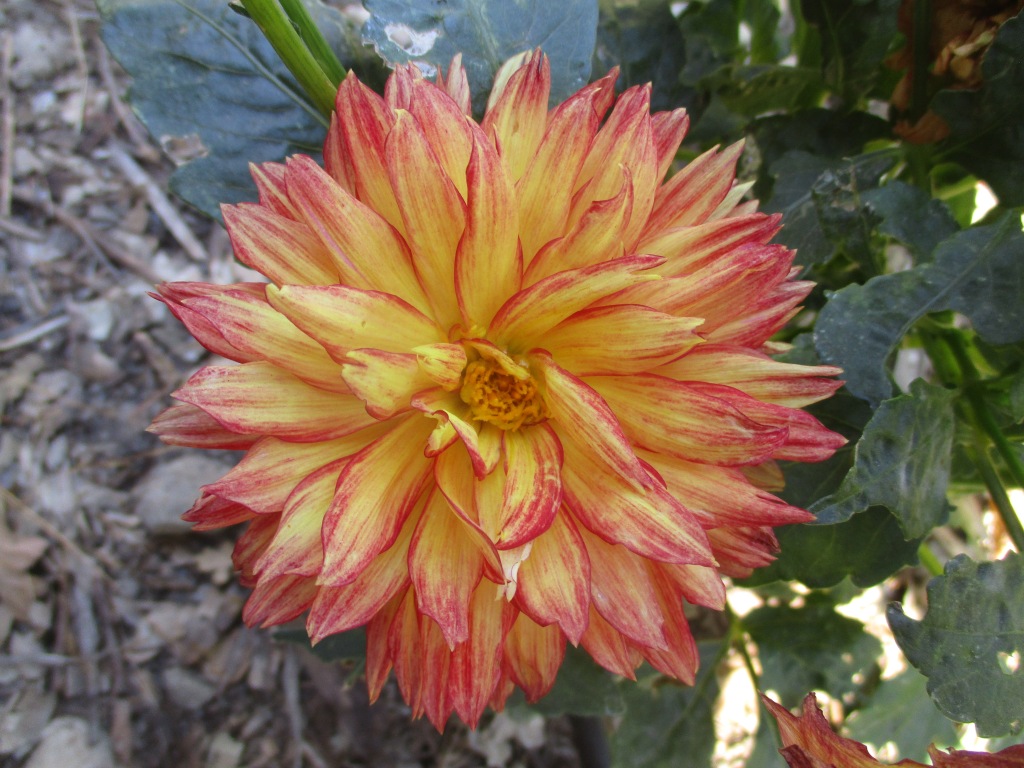
3. Dahlia is the one of these Six that does not try to be a lily. However, it is trying to be a new color. It was simply yellow last year. Perhaps it got this idea from ‘Cleopatra’ canna.

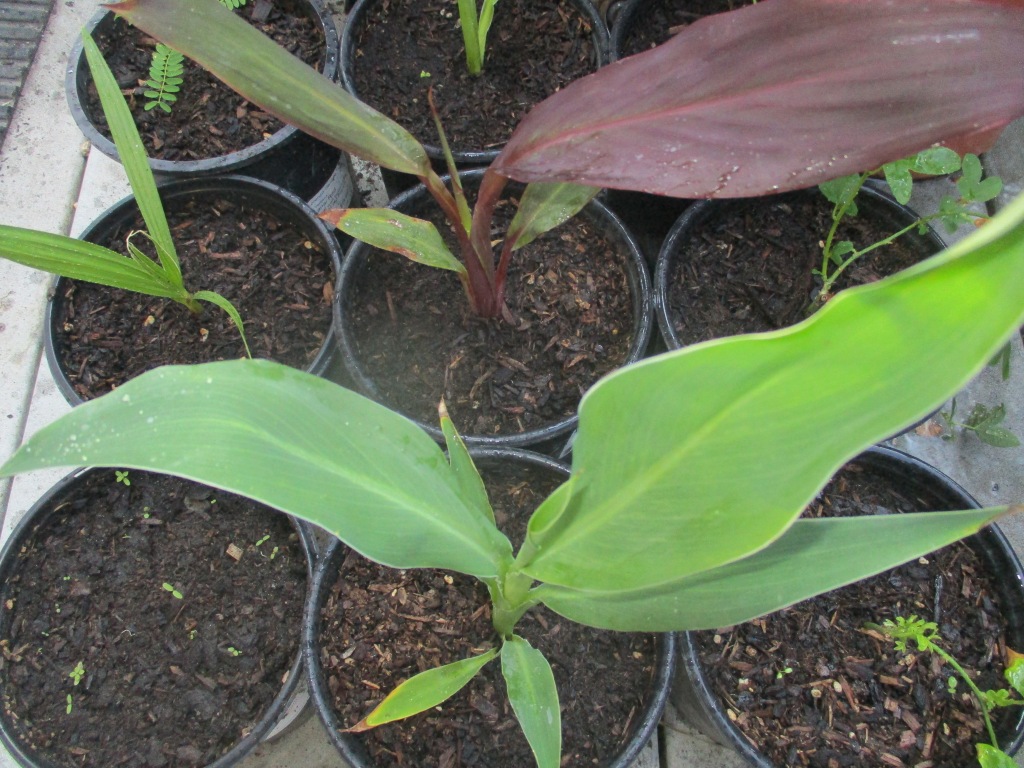
4. Canna lily, or canna, is trying an unexpected foliar color. Its parent is a bronze Canna musifolia, like the other seedling at the top of the picture. I anticipated genetic stability.

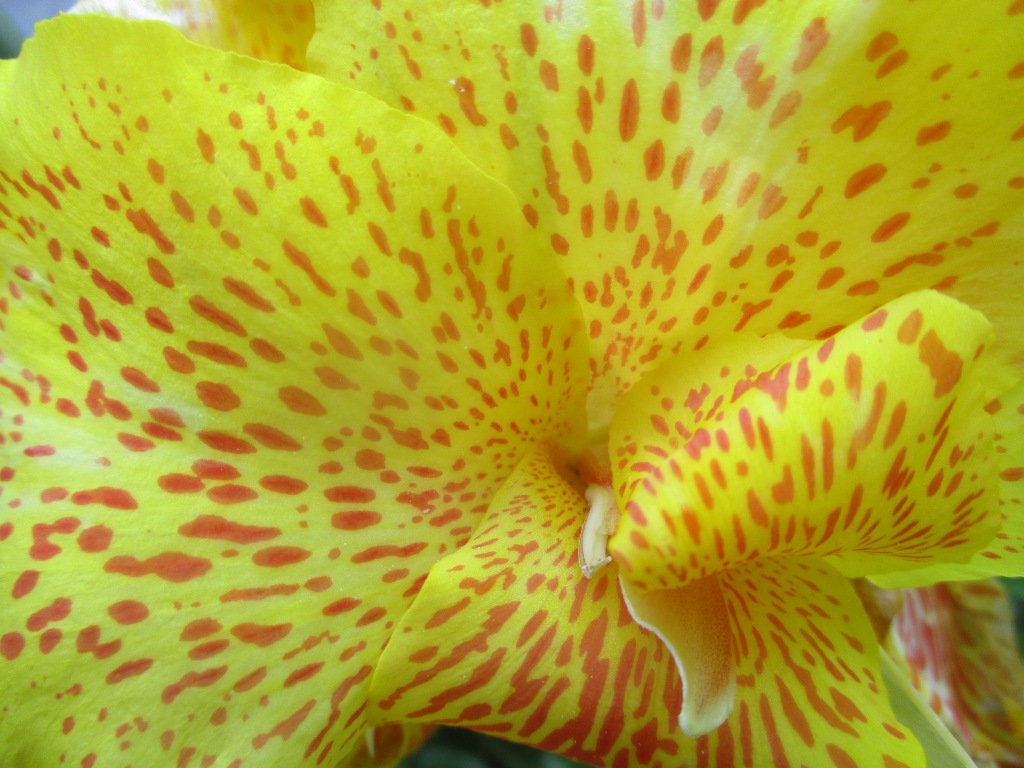
5. ‘Cleopatra’ canna generally, although not always, displays weirdly random red stripes on spotty yellow blooms. It seems to have shared much of its red with the yellow dahlia.

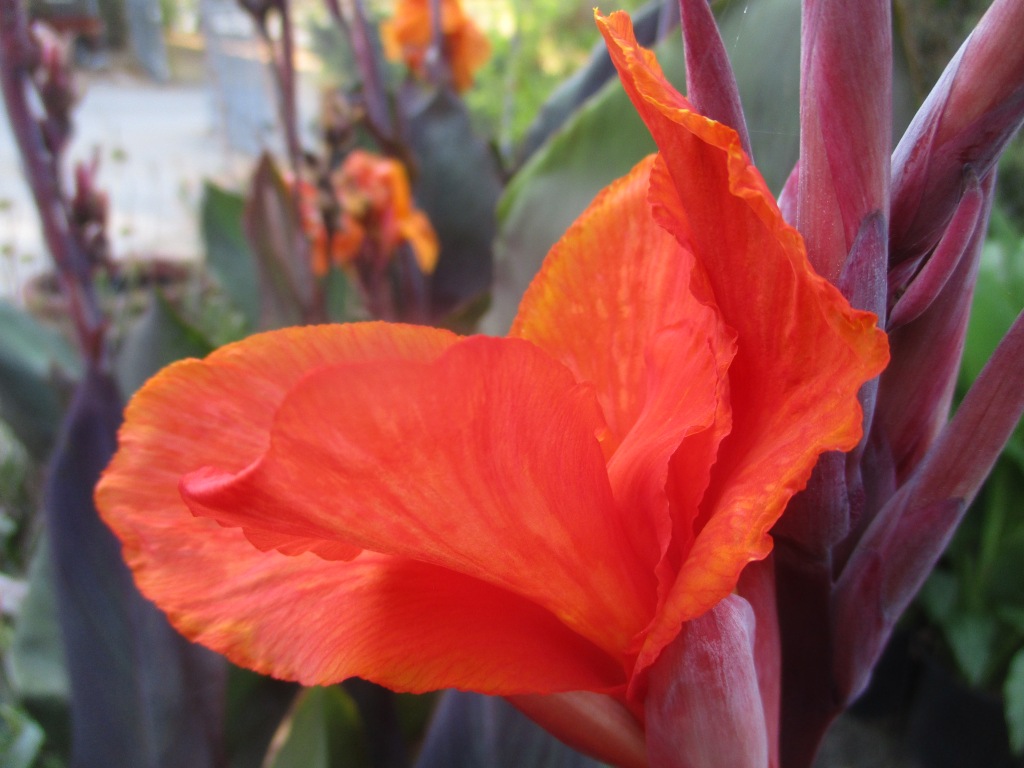
6. ‘Wyoming’ canna bloomed exclusively orange until this richly orangish red appeared. Perhaps ‘Cleopatra’ of the Nile was seedier than naked ladies with more than the dahlia.

This is the link for Six on Saturday, for anyone else who would like to participate: https://thepropagatorblog.wordpress.com/2017/09/18/six-on-saturday-a-participant-guide/

The Need For Seed

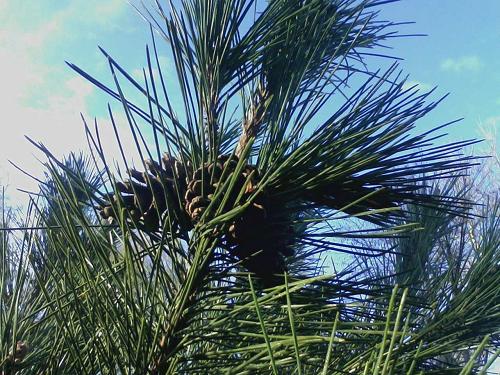
Seed for some pines is easy to collect as their cones open during warm summer weather. However, some pine cones must be dried or even heated to release their seed.

Lily of the Nile is so easy to propagate by division of congested old plants that not many of us bother to grow it from seed. No one wants to leave the prominent but less than appealing seed pods out in the garden long enough to turn brown and ripen after the blue or white flowers are gone anyway. Besides, only the most basic old fashioned varieties reliably produce genetically similar seed, and even these often revert between blue and white. Yet, collecting seed for propagation is still an option for those who do not mind the risk of genetic variation.

The natural variation of flower color among seedlings of some plants can actually make gardening a bit more interesting. No one really knows if naturalized four o’ clocks will bloom white, yellow, pink or red until they actually bloom. The few types of iris that produce viable seed almost always produce seedlings with identical flowers, but oddities sometimes appear. (Most bearded iris have serious potential for genetic variation, but do not often produce viable seed.)

Cannas are likewise likely to produce seedlings that are indistinguishable from the parents. However, seedlings of many of the fancier cultivars are often variable. Their seed are very hard so should be scarified before sowing. However, I find that I get so many canna seeds that even if less than half germinate without scarification, there are too many anyway! (Scarification involves scratching or chipping the hard seed coat to promote germination. It can be as simple as rubbing the seeds on a file or sand paper, but should not be so aggressive that it damages the seed within.) 

African iris are just as easy to divide as lily of the Nile are, and are as easy to grow from seed as naturalized four o’ clocks are. The difference is that they lack genetic variation, so are always indistinguishable from their parents. The only problem is that they are so easy to propagate that they can soon dominate the garden.

If seed capsules have not been groomed from the various perennials and annuals that can be grown from seed, or if they have been left out in the garden intentionally so that they can ripen, this would be a good time to collect them for their seed. (Four o’ clocks should have been collected earlier though.) Seeds from certain trees, such as silk tree, redbud and the many specie of pine, can likewise be collected. Most seeds prefer to be sown about now to chill through winter, since cold winter weather actually promotes germination when weather warms in spring. However, seeds for annuals and frost sensitive perennials, like cannas, that might germinate early and get damaged by frost, should probably wait until the end of winter to get sown.

Cultivar Is A Cultivated Variety

00422thumb
Most cultivars need to be cloned.

A plant ‘variety’ is a group within a species that exhibits distinguishing characteristics. A ‘cultivar’ is simply a cultivated variety. The first five letters of ‘cultivated’ merged with the first three letters of ‘variety’ to form the word ‘cultivar’. A variety should be self perpetuating to some degree, and may be naturally occurring. A cultivar perpetuates by unnatural means, and would go extinct otherwise.

Of course, the distinction between variety and cultivar is not always so obvious. Varieties of nasturtium were selected from plants that displayed desirable qualities. Seed of these varieties grows into plants that display the same qualities. However, without continued selection, some varieties eventually revert to a more feral state in only a few generation. They are not truly self perpetuating.

Most hybrid tomatoes are unable to perpetuate themselves naturally. Their seed is either not viable, or is very genetically variable. Genetically variable seed grows into plants that are very unlikely to produce fruit that is comparable to that which produced their own seed. Nonetheless, hybrid tomatoes grown from original (primary generation) seed are generally varieties rather than cultivars.

The distinction might be that they grow from seed. A plant that is cloned rather than grown from seed is a cultivar. Cloned plants can be grown from cutting, layering or grafting onto understock, but are genetically identical to the original. Some rare camellias grown now are genetically identical copies of original cultivars that were developed centuries ago. Their seed would not be the same.

Some cultivars developed from selective breeding. Others were random but appealingly distinctive plants in the wild or even in landscapes. Many originated as ‘sports’, which are mutant growths of otherwise normal plants. For example, some plants, on rare occasion, produce stems with variegated foliage. Cuttings taken from such variegated stems became popular variegated cultivars.

Seed from a variegated cultivar is very unlikely to produce more variegated plants.

Curb Mongrel

P91208Fruit trees, with few exceptions, have been extensively bred to produce the quality of fruit that we expect from them. Some are consequently genetically unstable, or at least less genetically stable than their wild ancestors were. Even if they never mutate or try to revert to a more stable state, they are very unlikely to produce seed that can develop into genetically similar trees.

In other words, they are not ‘true-to-type’. Their seed might grow into trees that produce fruit that resembles that of one of their ancestors, or of a pollinating parent tree. It is impossible to predict what fruit will be like until it actually develops.

That may take a while. Some seed grown fruit trees start out with juvenile growth, and take a few years to mature enough to bloom and produce fruit. Some types of avocado trees grow tall and lanky for a few years before they bloom. Most citrus are fruitless and wickedly thorny through their juvenile phase.

Grafted fruit trees or those grown from cuttings are true-to-type because they are genetically identical clones of their single parents. Cuttings and scions (for grafting) are made from adult growth, so do not need to mature through a juvenile phase.

The unpredictability of genetic variability is the main reason fruit trees are not often grown intentionally from seed. Juvenility might be the second main reason. However, neither of these two reasons prevents curb mongrels from growing wherever their seed lands, which is often next to sidewalks and curbs where cores and pits get discarded.

Curb mongrels generally get removed and disposed of, just like any other weed. It would be more practical to plant a known cultivar of fruit into a situation where such a tree is actually desired. Every once in a while, a curb mongrel appears where it is allowed to stay, and eventually produces fruit that justifies its preservation.

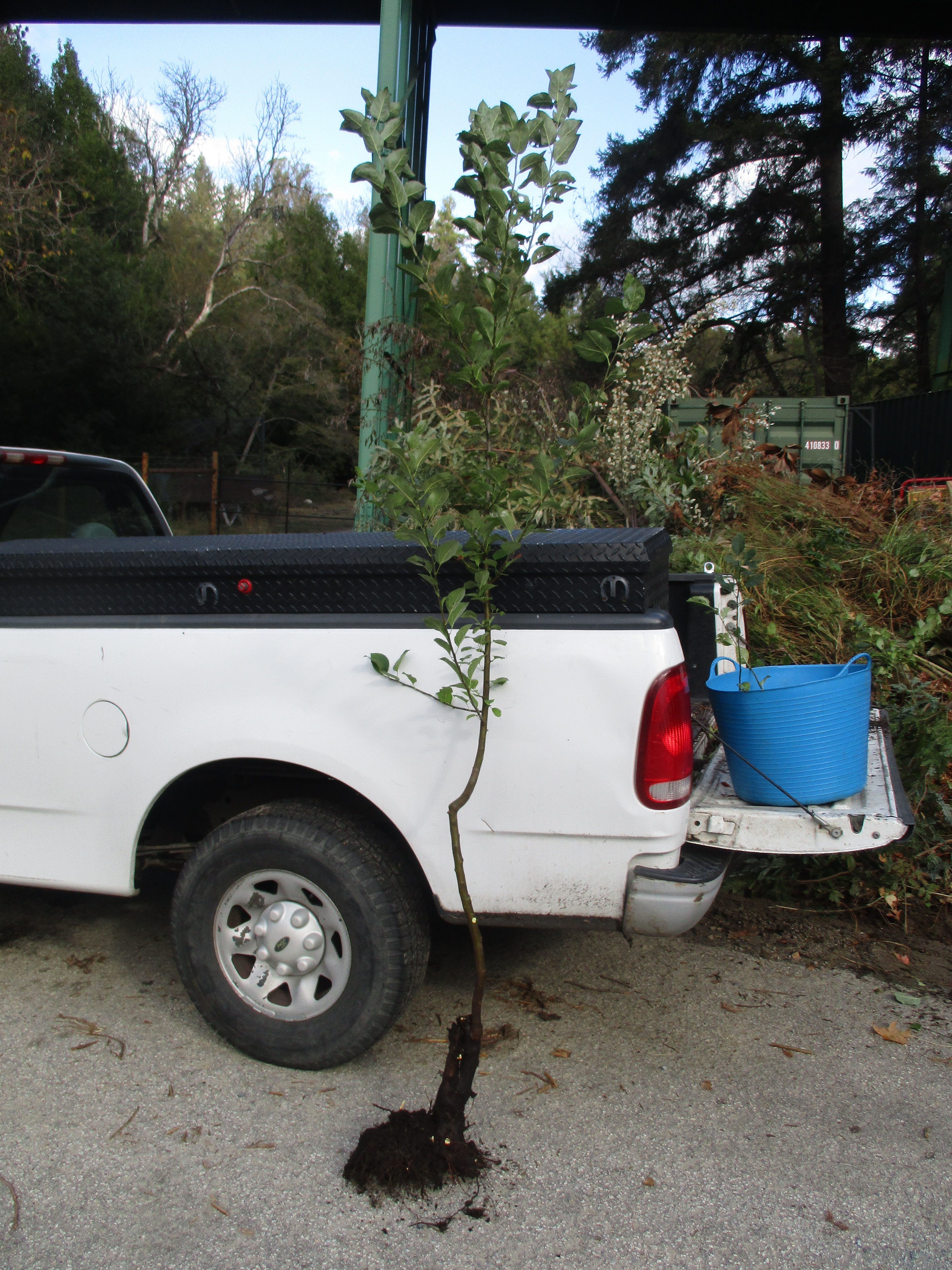
Well, that was not what happened with this curb mongrel apple tree that appeared adjacent to a patio used for outdoor dining. It was not compatible with the landscape, so got removed before it was able to produce any fruit. It looks like it was grafted, but only because someone tried to cut it down without removing the stump two years ago.

The problem now is that it came up with enough roots to survive relocation. It is not so easy to dispose of a tree with such potential, even though there is no way to know what its potential is until it fruits. It will get planted into a private garden and pruned back accordingly. If we had planned for it to be relocated, the process would have been delayed until it was defoliated.

If the fruit is of inferior quality, the tree can be removed and discarded. At least we tried. Alternatively, a desirable cultivar can be grafted onto it. In a home garden, no one needs to know that it is not a known understock (rootstock) cultivar. The foliage resembles that of ‘Red Delicious’, which makes sense for seed that likely originated from a commonly discarded core.

Horridculture – Bad Seed

P80317+California poppies are like no other wildflower. They are so perfectly bright orange, and look almost synthetically uniform in profusion, as if painted onto coastal plains and hillsides. They may be a bit more yellowish in some regions, or a bit deeper orange in others, but they are always bright and strikingly uniform.
Genetic variation is naturally very rare. I can remember hiking with my Pa up to the (lesser known) Portola Monument in the hills behind Montara, and finding a few pale white poppies, and even fewer pale purple poppies. It was like finding four leaf clovers! Genetic variants among California poppies are not quite as rare as four leaf clovers are, but finding a few of both white and purple was really strange. I never found a pink one though.
Nowadays, poppies can bloom in all sorts of shades and hues or orange, yellow, red, pink and soft purple, as well as creamy white. Some bloom with fluffy double flowers. Of course, all this variety is not natural. California poppies were bred to do this.
The potential problem with such breeding is that California poppy is naturally very prolific with seed. Any of these weirdly bred varieties could escape into the wild and interbreed with wild poppies, causing them to be more variable, and interfere with the ecosystem.
The problem is not just with California poppies. Many plants get bred extensively enough to interfere with how they behave in the wild if they happen to escape cultivation.
Fortunately for California poppies, the weird new varieties do not really get very far in the wild. The are not true-to-type, so revert back to their original bright orange in just a few generations, even without outside influence. If pollinators do not recognize their unfamiliar color and form, they are less likely to get pollinated to continue to tamper with the ecology. In fact, wild California poppies still have the advantage in that regard.
This yellow California poppy with an orange center is a second generation seedling, and is already halfway between the original yellow variety, and the wild orange.