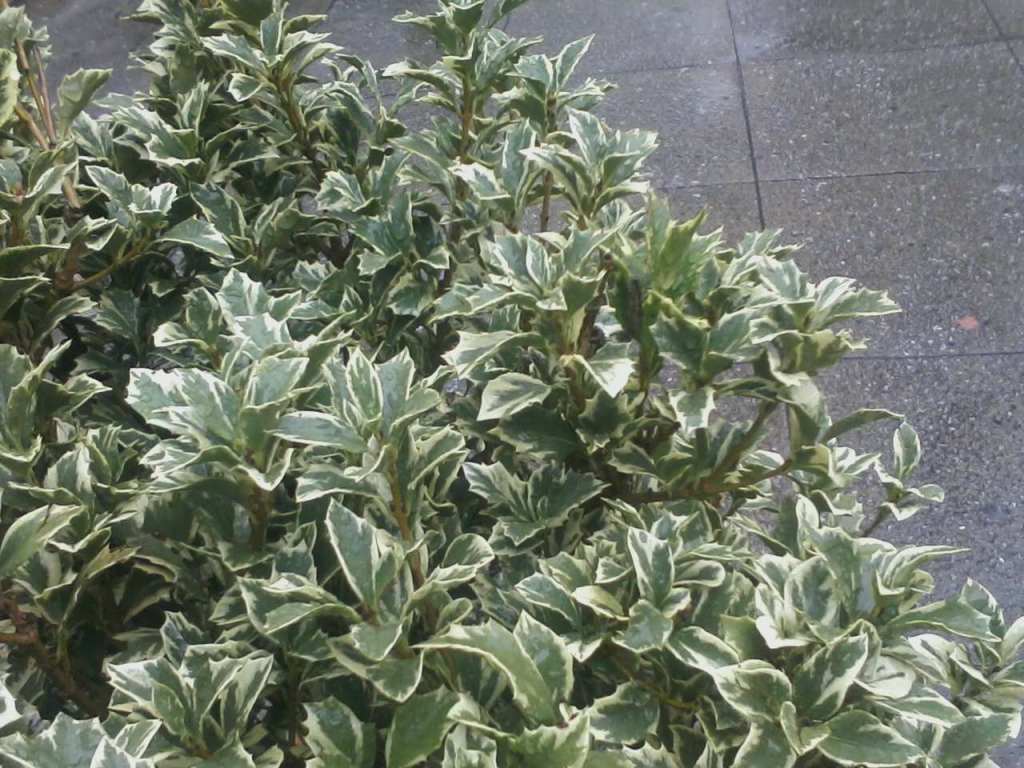
If the foliar spines (teeth on the margins of the leaves) of English holly are too nasty, holly olive, Osmanthus heterophyllus, might be a more docile option. It lacks the occasional bright red berries and the very glossy finish on the leaves, but is much easier to handle than real holly is, since the spines are not nearly as sharp. If you look closely, you can see that the one to two and a half inch long leaves have opposite arrangement (are in opposing pairs along the stems) instead of alternate arrangement (are single along the stems) like those of holly.
The more popular varieties of holly olive have some sort of variegation of white or gold. Variegation can be spots, blotches or more refined margins. Most of the modern variegated varieties prefer to stay less than six feet tall. The old fashioned unvariegated holly olive can get more than twenty feet tall when very old, but the upper foliage lacks the distinctive foliar spines of lower foliage. The tiny and mostly unnoticed flowers are pleasantly fragrant.
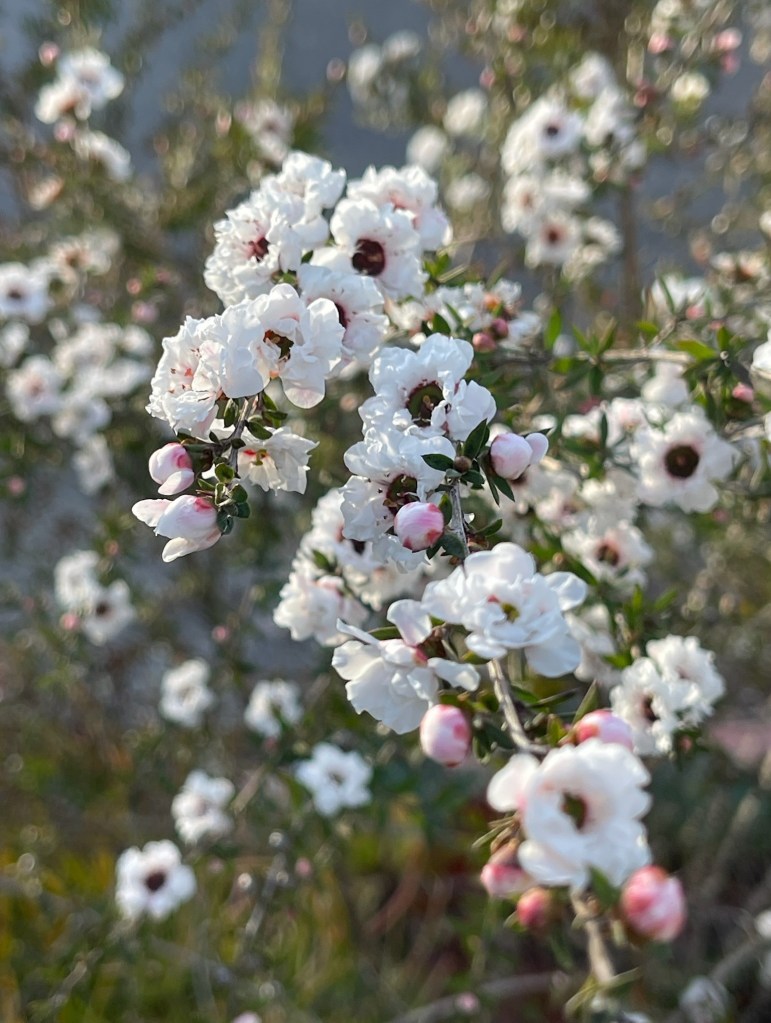
Bloom should probably be most profuse for late spring or early summer. In actuality, New Zealand tea tree, Leptospermum scoparium, blooms whenever and however it wants to. Now that it seems to be blooming prematurely, it might continue to bloom in phases until autumn. Minor bloom phases might even continue randomly through autumn and winter.
Floral color is white, pink or red, including deep ruby red. The tiny flowers are sometimes sporadic but sometimes quite profuse. A few cultivars have plump double flowers. Foliar color is olive drab green or bronze green. The finely textured evergreen foliage is slightly scratchy. Its tiny leaves have pointed tips. The fibrous brown bark is handsomely shaggy.
New Zealand tea tree works very well as a blooming informal hedge. Frequent shearing of formal hedges compromises both bloom and natural form. Elimination of lower growth exposes appealingly sculptural trunks supporting little trees. Some modern cultivars will not reach first floor eaves. Some reach second floor eaves. All demand sunny exposure.
It may not seem like much to take notice of. Sweet olive, Osmanthus fragrans, resembles glossy privet, but is neither as glossy nor quite as richly green. The dense and evergreen foliage can work about as well for a formal hedge though. It is even better as a small and billowy tree. It gets at least as high as ground floor eaves, and can reach upstairs eaves.
The primary allure of sweet olive is its delightfully pervasive and fruity floral fragrance. Its small and slender clusters of tiny pale white, yellow or gold flowers are mostly obscured by foliage. For those who are unfamiliar with it, the fragrance might be difficult to identify. Bloom is most abundant before and after summer. Sporadic bloom happens at any time.
Because sweet olive is more olfactorily appealing than visually appealing, it works quite nicely as in informal hedge behind prettier plants. It can stay narrow between windows of neighboring homes that are a bit too close together. If enough flowers are available, they might flavor tea and confectionery. A cultivar with variegated foliage is unfortunately rare.
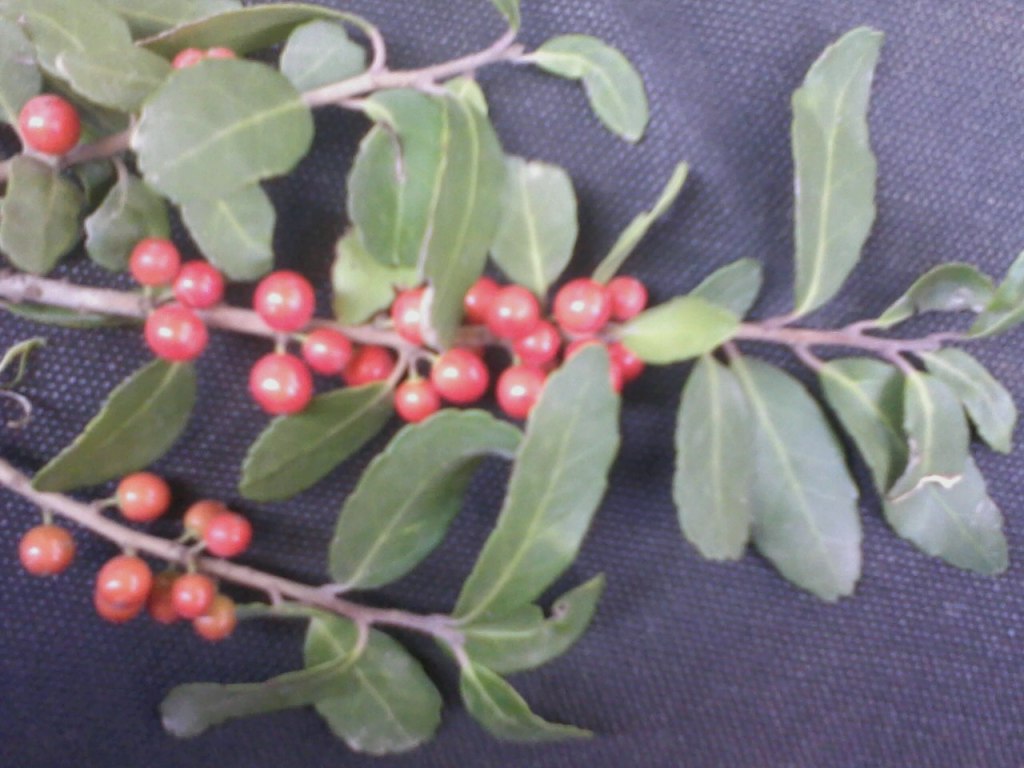
The unflattering Latin name does not suit the yaupon, which can make a tailored formal hedge of dense foliage, or a neat informal (unshorn) screen that may occasionally produce a few colorful winter berries.
Hollies are innately uncommon in California. Yaupon (holly), Ilex vomitoria, happens to be one of the least common. Ironically, because of its small leaves and dense growth, it is more tolerant to frequent shearing by maintenance gardeners who ruin other hollies. It can actually make a nice shorn hedge.
Hedged yaupon can eventually get up to the eaves of a single story. Unshorn plants can reach the eaves of a second story, and might display showy red berries about an eighth of an inch wide. The small and often randomly serrate leaves are only about half to an inch long, and maybe half an inch wide.
Strictly formal boxwood hedges are traditional components of old formal rose gardens. In California, Japanese boxwood, Buxus microphylla, had always been more popular than English boxwood, which may be more common where winter is cooler. Although it grows too slowly for high hedges, it gets high enough to obscure gnarled lower growth of roses.
Mature plants are generally less than three feet tall and wide, although they can get a bit larger if they get a chance. The oval and glossy evergreen leaves are only about half an inch or an inch long, but relatively thick, so are very conducive to formal shearing. Foliar texture is nicely dense but not too congested. Gray or pale brown bark is seldom visible.
Old fashioned Japanese boxwood, which remains the most common in old gardens, has a somewhat light or yellowish green color. Modern cultivars are darker green. A common problem with old formal hedges is the addition of modern cultivars or even other species to fill gaps. The darker foliage will not conform to the lighter foliage, so ruins the formality.
Pittosporum eugenioides leaves have distinctively wavy margins.
Large shorn hedges or informal screens are the more popular functions of Pittosporum eugenioides. It works like a modern and more relaxed option to privet. What few garden enthusiasts know is that it can alternatively be allowed grow into a small tree, either as a standard (on a single trunk) or with multiple trunks. It grows rather efficiently to more than twenty feet tall and about half as broad while young, and as it matures, can eventually get about thirty feet tall and broad.
The glossy leaves have appealingly wavy margins and distinctively pale midribs. The slightly fragrant flowers are only pale yellow, and are not abundant among young trees. Big old trees often bloom enough in autumn to be pleasantly fragrant. Stems and foliage are lemony fragrant when pruned or shorn. However, the common name of ‘lemonwood’ (or tarata) is not so common locally for Pittosporum eugenioides.
Johnny jump up and jumping cholla have no more than amusing names in common with hopbush, Dodonea viscosa. Neither a dangerous cactus nor a docile annual, hopbush is an elegantly upright and evergreen shrub. It is very popular for both informal and formally shorn hedging. With pruning, it can become a small tree with handsomely furrowed bark.
Hopbush has potential to get about as tall as a two story house, particularly with pruning for tree form. Conversely, with only occasional pruning for hedge form, it is just as happy to stay just six feet tall. Trees with single and straight trunks fit nicely into narrow spaces. Trees with a few irregular trunks that lean outwardly are more sculptural for larger areas.
The narrow evergreen leaves are about two or three inches long, with light bronzy color. ‘Purpurea’ has purplish bronze color, but does not grow as vigorously. Most hopbush are female, and generate interestingly papery seed. Bloom and seed production are variable though, and some specimens become male. Roots should be complaisant with concrete.
Roses might be more fun to grow and prune without their thorns. Blackberries are easier to pick from thornless canes. Thorny vegetation is simply unpleasant to work with. Some very desirable plants, such as roses and most blackberries, are innately thorny. The only alternative to contending with their thorny condition is to grow something totally different.
Thorns and similar structures are as diverse as foliage, with a few distinct classifications. True thorns are simply modified stems, like those of hawthorn. Spines are modified foliar structures or leaves, such as those of cacti. Prickles, such as those of rose, are modified epidermal structures. Spinose foliar margins, like those of holly, serve the same purpose.
The purpose that thorny vegetation serves is defense. It intends to inhibit consumption of foliage, fruit or bloom. That is why some trees are thorny only while young and low to the ground, then almost thornless as they grow beyond the reach of grazing animals. Thorny trunks of honeylocust may protect seed pods from bears, so birds can disperse the seed.
It is therefore no mystery that many of the thorniest plants are endemic to desert regions. The scarcity of edible vegetation in such regions increases the need for protection. Also, it is no mystery that most grazing animals are not too deterred by thorny vegetation to get enough to eat. Otherwise, roses and firethorn would be exempt from the ravages of deer.
Despite its intentions of deterrence, thorny vegetation inhabits home gardens for various reasons. Some produces desirable bloom or fruit, like roses and blackberries. Cacti and agaves develop remarkably striking forms. Such plants should be situated appropriately. Rose canes can be bothersome close to walkway. Agaves can be downright dangerous.
Thorny shrubbery, such as firethorn, barberry, Natal plum and English holly, is a practical deterrent for unwanted traffic. Firethorn espaliered on the top of a fence is as effective as barbed wire, and is more appealing. Maintenance of thorny plants is more of a challenge than for thornless plants. Otherwise, thorny plants should be more popular than they are.
Almost all photinia in local landscapes is Fraser’s photinia, Photinia X fraseri, which is a thornless and fruitless hybrid of two species that are now rare. Some of the old fashioned photinia are thorny. Some produce copious berries that can get messy, or feed birds who can get messy. More modern cultivars of Fraser’s photinia are becoming more available.
Fraser’s photinia is popular as a shorn evergreen hedge. New foliage that develops after shearing is richly reddish bronze, and fades to dark green. Bronze color is best in spring, after late winter shearing. Summer shearing stimulates a repeat performance, although it may not last as long before the foliage fades to green. Shearing enhances foliar density.
Unshorn photinia can develop into small trees as tall as fifteen feet, with new growth that is a bit less richly colored than that of shorn photinia. It also blooms, often profusely, with big and rounded trusses of tiny creamy white flowers. Bloom is not impressively colorful. Floral fragrance is objectionable to some. All photinia types are susceptible to fire blight.
Mowers are for mowing lawns and shallow ground cover. Blowers are for blowing debris from pavement, decking and other flat surfaces. The names of these tools suggest these particular functions. Those of us who use such tools tend to be aware of their limitations. Why are simple concepts of shearing and the associated tools so difficult to understand?
‘Mow, blow and go’ gardeners are not so bad if they simply mow, blow and go. They tend to the two most significant but also least pleasurable tasks in the garden, and then leave before causing problems. Most are also qualified to add bedding plants or shear hedges. However, some will shear anything that is within reach of their powered hedge trimmers.
Shearing is for hedges or shrubbery that is strictly foliar. There are few exceptions. Such shearing should be performed properly, and only for the few plants that are conducive to it. The process promotes foliar density, but also generally inhibits bloom. For hedges that function as living fences in the background of more interesting plants, this is no problem.
Otherwise, shearing plants that are not conducive to it ruins appealing form, and inhibits or prevents appealing bloom. Privet and photinia perform well as shorn hedges because their dense evergreen foliage is their primary asset. Their bloom is actually undesirable. Their natural forms are unremarkable, but their shorn forms can be remarkably practical.
Frequent or untimely shearing prevents lemon bottlebrush and oleander from blooming. However, shearing immediately after a bloom phase stimulates new growth to bloom for a subsequent phase. New growth only needs an opportunity to mature and bloom before removal. Such potentially blooming stems need extra space to extend prior to blooming.
As practical as it is for hedges, shearing ruins the foliar texture of other plants. Heavenly bamboo is worthlessly shabby without its naturally intricate foliar texture. Juniper retains good color, but becomes boringly plain. Rhododendron and hibiscus become disfigured and can not bloom. Each of these plants and all others are discriminating about pruning. Few are agreeable to shearing.