Where it had been left to develop naturally in old freeway landscapes, shiny xylosma, Xylosma congestum, grew as small trees. The largest are significantly taller than twenty feet. They can be pruned up to expose their nicely flaking bark on sculptural trunks and stems. The evergreen foliage is shiny and rather yellowish green, somewhat like that of camphor tree. The slightly serrate leaves are about two inches long or a bit longer. The tiny and potentially fragrant flowers are rarely seen, and not worth looking for. In refined landscapes, shiny xylosma is popular as a shorn hedge. Xylosma congestum ‘Compacta’ has denser growth, and can be kept only a few feet high if necessary. Vigorous shoots can have nasty thorns hidden in their deceptively gentle foliage. Once established, shiny xylosma does not need much water. It prefers full sun exposure, but will tolerate a bit of shade.
All the wrong plants get shorn. Mow, blow and go gardeners are known for shearing everything that they can reach into creepy and unnaturally geometric shapes, usually flared out at the top, and bulging obtrusively into otherwise usable space. Yet, functional formally shorn hedges are passe and almost never shorn properly.
First of all, a formal hedge should be uniform, which means that all the plants that comprise it should be the same, and planted at the same distance from each other. Any plants within a formal hedge that die should be replaced with the same plant. A single English boxwood plant added to a Japanese boxwood hedge will always stand out with a different shade of green and growth pattern. Seedlings of other plants that grow up into a hedge should be removed before they become part of it.
Secondly, a formal hedge should be contained within defined boundaries. It should get neither too tall, nor too deep (from front to back). A fat hedge wastes space. There is no excuse for a hedge to encroach obtrusively over walkways, driveways or patios.
The vertical faces of a hedge should be completely vertical or slope very slightly inward at the top, but should certainly not slope outward to shade lower growth. A slight inward slope is more important on a northern face of plants that are sensitive to shade.
Hand pruning hedges (with hand shears) produces the best finish, but takes quite a bit of time for big hedges. Shearing with typical hedge shears cuts leaves as well as stems, so can cause foliage with large leaves to look a bit tattered for a while. Hedges that grow fast may need to be shorn twice or more annually. Some hedges can get shorn back aggressively once annually, and then allowed to fluff out evenly through the rest of the year. Bottlebrush and escallonia hedges can bloom nicely and evenly if shorn only once annually.
Glossy and wax leaf privet are among the most traditional of formal hedges. Glossy privet can get quite tall, but wax leaf privet actually has glossier foliage. Photinia and shiny xylosma have a bit more color, but want a bit more space (from front to back). Boxwoods make very nice small hedges. Pittosporums are available in various shapes and sizes. Pittosporum eugenioides gets quite tall, and can be kept quite lean. Pittosporum tobira is shorter and wider.
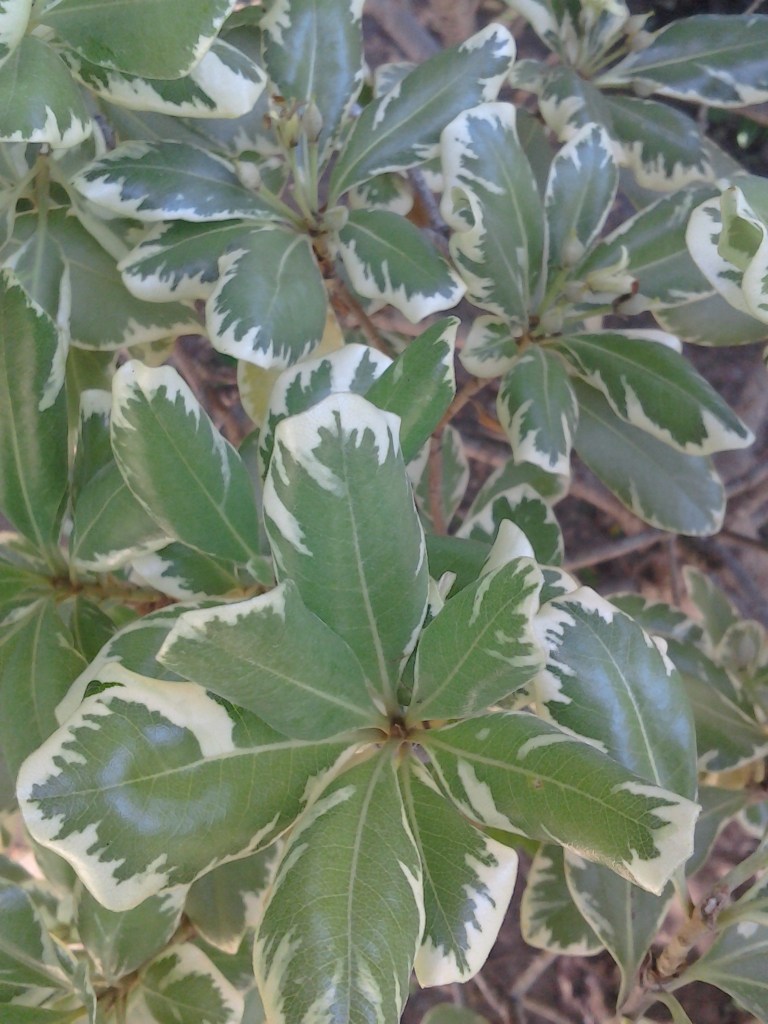
There are too many other plants known as ‘mock orange’ for Pittosporum tobira to still go by that name, which is why it is more commonly known by its Latin name, or simply as ‘tobira’. The pleasantly fragrant flowers do not smell too much like those of orange anyway. The glossy and dark green leaves are like those of some hollies, without the distinctive prickly points. ‘Variegata’ has lighter green foliage variegated with white, but does not bloom as much. Dwarf cultivars, both variegated and unvariegatd, bloom even less. ‘Variegata’ has a tendency to occasionally produce stems of green (unvariegated) foliage that grow more vigorously and can overwhelm the original variegated growth if not pruned out. Common green Pittosporum tobira can grow as a small tree in the partial shade of larger trees, but is more often maintained as dense shrubbery less than ten feet tall. It makes a nice dense hedge in full sun, but unfortunately does not bloom if shorn regularly. All cultivars are resilient to drought once established.
Good old fashioned boxwood hedges really look silly if just a single missing plant get replaced with a different cultivar (cultivated variety) or specie. Most of the older boxwood hedges are the traditional, but somewhat yellowish Japanese boxwood. Most middle aged hedges are a relatively newer cultivar that is a bit greener. Modern boxwood hedges are more likely a cultivar of English boxwood, Buxus sempervirens.
English boxwood resembles Japanese boxwood, but has slightly narrower leaves that produce a slightly more objectionable aroma when shorn or otherwise disturbed. These opposite (paired) glossy leaves are only about a quarter to half an inch wide and about twice as long. The color is slightly darker with a more ‘olive’ tone. Wild English boxwood in Europe can grow as small trees. Most garden varieties are fortunately much shorter and more compact, which is why they are so popularly shorn into small formal hedges. They also do well as topiary. ‘Aureo Variegata’ is variegated with nicely contrasting cream colored leaf margins.
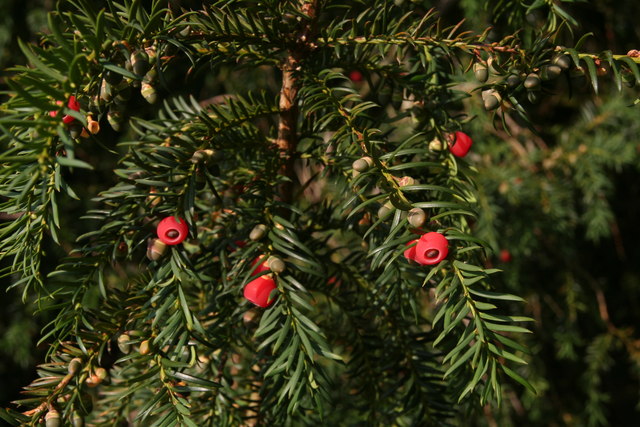
English yew has inhabited landscapes and gardens for centuries. (This is not my picture.)
It is difficult to know how big any of the various cultivars of English yew,Taxus baccata, will eventually get, and how long they will take to get that big. Most can get almost as tall as thirty feet. Some can get nearly twice as tall. However, they can take more than a century or several centuries to do so. Old specimens around Europe are significantly older than two thousand years. Slow growth is an advantage for formal hedges that get shorn only annually. English yew prefers regular watering. Partial shade is not a problem.
Irish yew is actually a cultivar of English yew with densely upright growth. The various golden yews have yellowish foliage. Otherwise, most English yews have finely textured dark green foliage on angular stems that resemble those of redwood. Individual leaves are very narrow, and only about half and inch to an inch long. The peeling dark brown bark resembles that of large junipers, but not quite as shaggy. English yew is toxic.
As a backdrop for more interesting plants, shiny xylosma, Xylosma congestum, may not get the respect that it deserves. If it seems to be a bit too common in some big landscapes, it is probably because it is so practical. It can function like the strictly shorn hedges that were popular decades earlier, but is a bit more adaptable to modern landscape styles. It can be formal or quite informal.
Formal hedges of shiny xylosma are typically no taller than eight feet, and a bit more plump than old fashioned privet hedges. They can get a bit sparse if kept too lean. Informal hedges are mostly lower and plumper, with casually irregular surfaces and no corners. Old shiny xylosma can grow as a small tree more than eight feet tall. Younger specimens are of the shorter cultivar, ‘Compacta’.
Established shiny xylosma is surprisingly resilient. Roots disperse impressive distances to reach moisture so that old specimens can survive without direct irrigation. Although, they prefer regular watering. Overgrown specimens can eventually regenerate nicely from coppicing or pollarding. The main disadvantage is that vigorous new growth will likely develop concealed but sharp thorns.
Victorian landscapes made good use of cherry laurel, Prunus laurocerasus. It works well as a large formal hedge. For more relaxed modern landscapes, it makes delightful informal screen. The main reason that it is now less popular than other hedging shrubbery is that it gets rather broad if not shorn back regularly. If allowed to grow as a low rounded tree, it can get twenty-five feet high!
Regularly shearing is not necessarily frequent. It should be efficient though. Confinement for such broad shrubbery is important. If shorn back farther than where the outer surface is desired late in winter, fresh new foliage can fluff out nicely within allowable space through spring. Subsequent aggressive shearing to maintain confinement may only be necessary once or twice during summer.
The big leaves are about three inches long, and luxuriantly glossy. If hedges get shorn less aggressively, but more frequently than two or three times annually, such big leaves can be rather shabby much of the time. If shorn less frequently, small trusses of creamy white flowers may get a chance to bloom. Cultivars are more compact than the species. One cultivar is variegated with pale gold.
Fences are necessary. They contain children, dogs and minor livestock. They exclude deer, cattle and others who are unwanted within an enclosed space. Some obscure unwanted scenery. However, even the more ornate sorts are more functional than aesthetically appealing.
That is why hedges are popularly grown to obscure fences that obscure outside scenery. Climbing vines take up less space than hedges, but are likely to damage the fences that they are intended to obscure.
Where I lived in town, the garden in back was surrounded by fences. I loathed them. I grew a grapevine on one. Another one was outfitted with a trellis of twine for pole beans to climb. Tall zonal geraniums obscured at least the lower half of the fence behind the laundry yard. I would have preferred no fences at all.
There were no children or dogs to contain. Nor were there cattle or deer to exclude. Except for the laundry and trash yards, there was no unwanted scenery to obscure. Nonetheless, the neighbors wanted fences, probably because they all believed that backyards should be fenced. It was just how it had always been.
Some urban fences are more like high and solidly constructed walls. Batons cover the seams between planks. Where local ordinance limits the height of fences, lattice is commonly added on top to (sort of) lawfully increase height. It is difficult to grow much on the shady north side of such tall fences.
I am fortunate that I do not work with many fences anymore. However, an area at work is surrounded by cyclone fences. It is necessary and practical, but would be very unappealing around landscape situations. I put pole beans on one, and two grape vines on another. If I must contend with them, I may as well take advantage of them.
There is significant traffic right outside. It is one of the three busiest roads around. No one here really minds, because we are mostly too busy with something else while we are here. We are accustomed to it as part of the ‘scenery’. The noise sometimes makes it necessary to shout to each other, or take a telephone call somewhere else, but is not too much of a bother otherwise.
However, the scenery that those in the traffic see from the road might be slightly less than appealing. Industrial buildings surrounded by pavement, building materials, work vehicles and all sorts of associated items are all that are in here. Next door, there is a herd of dumpsters! It is a view worth obscuring. Bay trees and box elders that used to screen the view are too tall now.
I should have planted these five Arizona cypress in a row along the road last autumn. If I were to plant them now, I will need to water them occasionally until next autumn, not that I would mind. After their first winter, they would be happy on their own. They would start to obscure the view within only a few years, and unlike box elders, would stay evergreen through winter.
They really should have been planted a long time ago. They have been in the same cans for so long that the medium within has decomposed and collapsed. Without staking, their lean trunks became disfigured in confinement. They really would not have needed to be staked if they had been planted sooner and been able to grow more vigorously. Fortunately, they should recover.
A Monterey cypress will be planted at the low end of the row next Saturday, even if these Arizona cypress are not planted until autumn. I will explain later.
Thorns, spines and prickles are not often considered to be assets. The weirdly stout prickles on the distended trunks of floss silk tree are more of an oddity than an ornamental attribute. The striking spinose foliage of agaves and yuccas can be more trouble than it is worth. After all, thorns, spines and prickles are intended to repel grazing animals.
They all work the same way, but are physiologically quite different. Thorns are modified stems, like those of bougainvillea. Spines are modified leaves, like those of cacti. Prickles are modified epidermis, like those of roses. Then there are all sorts of plants with spinose leaf margins, like English holly. Such defenses can be a nuisance to those of us who must work with them.
However, they can be useful deterrents. Natal plum that seem to be so innocent can be grown as low hedges that no one would go through more than once. Firethorn (Pyracantha) makes a larger and comparably impenetrable hedge. Their potentially dangerous thorns are almost always adequately effective with their first few pokes, before they cause too much injury.
Some plants are so dangerously thorny that they should be kept at a safe distance. Cacti, agaves and some yuccas can be strategically placed near the perimeters of large landscapes to deter trespassers. They are scary enough to be visually deterrent remotely. Mediterranean fan palm looks friendlier, but is just as mean up close.
Japanese barberry, roses and the spinose foliage of English holly are relatively safe deterrents to inhibit traffic in smaller spaces. They will keep people away from windows without necessarily blocking either access for washing the windows, or views from within. In case of fire, they are not too dangerous to escape through; although roses should not be allowed to get overgrown.
Because thorns, spines, prickles and spinose foliage are unpleasant to handle, the plants outfitted with them often get less maintenance than then should. When they get overgrown from a lack of pruning, they are even more difficult to handle. It is probably better to put nasty debris into greenwaste instead of compost. Thorns and spines are hard, so linger as foliage decays.