
This is the first article within the designated ‘rant’ format, that will continue each Wednesday. Articles for the other six days of the week will be more cheerful, or at least less objectionable. These articles may not always be rants, so might alternatively include discussions of particular fad, trends, gimmicks and so on. Perhaps some topics will remain just that; discussions in which the advantages and disadvantages of a particular subject are compared. Categories may develop, so besides ‘Horriduclture’, there could be a category for discussions of fads, for example. This is a new format for me, so I will keep it open to modification, and see how it goes.
Fat hedges are one of my serious peeves!
Hedges done properly are very useful landscape features, that provide privacy, obscure undesirable views, muffle outside sound or simply divide a large garden space into smaller garden rooms. Landscape designers know how to use them, and are good at planning their locations and orientations, as well as designating the plant material to be used for particular hedges. Some informal hedges or screens are outside of useful space, where they have plenty of room to grow plump and wild without becoming obtrusive. Formal hedges are those that require shearing for confinement within limited space.
Fat hedges are those that are designed to be contained, typically by formal shearing, but are instead allowed to encroach into the usable space within the landscape that they are designed to enclose. They can be a serious problem in confined garden space, and sometimes occupy most of the space themselves.
Seriously, they are very often several feet deep (from front to rear). Fat hedges on either side of a small garden room that is only about twelve feet wide can easily occupy more than half of the area. Think about it. If each hedge is just three feet deep, and there are two hedges, that means that six feet of the width of the twelve foot wide space is occupied by fat hedge! That is half of the area available! Some fat hedges are even deeper! A fat hedge does nothing more than a properly maintained hedge. Really, a three foot hedge accomplishes no more than the same sort of hedge that is only one foot deep. The interior is only bare twigs.
Fat hedges are mostly the result of inept gardeners who allow the hedges to gain a bit more width with each shearing, without ever renovating overgrown hedges. To make matters worse, they allow the tops of the hedges to get wider, which shades out lower foliage, which becomes sparse. Then the fat hedge becomes a top heavy hedge, leaning into usable space where it should be leaning slightly away. Ends of top heavy hedges often protrude a bit more than the sides of the hedges. If these hedges flank a driveway or walkway that is perpendicular to the sidewalk or a patio, the distended end is particularly obnoxious.
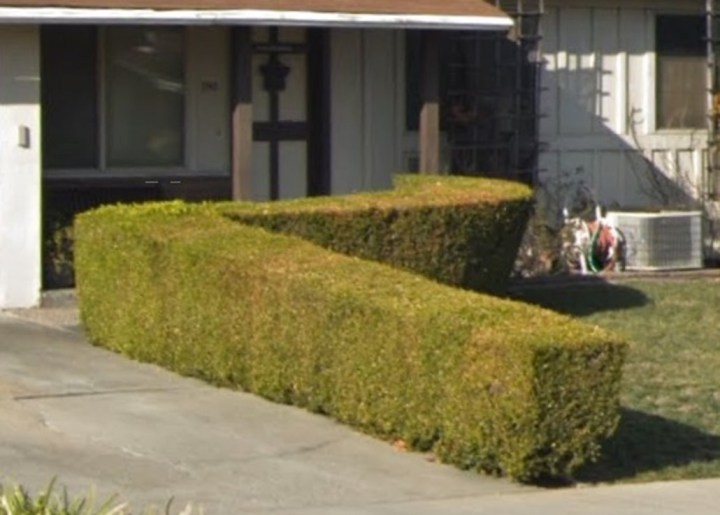
In the picture above, the low hedge seems to be well maintained. If it is a fat hedge, it is in a situation where it is not really crowding much. However, notice the width of the sidewalk. It is quite broad. Then there is a significant constriction where the hedge protrudes over the sidewalk. What is the point of so much concrete and such a wide sidewalk if almost a quarter of the width of it is overwhelmed by vegetation? It is like four lanes of freeway that merge into three, only to merge back into four.
 Those of us who appreciate olive trees for their fruit production or distinctively gnarly trunks probably would not understand the popularity of the Little Ollie olive, Olea europaea ‘Little Ollie’. Not only is is completely fruitless, but it lacks sculptural trunks and limbs. It is instead a short and and shrubby plant that gets only about three or four feet tall, with very dense grayish green foliage. Only the narrow evergreen leaves are recognizable as those of an olive tree.
 While flashier but typically weaker modern cultivars of so many other specie are being developed, the most popular of the many cultivars of English boxwood, Buxus sempervirens, remain the same. There is not much to improve on. Most cultivars get only a few feet tall, and are densely foliated with inch long evergreen leaves that are excellent for topiary and low formally shorn hedges.
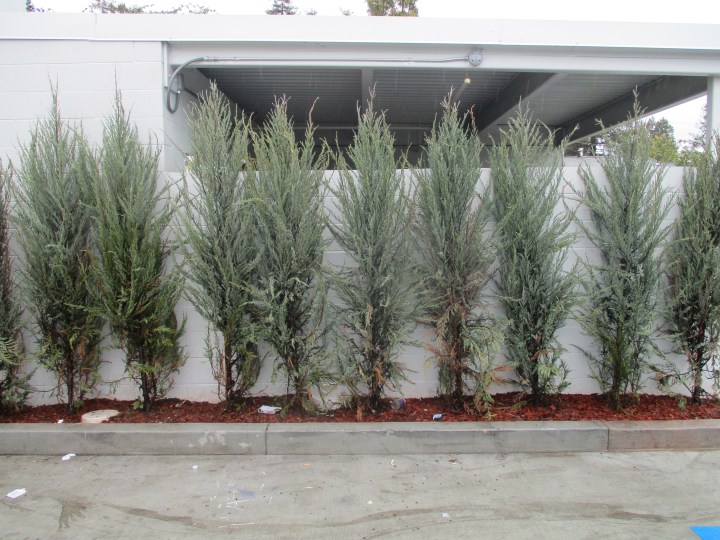 Back when horticulture was still respected, a very long time ago, dense shrubbery with finely textured foliage, such as Japanese boxwood, could be purchased already shorn into cubes that only needed to be installed in a closely set row to become an ‘instant hedge’. For some small hedges composed of small plants that recovered efficiently from transplant, it actually worked reasonably well, even if they did not look so great at first. It also worked for a few larger shrubs that happened to transplant very easily, such as glossy privet. Tall arborvitaes happen to work exceptionally well as instant hedges, although the best spacing for them leaves temporary gaps in between.
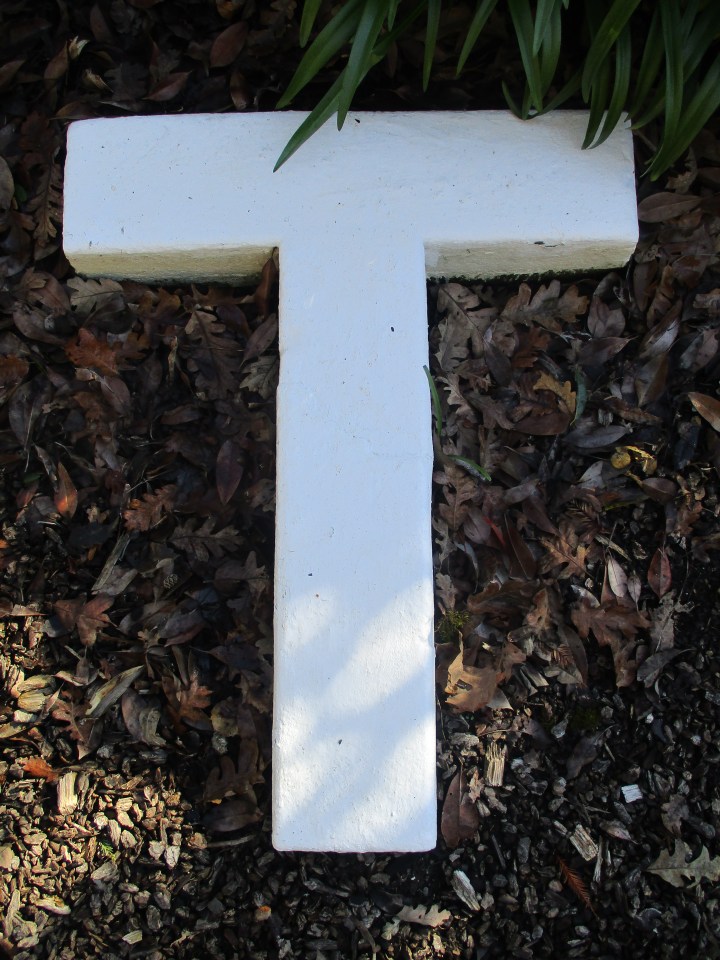 Today’s episode is brought to you by the letter ‘T’.
 Autumn is for planting . . . but not much else. While it is important to get certain new plants into the garden before cool and rainy weather, other gardening chores will not be necessary while plants are becoming less active before winter dormancy. Raking falling leaves is probably the biggest of the new chores that are specific to autumn.
 It was so long ago that I barely remember it. I was just a little tyke. My older sister tripped on the driveway and broke one of the Japanese boxwood shrubs in the hedge on the edge of the driveway and front walkway. The hedge was still young then, and not completely filled in. My Pa replaced the missing shrub shortly afterward, but not before my younger brother and I learned that the gap was a shortcut through the hedge. The puny new shrub was not enough to compel us to go around like we had done before. Of course, it did not survive for long. It too got broken off.
 Baldness was not yet cool while Brent and I were studying horticulture at Cal Poly in San Luis Obispo back in the late 1980s. Nor were hairpieces yet tacky. Consequently, some middle aged men work toupees. As these men aged and grayed, their formerly well matched topees did not.
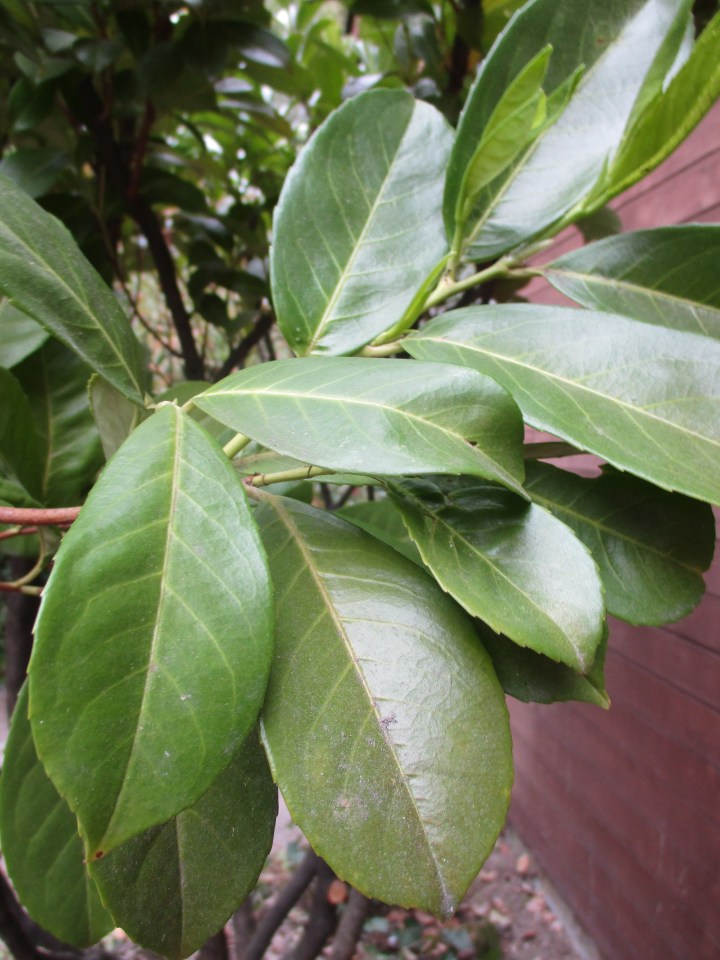 There is a reason why the most popular specie for frequently shorn formal hedges have small leaves and finely textured foliage. Technically, a formal hedge of cherry laurel, Prunus laurocerasus, can be shorn as well, but should be shorn only once or twice annually, and then allowed to fluff back out. Otherwise, the big leaves get shredded as quickly as they recover from previous shearing.
 The pros and cons of wax privet, Ligustrum japonicum ‘Texanum’ might get it a rating of about 2.5 out of 5. It seems that every asset is offset by a liability. The profuse clusters of tiny white flowers are sweetly fragrant, but are also a serious problem for those allergic to pollen. The berries attract birds, but are also very messy, and contain seeds that can germinate in the strangest of places.
