Hazards

Horticultural industries are innately hazardous. Most horticultural professionals work outside in all sorts of weather, regardless of what that weather might be; stormy, cold hot and so on. Some of us who grow horticultural commodities might occasionally work with hazardous chemicals, and many of us work exhaustingly long hours, and sometimes in the dark of night. Those who work with landscapes might also work with the same chemicals, as well as potentially hazardous motorized tools. Arborists work with the most hazardous machinery, as well as dangerously heavy debris falling from great heights, and those who climb do their work dangerously high above the ground. Then there is this, which sounds much worse than its bad punctuation. “!PLEASE DO NOT! SIT (I WAS HIT BY A STRAY METEOR)” It sounds like all sorts of bad! I do not know what is worse, sitting or a stray meteor. It is not actually a horticultural concern, but the implication is that whatever happened, it happened on this now broken bench that was formerly located within one of the landscapes that we work in. I suspect that the bench merely broke because it was deteriorated by the weather, which is a concern of meteorology.

Shopping Around For Various Nurseries

Real nurseries have the best plants.

The differences between nurseries and garden centers within big box type home improvement centers should be more obvious. Contrary to all the fancy marketing, a big box garden center really is just another of many departments within a larger home improvement center. A good nursery specializes in plants, and only plants. A sales representative in a big box store might have been selling paint or refrigerators last week. A nurseryman in a real nursery works regularly and more exclusively with horticulture.

It is probably safe and most likely significantly less expensive to obtain common and resilient plants from big box garden centers. Crape myrtles (ick!), oleanders, pittosporums, junipers and photinias seem to be healthy regardless of their respective origins. However, more unusual varieties of more unusual plants, or plants that are likely to be damaged by a bit of neglect, are either unavailable or likely to be of inferior quality in big box garden centers. Only the most common and resilient cultivars (varieties) of rhododendrons, flowering cherries, flowering dogwoods and fuchsias are marketed. If they get damaged, the damage may not be noticed by the possibly undiscriminating staff.

Nurseries are not only able to maintain their stock better, but can maintain a much more extensive selection of different types of plants. The more finicky types of ferns, columbines, azaleas and Japanese maples are no problem. Experienced horticulturists are familiar with the plants that they work with, and can make recommendations for those who might need help with selection. The prices are often more expensive, but are justifiable to those wanting specific plants that can not be found elsewhere.

A few wholesale nurseries that procure nursery stock for the landscape industry are open to the public for retail. Their retail (not wholesale) prices can be comparable to those of big box garden centers. The selection is different, which means that they lack many plants, but have a few others that the big box garden centers lack. They have plenty of horticultural expertise, but not much sales staff.

Horticulture – It’s What I do.

P00506
Rhody, . . . because everyone loves Rhody, . . . and this is not about horticulture anyway.

This is not a misspelling of a misspelling. There is no misspelling of “Horticulture” in the title this week. “Horridculture” is typical of my rants on Wednesday. It is not the only deviation from the norm here. I included the contraction of “It’s” in the title. I have been trying to relax my otherwise objectionably uptight writing style; but a contraction in the title still makes me cringe.

Horridculture – It Is What I Do Not Do.” would be consistent with my style, but silly, and not so relevant to the subject matter. I am a horticulturist, arborist and garden columnist. I enjoy what I do very much, which is why I made a career of it. It is demanding work though, and does not afford much time for blogging. The quality of my blogging is consequently compromised.

I still work as many as three days weekly at a job that was supposed to be temporary two years ago! It is so excellent that I can not bear to leave, although I must eventually do so. It entails the maintenance of many acres of landscapes and forest at a Christian Conference Center. We have been unable to work for the past month, so will be busier than typical as we resume work.

Mondays and Tuesdays are my days for writing my weekly gardening column. I should probably retire from this work, but enjoy it so much, and would prefer to instead expand it into other publications to fill in the gaps between San Francisco and Los Angeles. I do intend to simplify this writing, even if expanding it; so that I can do it all on Mondays like I used to not so long ago.

For more than the past two years, I have not inspected trees or landscapes for other arborists or landscape professions. There just is not sufficient time! I do miss that work, and composing reports for those who dislike writing. (Arborists and landscape professionals who enjoy their trees and landscapes innately dislike writing.) If I ever resume such work, it will be only rarely.

I intend to eventually return to the farm where I belong, and resume production of horticultural commodities. As much as I enjoy the rest of what I do, growing things is what I do naturally. It is why my ‘temporary’ job was supposed to be ‘temporary’ two years ago. It will involve even more demanding work than what I already can not keep up with, but it is what I need to do.

Therefore, I will have even less time to devote to blogging. I intend to continue to post my brief weekly gardening column in two parts on Mondays and Tuesdays, as well as old articles from the same gardening column in two parts on Thursdays and Fridays. I would also like to continue with Six on Saturday and other brief posts for Saturdays at noon, Sundays and Wednesdays.

I write for my gardening column weekly regardless of the blog. Old articles from the column are already written. Only new posts for Saturdays, Sundays and Wednesdays need to be written separately; so some or all will be omitted if necessary. What I must discontinue now is my involvement with the many compelling blogs that I have been following for the past many months.

I will not stop following any of the blogs that I presently follow. I will just not be able to read all of the posts, or interact with them like I had been. For me, it will be quite a weird adjustment. I feel obligated to read much of what others post into blogs that I follow. If someone puts effort into positing it, then it must be important. I certainly enjoy how others interact with my blog.

I certainly do not want anyone to think that I lost interest in their respective blog. Many of them provide ideas for what I should write about within the context of my own weekly gardening column. Insight into horticulture in other climates, regions and even cultures has been fascinating. This is merely something that I must sacrifice in order to continue on with my own writing.

Arborists’ View

P91026KArborists see trees very differently from how most of us see them. They know their trees very intimately, and by botanical name. Arborists know how big particular trees get, both tall and wide, and if they are likely to develop structural deficiency or aggressive roots. They can tell us which are deciduous, which are evergreen, and which are messy with foliage, bloom or fruit.
Some arborists are happy to divulge a bit of history of some trees, whether exotic or native. They might tell us where the exotic trees came from, and why they were imported. Some trees were brought for timber. Some were brought for fuel. Some were imported just because they were pretty. Some naturalized, and now impose on the natural ecosystem. Natives try to adapt.

Since they know the innate characteristics of trees, arborists know what their cultural preferences are. They know that some are understory trees that prefer the company of other bigger trees. Many others are those bigger trees, that want to dominate their respective landscapes. Some want plenty of water. Many of the natives do not want much more than annual rainfall.

An arborist might provide you with way more information than you ever thought you wanted about your seemingly innocuous trees.

Besides all that, arborists are a weird breed that really enjoy their work. Arborists like me simply enjoy diagnosing problems with trees, and prescribing corrective arboricultural procedures. Those who climb trees to execute such procedures are much more involved! Their work is as demanding as extreme sports, and they take it very seriously. They must. It is their profession.

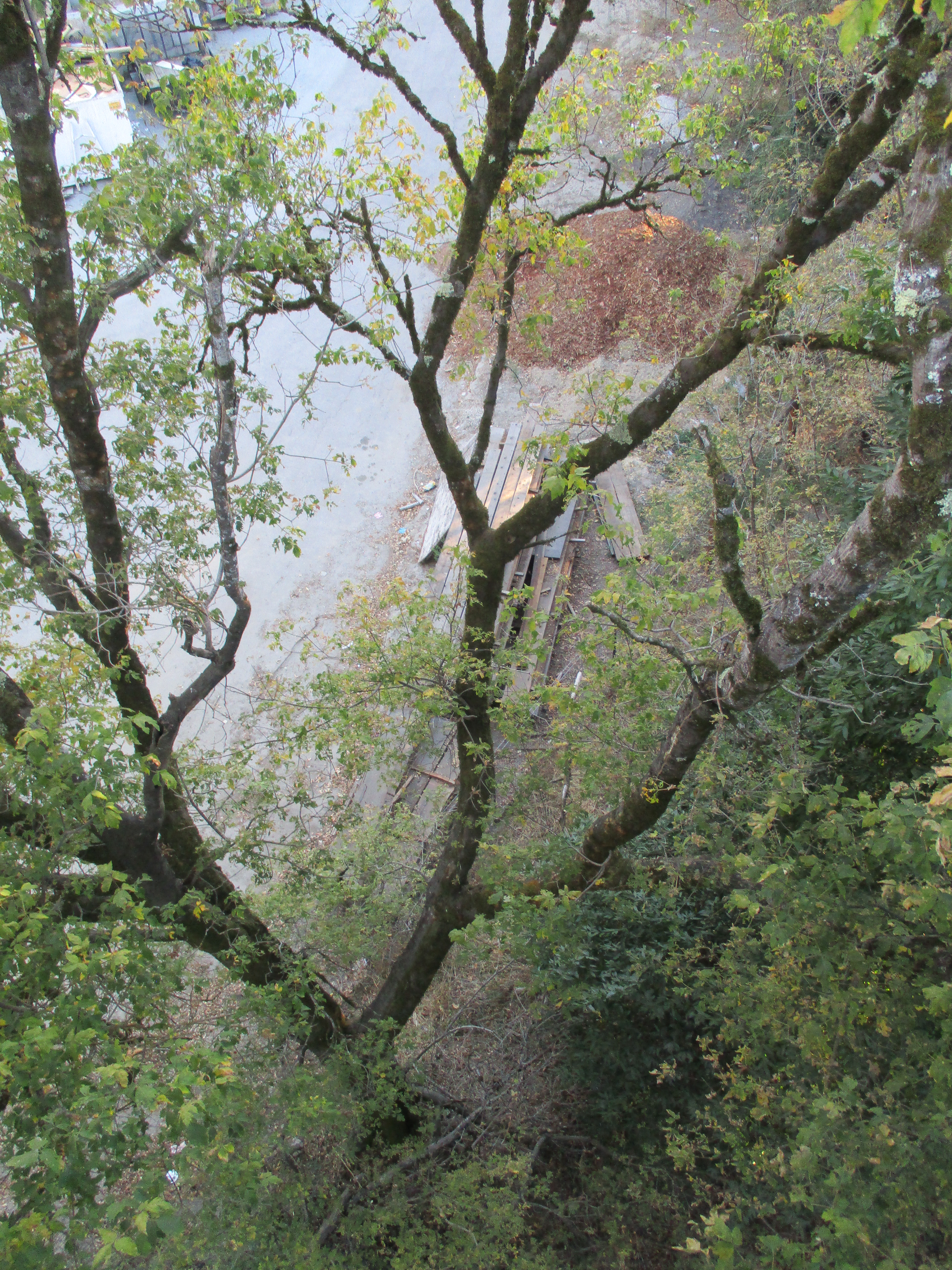
This view of a big box elder, Acer negundo, from above, which I got from the edge of a bridge, might be that of just another day at the office for other arborists.

Horridculture – Reputation

7

I earned it. For several years, back when newspapers were composed of a rather ingenious combination of both news and paper, I was a respected garden columnist, as well as a respected horticulturist and arborist. Of course, I was an a horticulturist and arborist first. I later started writing my garden column because I wanted to do better than what the professional columnists who lacked practical experience with horticulture were doing.
For someone who would have preferred to simply grow horticultural commodities back on the farm, the notoriety was an odd fit. I was often asked to be a guest speaker for all sorts of garden clubs, and to write about their events. For a few years, I was a guest of honor and staffed a gardening question booth at Spring In Guadalupe Gardens in San Jose. It was awkward to walk from where I parked to the booth, past a dozen or so posters with my picture and various quotes on them.
People read my gardening column because they wanted accurate and relevant information. Although I was not proficient at writing, I managed to maintain my integrity as a horticulturist and arborist. My expertise was respected.
Then, a ‘colleague’ who wanted to capitalize on my notoriety convinced me to work for him while he established a website for me. I agreed, along with the stipulation that the website conform to my discriminating standards.
That stipulation was ignored. The website was embarrassingly flashy, with pictures of tropical plants that would not survive as more than houseplants in California. The grammar and spelling were deplorable. Articles were modified to be relevant in any season, just in case, for example, someone was worried about frost in the middle of summer. My ‘manager’ was not at all concerned with horticulture, but was instead more interested in installing advertisement for his products into the website.
About that time, I was invited to install a landscape into the 2009 San Francisco Flower and Garden Show. I would have declined, but was encouraged to compose a landscape to promote the new website. The landscape was ‘adequate’, and did happen to feature an excellent reproduction of an old windmill that my ‘manager’ happened to procure. However, the real priority was showcasing the products that my ‘manager’ was marketing, including a rainwater harvesting system. Within our limited space, we had a big black vinyl water tank! Instead of getting a vendor booth at the show, he used the landscape to pimp his products and services! It was mortifying! The fact that my modified design won awards seemed to make it even worse, as if to justify out extreme gaucheness!
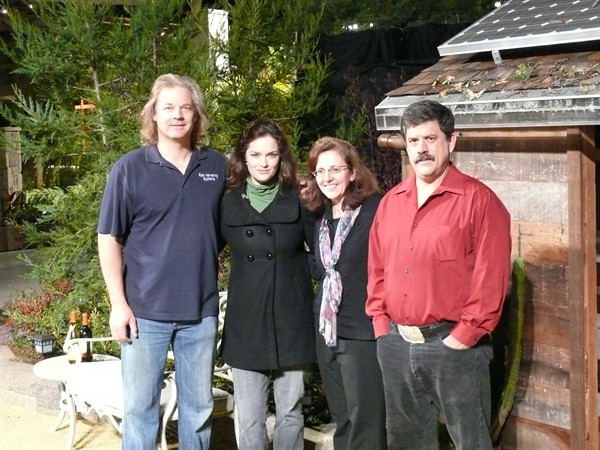
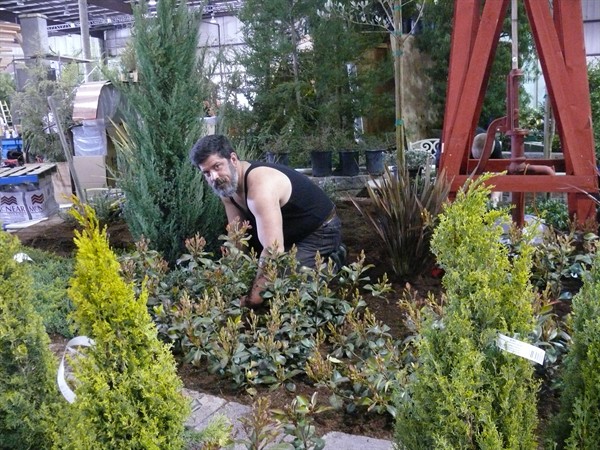
It took a few years and the assistance of an attorney to get the ‘manager’ to close down and delete what was supposed to be my website, but was merely a collection of links back to websites and advertisements for what the ‘manager’ wanted to sell. Otherwise, anyone searching for me online would still be directed to products and services that I want nothing to do with, but seemingly endorse. Even now, these two images above and below would be at the top of the list of a search for images of Tony Tomeo on Google. They are from the 2009 San Francisco Flower and Garden Show, and are now associated with a website with which I have absolutely no affiliation. I want nothing to do with such unethical standards.
The picture above was taken within the landscape just before the Show opened to the public. The black vinyl tank is visible in the background. The picture below was taken during the assembly of the landscape, before I had shaven and gotten appropriately dressed.

8

Career Counseling

P71206This is not a sequel to my rant ‘Real Deal’ from yesterday. It is just another rant. I should write more such rants; and I am actually considering designating Wednesday, as the day for discussion of the various hooey in horticulture, from some of the many fads and gimmicks to the lack of professionalism in the horticultural industries. Wednesday is the day between my current gardening column articles and the gardening column articles that are recycled from last year. There is certainly no shortage of hooey to discuss. I have been mostly polite about it so far. I sometimes wonder why I should bother with politeness. I sort of think that some would prefer more honesty than such unfounded pleasantries. Well, I can give more thought to that later. There are still a few more pleasant topics that should be discussed as well. For now, I will continue:

Many years ago, while driving the delivery truck, I took a few orders to various jobs of a particularly annoying ‘landscape designer’ in Contra Costa and Alameda Counties. His orders were never planned. He would come to the nursery and just pick out random plants that he thought were interesting, including many that happened to be on the side of the road waiting to be taken away for disposal. (Overgrown and disfigured rhododendrons that get junked often bloom better than plants of better quality because they are more mature.) His landscape design was planned in the same manner. He just planted things wherever he though they looked good. There was no thought to the preferences of the various cultivars, exposure, irrigation, the trees above . . . or anything. He landscaped right around whatever happened to be in the way, including dead trees, fences overwhelmed with ivy, and dilapidated carcases of old brick barbecue pits that were beyond repair. I really disliked being on his job sites.

During one such deliver, he explained to me that he had been a chiropractor. He got bored with his career, and decided to do something more fun, so decided to become a landscape designer. He enjoyed buying pretty blooming plants in nurseries and wearing khaki shorts and big straw hats to work like all the landscapers with something to prove do.

My comment to him was that my career as a horticulturist was so much hard work and so frustrating at times that maybe I should also consider a career change. Perhaps I should consider becoming a chiropractor. If someone without ANY education or experience in horticulture or design . . . or anything even remotely useful in the landscape design industry can become a landscape designer, than it should be just as easy to become a chiropractor, despite a lack in formal education or experience in the industry.

He did not like that comment.

Arboriculture: Deep Space Nine

P71231The “Poly” in Cal Poly is for “Polytechnic”, as in there are multiple schools within “California Polytechnic State University” at San Luis Obispo. There were seven school when I was there between 1985 and 1990. I was a student of the “School of Agriculture”. “Horticulture” was my “Major”, or major realm of study within this school. Within this major, I selected “Floriculture and Nursery Production” as my “Concentration” of study. That certainly is a lot of quotation marks.

While majoring in horticulture at Cal Poly, I studied with students whose concentrations of study were within “Landscaping” or “Floral Design”. Withing the School of Agriculture, we studied with students who majored in “Crop Science” or “Animal Science” and so on. Like horticulture, each of those other majors was divided into other concentrations.

Then there were all those students of the other six schools, which I will not even get into because I am wearing out the quotation mark key.

In the summer of 1988, while many of my colleagues were going to Australia, New Zealand or South Africa for their internships, I stayed right here in California, and took a job with a Lee’s Tree Surgeons in Saratoga. My colleagues thought that was a bad idea. Not only was that sort of internship for those in the landscaping concentration, but it was for the lowliest among them. They climbed trees and used chain saws and ropes and such. They were primitive. They were barbaric. They were not like us.

As it turned out, I was not like them. Fortunately, they did not mind. They took very good care of me, and trained me as best they could about arboriculture in the three months I was with them. They realized pretty quickly that I was not a good candidate for the job they gave me, but made accommodations for me. Although I was never proficient at climbing, and was not really good for much at all during that summer, I later went back to work for some of them, and eventually became a somewhat proficient groundsman; but that is another story for another time.

In my fourth year at Cal Poly, San Luis Obispo, after my internship with Lee’s Tree Surgeons, I relocated from my semi-rural home back into town, and lived in a big apartments with three roommates. We made a tradition of watching “Star Trek: the Next Generation” on television. One of the roommates, who is now a very respected professor at Cal Poly, made cornbread for the weekly event. Although I did not continue the tradition after we all graduated and went our separate ways, I did sometimes watch “Star Trek: Deep Space Nine” when it came out a few years later. I really need to stop with the quotation marks.

In Star Trek: Deep Space Nine, I liked the concept of so many different species living together in an society in which it was very necessary to make accommodations for those who are different. Everyone needed to respect everyone else. Some even learned to appreciate the differences. Even the bad guys had redeeming and very often likeable traits.

In my career, I am primarily a nurseryman. That means I grow things. Other horticultural professionals might compare my people to the Vulcans. They think that we are too uptight, efficient and plain to be much fun. Factory growers (who work for the big corporate growers) would be more like Romulans, and are therefore less dedicated to what is right and logical if it is to their disadvantage. Some of the better artistic landscape designers are likened to the Bajorans. Unscrupulous maintenance gardeners who will do what they must to make a buck are comparable to the Ferengi. Some of them work for the larger and imperialistic Cardassian landscape corporations.

Arborists are the most excellent of all; or perhaps the second most excellent after Vulcan nurseryman. They are like the Klingons; honorable, noble, independent, passionate and boisterous! I can understand why my colleagues think of them as barbaric and primitive, but I also believe that my colleagues should be more accommodating. When I consider what arborists must have though of me what I did my internship, I realize that it must not have been easy for them to accommodate me. Yet, they did, and in the most excellent way. They still respect that I have my own career in my own world, but to this day, thirty light years later, they are still pleased to invite me to their world.