Tornado

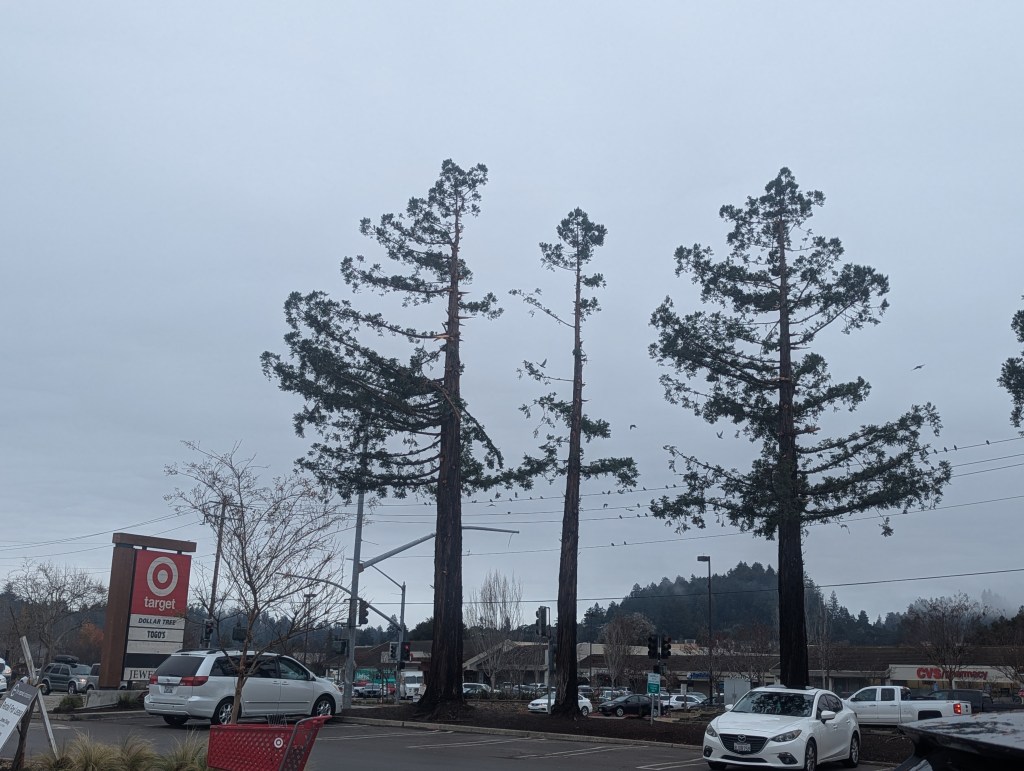
The tornado that stripped these redwoods landed right on Target. Notice the sign to the lower left.

The weather here may seem boring to those who are acquainted with other climates. It gets neither too warm nor too cold. Rain is limited to the relatively short rainy season. Humidity is minimal. Snow is so extremely rare that I can remember it only once in the Santa Clara Valley during my lifetime, and it was only half an inch deep. Tornadoes are about as rare, or at least they were. I can now remember two here, which is twice as many occurrences of snow that I can remember. Shortly after half past one last Saturday, rain, which had been falling for a while, suddenly became torrential, then instantly stopped, then instantly became torrential again. I stepped outside with Rhody to observe, and noticed Heather, Rhody’s feline ‘associate’ who prefers to stay inside during such stormy weather, had also come outside to observe, and was staring to the south. When I looked to see what she was looking at, I saw that not only were dark clouds speeding to the east, but that a portion of them was backtracking, as if swirling. My comment to Rhody and Heather was something like, “Well, at least tornadoes do not happen here.”. A few minutes later, a tornado did happen, right on Target, literally. It landed right on the Target store in Scotts Valley, less than two miles away. It was rated as an EF1 tornado, which apparently means that it was rather minor. It lasted for five minutes, though, while travelling only about a quarter of a mile. That is much slower than the clouds that we observed only a few minutes earlier. Fortunately, injuries were minimal, although a few cars were tossed. Utility cables, streetlamps and traffic signals were thrashed. So was much of the vegetation of the urban landscape.
Aridity Is Opposite Of Humidity

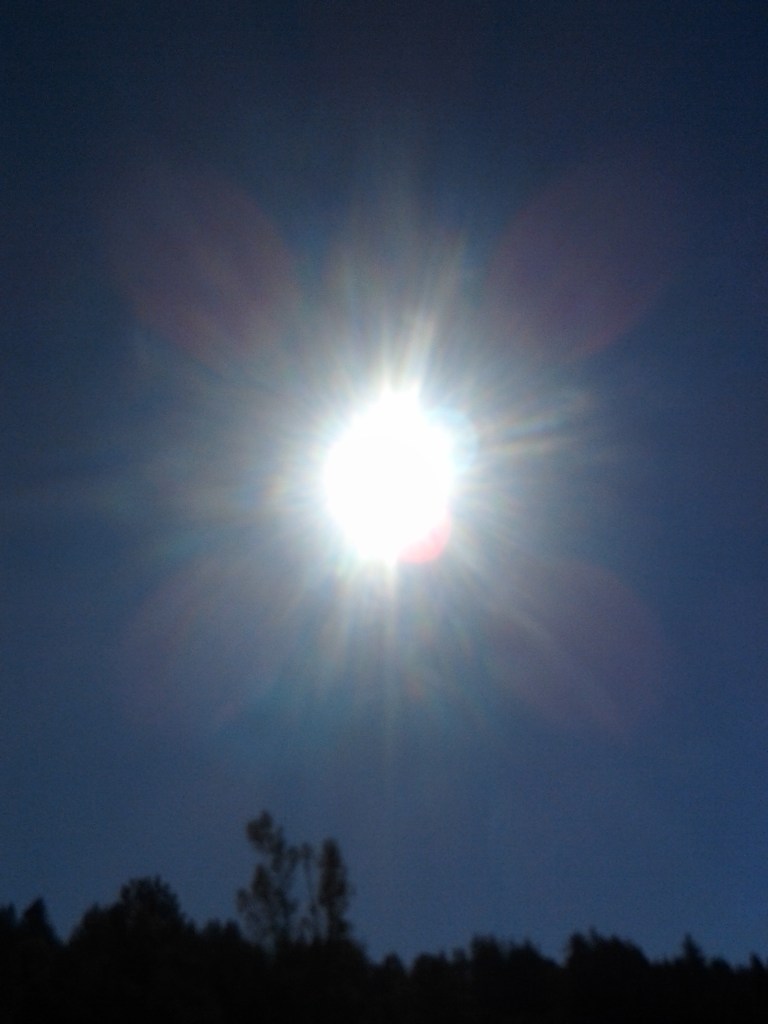
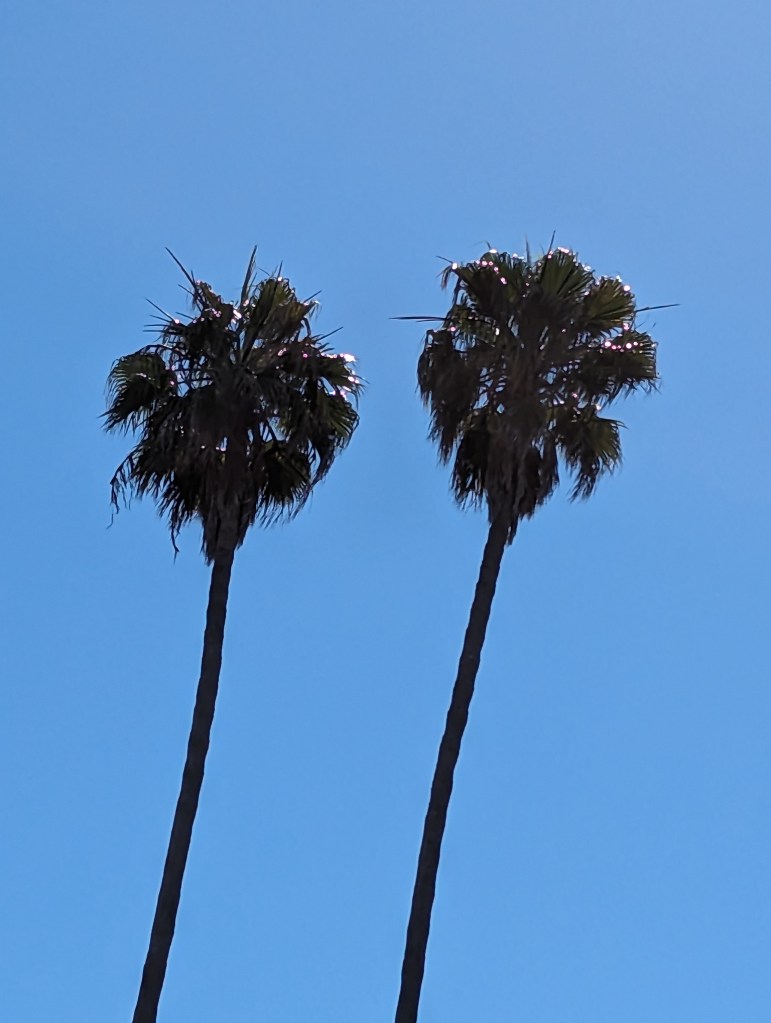
The sky is bluer with aridity.

Aridity is a measure of humidity. Humidity is a measure of aridity. Although opposite, they are similar. Humidity is the quantity of water vapor that is suspended within the air. Aridity is a deficiency of humidity. They are components of weather that are more likely felt than seen. Although, aridity clarifies the air, which typically causes the sky to seem more blue.

Of all components of weather, only atmospheric pressure is less tangible than aridity. It is measurable with instrumentation, but perceptible to very few. Except for its clarification of the sky, aridity is just as invisible. It is more perceptible, though. Just as humidity inhibits dissipation of heat, aridity promotes it. Therefore, arid heat feels cooler than humid heat.

That is why the West Coast is famous for its delightfully arid weather with sunsets. Even when the weather here is warmer than elsewhere, it may be more comfortable. Although undesirable, smog and smoke from forest fires provide color for clear sunsets. Temperate arid weather is more conducive to gardening. However, some vegetation might disagree.

Fragrant flowers can not disperse their fragrance quite as effectively during arid weather. Nor can aromatic foliage disperse its aroma quite as effectively. A few varieties of colorful foliage and flowers may fade a bit faster with minimal humidity. After all, most vegetation within home gardens is originally from more humid climates. It naturally enjoys humidity.

More importantly, most vegetation needs more water through arid weather. It loses much more moisture from its foliar surfaces at such times. Any breeze, which people might like, exacerbates loss of moisture. Obviously, warmth does also. Automatic irrigation requires appropriate adjustment as weather changes. Manual irrigation may become demanding.

Irrigation is less demanding for species that actually prefer local Mediterranean climates. Many of such species are native. Most are native to other regions with similar climates. A few are native to climates that are more arid, but tolerate a bit of extra moisture. Weather and climate do not adapt to a garden. It is best to cooperate with climate than not.

Unhappy Fishtail Palm

Now that the foliar color has improved, the foliar density is deteriorating.

Fishtail palm is never completely happy here. It is not much happier in Southern California. Even the happiest are discolored to a minor degree. Many are more significantly discolored. Some are so very discolored that they are visually unappealing.

No one seems to know why. I suspect that they would prefer more humidity. Perhaps they prefer more humid warmth. They may dislike the pH of the soil.

Furthermore, fishtail palms are monocarpic. Each trunk dies after bloom. Clumping sorts develop new trunks prior to the demise of a blooming trunk. Those that do not develop replacement trunks die completely.

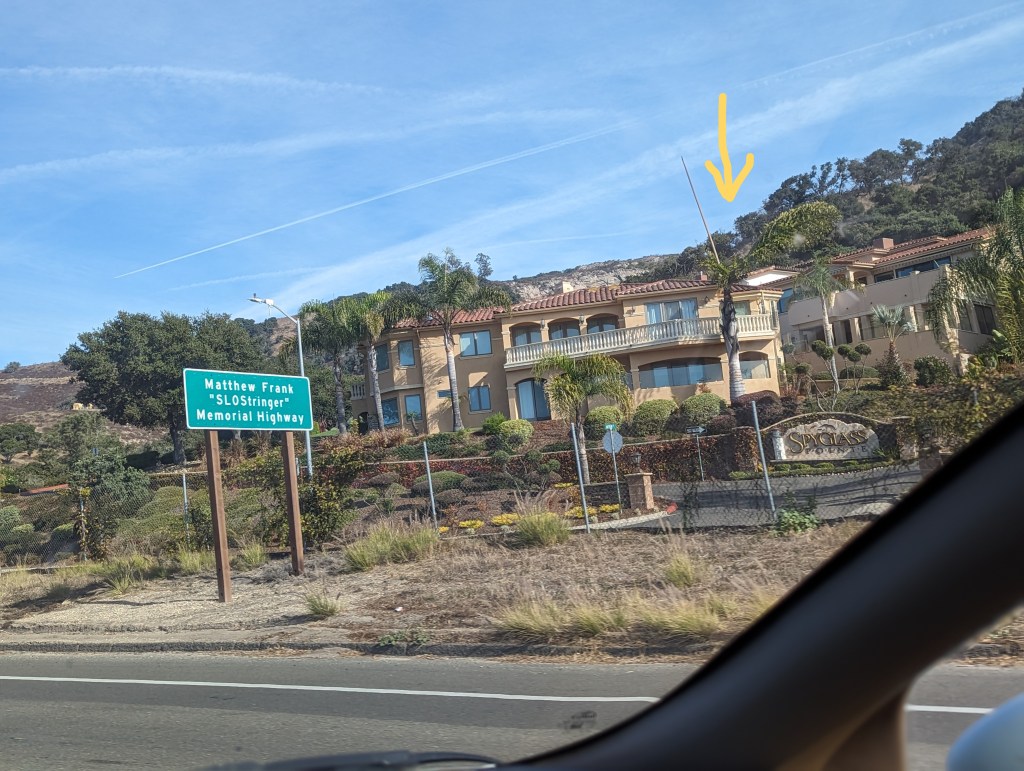
The illustration above is obviously not of exemplary quality. I took it from the car while driving. This was on northbound Highway 101, at the northern extremity of Pismo Beach. The palm to the upper left of the sign for Spyglass Pointe, with the yellow arrow pointing at it from above, is a fishtail palm. Until recently, it had been famously chlorotic.

Colleagues who drove through Pismo Beach typically asked me about this palm after seeing how chlorotic it typically had been. This it he least chlorotic that I have ever seen it. However, it may be naturally deteriorating after its primary bloom. Although I have not observed any bloom, I can see that new leaves are not developing on the same rate that They had in the past. This picture shows it with only a single open leaf, with another foliar spike extending from the terminal bud.

This particular fishtail palm is not very old. I can remember when the associated residential buildings were constructed less than two decades ago. landscapes and associated trees were added shortly afterward. Since then, the fishtail palm had been unhappy. This likely why fishtail palm is not more commonly available here than it is.

Humid Weather is Atypical Here

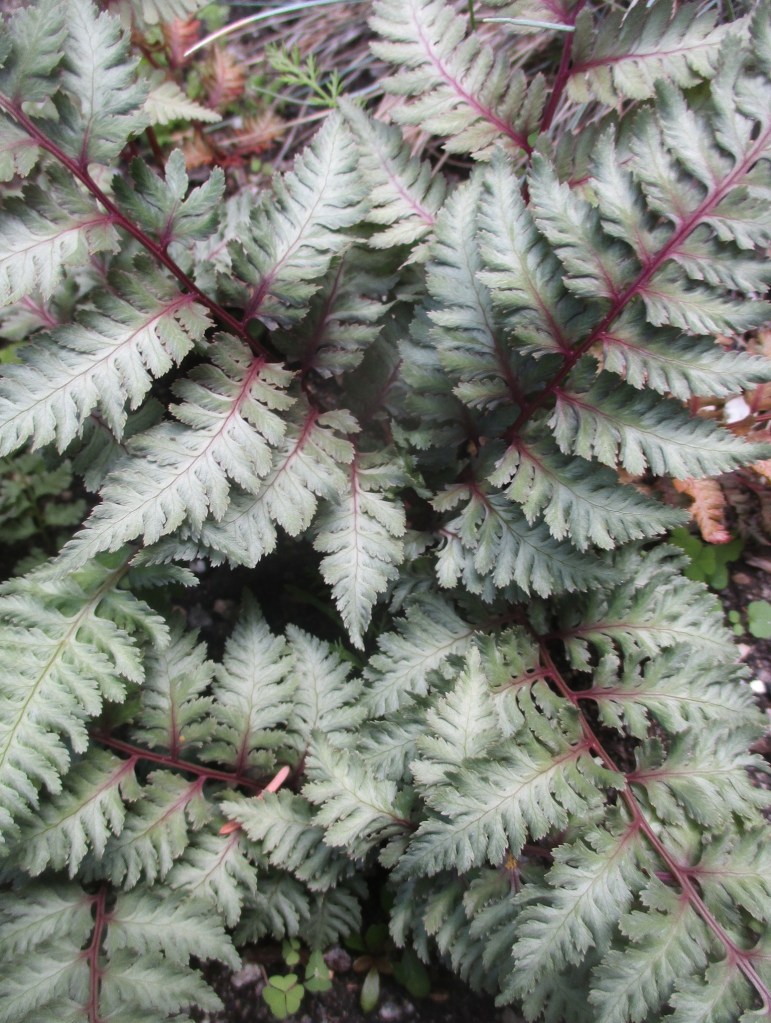
Ferns generally appreciate humidity with warmth.

Aridity is the opposite of humidity. It is why summer warmth is not as unpleasant here as in humid climates. It does not get so much consideration though. Most of the populace of California inhabits arid chaparral or desert climates. Aridity is so typical that any absence gets more attention. Humid warmth is both uncomfortable and relatively uncommon here.

Hurricane Hilary recently demonstrated how unusual humid weather can be here. It was merely a tropical storm as it left Mexico, but was significant nonetheless. Humidity briefly remained elevated after torrential rain in Southern California. It may have lingered longer in regions that lacked rain in Northern California. It caused warmth to seem a bit warmer.

This humidity would have been more horticulturally influential if it had lasted a bit longer. Obviously, irrigation is temporarily unnecessary for saturated landscapes. Some flooded. Some simply absorbed rain. Less obviously, landscapes that received no rain need a bit less water with humidity. Humid weather reduces evaporation from active foliar surfaces.

Humidity also reduces the volatilization of floral fragrance. Fragrant flowers are therefore more fragrant during humid weather. Delicate floral structures also last a bit longer. Many flowers are more turgid and colorful with humidity. All sorts of foliage, particularly tropical foliage and fern foliage, is more lush. After all, most vegetation is from less arid climates.

Humidity influences allergens also, both positively and negatively. Some allergens, such as fungal spores, are more abundant with humid weather. Some allergens, such as dust and pollen, are more abundant with less humidity. That is why humidifiers are helpful for dust or pollen allergies. It is also why dehumidifiers are helpful for fungal spore allergies.

Spontaneous limb failure can be another consequence of humid warmth. It is hazardous because it occurs very unexpectedly without wind. Warmth accelerates vascular activity, which increases foliar weight. Humidity with slow air circulation inhibits evaporation from foliage. If unable to shed enough weight, foliage becomes too heavy for limbs to support.

Arid Weather Increases Water Consumption

Chaparral vegetation naturally tolerates arid weather.

Superbloom is brief for two main reasons. It involves native species that know to bloom quickly before arid weather of summer. Also, wildflowers in the wild receive no irrigation to sustain bloom through arid weather. With irrigation, some of such species are capable of prolonging bloom. A few can disperse seed for subsequent generations to bloom later.

That is why California poppy blooms for a longer season within home gardens. It easily performs through much of summer with irrigation. Also, with irrigation, it might regenerate to bloom for autumn after summer dormancy. Seed from earlier spring bloom might grow to also bloom for autumn. Some godetias and lupines perform similarly within cultivation.

Most species within home gardens are exotic though. In other words, they are not native. Those that are native to a similar mediterranean climate respond similarly to cultivation. Generally, some from desert climates do so also, although many dislike extra irrigation. The majority of exotic species actually rely on some degree of cultivation and irrigation.

Such species are native to climates with cooler and less arid weather through summer. Rainfall here is too limited to winter to sustain them through summer. Minimal humidity and warmth increase the need for moisture while it is least available. Cooling summer breezes actually accelerate desiccation. Arid weather certainly has its disadvantages.

As spring relinquishes to warmer and drier summer, irrigation becomes more important. Frequency and duration of automated irrigation must adjust to increasingly arid weather. Shallow root systems, such as those of turf grass lawns, require more frequent irrigation. Deep root systems, such as those of maturing trees, require more voluminous irrigation.

However, irrigation should not be so excessive that soil remains saturated. Many mature trees and shrubs need none at all. Some receive enough from what adjacent vegetation does not consume. Some are satisfied with only occasional irrigation. Turf and annuals require the most frequent irrigation. Yet, even they can rot if their soil is always saturated. Calibration of irrigation requires diligence.

Arid Climates Can Be Challenging

Some plants shrivel in arid warmth.

‘Mediterranean’ translates as an adjective that describes being at the middle of the Earth. Those who inhabited that region many centuries ago considered the Mediterranean Sea to be central to their World. That was long ago and far away. Nonetheless, climates here and now are somehow Mediterranean. Maybe semi arid climates of Italy are Californian.

Mediterranean climates are temperately warm with dry weather through summer. Rain is almost exclusive to a rainy season between autumn and spring. Although rain can briefly get abundant during the rainy season, the average annual rainfall is modest. Humidity is minimal for much of the time. Arid warmth is more comfortable than rarely humid warmth.

Desert climates accumulate less than ten inches of rain annually. Local climates receive more than fifteen inches of rain annually. They are therefore not sufficiently arid to qualify as desert climates. Technically, they are only semi arid chaparral climates. This climactic designation is perhaps more appropriate than the regional designation of Mediterranean.

Native plants and plants that are native to other chaparral climates are naturally pleased with the local climate. However, some initiate at least partial dormancy to survive through the long and arid summers. They may bloom early, but then partially defoliate for several months. Some delay dormancy if watered. A few dislike watering. It is unnatural for them.

Most plants in home gardens are not native to chaparral climates. They require watering to compensate for aridity during summer. Minimal humidity accelerates evaporation from foliar surfaces, which increases the demand for moisture. In conjunction with warmth and wind, aridity can desiccate foliage. Like people and pets, plants must maintain hydration.

Humid warmth that is less comfortable for people and pets is more comfortable for plants than arid warmth is. Humidity inhibits evaporation from foliar surfaces so plants consume less moisture. Incidentally, most pathogens, such as fungal diseases, bacterial diseases and most insects, also prefer warm humidity. People and pets seem to be in the minority.

Humidity And Wind Affect Heat

Heat is more than mere temperature.

Gardening is not so much fun when the weather gets as warm as it has been recently. It is more comfortable to stay inside with air conditioning, or at least where it is shadier. The plants out in the garden are on their own. Except only for those that are potted, they do not have the option of coming in out of the heat.

Most plants actually do not mind the sort of heat that is uncomfortable for us. Some actually enjoy it. The problem is that heat often occurs in conjunction with other weather conditions that can collectively become really unpleasant for plants.

Minimal humidity makes otherwise unpleasantly warm weather more comfortable for us, but can desiccate foliage that prefers more humidity. Japanese aralia, fuchsia, rhododendron, split-leaf philodendron and many other plants that should not mind warmth can get roasted if warm weather is also too dry. Because sunlight enhances the process, exposed foliage is much more susceptible to damage. To make matters worse, sunlight is more penetrating through clear dry air.

Wind that makes us feel a bit cooler in warm temperatures can likewise cause desiccation as it draws more moisture from foliage. Finely textured plants like Japanese maple, many ferns and some grasses, are particularly susceptible. Offshore wind, like the famous Santa Anna Winds of Southern California, are the worst, because they come in both hot and dry from more arid inland areas, combining all three factors of minimal humidity, heat and wind.

Many of the plants that are susceptible to damage from heat happen to be tropical or subtropical plants that typically enjoy heat as long as the air is humid and still. Others are ‘understory’ plants that naturally live in the shelter of higher trees, so do not like direct sun exposure or wind. Yet, even substantial trees, like fern pine (Podocarpus spp.) and even redwood, can get a bit roasted if the weather gets hot, dry and windy enough.

Conservation of water makes warm weather even more uncomfortable for sensitive plants. They really want more water to keep their foliage and stems well hydrated. Hosing ferns and grasses when things get really hot helps to cool the foliage, and briefly increase the ambient humidity. Because thin young bark is more susceptible to sun-scald in hot weather, pruning that would expose more bark should be delayed until the weather turns cool again.

Humidity Is The Other Weather

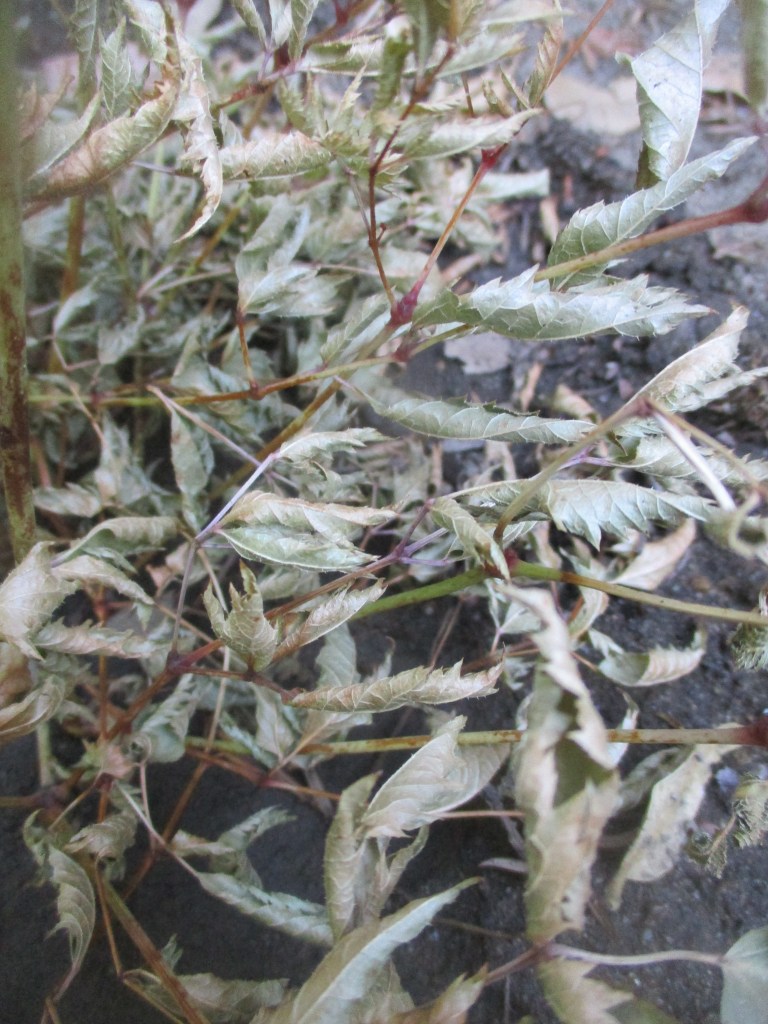
Some delicate foliage prefers more humidity.

It is difficult to always ignore the weather. Regardless of how pleasant it typically is here, it sometimes gets warm or cool. It occasionally gets hot or cold. Rain is wet and perhaps messy. A breeze is comforting while the weather is warm. Strong wind can be damaging. However, humidity is one major component of local weather that gets little consideration. 

Humidity gets more consideration in climates that are either uncomfortably humid or arid. Some parts of Florida get famously humid and hot simultaneously during summer. Some flora and insects enjoy such weather. Unfortunately for the rest of us, humidity enhances the already unpleasant heat. Locally, hot or warm weather is rarely bothersomely humid.

Similarly, local weather is rarely unpleasantly arid (lacking humidity). This is a chaparral climate, which is ‘semiarid’. Relatively minimal humidity makes heat a bit more tolerable than it would be with more humidity. Yet, humidity is generally sufficient to sustain foliage that would desiccate in a more arid desert situation. Actually, this is an excellent climate.

Although, it is not perfect. Flora and fauna have different standards for exemplary climate and weather. The relatively minimal humidity that makes uncomfortably warm weather a bit more tolerable for people and animals is much less appealing to some plants. Except for those that are native to desert or chaparral climates, most plants prefer more humidity.  

Many popular plants are understory plants, that naturally live in the partial shade of taller vegetation. With shelter from desiccating arid wind and harsh sunlight (to enhance heat), most do not mind heat. Otherwise, foliage might roast. Those with finely textured foliage, such as astilbe, ferns, grasses and some Japanese maples, are particularly susceptible.

Some tropical and subtropical plants, such as split leaf philodendron and fuchsia, prefer to be understory plants here, even if they would prefer more exposure within their natural ecosystems. The shelter provided by more resilient vegetation compensates for deficient humidity. Furthermore, adequate irrigation promotes healthy hydration of delicate foliage. 

Daphne

P00215K
Bloom worthy of a Scooby Snack

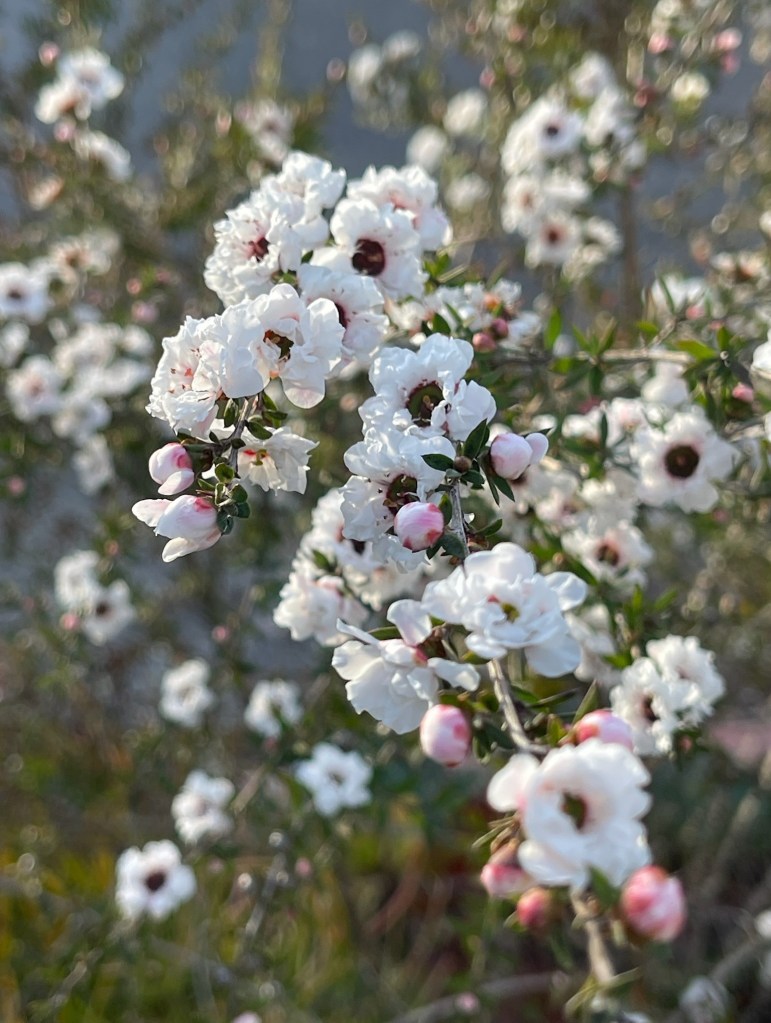
Jeepers!! As Daphne Blake’s colleague, Fred Jones, might say, “Looks like we’ve got another mystery on our hands.” What got into this Daphne odora ‘Aureomarginata’?! It rarely performs so well here, particularly so soon after being planted into a new landscape. This particular specimen, and about three others nearby, were planted as they finished bloom less than a year ago.

Since their season began, I have been commenting to those who share pictures of theirs, that such healthy and prolifically blooming daphne is enviable to those of us who do not live within a climate that is favorable to such performance. I know that this diminutive floral truss is not exactly exemplary compared to those of other regions, but for this region, it is almost spectacular.

The aroma is exquisite! It is everything that the rest of us grow daphne for, and is enhanced by the delightful but unseasonably clear and warm weather. Surroundings forests dampened by rain almost a month ago maintain just enough humidity for the fragrance to disperse. If it were not such a distinct fragrance, I would be wondering where it is originating. It is so unexpected.

Those in other regions believe that we can grow a more extensive variety of species here where winters are relatively mild. For some, that might be true. However, there are many climactic factors that limit what can be grown in every region. Species that require sustained chill in winter are not very happy here. For daphne, minimal humidity might be what they dislike locally.

Perhaps daphne happens to be happy in the particular location, next to a stream that enhances humidity much of the time when there is not much breeze. Perhaps the weather happened to be be conducive to such a performance. Perhaps it will remain a mystery.

Summer Turns Up The Heat

90626thumbDoes the heat seem to have come on suddenly this year? There was all that rain through winter, then a quick but delightful spring, and now it is suddenly over a hundred degrees in some places! What happened?! There is certainly nothing abnormal about such warmth in the middle of June. It just comes as a surprise when it arrives so suddenly after such pleasantly mild spring weather.

At least warm weather here is not as dreadful as it is in other climates. It cools down a bit overnight. Humidity is typically (although not always) low. There is typically at least a bit of breeze by late afternoon, just after the worst of the warmth. We need not contend with the sort of dankly humid heat, that lasts all day and into the night without even a slight breeze, that so much of America gets.

Of course, that is no consolation now. By our standards, it is hot. Gardening is no fun, and some of it gets neglected. We become more aware of where shade trees should have been planted. We might also notice wilted or pallid plants that are not getting enough water. Pruning that was delayed while new spring growth matured may need to be delayed a bit longer, until the weather cools.

Unfortunately, the minimal humidity and occasional breezes that make the weather more comfortable for us make it more uncomfortable for the plants in the garden. Plants can realistically tolerate more heat than we can, but prefer it to be in conjunction with humidity. Otherwise, they can lose too much moisture to evapotransipiration (evaporation from foliar surfaces), and wilt or desiccate.

Automated irrigation obviously needs to be adjusted accordingly. Potted plants need more of an increase than those in the ground. Those that are overgrown, in hanging pots, or exposed to the typical evening breezes will be the most consumptive. It is not always easy to know how much they need, but one can be certain that if they are wilting, they need more than they have been getting.

Pots exposed to sunlight can get uncomfortably warm. If cascading or bushy growth does not shade the south sides, smaller potted plants can.