Hybridization has produced unnaturally rich color.
Several species of iris are native to the West Coast of North America. Iris douglasiana is probably the most colorful species. Hybridization with the others improved its floral color range and other characteristics. Several of such hybrid cultivars collectively became the Pacific Coast hybrid iris. However, the various cultivars developed from various ancestry.
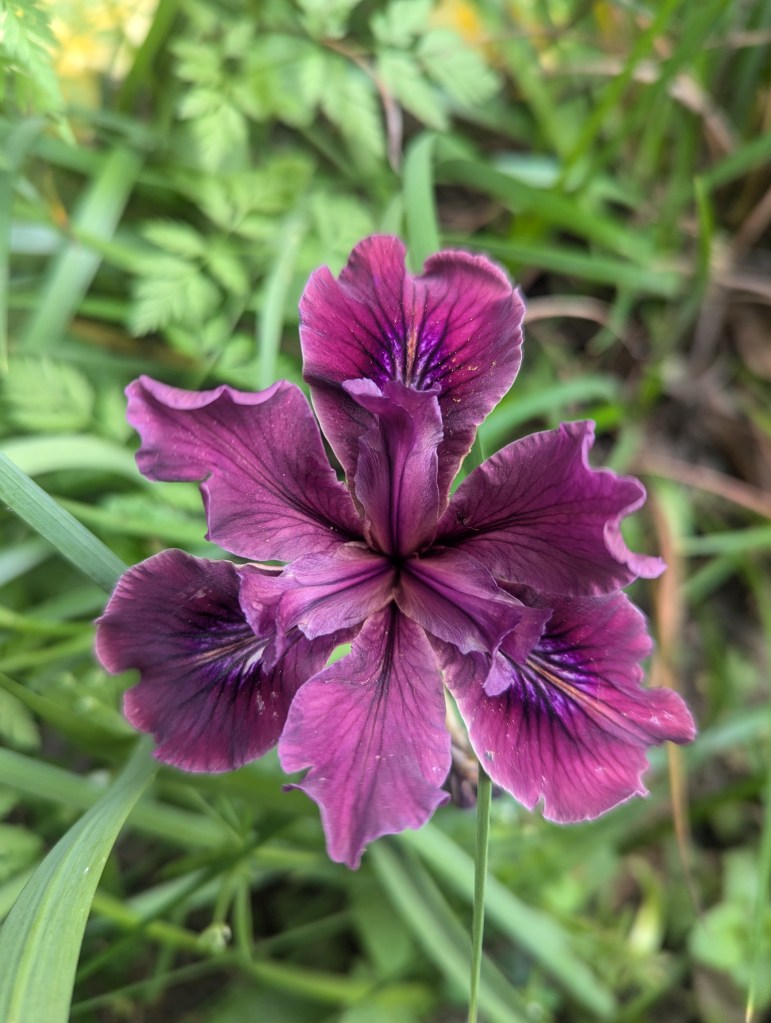
Most Pacific Coast hybrid iris are finishing their bloom about now. Some bloomed earlier, at the end of last winter. Their flowers can be various shades of blue, purple, red, orange, yellow or white. This includes lavender, burgundy, rust, rose, coral, gold or creamy white. Only green colors lack. Brown pods of sterile seed are visually unappealing after bloom.
Flowers are about three or four inches wide and stand about a foot tall. Individual flowers do not last long, but bloom in succession for quite a while. Grassy and dark green foliage develops low mounds that stay lower than bloom. Propagation is simple by division from large foliar mounds during autumn. Generous watering can cause rot and patchy growth.
Botanical nomenclature has gotten sloppy. So has breeding. Hybrids of different species are now common. Their botanical names often lack proper species designation. Instead, their names include only their genus names with their variety or cultivar names. This can seem simpler. However, it complicates the simplicity of binomial botanical nomenclature.
Interspecific hybrids involved different species of the same genus. Therefore, any genus name is the same as that of both parents. An “X” precedes its species name to indicate it as an interspecific hybrid. Its species name is as new and unique as the new hybrid. Any cultivar or variety name follows its species name in single quotes. it is all quite sensible.
Intergeneric hybrids involved different genera. Therefore, an “X” precedes a genus name of an intergeneric hybrid to designate it as such. Its entire name is as new and unique as the hybrid. Like for all botanical names, both its genus and species names are italicized. This designates them as ‘Latin’ names. Variety and cultivar names lack such italicization.
Many hybrids are naturally sterile. Most that can produce viable seed are not true to type. In other words, their progeny is very different from them, and commonly of inferior quality. Most hybrids are therefore cultivars, or cultivated varieties. They are reliant on unnatural cultivation for perpetuation. However, some naturally perpetuate vegetatively, like canna.
Tree ivy, X Fatshedera lizei, is an example of an intergeneric hybrid. The “X” in its name precedes its genus name. London plane, Platanus X acerifolia, is an interspecific hybrid. The “X” precedes its species name. Platanus X acerifolia ‘Liberty’ is a cultivar of London plane. Its species name remains, which is proper with botanical nomenclature of hybrids.
Rhododendron and rose hybrids violate nomenclature rules because of their breeding. It is too extensive for their species to be identifiable. For them, the abbreviation “spp.” may substitute for a species name. It is for “species pluralis”, which means “multiple species”. Although it is Latin, it is not italicized. Nor are their more important cultivar names after it.
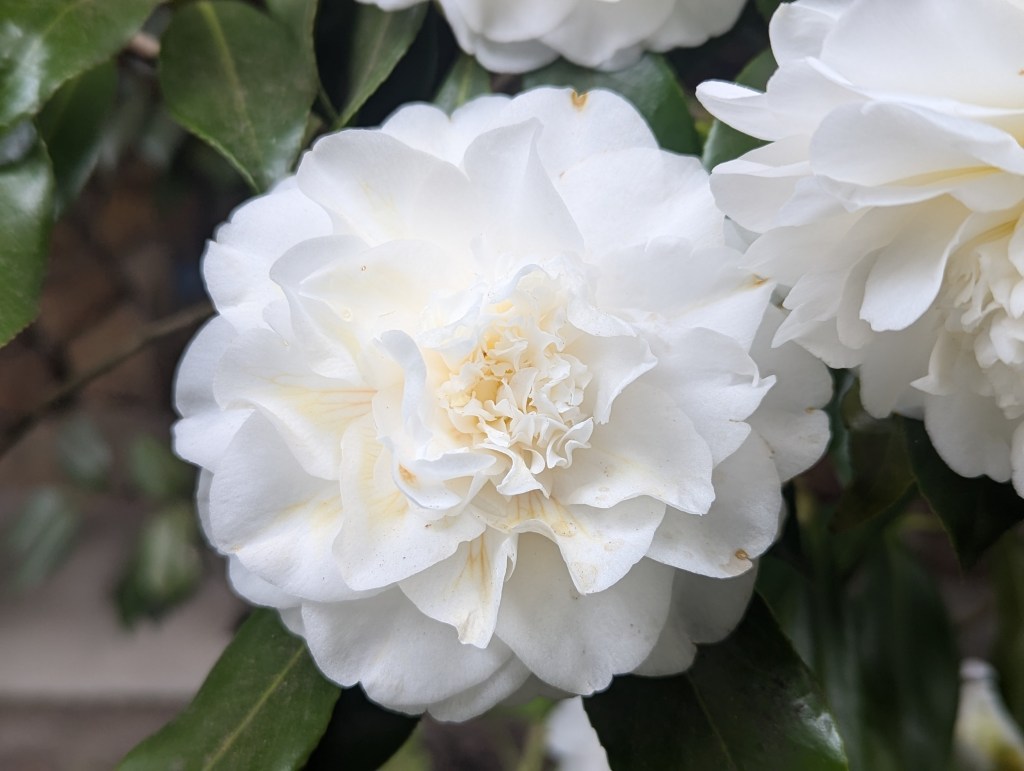
Camellia japonica seems to be too diverse to be a single species. Several of its countless cultivars seem to be either other distinct species or hybrids of other species. Regardless, they are all products of selection and breeding from within their single species, which is why the camellia pictured below is the only one of these six without an “X” in the middle of its name. The other five are hybrids, and three are the same hybrid species. However, one commonality of all six is that their cultivars are unidentified. I guessed a cultivar for the rose in the past. Columbine grew from a feral seed of a hybrid parent that apparently was not particularly sterile.
1. Iris X pacifica, Pacific Coast iris are hybrids of various native species, although mostly Iris douglasiana. Different cultivars can have different ancestry. These are unidentified.
2. Rosa X hybrida, rose is also an unidentified hybrid of unidentified ancestry. It seems to be a floribunda rose, with a few secondary floral buds behind each primary floral bud.
3. Iris X pacifica, Pacific Coast iris is my favorite color, but is actually not my favorite of the cultivars here. Blue, purple and burgundy red are too velvety exquisite to not prefer.
4. Aquilegia X hybrida, columbine grew in an awkward location from the seed of others that did not want to grow where planted. It stayed because it is the only columbine here.
5. Iris X pacifica, Pacific Coast iris in yellow is a bit more colorful than the white cultivar but not as richly colorful as the others. Blue, purple and burgundy red are done already.
6. Camellia japonica, camellia is as unidentifiable as the other five of these six but is not an interspecific hybrid, which is why it lacks an “X” in the middle of the botanical name.
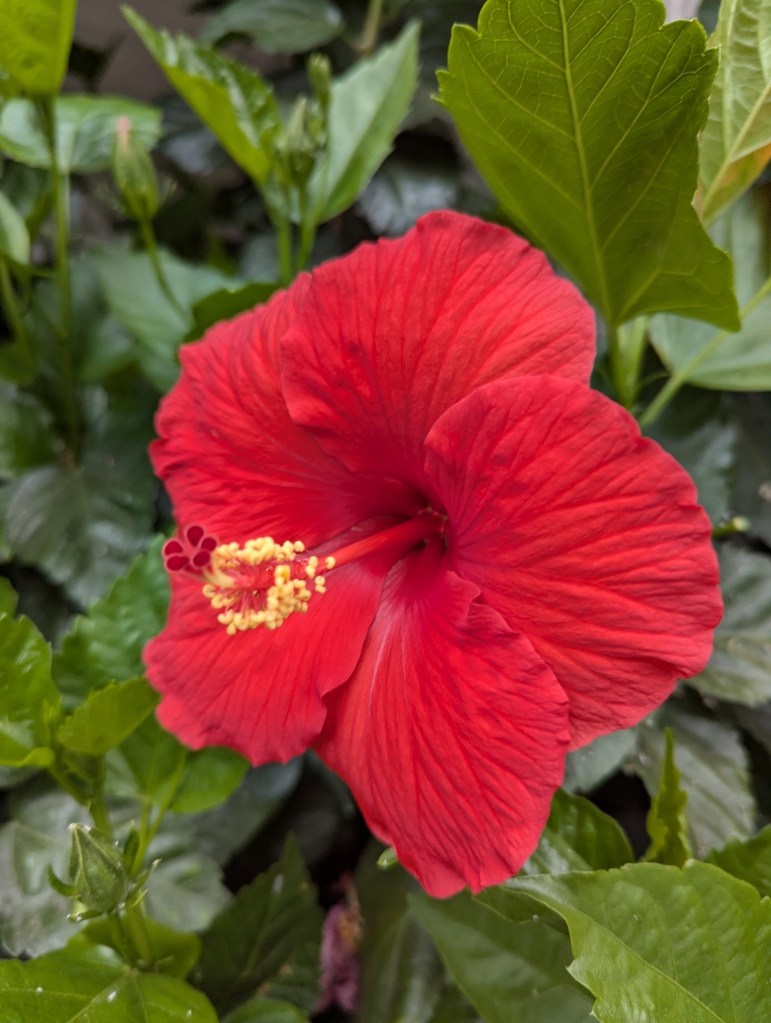
Hummingbirds and butterflies are quite fond of tropical hibiscus, Hibiscus rosa-sinensis. They are attracted to the bright yellow, orange, red, pink or white color of its bloom. They stay for the syrupy nectar that they find deep within the flowers. Tropical hibiscus attracts pollinators rather efficiently, but almost never generates seed. Most cultivars are hybrids.
Tropical hibiscus flowers are not overly profuse, but are about three or four inches broad. Fancy hybrids that bloom with broader flowers are not as vigorous as more typical sorts. Most cultivars bloom with somewhat ruffled single flowers. Some bloom with more ruffled double flowers. Both types of flowers have five garishly flaring petals. None are fragrant.
Tropical hibiscus grows as evergreen shrubbery about six to a bit more than ten feet tall. Pruning to remove congestion of inner growth promotes healthier outer growth. Besides, whitefly and scale insects often proliferate on crowded foliage. Leaves are mostly two to five inches long and two to three inches wide. Bloom continues from summer to autumn, mostly with warmth.
Its common name is both simple and descriptive. Little leaf sage is a literal translation of its botanical name, Salvia microphylla. However, several of its most popular cultivars are actually hybrids with other species. Also, they are more popularly but inaccurately known as Salvia greggii. Most lack their species name between their genus and cultivar names.
Little leaf sage is a small and generally evergreen shrubby perennial. Mature specimens are about three or perhaps four feet tall. They are a bit wider, and some can slowly widen by dispersing little rhizomes. Their little leaves are less than an inch long and delightfully aromatic when disturbed. Where winters are cooler, frost might initiate partial defoliation.
Bloom is most abundant for late spring or early summer, and again for autumn. Sporadic bloom can continue throughout most of the year. A few flowers may even bloom through winter. Floral color ranges through red, white and pink, as well as peachy and rosy pink. Coppicing old growth at the end of winter promotes replacement with new basal growth.
Rhody, Carson and I are still here. We should be in Washington now. We were supposed to leave at about midnight between last Tuesday and Wednesday. Now, we plan to leave at about midnight between Sunday and Monday, and stay in the Pacific Northwest for as long as initially planned. I wrote about the delay earlier. It is why I posted no pictures of our trip yet. Instead, there are three ‘X’s and three eXotics, although the last might really be an undocumented native species. The first three ‘X’s are between generic and specific names of three interspecific hybrids. By next week, I should get six pictures from Oregon and Washington. Incidentally, the Official State Flower of Washington was nicely named after Rhody.
1. Prunus X subhirtella, winter flowering cherry was featured for the garden column last week, or later in some papers. This picture was not used. I did not want it to go to waste.
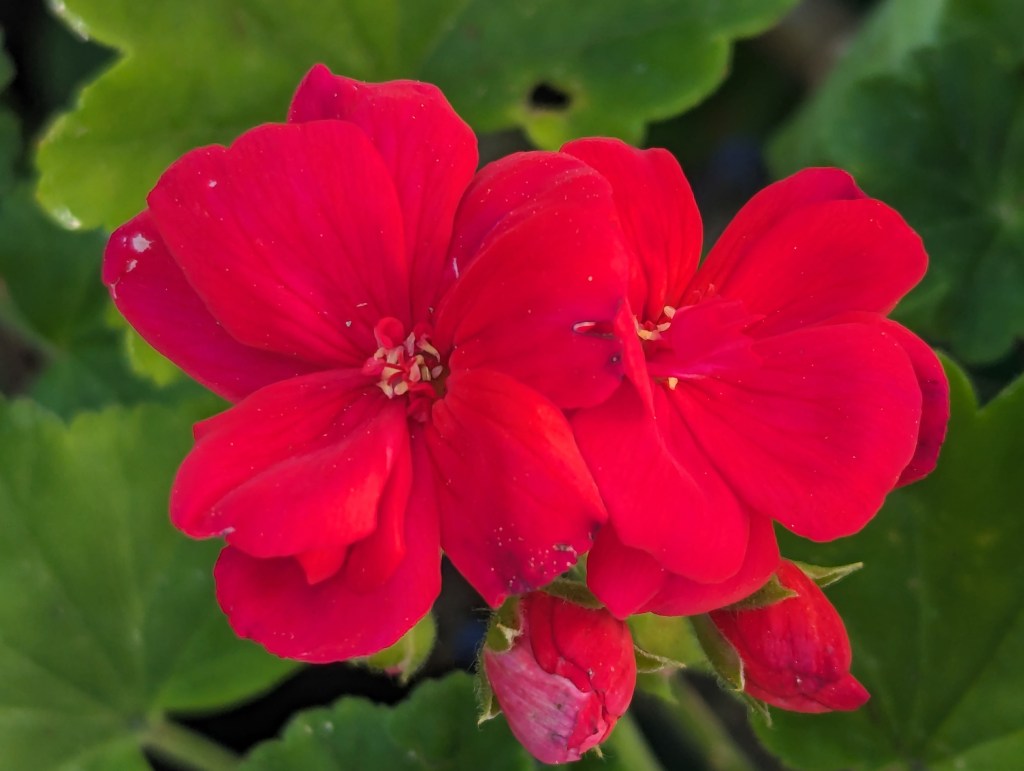
2. Pelargonium X hortorum, zonal geranium is nothing special, but I happen to like this red too much to discard it after it was clobbered by a car. I can only hope it was a Buick.
3. Freesia X hybrids, freesia is likewise nothing special, but got my attention just after I mentioned feral freesia in the garden column. It is misplaced but too colorful to be feral.
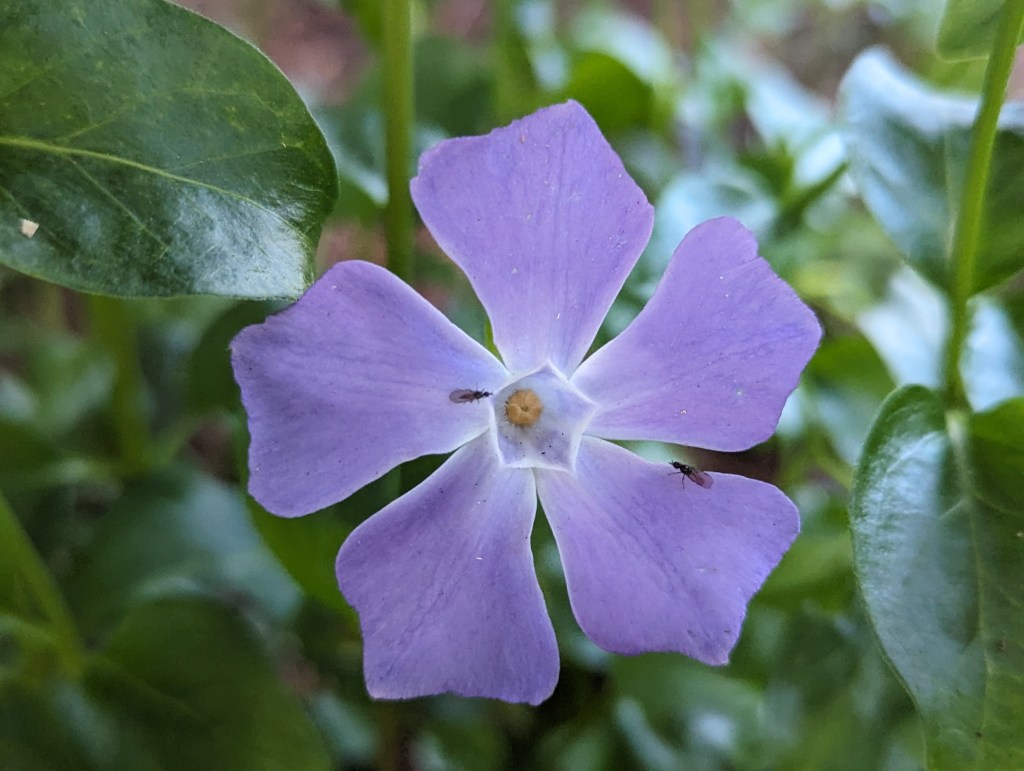
4. Vinca major, greater periwinkle is an aggressively invasive naturalized exotic species. Less pretty aggressively invasive naturalized exotic species would replace what I remove.
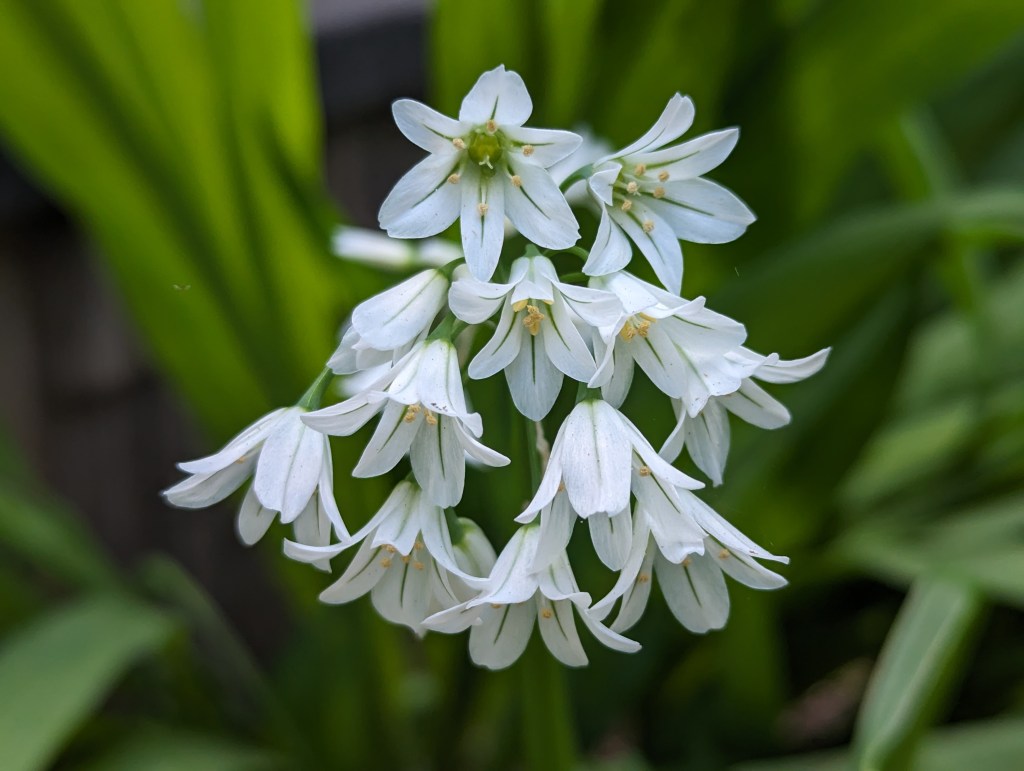
5. Allium triquetrum, wild onion is supposedly another aggressively invasive naturalized exotic species. It is so established that I had always considered it to be a native species.
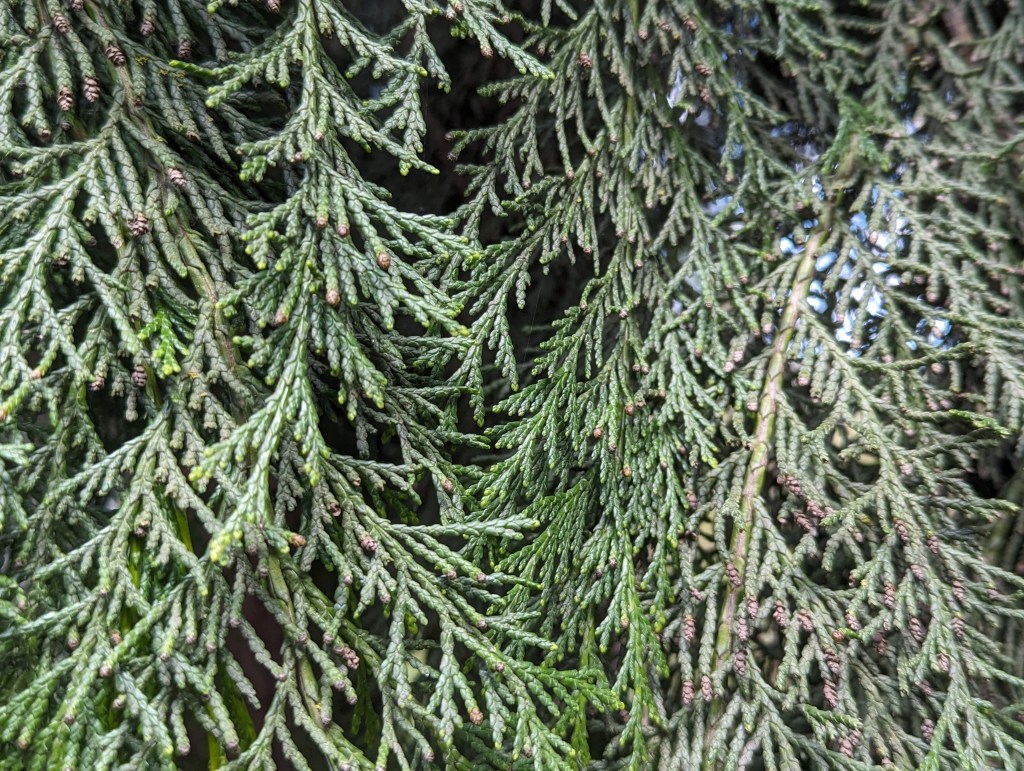
6. Thuja plicata, Western red cedar is supposedly a naturalized species, but could be an undocumented native species. No one seems to know; but it is not aggressively invasive.
Deadheading conserves resources that would otherwise sustain production of seed. For species that bloom more than once, it promotes continued bloom. For others, it promotes healthier vegetative growth. Also, it inhibits proliferation of potentially invasive seed. It is neater anyway. However, several species might forego deadheading for seed collection.
Flowers that bloom only once for a brief season generate all their seed at the same time. Flowers that bloom for an extensive season generate seed for a more extensive season. Some seed is obtainable from ripe fruit. Some is obtainable from unharvested vegetable plants that go to seed. Seed collection involves various sources during various seasons.
Regardless of its season and source, most seed is too abundant for complete collection. A single fruiting vegetable, such as a true to type chile, provides more than enough seed. A few stalks of naked lady might provide more seed than one garden can accommodate. Wildflowers are an exception. Their seed collection is rarely too excessive to broadcast.
Many species do not reliably generate viable seed though. Some require pollination by a very specific pollinator that does not live here. Yuccas that are from Central America rely on moths that live only in Central America. Some bamboos generate seed only once in a century or so. Most hybrids are too genetically dysfunctional to produce any viable seed.
Hybrids that can generate viable seed are very unlikely true to type. In other words, their progeny will be very different from them. Such progeny tend to revert to a simpler or more primitive form. The same applies to progeny of cultivars of extensive breeding within one species. Genetic aberration, such as variegation, is likewise unlikely inheritable by seed.
To complicate seed collection, some species begin life with juvenile growth. Some might take several years to mature. Avocado seedlings initially grow very fast, and tall, without blooming. By the time they mature, bloom and produce fruit, such fruit can be too high to harvest. Trees from nurseries are fruitful lower only because of grafting with adult growth.
‘La France’, in 1867, was the first hybrid tea rose to be hybridized. ‘Peace’, in 1945, was the first hybrid tea rose to be classified as a hybrid tea rose. Yes, it took quite a while.
Afterward, hybrid tea roses became very popular both for the cut flower industry and home gardens from the 1950s through the 1980s. Because of their single bold flowers that bloom on tall and sturdy stems from spring until autumn, they are still very popular as florist flowers. However, more florific floribunda roses became more popular for home gardens through the 1990s. Since the turn of the Century, all sorts of simpler shrubby roses, such as carpet roses, became more popular than all of the other types of roses. Hybrid tea roses and other types that produce comparably exemplary cut flowers require more specialized maintenance than most people want to commit to. Sadly, hybrid tea roses are now passe.
‘Proud Land’ was the first of the hybrid tea roses that I installed into my mother’s new rose garden in 1984. It came from Jackson & Perkins while Jackson & Perkins was still based out of Medford in Oregon. Unfortunately, it suckered so profusely during its first season that I wrote a letter to Jackson & Perkins about it. Jackson & Perkins generously replaced it for the following season. Also, my mother, who was unaware of the replacement, purchased another replacement. As if that were not enough, I managed to abscise all sucker and burl growth from the original while it was dormant for the following winter. So, three individual specimens of ‘Proud Land’ bloomed at the center of the small rose garden for 1985, which was the year that I graduated high school.
Technically, hybrid tea roses are at their best after about five years, but should probably be replaced before about ten years. ‘Proud Land’ continued to perform though, with no indication of deterioration, until I finally removed them in 2020. They live here now. I grew a few ungrafted copies from their pruning scraps. I should properly graft a few copies also. Realistically, there is no need to retire the originals.
Some consider hybrid tea roses to be passe. I consider them to be historical.
There is no doubt about it. Weeds are sustainable. Otherwise, they would not be weeds. By definition, they grow where they are undesirable. Less sustainable vegetation should be less invasive. Also, it should be less resistant to eradication than most familiar weeds are. Unfortunately, also by definition, weeds are undesirable. They can not become fads.
Sustainable horticulture is a fad though. Unlike most fads, it is actually quite sensible. In theory, it is horticulture that requires as minimal intervention as possible. It excludes that which requires intensive or impractical cultivation. For example, native species that grow wild are sustainable. Tropical species that may survive only within greenhouses are not.
A problem with the sustainability fad is its marketability. ‘Sustainable’ and ‘Sustainability’ have become cliche buzzwords. They too often describe merchandise that is contrary to the fad. Realistically, genuine sustainability is unsustainable within profitable marketing. Truly sustainable merchandise would eliminate most of the need to ever purchase more.
Modern cultivars can qualify as ‘new and improved’ as they first become available. They are certainly new. However, their improvements may be questionable. Hybridization and extensive breeding can cause genetic deficiency. Even natural variegation compromises vigor. Seed is not true to type. Most aesthetic improvements are contrary to sustainability.
Native species are technically sustainable. Once established, they might survive without irrigation or other attention. Unfortunately though, some are not very adaptable to refined home gardens. Some are vulnerable to rot if nearby vegetation needs frequent irrigation. Some perform vigorously only for a few years. Several species are innately combustible.
Ironically, several of the most passe and old fashioned species are the most sustainable. That is why some of them became passe. Lily of the Nile can survive indefinitely. If it gets overgrown, it is easy to divide and relocate. It may be available for free from neighbors or friends. African iris, New Zealand flax, bergenia, most aloe and many yucca are similarly sustainable.
Pluots, plumcots, apriums and peacharines! Who comes up with this stuff?! Aren’t good old fashioned plums, apricots, peaches and nectarines good enough? Who decides that these weird hybrids are somehow better than their parents? Some of them are actually quite weird, or downright ugly. Several do not even look like they would taste good. It may be an acquired taste; but I have all the good taste that I need without acquiring any more.
Some old classic cultivars (cultivated varieties) of fruit were develop centuries ago. More have been evolving from those ancestors since then. Some were intentionally bred from parents with desirable qualities. Others just grew incidentally where their seed fell, and were found to be somehow better than their parents. Some were merely discovered as natural occurring mutants, and perpetuated for their superior qualities. It is a slow process.
So, putting two different kinds of fruits together, or finding an aberration of a single type of fruit, is nothing new. Tangelos were created by hybridizing Mandarin oranges with pomelos or grapefruits. Ever-bearing ‘Eureka’ lemon was perpetuated from a mutant of the seasonally bearing ‘Lisbon’ lemon. This is how cultivars evolve and develop. Generally, newer cultivars become popular because they are somehow superior to their ancestors.
Yes, somehow ‘superior’ to their ancestors. Who decided that a hideous hybrid of a plum and an apricot was somehow better than either a perfectly good plum or apricot? Furthermore, what evidence was there for such a weird claim? Even farthermore (if that is a word) how and why do so many people believe this evidence?
I was still growing citrus (trees not fruit) back in the early 1990s when the ‘Cara Cara’ pink orange was popularized. Yeah, a ‘pink’ ‘orange’. It is really just a pink mutant of the formerly more popular ‘Washington’ navel orange. We could not grow enough of it. It was just too popular. Some people really seem to believe that it is somehow better than ‘Washington’ and other navel oranges. I can’t argue. They certainly know what they like.
To me, it has a milder flavor than ‘Washington’. Yes, it tastes about as bland as it looks; pink.







 Pluots, plumcots, apriums and peacharines! Who comes up with this stuff?! Aren’t good old fashioned plums, apricots, peaches and nectarines good enough? Who decides that these weird hybrids are somehow better than their parents? Some of them are actually quite weird, or downright ugly. Several do not even look like they would taste good. It may be an acquired taste; but I have all the good taste that I need without acquiring any more.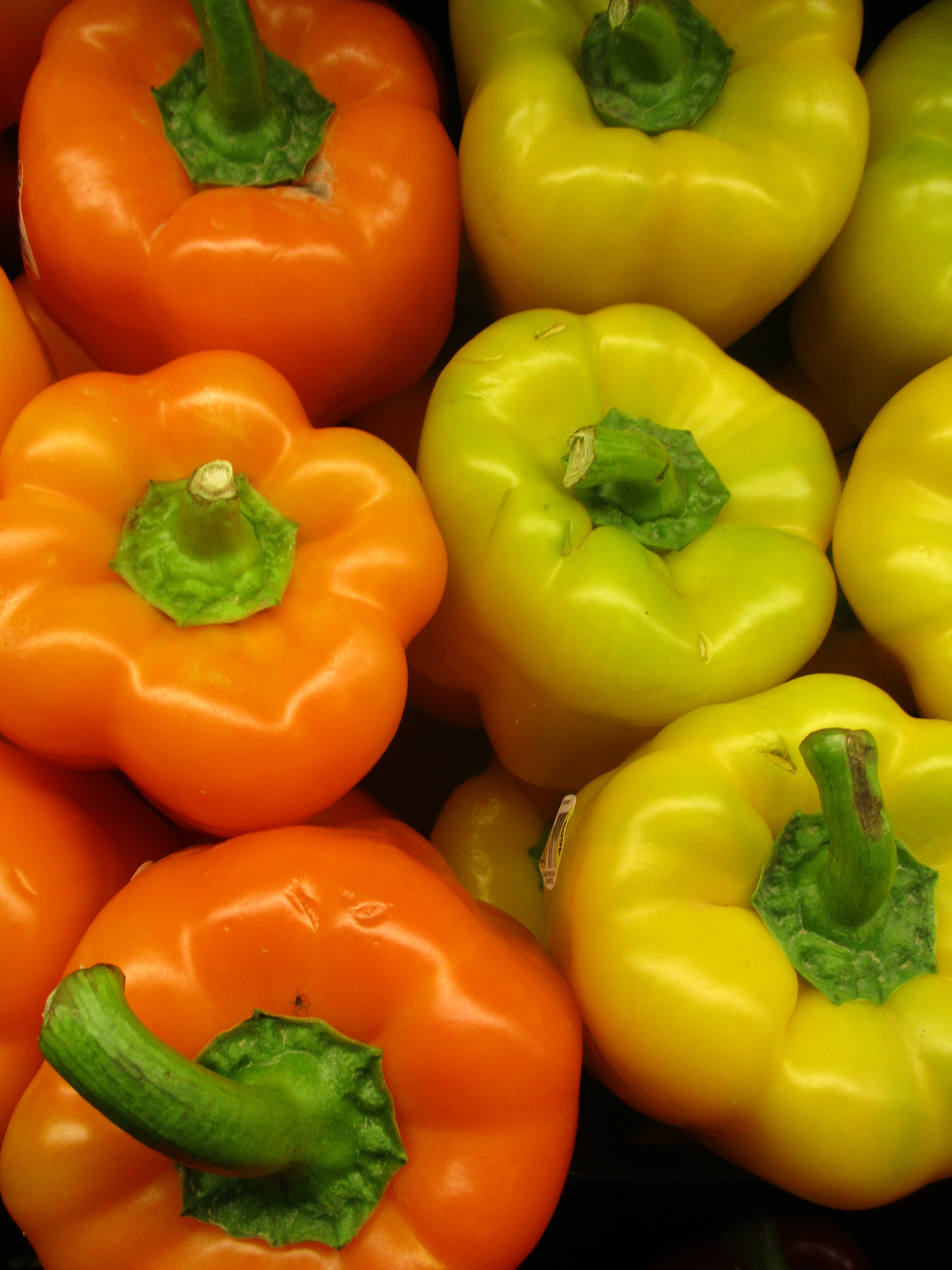
 Tony Tomeo