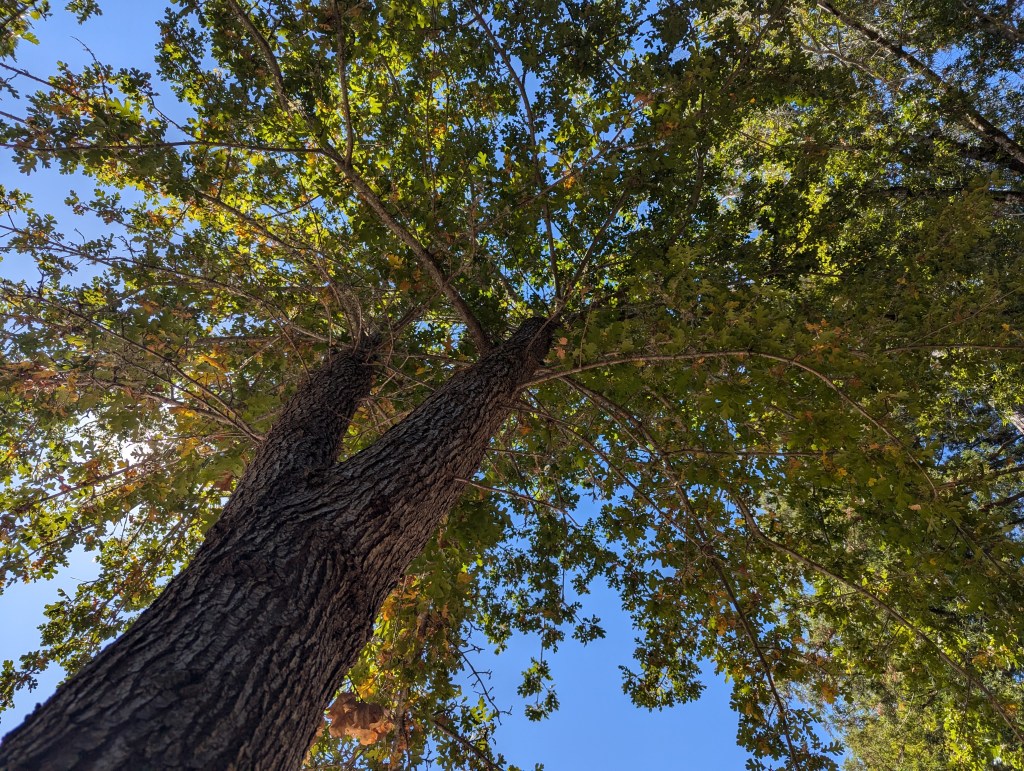
Shedding Foliage Often Precedes Defoliation

Shedding foliage will eventually get messy.

Indian summer is more typical here than not. As usual, the weather cooled somewhat as summer finished, and then warmed again. It is now autumn by date, but still seems to be summer by weather. This might confuse some vegetation, although some is familiar with this pattern. Some vegetation reacts by shedding foliage prematurely, prior to dormancy.

Prematurely shedding foliage is not the same as defoliation of deciduous species. Many of the species that exhibit such response to the weather are evergreen. More importantly, both evergreen and deciduous species do it prior to autumn dormancy. Also, they do not defoliate completely. There will be enough deciduous foliage for autumn foliar color later.

In the wild, prematurely shedding foliage is common among native California sycamore. It is a natural response to minor desiccation from any combination of aridity and warmth. It is as random as weather. Anthracnose is a foliar disease that might cause more severe defoliation earlier. Either type of shedding may be visually unappealing, but is harmless.

Actually, premature shedding foliage is common among many regionally native species. It helps them survive within chaparral climates. Although not a problem in the wild, it can be messy in or adjacent to refined landscapes. Both coastal redwood and coast live oak are notoriously messy. Yet, both species are evergreen and endemic to coastal climates.

Some exotic species from various climates can exhibit prematurely shedding foliage too. Species from other chaparral or desert climates are naturally proficient with the process. Species from less arid climates learn fast. It can be stressful for some of them. Daylength assures them that shedding is now safe. However, warmth that necessitates it might not.

Various species react variously to the various causes of premature shedding. That is too many variables. Simply, shedding is different every year because the weather is different every year. Eastern redbud and birchs that are exceptionally messy now may not be next year. Japanese maples happen to be shedding a bit less this year than they typically do.
Six on Saturday: Fake Autumn

Daylight does not last quite as long as it had earlier in summer. Shadows stay noticeably longer. Summer actually ended about two weeks ago. For now it is early Indian summer.

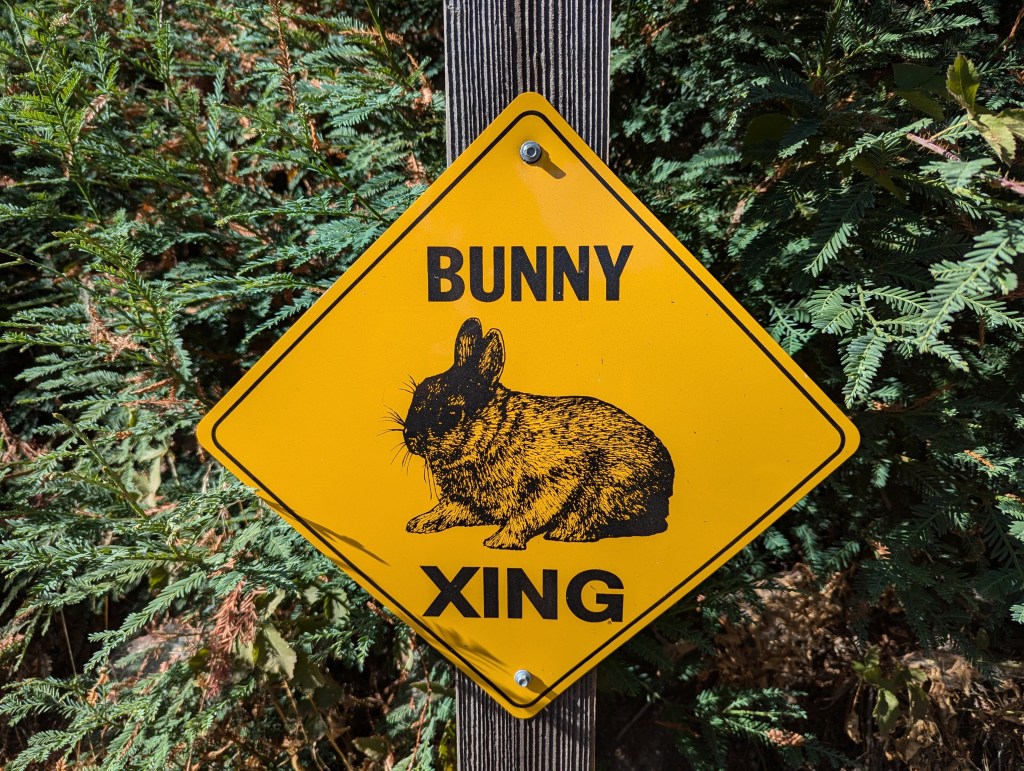
1. “Bunny Xing” is as irrelevant to autumn as it is to Charing Cross Road in Los Angeles. I just found it to be amusingly odd that a neighbor seems to be protective of wildlife that can be so detrimental to some gardens here. Bunnies fortunately do not bother us much.

2. Juglans nigra, Eastern black walnut or Juglans nigra X hindsii, royal walnut, yellows early, more likely because it is tired of summer heat than because it anticipates autumn. Both walnut tree types naturalized from understock that sustained old walnut orchards.

3. Quercus lobata, valley oak typically but not always begins to brown after walnut trees yellow. This yellowish color is likely a result of the weather cooling a bit before warming again. This species is native nearby, but may have naturalized here after getting planted.

4. Acer rubrum, red maple is likely only coloring because it is distressed by confinement of its roots within its big clay pot. Recent and suddenly warmer weather after seasonably cooler weather may have accelerated the process. I really want these trees in the ground!

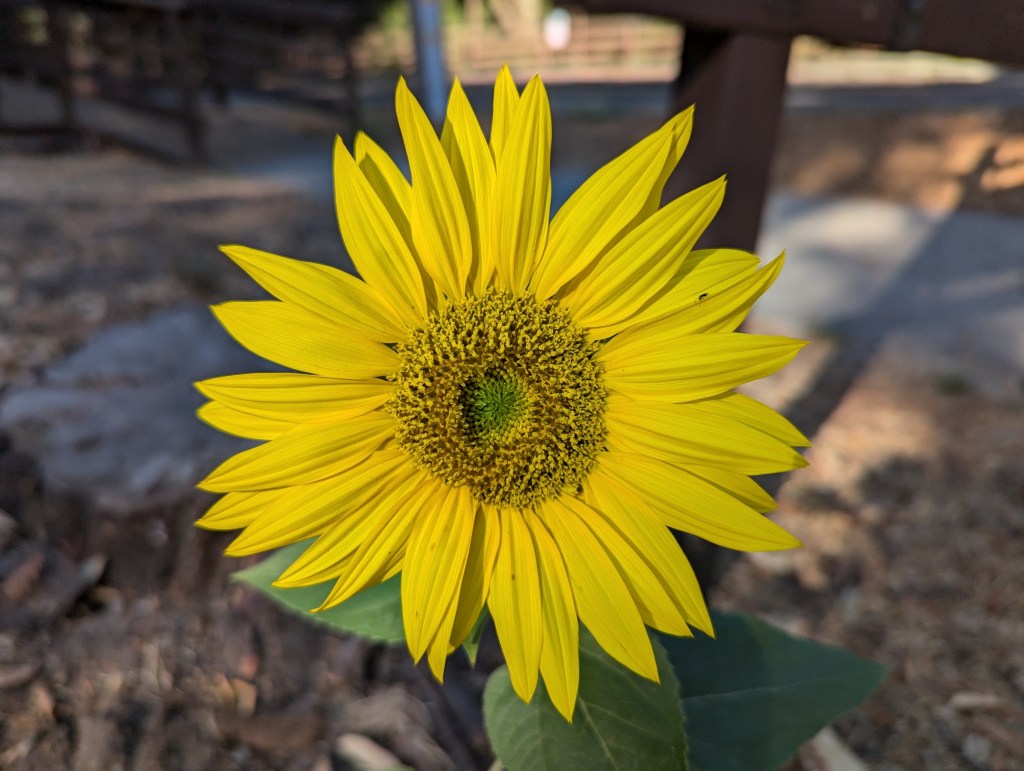
5. Helianthus annuus, sunflower mysteriously appeared precisely where we should have but neglected to grow sunflowers this year. This is the only one, but it is enough to show us what we are missing because of our lack of diligence. It is only a bit early for autumn.

6. Rhody is ready for autumn. More specifically, he is ready for cooler weather. Although it was scarcely more than ninety degrees yesterday, and only for a few hours after noon, it seemed to be unseasonably warm, after earlier weather was already beginning to cool.

This is the link for Six on Saturday, for anyone else who would like to participate: https://thepropagatorblog.wordpress.com/2017/09/18/six-on-saturday-a-participant-guide/

Six on Saturday: Best or Worst for Last

Indian summer is now doing what it does every few years or so. It was more than ninety degrees for a second day here yesterday, and was even warmer in the Santa Clara Valley. As typical, it happened after cooling weather already started to feel like autumn. It is not a good time to relocate vegetation, which I started to do while the weather was still cool. Also, I must briefly increase irrigation. Not all of these Six are relevant to the weather or any particular theme. Actually, half are irrelevant. The last is open to interpretation. It is not a good picture, but is likely the best.

1. Water from the spigot occasionally gets slightly colorful here. Water from the streams and creek is clearer. It is a consequence of hydrant flushing. It is harmless for irrigation.

2. Unidentified ferns needed to be removed from where an old fence was replaced. I can not simply discard them. I buried them elsewhere so that they can regenerate next year.

3. Unidentified spirea was also in the way. Of course, although I do not expect much of it to survive, I relocated it also. I typically cut this spirea back to the ground during winter.

4. Marah macrocarpa, wild cucumber develops huge tubers that can weigh more than I do. This one is merely about a foot and a half long, so is relatively small, but now what?!

5. Portulaca grandiflora, moss rose is not mine, is not here, and did not give me a good picture. Nevertheless, I feel obligated to share at least some summery floral color today.

6. Rhody did not cooperate for this picture either. I can not explain how he so efficiently hid behind only one yawn. As bad as this picture is, it just might be the best of these Six.

This is the link for Six on Saturday, for anyone else who would like to participate: https://thepropagatorblog.wordpress.com/2017/09/18/six-on-saturday-a-participant-guide/

Indian Summer Is The Norm

70920thumbThe popular definition of ‘Indian summer’ suggests that it is unseasonably warm and dry weather in spring or autumn, and that it typically happens after frost. Well, that definition just does not work here. It makes about as much sense as our so-called drought, which is actually the normal weather for our chaparral climate. Weather that repeats annually is neither unseasonable nor abnormal.

There are certainly years with more or less rain, and years with warmer or cooler weather in late summer and early autumn. Weather is naturally variable. It does not work like the thermostats in our homes, or the automated irrigation systems in our gardens. It is impossible to predict precisely how this summer will end, but it will likely have some characteristics of a normal Indian summer.

The one characteristic of the popular definition of Indian summer that will be notably absent is frost. That will not happen until after autumn. Locally, Indian summer can either be what seems to be a continuation of summer weather, or a resumption of warm summery weather after a bit of cooler weather. The main difference from earlier warm weather is that the nights are significantly cooler.

That is more important than it sounds. We do not notice the cooler nights as much as the plants that are outside all night do. While the days are as warm as they had been, some deciduous plants will begin to defoliate. Eventually, those that get colorful in autumn will begin to do so. Roses can be fertilized one last time, but even as they continue to bloom, they should not be fertilized again.

Indian summer prolongs the summer growing season significantly, but also has the potential to interfere with the winter growing season. Warm days keep warm season vegetables and flowering annuals performing so nicely that we do not want to remove them to relinquish their space for the cool season plants that will be needing it soon! In other climates, frost ends the summer season for us, and necessitates the transition to cool season crops. Indian summer can be too much of a good thing.