Eastern Red Cedar

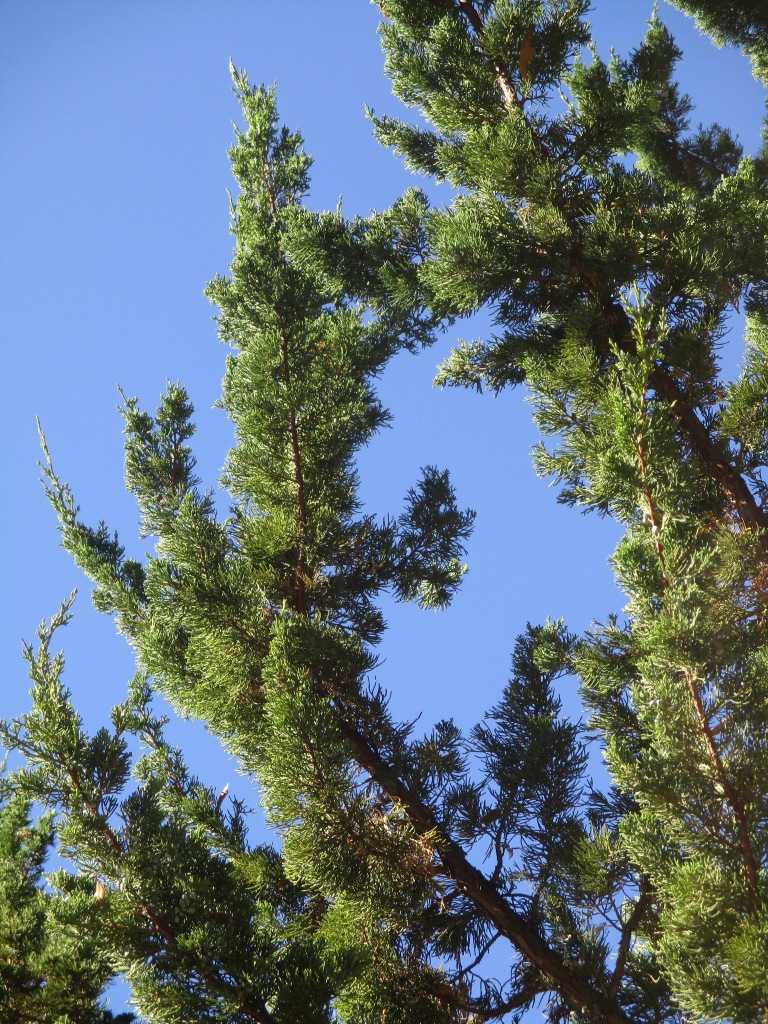
Eastern red cedar is rare in the West.

One of the less common and certainly least familiar of junipers happens to be the most culturally and environmental significant juniper in North America, even though it is not even known as a juniper. Juniperus virginiana is instead known as the Eastern red cedar. It has a vast range, including every state east of Colorado, as well as Quebec, Ontario and even Oregon to the west. In some areas within and near the natural range, fire suppression has allowed Eastern red cedar to become invasive.

Mature trees are mostly less than fifty feet tall, but are the biggest evergreen trees in Kansas nonetheless. The largest Eastern red cedars can get almost ninety feet tall. Most are well branched from top to bottom unless pruned for clearance. The fibrous bark is ruddy brown, but not often seed from the outside.

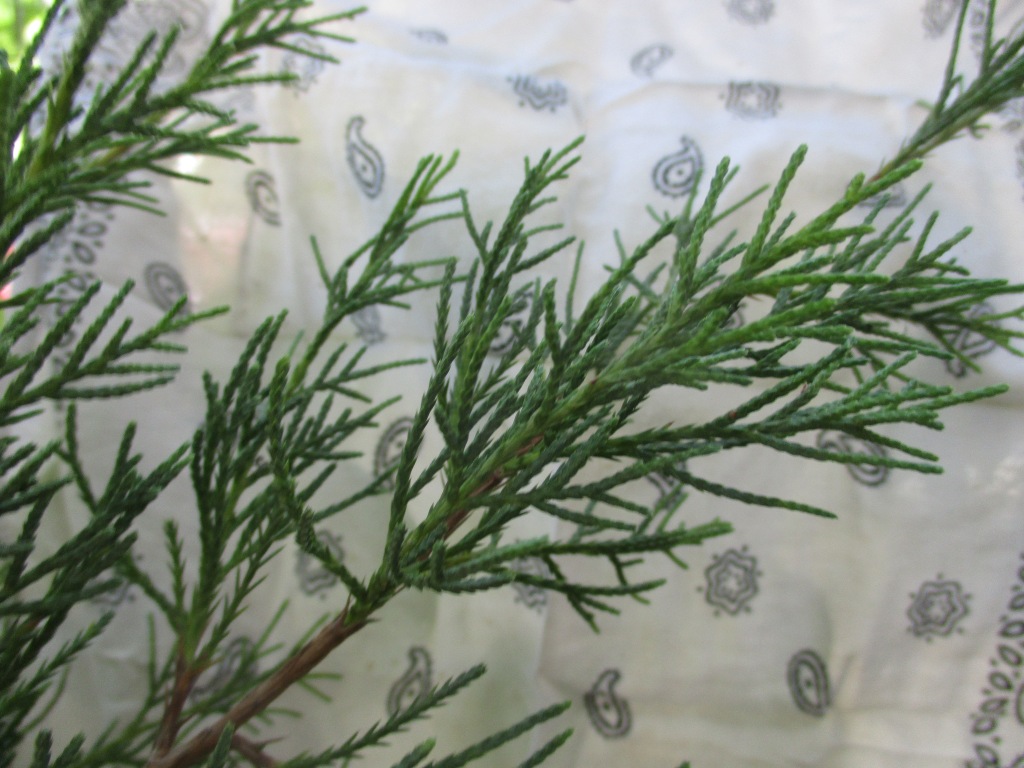
Foliage and fruit are rather variable. The prickly juvenile leaves of young plants and interior stems of mature plants can be rather annoying. The scale-like adult leaves are more typical of junipers. Male trees produce pollen that can be a significant allergen. Female trees produce sporadic, small berries in blue or purplish black, that are quite popular with certain birds through winter.

Prior to the discovery of the incense cedar in the west, Eastern red cedar was the common aromatic cedar that was used to make pencils and to laminate cedar chests and closets to protect woolens and natural fibers from moths. Since it is so repellent to insects and decay, it is commonly used as fence posts. Native American Indians also used posts of Eastern red cedar, painted red with blood of the animals they hunted, to mark the boundaries of their hunting ranges. The name of Baton Rouge, which means ‘red stick’, was actually derived from such marking posts.

During the Dust Bowl drought of the 1930s, and before becoming known as a potentially invasive species, Eastern red cedar was promoted by the Prairie States Forest Project as a resilient wind break. They tolerate drought, harsh exposure and inferior soil. They can be planted close together to fill out and gain height more efficiently. More information about Eastern red cedar can be found where I got much of this information, at the Great Plains Nature Center.
Juniper Cultivars Deserve More Consideration

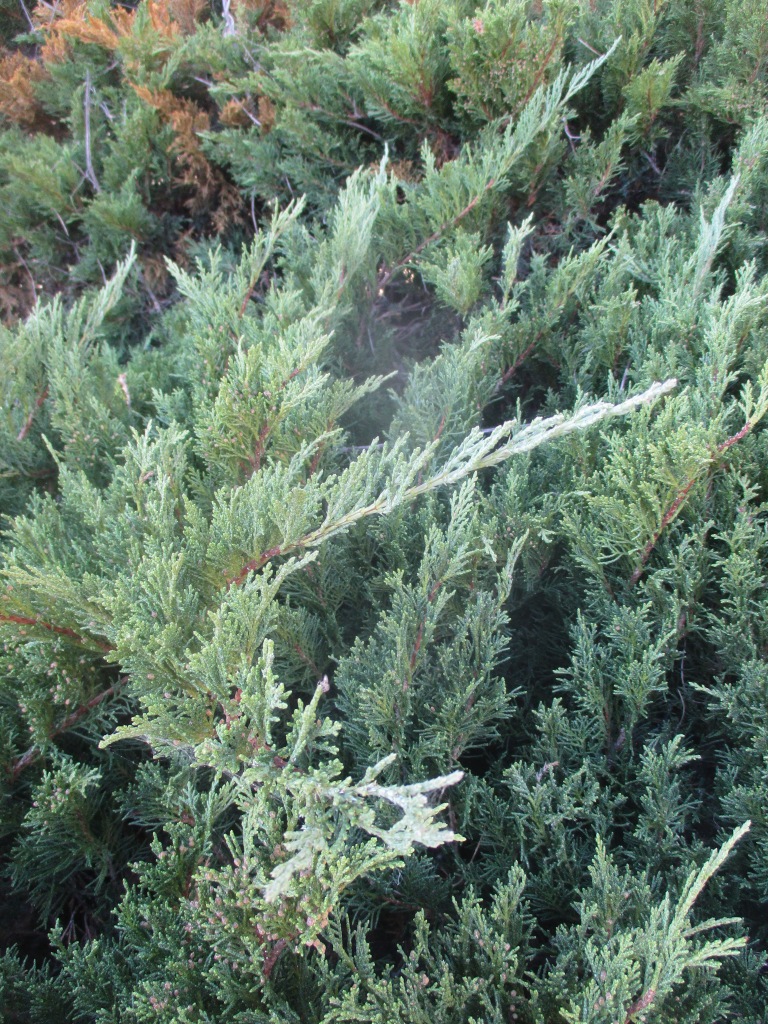
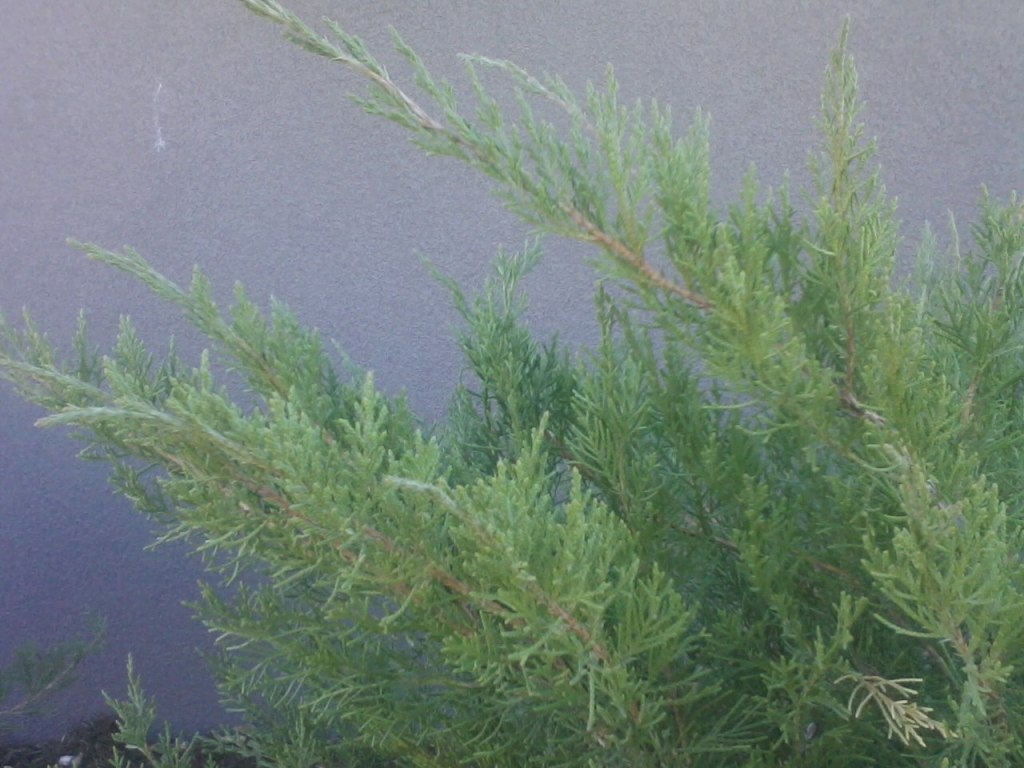
Evergreen juniper foliage has distinctive texture.

Fads come and go. Many can be good, even if only briefly. A few might be bad enough to later stigmatize the object of the fad. For example, the formerly esteemed crape myrtle is now familiar as a mundanely common tree. Flashy bloom and complaisance contributed to its excessive popularity. Most sorts of juniper are similarly victims of their previous fad.

A few cultivars of juniper suddenly became overly popular during suburbanization of the 1950s. They were remarkably reliable and resilient. Most were shrubbery or low hedges. A few were groundcover. Hollywood juniper grew as a compact sculptural tree. However, most junipers grew too big. They became difficult to maintain, or impossible to renovate.

As many outgrew suburban gardens, few junipers outgrew their reputation. Even modern cultivars that were unavailable during the fad of the 1950s are perhaps less popular than they should be. Realistically, many old and new cultivars of juniper are quite practical for refined home gardens. They merely need to be appropriate to their particular application.

Many cultivars of several species of Juniperus are commonly available. Straight species are very rare from nurseries, although a few are native nearby. All junipers are evergreen with tiny awl or scale leaves. Foliar color ranges from forest green to silvery gray. Bloom is unremarkable. Some junipers produce pretty and aromatic blue, gray or black berries.

Junipers generally do not respond favorably to pruning that damages their natural forms. Those that grow as groundcovers, with stems that sprawl over the surface of the soil, are not offended by pruning to contain their edges. However, most groundcover junipers are actually just low shrubbery. Pruning might leave holes within their dense foliar canopies.

Junipers that grow as small trees do not mind removal of lower limbs at their main trunks, but object to partial pruning or ‘stubbing’ of such limbs. Regardless of their natural forms, all junipers should be proportionate to their particular applications. With sufficient space, they can mature and develop their naturally distinguished forms with minimal altercation. Maintenance could really be quite minimal.

Sea Green Juniper

It may seem to grow slowly, but ‘Sea Green’ juniper outgrew the stigma that has followed junipers since the 1950’s.

No one can deny that junipers are useful, sustainable and resilient. They tolerate cold, heat and harsh exposure. Once established, they do not need much water.

Sea green juniper, Juniperus chinensis ‘Sea Green’, is a bit lighter green than more traditional dark green junipers. It can grow somewhat slowly, eventually getting to about five feet tall, and a foot or two wider. Like all junipers, it should never be indiscriminately shorn, but should instead be selectively pruned to exploit its distinctive ‘fountain’ shaped branch structure that points up and outward from the base.

Juniper Turns A New Leaf

Hollywood juniper was formerly overly popular.

Juniperus, which is the entire genus of juniper, had been languishing in a bad reputation for too long. The problem likely began nearly three quarters of a century ago. More people than ever were enjoying leisurely suburban gardening. Many appreciated the resiliency of juniper cultivars. At that time, a few species of juniper were gaining popularity. Evolving cultivars sustained new demand.

Unfortunately, these modern and once distinctive cultivars of juniper eventually became passe and too common. As practical and resilient as they truly are, they collectively shared the stigma of a minority that were problematic. Their problems were disproportionately evident merely because of their commonness. Many matured at the same time, so developed problems at the same time.

Realistically though, the majority of the garden varieties of juniper that grew during that time were quite practical. Those that started in the 1950s, but developed problems in the 1990s, performed satisfactorily for four decades. Not many other types of plants perform as reliably for as long. Many problems resulted from selection of cultivars that were inappropriate for particular applications.

Although all junipers are evergreen foliar plants that provide no obvious bloom, they are remarkably diverse. The most popular sorts are low and dense shrubbery. Others are lower and sprawling ground cover. Some are small trees. A few species grow more than thirty feet tall! Branch structure is mostly densely compact, but can be sculpturally irregular, rigidly upright or gracefully arching.

Foliage is generally rich deep green. Some cultivars exhibit yellowish new foliage that fades to green through summer. A few are variegated with creamy white. Several popular cultivars are gray or bluish gray. Leaves of almost all popular cultivars are scale like. Some have needle like leaves. A few have both. Even without prominent bloom, a few cultivars produce appealing tiny berries.

It is time for the many cultivars of juniper to grow beyond their former bad reputation and turn a new scale or needle.