Horridculture – High End

Gladiolus papilio from Skooter’s Garden makes my garden more special than any ‘high end’ garden.

What exactly does that mean?! Why should I care? My lack of concern seems to be directly proportionate to the intensity with which someone tries to impress upon me that I should be so concerned. A colleague from high school tried to tell me about a new television show about a so-called ‘landscaper’ in Michigan who is so extremely ‘successful’ that he also lives in a home in Florida for the winter. I suspect that both of his homes combined are worth about as much as a single home here, but I will just continue with this premise that he is successful. He does exclusively ‘high end’ work, which regularly involves moving huge boulders with old fashioned technology because that is what his ‘high end’ clients want. I needed to interrupt. The ‘high end’ nonsense annoyed me too much. So, they have huge boulders in their landscapes. Perhaps their landscapes were very expensive to install. Splendid! ‘High end’ spending is healthy for the economy. Why is this any of my business? I do not know. I am a horticulturist, not an economist. My garden contains rhubarb from the garden of my paternal paternal great grandfather, and Dalmatian iris from the garden of my maternal maternal great grandmother. That is horticulturally significant. ‘High end’ gardens seem to be more concerned with expenditure than with horticulture, as if spending more will somehow make it better. Do those who purchase ‘high end’ gardens actually work in them? Do they grow anything from the gardens of their ancestors? I know that some do, but I suspect that some do not. The primary purpose of their ‘high end’ landscapes is lavishness. I can not doubt that such landscapes serve such purposes more than adequately, but am nonetheless unimpressed by their typical lack of horticultural relevance.

Horridculture – Cyclamen (deferred from Wednesday)

Cyclamen are too expensive to be as disposable as they are.

Cyclamen persicum is a popular cool season annual. It is known simply as cyclamen here because it is the only common cyclamen that is available. It might be known as florists’ cyclamen where other species are available. Red and white are the most popular colors because cyclamen are associated with Christmas. Cyclamen can alternatively bloom with various tints and shades of pink, salmon pink and purplish pink. Some bloom with two-toned color or picotee margins. Cyclamen really is a delightful perennial.

Yes, perennial. Like many garden annuals, cyclamen is actually a perennial. It can survive in the garden for many years. It merely goes dormant through warm summer weather, and then resumes growth as weather cools during autumn.

Not only is it a perennial, but it is an expensive perennial. It is too expensive to be so disposable. So-called ‘landscapers’ do not mind. Disposable annuals are lucrative for them. Besides, even where cyclamen can perform as a perennial, it is not colorful throughout the year, and even in season, it is not as colorful as it is for its first season away from the nursery that it originally grew in.

Other species of Cyclamen that are available within other regions are becoming available here as well. Their bloom is sparser, with only light pink or blushed white flowers. They are grown as perennial wildflowers that bloom for autumn or winter, when not much else blooms. Although not as garish as common florists’ cyclamen, they are appreciated for their perennial performance.

The few florists’ cyclamen that we install at work bloom somewhat reliably only until spring. Because they were grown within ideal greenhouse conditions, they do not adapt immediately to landscape conditions. By spring, many are already beginning to rot. Those that survive their summer dormancy may become perennial.

Horridculture – Too Many Trees (deferred from Wednesday)

Excess is expensive . . . or profitable.

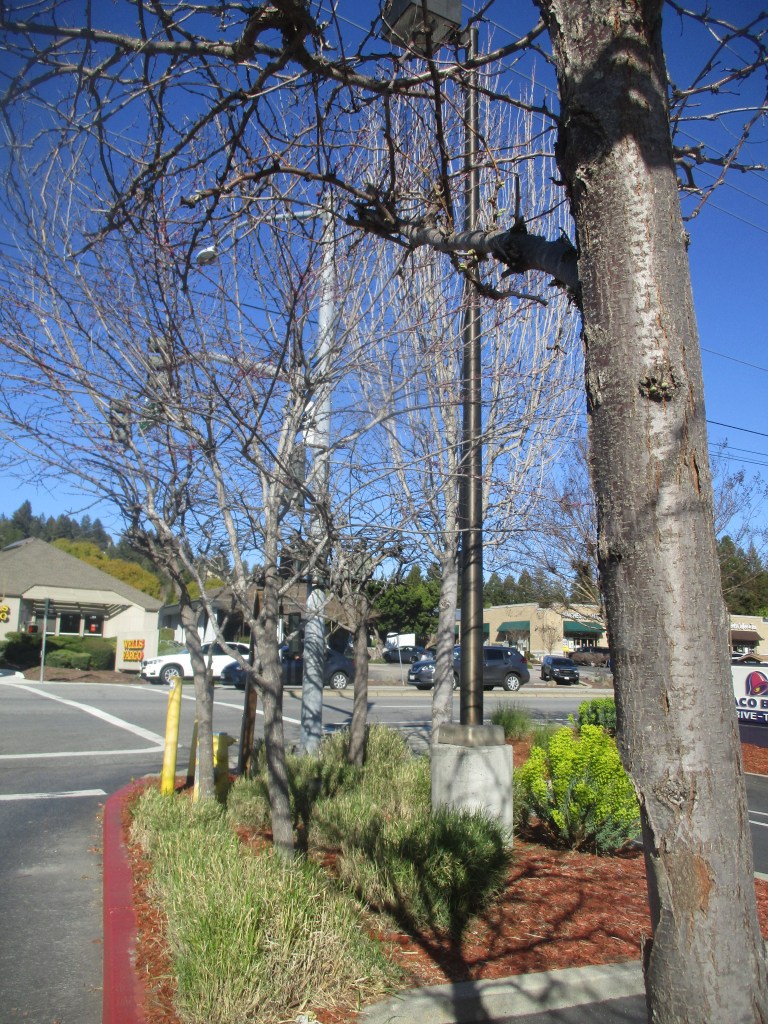
One can not see the forest for the trees here. Actually though, there is no forest, but only too many trees, surrounded by vast pavement. A wide roadway is beyond these trees. A driveway is to the left. A parking lot is to the right. Not much space remains in between for so many trees.

A honeylocust is in the foreground to the right. It mostly obscures a crape myrtle in the background. To their left, and slightly to the right of the center of the picture, there is a red maple. To the left of the center of the picture, there are three Eastern redbuds. That is six trees confined to an area that is about as spacious as three parking spaces. The picture is not of good quality, and because it is a few years old, I can not remember many more details about it.

The honeylocust and the crape myrtle are components of the original landscape of the shopping center that this landscape is associated with. Alone, they are both quite practical for this particular landscape, and would not be too crowded. The red maple and three Eastern redbuds were added for the ‘upgraded’ landscape of the adjacent business establishment. Not only are they much too crowded to grow and develop healthy form, but they also encroach into adjacent traffic signals, and obstruct illumination of their corner of the adjacent parking lot.

Furthermore, they contribute little more than problems to the landscape. Red maple provides nice foliar color for autumn, but is obscured by the other trees. Eastern redbud could bloom nicely for spring, but is too brutally pruned for clearance to do so.

Unfortunately, these crowded trees were more profitable than smaller plant material would have been for the so-called ‘landscape company’ that installed them.

Horridculture – Bend The Truth

This bender board does nothing that the curb should not do.

The truth of this bender board is that it is not necessary. Seriously, what it is supposed to accomplish there that the curb should not already be doing? That stake wedged between the curb and the bender board to the upper left makes it seem even sillier than it already is. I realize that bender board is designed to bend, but this just draws attention to bad design. Perhaps this is one of those rare situations in which the stake should be on the inside, with the bender board screwed onto it, like might have been the intention for the unattached stake to the lower right. Heck, the curb does almost all of the work of holding the bender board in place anyway.

The dyed chipped wood to the upper right of the bender board seems to rely on the bender board for containment. That would be a realistic application for bender board in a situation that lacks a curb. For this situation, the curb should be adequate. If the soil below the chips is too high, it should have been excavated to a lower level prior to the installation of the chips. As one can see in this picture, such excavation would have been minimal.

Bender board certainly has practical application, such as separating chips like these from turf grass or ground cover. It might contain or provide a neat edge for vigorous ground cover. However, it does nothing that a curb does not already do. In some landscapes it merely adds another component to an innate tripping hazard. It gets dislodged or damaged if vehicles drive over it, or if enough people trip over it.

Unfortunately, for so-called ‘landscape professionals’ it is too easy to install; and such installation is too lucrative. Simplicity is much less lucrative.

Horridculture – Metasequoia glyptostroboides

P90626The easier name is ‘dawn redwood’. I just used the big and fancy Latin name because that is how landscape designers with something to prove say it. If the big name does not impress clients, an explanation of how rare it is, and that it is one of only a few deciduous conifers, will likely do the job. Even back when it was still a fad, I got the impression that was its main function; to impress clients.
It is not even a particularly practical tree. If it gets too big for its situation, it is difficult to contain without disfiguring the canopy. Because the priorities for most were conformity to a fad and to dazzle a client, not much thought went into their appropriateness to their respective landscapes. Consequently, many went into landscapes that were not big enough for them.
Although deciduous, dawn redwood does not even get good color in autumn. It just turns rusty brown, and quite frankly, looks dead.
It is true that there are only a few deciduous conifers. However, the dawn redwood stopped being rare shortly after it became a fad. I mean, how rare can it be if every landscape designer with something to prove gets to plant one?! Isn’t that what happened to the formerly rare yellow clivia after it became a fad?
The only one that I work with now happened to be planted before dawn redwood became a fad. I suppose that makes it okay. It is quite tall now, and has plenty of space to mature. However, I can not help but notice how silly it looks with all the other surrounding coastal redwoods. Although very different, it is similar enough to look like a coastal redwood with some serious problems, especially when it seems to die every autumn.

Utilitarian Landscape

P90505I am no designer. I am merely a horticulturist. I grow things, and I know how things should be grown in landscape situations.
My colleague Brent Green is a landscape designer, as well as a horticulturist. He knows how things should be grown in landscape situations too, but more importantly, he knows how to assemble the landscapes that they grow in. He creates the sort of landscapes that most people think that all horticulturists strive for. (A few pictures of his home garden can be found in a former article, as well as another similar article that it links to: https://tonytomeo.com/2019/04/06/six-on-saturday-brents-garden/ .)

Brent and I have two completely different sets of standards for landscape design, to say the least. His ideal landscapes are very lush and inviting, with abundant color and fragrance. Mine are very simple and structured, with abundant fruits and vegetables. He strives to bring the ambiance of wild jungles into very urban settings. I try to instill formality and structure into the forests. Yet, we both agree that landscapes must be functional.

That means that landscapes must work for those using them, whatever they are using them for. Almost all of Brent’s clients use their landscapes as extensions of their homes, so want them to function as such.

I do not design landscapes, but I do happen to work in some. Most are in public spaces, and some are comparable to athletic fields. They function very differently from those in residential situations.

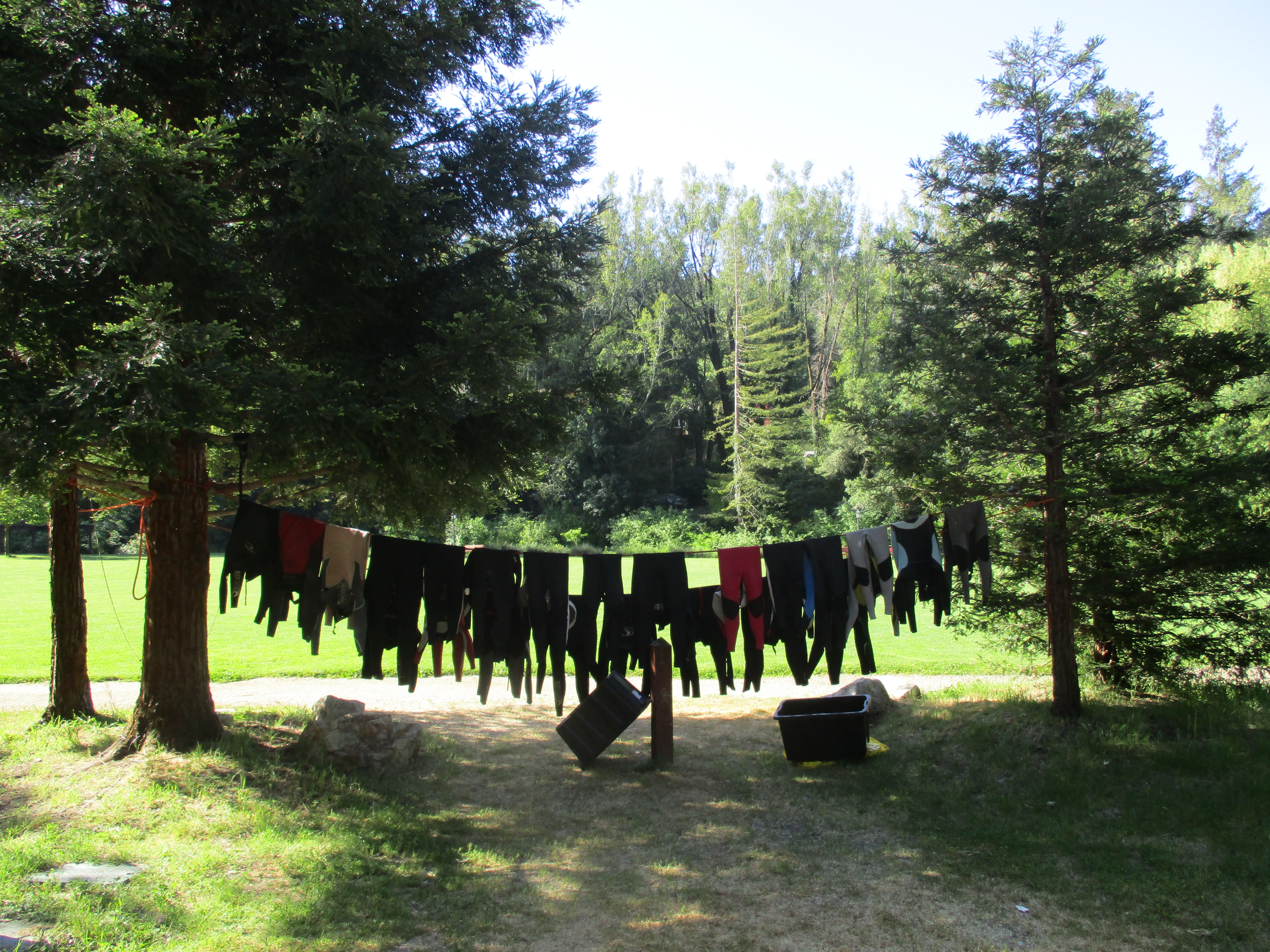
The unexpected way that these three small redwoods are functioning in this landscape was just too amusing to not get a picture of. I have no idea where all these wet suits came from, or why they are hung in this particularly prominent location, but it is the last thing I expected to encounter here.

Horridculture – Three Is A Magic Number

P81219We learned it young from Schoolhouse Rock. Those of us who studied Landscape Design were compelled to learn why, and assume that it is always true.
Well, I am not a landscape designer. I am just a horticulturist and arborist. I can see why three is the best number for groups of trees, and that five is probably the second best option for larger groups, followed by seven, and then nine, and so on. I sort of understand why two, four, six, eight and so on are not so desirable. However, these rules are not absolute.
When I was a kid, many suburban front yards were outfitted with three European white birch trees. Such groups were typically in a corner of the rectangular yards, just outside of the curvacious mowing strips that were designed to make the rectangular spaces seem to be more irregular than they really were. Individually, the groups of three birches were appealing. Collectively, they were cliché. They were supposed to look more ‘natural’; but there is nothing natural about contrived groups of three trees, especially when it is so prevalent. That is not how they grow in forests.
Now, although I am no landscape designer, I do happen to know that good landscape design is compatible with the architecture of the building that it is associated with.
Early American architecture really should be landscaped in the Early American style. This might seem to be simple, just because Early American landscapes are simple and utilitarian, with most of the plant material at a safe distance from the buildings. The difficulty is that such landscapes are very symmetrical, with paired shrubbery and trees, and several paired and evenly spaced trees flanking roadways. The left matches the right. That means quite a bit of twos, fours, sixes, eights and so on. Early American landscape design developed at a time when nature was something to be dominated and utilized in the most efficient manner possible. Not many landscape designers comprehend this philosophy, or would adapt to it if they did understand.
The group of three dwarf Alberta spruce in the picture below was not intended to be a rebellious expression of formality. As you can see, it really is a group of three. Yet, they are also evenly spaced in a straight row that parallels the adjacent wall. Without pruning, they will always be very symmetrically conical. Cool!P81219+

Horridculture – Lessons From Motivational Posters

P81010I work for the best. I do not intend to be too terribly pompous about it. I am just being honest.

This is not first time I have worked for the best. I have worked for at least three of the best arborists in the Santa Clara Valley, and two legendary horticulturists. I intend to eventually return to work for one of those legendary horticulturists back on the farm.
The main work I do now is part time and temporary. That means that I work less than four days each week, and will not be working there forever. I try to not think about leaving because it is saddening. I enjoy those whom I work for so much.
I work for only one other horticulturist, and one who is studying to be an arborist. Neither of them grow any significant quantity of nursery stock like I intend to spend the rest of my career doing. They maintain landscapes and facilities. The others of our elite group are very specialized professionals who work with everything else that is not relevant to horticulture. One is a carpenter. One is an electrician. One is a plumber; and so on. Although impeccably specialized, any one of us would do what he must to accomplish whatever needs to be done, even if it is beyond his respective specialty. Collectively, we are the ‘maintenance staff’.
How is this relevant to horticulture? I suppose it is not very relevant. However, everyone else on the maintenance staff respects what the other horticulturist, the other arborist, and I do. Anyone who needs vegetation pruned for clearance from a project contacts us to get it done properly. Anyone who sees obvious problems in the landscape informs us about them. Everyone on the maintenance staff respects everyone else and their respective professions.
To describe what makes the maintenance staff the best, I could use any combination of those inspirational words that are so ungraciously followed by an overly simplified dictionary definition on those insultingly inane motivational posters that so many other employers display prominently in the workplace. They are all relevant. However, we have nothing to prove.
Besides, this is not about the best. It is Wednesday, when I write within the context of my ‘Horridculture’ theme.
I have also worked for the worst. One of these worst was portrayed to be a very professional landscape maintenance company. We had a much larger staff, spread out over nine counties. We had a good variety of those motivational posters in our main office. Unfortunately, I did not realize when I went to work there, that those posters merely defined what we lacked.
Integrity – Dedication – Perseverance – Discipline – Teamwork – Excellence – Strength – Endurance – Accountability – We had none of that. I was the only horticulturist in the big staff of a big landscape maintenance company that simply did not care. I do not know how to describe it more accurately. We simply did not care. We were there to make a buck any way we could. We swindled, cheated and lied. I was only there as their token horticulturist and arborist, to help them get away with more of their illicit activity, and to make a good impression for their victims.
It is so backward. The big and seemingly reputable landscape maintenance company has less regard for horticulture than a maintenance staff who has other completely different priorities.

Horridculture – Agave

06When they became a fad in the 2000s, it was one of the very few fads that was actually sensible for California. Agaves certainly are not for every landscape, and certainly do not suit everyone’s taste, but they are ideal for the climate here. In some regards, they are more practical than the more popular of the native specie that tend to be scrubby looking and short lived. Agaves really should have become trendy a long time ago.
The problem with the fad, like so many other fads, is that it caused the object of desire to be overly popular for a while. Many agaves consequently got planted into situations where they did not belong. Landscape designers often forced them into the gardens of clients who did not know what they were, or did not even like their bold style. To show them off most prominently, designers often put the agaves next to walkways, driveways and doorways, rather in the background.
Those who know agaves know that they belong in the background because of their nasty foliar teeth! Technically, they are neither thorns not spines, but they are so wicked that they are known by both terms. These teeth are remarkably sharp and stout. Next to walkways and doorways, they can inflict significant injury to anyone unfortunate enough to bump into them. Next to a driveway, they can puncture tires! The foliar teeth of agaves are so dangerous that they do not belong anywhere in the gardens of homes where children or dogs live.
What is worse about those that are too close to walkways and such is that they grow! Landscape designers are notorious for installing small agaves that grow large in tight spots, merely because they were so cute and innocent when they were small.P80822K

Career Counseling

P71206This is not a sequel to my rant ‘Real Deal’ from yesterday. It is just another rant. I should write more such rants; and I am actually considering designating Wednesday, as the day for discussion of the various hooey in horticulture, from some of the many fads and gimmicks to the lack of professionalism in the horticultural industries. Wednesday is the day between my current gardening column articles and the gardening column articles that are recycled from last year. There is certainly no shortage of hooey to discuss. I have been mostly polite about it so far. I sometimes wonder why I should bother with politeness. I sort of think that some would prefer more honesty than such unfounded pleasantries. Well, I can give more thought to that later. There are still a few more pleasant topics that should be discussed as well. For now, I will continue:

Many years ago, while driving the delivery truck, I took a few orders to various jobs of a particularly annoying ‘landscape designer’ in Contra Costa and Alameda Counties. His orders were never planned. He would come to the nursery and just pick out random plants that he thought were interesting, including many that happened to be on the side of the road waiting to be taken away for disposal. (Overgrown and disfigured rhododendrons that get junked often bloom better than plants of better quality because they are more mature.) His landscape design was planned in the same manner. He just planted things wherever he though they looked good. There was no thought to the preferences of the various cultivars, exposure, irrigation, the trees above . . . or anything. He landscaped right around whatever happened to be in the way, including dead trees, fences overwhelmed with ivy, and dilapidated carcases of old brick barbecue pits that were beyond repair. I really disliked being on his job sites.

During one such deliver, he explained to me that he had been a chiropractor. He got bored with his career, and decided to do something more fun, so decided to become a landscape designer. He enjoyed buying pretty blooming plants in nurseries and wearing khaki shorts and big straw hats to work like all the landscapers with something to prove do.

My comment to him was that my career as a horticulturist was so much hard work and so frustrating at times that maybe I should also consider a career change. Perhaps I should consider becoming a chiropractor. If someone without ANY education or experience in horticulture or design . . . or anything even remotely useful in the landscape design industry can become a landscape designer, than it should be just as easy to become a chiropractor, despite a lack in formal education or experience in the industry.

He did not like that comment.