 We learned it young from Schoolhouse Rock. Those of us who studied Landscape Design were compelled to learn why, and assume that it is always true.
Well, I am not a landscape designer. I am just a horticulturist and arborist. I can see why three is the best number for groups of trees, and that five is probably the second best option for larger groups, followed by seven, and then nine, and so on. I sort of understand why two, four, six, eight and so on are not so desirable. However, these rules are not absolute.
When I was a kid, many suburban front yards were outfitted with three European white birch trees. Such groups were typically in a corner of the rectangular yards, just outside of the curvacious mowing strips that were designed to make the rectangular spaces seem to be more irregular than they really were. Individually, the groups of three birches were appealing. Collectively, they were cliché. They were supposed to look more ‘natural’; but there is nothing natural about contrived groups of three trees, especially when it is so prevalent. That is not how they grow in forests.
Now, although I am no landscape designer, I do happen to know that good landscape design is compatible with the architecture of the building that it is associated with.
Early American architecture really should be landscaped in the Early American style. This might seem to be simple, just because Early American landscapes are simple and utilitarian, with most of the plant material at a safe distance from the buildings. The difficulty is that such landscapes are very symmetrical, with paired shrubbery and trees, and several paired and evenly spaced trees flanking roadways. The left matches the right. That means quite a bit of twos, fours, sixes, eights and so on. Early American landscape design developed at a time when nature was something to be dominated and utilized in the most efficient manner possible. Not many landscape designers comprehend this philosophy, or would adapt to it if they did understand.
The group of three dwarf Alberta spruce in the picture below was not intended to be a rebellious expression of formality. As you can see, it really is a group of three. Yet, they are also evenly spaced in a straight row that parallels the adjacent wall. Without pruning, they will always be very symmetrically conical. Cool!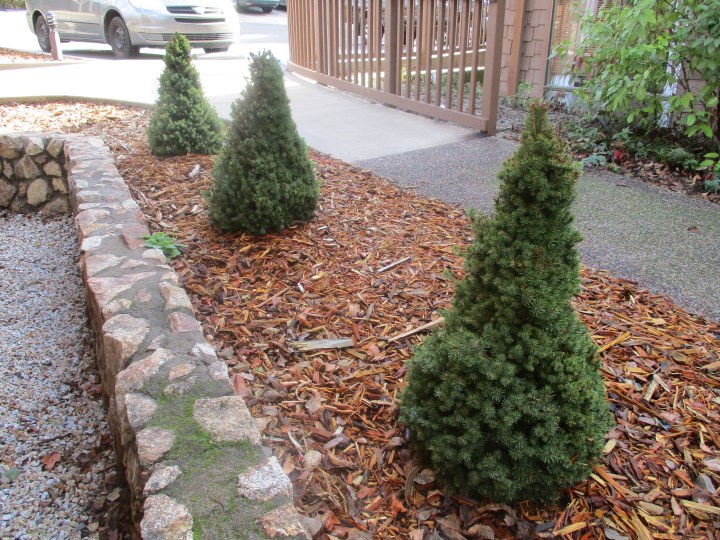
Plan Ahead For Coniferous Evergreens
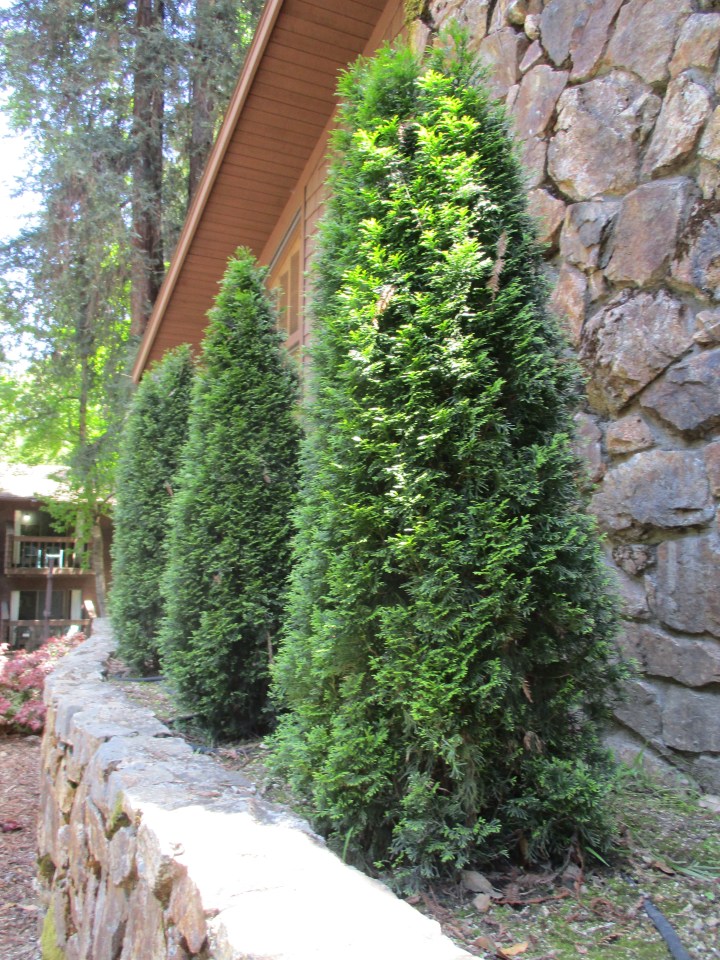 We all know what autumn is for. Planting, of course. Yes, it is a recurring theme; but there are so many different things to plant. Dormant bulbs need to get into the ground before cool and rainy winter weather. Deciduous plants that should be planted while dormant prefer an early start if planted as soon as they defoliate in autumn. Believe it or not, most evergreen plants are no different.
Evergreen plants do not experience the degree of dormancy that defoliated deciduous plants do, but they too are significantly less active during autumn and winter than they are during warmer weather. Therefore, if possible, they should also be planted in autumn, so that they can begin to slowly disperse roots through winter, to be ready to resume growth as weather warms next spring.
All planting should be planned. This is more important for trees, big shrubbery and other plants that are difficult to relocate once they have dispersed their roots. Some broadleaf evergreens that get bigger than expected can be pruned into submission. However, most coniferous evergreens are notoriously difficult to contain if they get too big for the situations into which they get planted.
‘Coniferous’ plants are those that produce cones. Cypress, pine, fir, spruce, cedar and redwood are the more familiar coniferous trees. Most coniferous trees, except for most of the various cypress, have excurrent branch structure, with lateral limbs extending from a central trunk. They can not be pruned down without disfiguring their central trunks. Lateral limbs can be disfigured if pruned back. Such trees should therefore be planted where they can grow unobstructed to mature size.
Juniper and arborvitae are some of the more familiar of coniferous shrubbery. They can be shorn even into formal hedges, but only if shorn very regularly. Their dense foliage shades out interior foliage. If they get too big for the respective situations, they can not be pruned back into submission without exposing their bare interiors. Once exposed, bare interior stems may never recover.
Horridculture – Ignoring Arboriculture
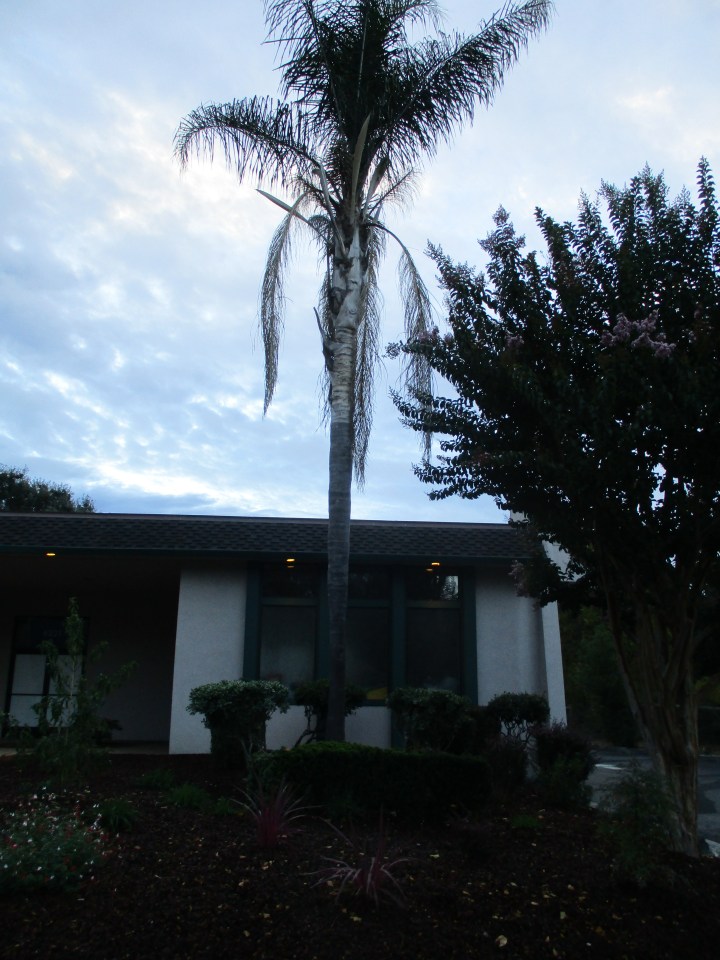 There are too many different types of horticultural professionals to count. There are nurserymen who grow horticultural commodities. There are landscape architects and landscape designers who design the landscapes into which some of these horticultural commodities will go. There are landscapers who install such landscapes. Of course, there are gardeners who maintain the landscapes after they are installed. These are just a few of the more familiar horticultural professionals.
I will refrain from my typical ranting about the extreme lack of professionalism among almost all horticultural professionals who are not nurserymen or arborists (okay, and one landscape designer), but must point out something in the picture above. Do you see it?
It is not the fact that this once very well designed landscape was dismantled and mostly replaced with a cheap slapped together assemblage of cliché plants by someone who just needed work.
Nor is it the pointlessly disfigured shrubbery from the original landscape that was salvaged while the best features that could have been salvaged were removed.
Nor is it the fact that this process has been repeated a few times since the building was originally landscaped back in the 1980s, leaving a nicely maturing but weirdly non conforming crape myrtle in front of the queen palm that should be the focal point, as well as a new dogwood that will compete with both focal points.
It is the fact that despite all the effort that went into the installation of this garage sale style landscape, no one bothered to procure the services of an arborist to groom the queen palm. Do you see it now; all those dead fronds hanging from the canopy of the queen palm? It is like taking a pick up through a car wash while it is loaded with garbage.
Horridculture – Agave
 When they became a fad in the 2000s, it was one of the very few fads that was actually sensible for California. Agaves certainly are not for every landscape, and certainly do not suit everyone’s taste, but they are ideal for the climate here. In some regards, they are more practical than the more popular of the native specie that tend to be scrubby looking and short lived. Agaves really should have become trendy a long time ago.
The problem with the fad, like so many other fads, is that it caused the object of desire to be overly popular for a while. Many agaves consequently got planted into situations where they did not belong. Landscape designers often forced them into the gardens of clients who did not know what they were, or did not even like their bold style. To show them off most prominently, designers often put the agaves next to walkways, driveways and doorways, rather in the background.
Those who know agaves know that they belong in the background because of their nasty foliar teeth! Technically, they are neither thorns not spines, but they are so wicked that they are known by both terms. These teeth are remarkably sharp and stout. Next to walkways and doorways, they can inflict significant injury to anyone unfortunate enough to bump into them. Next to a driveway, they can puncture tires! The foliar teeth of agaves are so dangerous that they do not belong anywhere in the gardens of homes where children or dogs live.
What is worse about those that are too close to walkways and such is that they grow! Landscape designers are notorious for installing small agaves that grow large in tight spots, merely because they were so cute and innocent when they were small.
Six on Saturday: Infrastructure
There is so much more to horticulture than plant material. There is a lot of hard work, which is hard to get in pictures. There are a lot of materials. There is a lot in infrastructure.
Well, I do not have pictures from the farm to show how our horticultural commodities are grown. That would not be very interesting anyway. These pictures are merely odds and ends of what we work with in regard to landscape maintenance.
1. Incarcerated stone. Yes, it is quite obvious that this prison is overcrowded. This is where they do ‘hard’ time. Incidentally, ‘Pet Rock’ was invented in Los Gatos.
2. Half barrel. Back when there were more real wineries in the Santa Clara Valley, barrels such as this were cheap, and could sometimes be found left on the sides of roads for anyone who wanted to take them for kindling. At nurseries and lumber yards, they could be purchased already cut in half, perforated with a few drainage holes on the bottom, and painted with wax on the inside, for use as planters. They are more expensive now. This particular barrel came from France, so is not even made of local valley oak. See the fancy label at the top of the picture? The drainage hole on the left was not drilled through because the drill bit encountered something metallic in the wood. Check out the tips of my stylish boots at the bottom of the picture.
3. ErmitagE France. This metallic label on the wine barrel is so comically contradictory! The lack of an ‘H’ at the beginning, and the capitalized ‘E” at the end of ‘ErmitagE’ implies that the former contents of the barrel was something fancy, but is then followed by ‘France’.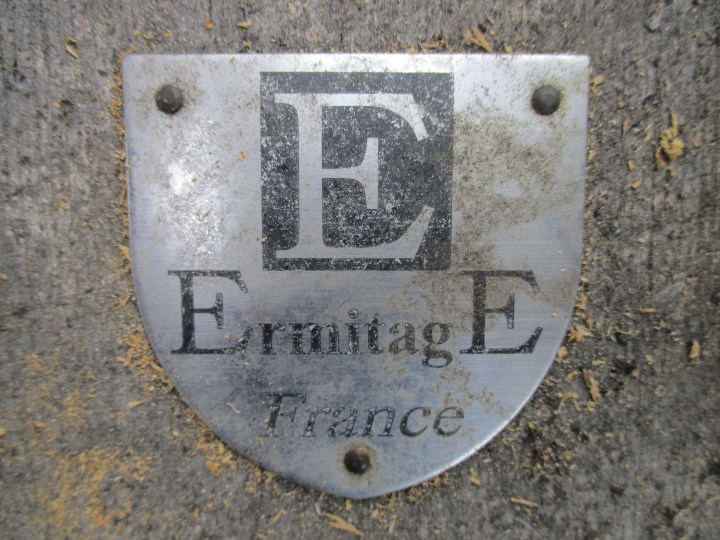
4. NO DUMPING ALLOWED. This is a classic example of ‘Do as I say, not as I do’. We dump debris from landscape maintenance all the time. When we prune for road clearance, much of the debris gets thrown back out into the forest behind what was pruned. In some spots, it works like mulch to keep some of the weeds down. Larger bits must get taken away of course. This sign will be posted on a wide spot on one of the roadways where dumping had apparently been a problem. By the way, it is just coincidence that the two words ‘CHILD DUMPING’ lined up like that.
5. White star magnolia. This was just moved to the new landscape of a newly renovated building. https://tonytomeo.wordpress.com/2018/06/16/six-on-saturday-rock-on/ We would have preferred to wait for it to defoliate in autumn before relocating it, but it was in the way within another recently landscaped area, and we really wanted to install it here in the new landscape before other material gets installed around it. https://tonytomeo.wordpress.com/2018/04/07/six-on-saturday-rock-concert/ It does not seem to know that it has been moved. I happened to grow these along with many other magnolias back in the late 1990s, and really did not like working with them in the nursery. We just were not set up for them. However, I really like them in the landscape. This particular magnolia grows like a large shrub, so will not get big enough to drop flowers onto all that pavement. That would have been a concern with larger magnolia trees that bloom with larger flowers that can be a slipping hazard when they fall onto pavement.
6. Epiphyllum. This just happens to be in bloom at the shop. It belongs to the horticulturist who maintains all the landscapes here, so has nothing do do with the landscapes. With all the pictures of inert items and only one white star magnolia, I thought I should include something a bit more colorful. It does not get much more colorful than this.
This is the link for Six on Saturday, for anyone else who would like to participate:
https://thepropagatorblog.wordpress.com/2017/09/18/six-on-saturday-a-participant-guide/
Six on Saturday: ROCK ON!
This might be the very first post in the history of Six on Saturday that lacks any plant material! There are certainly plenty of flowers blooming out there, but that was not what I was working with this week. The first two pictures were at a site where I was working earlier in the week. The other four pictures were at a larger landscape that is in the process of being renovated. Until this week, I had not seen much of the site, but heard about it daily. The work is behind schedule, so a whole bunch of us went to the site to help. Although we were very grateful for the help, and everyone was genuinely pleased to be of service, I can not help feeling guilty about my esteemed colleagues engaged in the unpleasantries of such dusty and dirty work, especially when they have so much of their own work to tend to.
1. The soil at the first job site is of exceptional quality, but is only about a foot deep! This now broken mudstone is what lurks below, but it is not broken down under. It is only broken in the picture because it needed to be pried up so that larger plants could go into the ground. It took all morning just to install a few #5 plants. The smaller #1 plants were planted much more easily on top of the mudstone. 2. This sometimes happens when prying up mudstone.
 3. At the second and much larger landscape, the irrigation system and lighting needed to be installed before the rest of the landscape. There is now irrigation pipe and electrical conduit everywhere! It took some serious digging. Because so much excavation had already been done at the site for the installation of big wide walkways, much of the soil was being moved a second time. The soil is so loose and sandy that much of it needed to be dug a few more times from the ditches as the irrigation system was installed.
 4. A few big boulders were installed on the site. To avoid driving the heavy machinery on the new concrete, the boulders were installed early in the renovation process, before the new concrete was installed. Consequently, they were buried by the soil that came from all the ditches for the irrigation and lighting systems. They reappeared as the ditches were filled. I still do not understand the appeal of stone and boulders in landscapes. The mudstone that was encountered earlier in the week was not much fun.
 5. Plant material has not yet been installed, so the landscape features only a few dogwood trees that were already there, and these few boulders scattered about in the dusty soil. It really is dusty! I cannot figure out why the dogwoods are so happy there. I can not figure out why the boulders are so happy either, . . . or if they are happy . . . or if they really care at all. I just do not know.
 6. One of our soil science professors at school was emphatic about soil being ‘soil’. We were not allowed to refer to soil as ‘dirt’. Well, this soil happens to be better than it looks, and it is good enough for dogwoods, but it really is very dirty soil.
 This is the link for Six on Saturday, for anyone else who would like to participate:
https://thepropagatorblog.wordpress.com/2017/09/18/six-on-saturday-a-participant-guide/
Location – Location -Location!
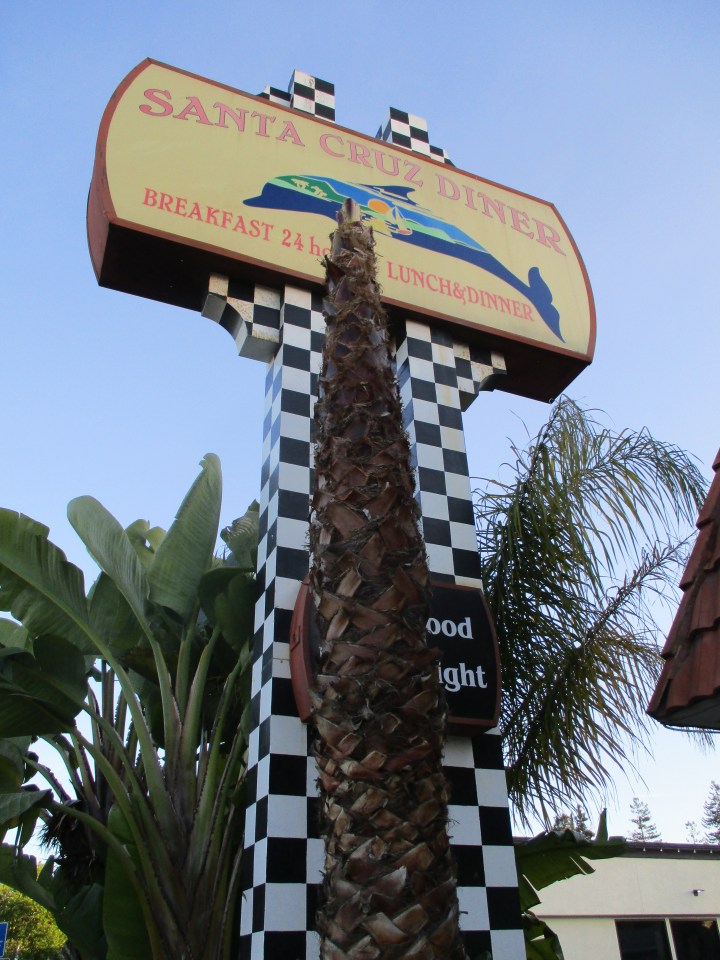 Speaking of which, this is not the right location!
This unhappy Mexican fan palm may have grown here from seed, as they often do. They are notorious for growing under utility cables because that is where birds drop so many of their seed. Perhaps the seed for this one was dropped by a bird perched on the sign many years ago.
Ironic, isn’t it. Birds tend to perch on utility cables and signs and in trees and everywhere that palms should not be planted. How often do they drop seeds out in the open, where whey will not encroach into something as they grow up? Why can’t they drop palm seeds in places where palm trees would actually be an asset? It happens sometimes, but not as often as palms appear where they are not wanted.
The picture below shows three larger Mexican fan palms that were intentionally planted in the original landscape, with a smaller palm between two of the larger palms. The palm in the first picture is barely visible in front of the sign in the background, and is about the same size as the smaller tree that is more visible between the taller trees.
It is possible and perhaps likely that the two smaller palms were not planted intentionally. It is also possible that someone actually planted them.
It does not matter now. The palm in front of the sign needs to be removed. The removal of all the foliage will not kill it. It will generate new foliage that will again obscure the sign if the tree is not eliminated soon. There is no way to prune the palm to divert growth around the sign. It has only one terminal bud, and is unable to generate another if topped. Palms under utility cables have the same problem. Once they get too close to the cables, they must be removed.
Getting back to the first picture. The shock and awe of the defoliation of the subject Mexican fan palm was likely sufficient distraction to prevent anyone from noticing the queen palm foliage peeking around the right side of the sign. Unlike Mexican fan palms, queen palms rarely grow from seed here, especially in a spot where there are no other queen palms nearby. Yes, someone planted ‘another’ palm in the same spot!
Mower
 After all the years it was out there, someone, somewhere must have gotten good pictures of it. I never did. Nor did anyone I know. It was something of a famous landmark in Santa Clara.
First, I should explain these pictures that my niece sent from here Mid City Heights neighborhood in Los Angeles. As you can see, this is a well kept middle aged home with minimal setback from the sidewalk. It is in a delightfully tree shaded neighborhood of comparable homes.
What are those black and white silhouettes of city skylines on those two plastic panels in front, you ask? They are a fence. Seriously. There are several similar panels around the perimeter of the front yard, at the edge of the sidewalk, and up the sides. They depict a variety of familiar landmarks, such as the Golden Gate Bridge, the Space Needle, the Eiffel Tower, the Tower Bridge and so on. They are all jumbled together so that landmarks from cities that are thousands of miles apart can share the same skyline. Mount Rushmore is depicted on the gate, adjacent to a city skyline that features both the Gateway Arch and the Sydney Opera House. Someone actually paid a lot of money to get this fence constructed and installed around the front garden of their otherwise well tended home. But wait; there’s more.
The picture below shows what lurks behind the fence. It was actually worse before the fence was built, when it was in full view. As tacky as the fence is, at least it obscures it. ‘It’ is a fountain; but not just any fountain. This picture does not do it justice. It really should be viewed at night, when it lights up with disco lights and emits eerily illuminated water vapor. It sometimes plays music. Yes, someone really though it was a good idea to put this in the front yard, where, before the fence was built, it was visible to anyone in the vicinity.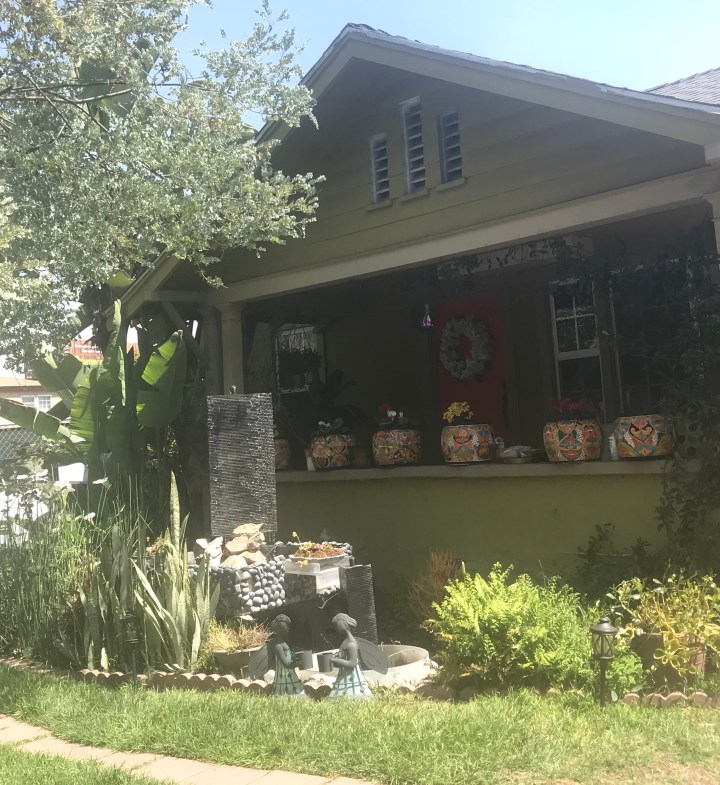
Now, getting back to the mower. It did not work. It probably worked at one time. It was an old mower, from before the mid-1960s or so. The person who owned it apparently did not like using it, but did not want to get rid of it either.
He had it bronzed. Yup. Bronzed. The front garden of his mid-1950s tract home in Santa Clara was paved with exposed aggregate concrete, with a big pedestal in the middle, on which, the bronzed mower was proudly displayed. The concrete was of exceptional quality, and would have made a nice patio if it had a bit of landscaping around it. Instead, it was surrounded by only a simple but tasteful low iron fence with tan slumpstone pillars. The fence surrounded the perimeter of the front garden, at the edge of the sidewalk and up the sides. There was no plant material in the front garden. None.
The mower debuted sometime about 1970. The kids of my generation do not remember it not being there, so it was there as long as any of us can remember. Some of our parents believe it might have been there as early as 1964. The home and paved front yard were always impeccably maintained.
Tacky? Yes, of course.
Crazy? Maybe.
It gets worse.
In about 1995, the home sold. It actually sold rather quickly because it was in such good condition. Everyone thought that whomever purchased it would remove all the pavement and the mower, and landscape the front garden. But no. They moved in, painted the home a different color, and maintained the front garden as it had always been maintained. What is the point of living in such a nice home in such a nice neighborhood with such nice soil and in one of the best climates on in the World if the garden is paved?!
Only a few years ago, the home was sold a second time, and those who purchased it finally removed all the concrete and bronzed mower, and outfitted the home with a simple but presentable landscape that is more compatible with the rest of the neighborhood.
The funny thing is that everyone in that neighborhood had lived with the bronzed mower for so long that it was somewhat saddening to see it go! We all knew why it needed to go, and that the home looks so much better without it, but it was familiar. It was cool in a weird sort of way. It was defiant. It certainly was unique. It was environmentally responsible, and about as drought tolerant as it gets.
It is still impossible to imagine that the black and white plastic ‘city skyline’ fence and steamy disco fountain within will ever be so appreciated; but who knows?
Shady – MSDS – (yes, another sequel)

As the Certified Pesticide Applicator working for the ‘landscape’ company that I wrote about earlier ( https://tonytomeo.wordpress.com/2018/03/18/shady/ ), I assumed several responsibilities pertaining to the pesticides and other chemicals that the ‘landscape’ company used. Among other things, I needed to inventory all the chemicals, monitor their use, submit use reports to the Department of Agriculture for each of the nine counties in which we used these chemicals, and provide MSDS binders for all of the ‘landscape’ company offices and vehicles within their fleet.
MSDS is for ‘Material Safety Data Sheet’. They are actually several pages each. Each MSDS binder contained two copies of the MSDS for every chemical the ‘landscape’ company used, or even had on site, whether it was actually used or not. One MSDS was in American English. The other was in Mexican Spanish.
So every office and every facility and every vehicle in the fleet of the ‘landscape’ company was equipped with an MSDS binder. Every binder was equipped with two copies of the MSDS for every chemical even remotely associated with the ‘landscape’ company. That is a whole lot of MSDS!
It’s the law.
I was required to provide all of this literature in languages spoken by anyone and everyone in the workplace, for all vehicles and facilities. Okay, so we’re clear on all that.
However . . .
There is no law requiring those using chemicals to be literate.
I certainly do not expect everyone to be literate in American English. They do not need to be able to read or write it. That is why there were copies of all the literature in Mexican Spanish. I could translate field notes from those who wrote them in Mexican Spanish. That would not have been a problem.
The problem was that many of those using the chemicals could neither read nor write in ANY language! At first, I though we could improvise. I instructed the accounts managers to inform their technicians to merely write down basic information, like the identification number of a chemical being used, the volume of the chemical used, and so on. Most of it involved copying information from the label, and the location from the work order provided to the accounts managers. It sounded simple enough. Sadly, it was not. Copying such information was too much to expect from those handling these potentially dangerous and polluting chemicals. The literature in the MSDS binders that I had so dutifully printed and provided was merely used as napkins and toilet paper.
By the time I could no longer be affiliated with this particular ‘landscape’ company, I had no idea where all of the inventoried chemicals ended up or how they were applied.
Shady
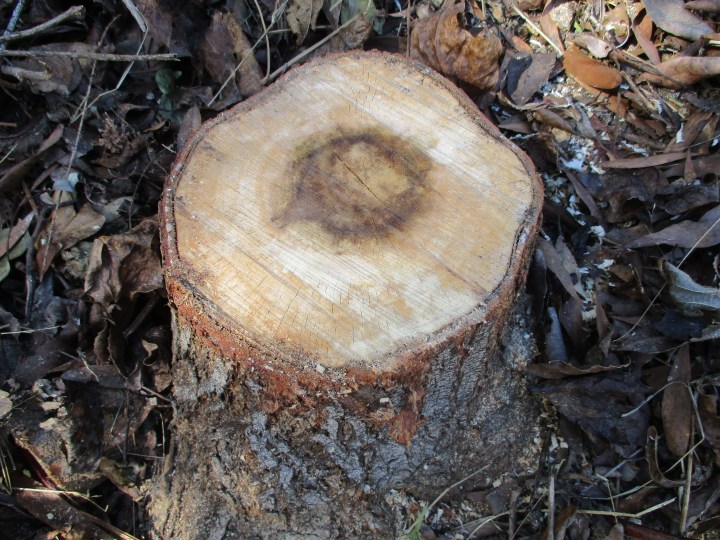 Shady applies to more than trees. It applies to many of those who are hired to maintain trees and landscapes. In my career, I have worked for some of the best arborists, nurserymen and other horticulturists. In fact, some of my colleagues, particularly a landscape designer, two nurserymen and at least three arborists, happen to be legendary. I would say that I don’t mean to brag, but that would be inaccurate. I will write about some of them sometime. This here is not about them.
Sadly, I have had the misfortune to work with some really shady characters and businesses. They may seem to be more professional than the real professionals who take their professions very seriously, but it is all for show. I can tell you all about the brochures, and use all the buzz words, but it is all a lie. From sustainability and planting natives to save water, to diagnosing problems before they become serious, they are all lies. Their objective is to take money; as much money as possible, for as little effort as possible.
Even their contracts were not considered to be sustainable. I once informed an operations manager that the oleanders that were planted below a sign were not the dwarf oleanders that they were supposed to be, and that in order to prevent them from obscuring the sign, they would need to be pruned and deprived of bloom. He was not concerned, and told me that we have no idea who will be taking care of the landscape by the time that happens.
Sure, they would plant garden varieties of native ceanothus, supposedly to save water, but then water them so much that they would rot and die. In fact, they would put so much water on lawns that many established trees would rot and die. They would then charge a lot of money to remove the dead trees, and then charge more money to plant new ones, even though they were responsible for killing the originals.
I was once instructed to go look at a ‘Marina’ madrone that was a street tree in what had been the old Fort Ord, where some of the old homes, buildings and landscapes were in the process of being salvaged or renovated. I was only informed that the tree was in bad condition. Upon arrival, I found the single madrone in a well matched row of others, on a curving street. I was quite annoyed that the tree was so distressed from severe aphid infestation that it could not be salvaged. The subject looked as if it had been healthy for many years, but only recently became infested with aphid within the previous two years. The other ‘horticultural professionals’ at the site should have noticed the problem before the tree had deteriorated as much as it had. Now, removing the tree was going to compromise the conformity of the evenly spaced and well matched row of street trees. I wrote the report prescribing removal.
I needed to visit the site for another problem a few weeks later, and when I drove by where the tree should have been removed, I noticed that it was still there, and very dead. Interestingly, a tree next to it was missing. That made me wonder. I radioed in, and was informed that the tree had been cut down. You can guess where this is going. They had cut down the wrong tree; a perfectly healthy ‘Marina’ madrone. Why didn’t the crew removing the healthy tree question the removal of such a healthy tree next to a dead tree? Who knows. I wrote another report prescribing the removal of the dead tree, which was removed the second time around.
The client was charged for the removal and replacement of BOTH trees, the dead tree, and the healthy tree that was removed by ‘mistake’! The replacement trees were large boxed trees that better matched those that were removed!
For those who do not know, madrones should be planted while young, and will rather efficiently grow to match the others. Boxed trees get too distressed from the transition to recover right away, and wait around for years before they resume growth. By the time a big boxed tree starts to grow, a smaller tree would have already gotten established and grown larger. Boxed madrones are really for those who want to charge more money than they could get for smaller trees that cost much less.
So, the landscape company charged a lot of money to maintain the landscape, so that trees would not die from negligence. Then, they charged not only for the removal and replacement of a tree that died as a result of their negligence, but also a tree that was killed by their stupidity. As if that were not enough, they charged for the the most expensive replacement trees available. They were shadier than the trees that they killed.
 Tony Tomeo