Scofield Tree Update – Spring 2018

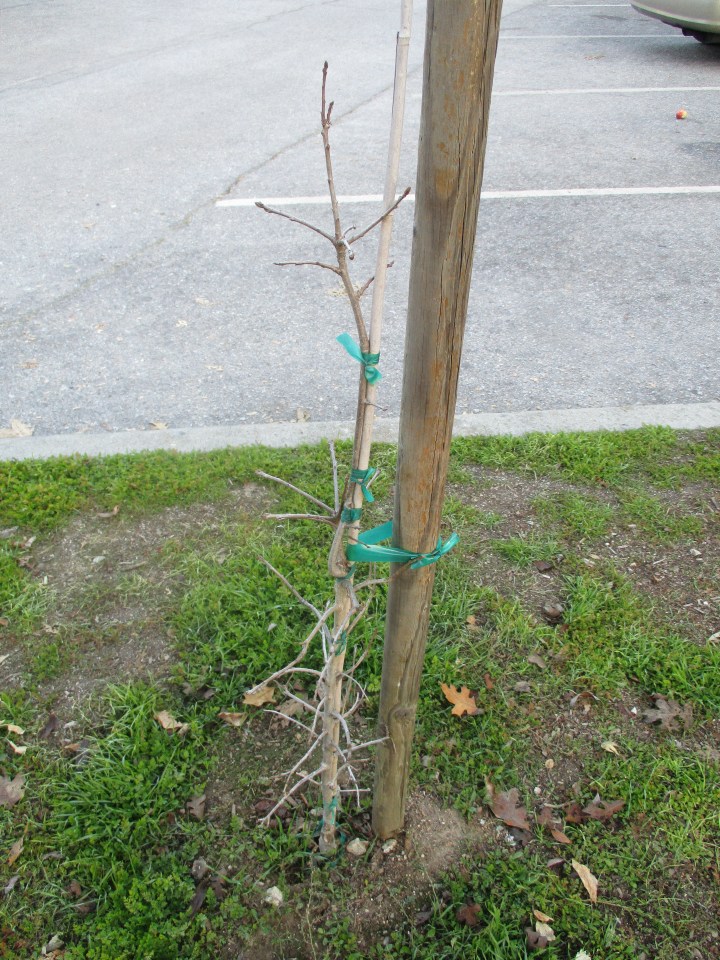
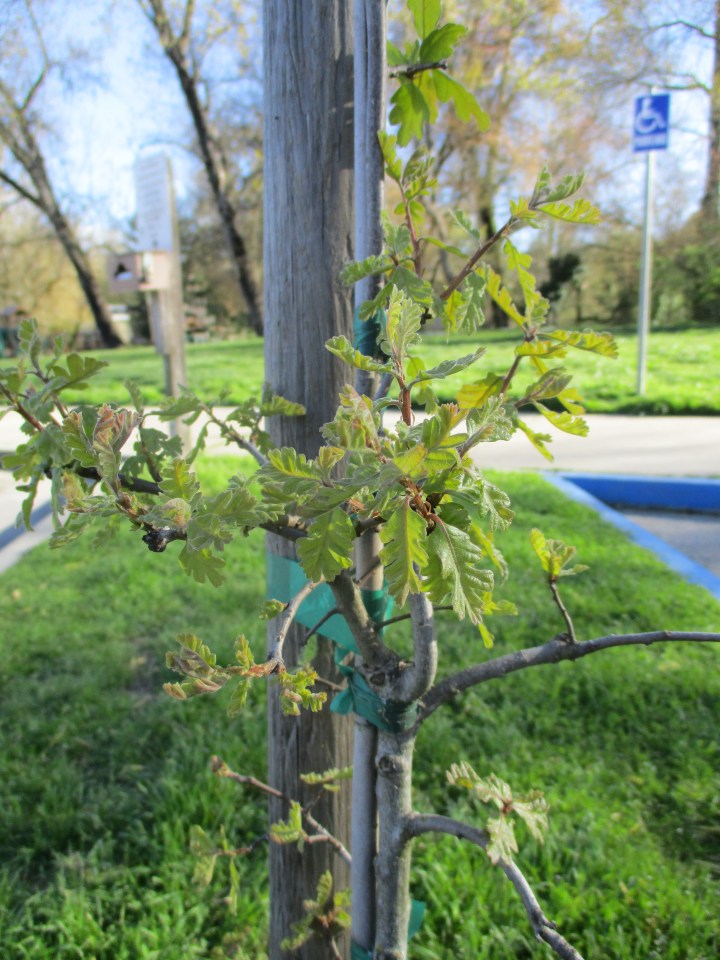
P80331KNot much has happened since the last update on Christmas Eve. https://tonytomeo.wordpress.com/2017/12/24/scofield-tree-update/ The Scofield Tree has been bare all winter, and is only now developing new foliage.

It was planted more than two years ago, but had been set back by some serious damage from an altercation with a weed whacker. Unbelievably, after emphatic explanation of how dangerous weed whackers are to such young trees, and an unfulfilled promise that the tree would be outfitted with a tree guard, a ‘gardener’ attacked the tree with a weed whacker AGAIN! Fortunately, the tree had previously developed enough scar tissue to not be damaged by this latest assault.

It will certainly be pampered this year. It really needs to grow. The bark at the base needs to be tough enough to survive an even more aggressive weed whacker attack. The trunk must be resilient to someone bumping into it, or a dog getting a leash tangled around it. Eventually, the trunk will be resilient to a car bumping into it, which is a possibility in the parking lot in which it is located. The canopy must eventually grow up and above the height of parked cars and those getting into and out of those cars. Ideally, it should be out of reach of gardeners with cutting tools that they do not know how to use properly.

The old lodgepole stake will be replaced because it is likely rotten at the base. The binding stake will also be replaced because it has warped in the last two years. Such binding is not horticulturally correct, but is necessary to correct disfigurement, as well as to help protect from more damage. Fertilizer should accelerate growth.

The first article about the Scofield Tree was posted back on October 6. https://tonytomeo.wordpress.com/2017/10/06/small-tree-in-a-big-park/P80331K+
Scofield Tree Update

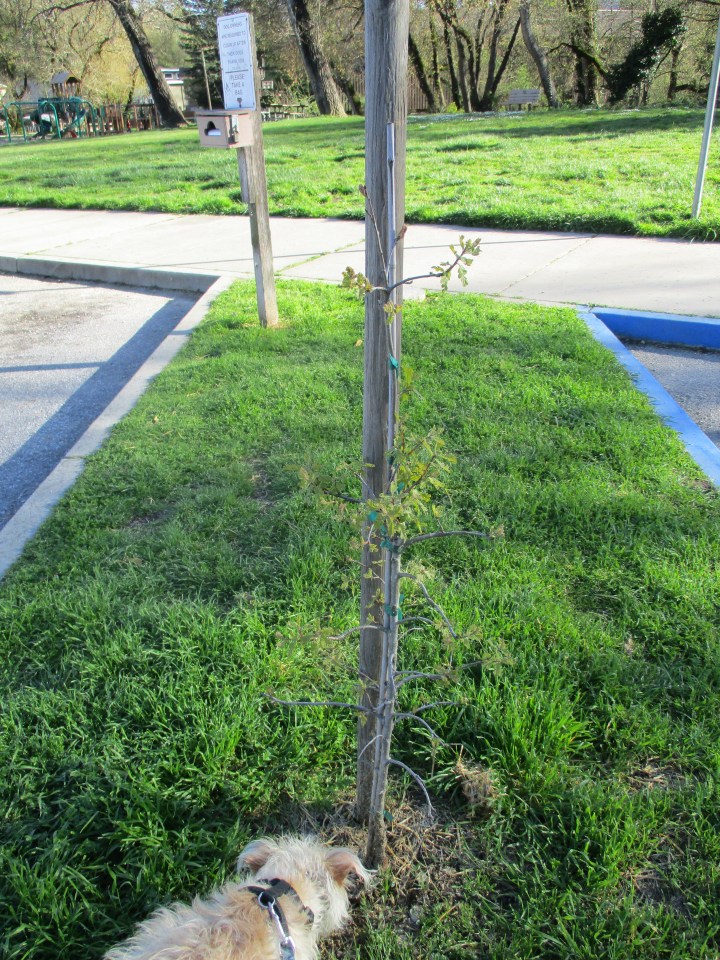
P71212+KThe sad little Scofield Tree in Felton Covered Bridge Park did not do much this year. (https://wordpress.com/read/blogs/135014809/posts/322 and https://tonytomeo.wordpress.com/2017/12/02/felton-covered-bridge/) In fact, it grew only about five inches taller, so is now only about four feet tall. The damage from the weed whacker really set it back. Growth was healthy on the side shoots, but that growth will need to be tucked back to promote apical dominance. The good news is that the vigor and health of the foliage of the sideshoots indicated that root dispersion was likely adequate to sustain healthier and normal vigorous growth next year.
Although the sideshoots will get tucked back to limit their competition with vertical growth of the main trunk, the stubble will remain to promote caliper growth of the trunk.

The trunk will be bound like a tree in a nursery; and the bound trunk will be staked for stability. Binding outside of a production nursery may not seem to be horticulturally correct, but is necessary for a straight trunk. The staking is done more to protect the tree in such a high traffic area than to support the tree. It would be better for the tree to do without binding and staking so that it can learn to support its own weight. Once the straight section of trunk is taller than about six feet, the bindings will be loosened, and eventually eliminated as the trunk lignifies into form.

A bit of fertilizer will be added to the soil around the tree before the last rains of winter. This might seem like cheating, bur for right now, the tree is too small to be safe in such a high traffic area. It will also be irrigated occasionally after the rain stops. It does not get much water, but will get enough to keep it vascularly active through the growing season. Too much water promotes shallower roots, which might damage the nearby concrete curbs and asphalt pavement. Valley oaks naturally disperse their roots very deeply, so the curbs and pavement should be quite safe for a century or so.

Birthday

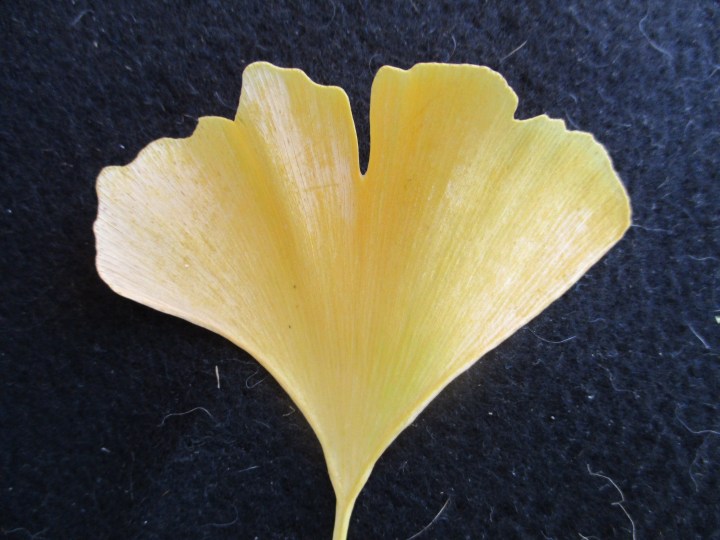
P71213This single yellow ginkgo leaf says a lot. It was found among the abundant cottonwood leaves on the broad walkway in Felton Covered Bridge Park (https://tonytomeo.wordpress.com/2017/12/02/felton-covered-bridge/). There are no ginkgo trees in the neighborhood that I am aware of. It must have come a long way to arrive here on the morning of December 13.

It really did not need to go through all the effort to get here. I need no help to remember the date. It is the birthday of a good friend who passed away last May.

Steven Michael Ralls is one of two friends I went to Oklahoma with late in 2012 (https://tonytomeo.wordpress.com/2017/11/19/oklahoma/). In the picture attached to my article about going to Oklahoma, there is a handsome gentleman to the left. That is me. The bronze guy in the middle was just standin’ on the corner in Winslow, Arizona. Steven is on the right. Gayle is on the sidewalk groping the bronze guy.

Steven did not know or care much about horticulture, but he knew ginkgo. It was his favorite tree; and it is the only tree that he remembered the botanical name for. There are a few gingko trees about Santa Cruz and elsewhere. He would sometimes point them out and exclaim, “Gingko biloba!”

I have not yet planted a ginkgo tree for Steven. At the spot under the Felton Covered Bridge where we scattered his ash, I planted a few canna seed that I brought back from Oklahoma, and some rooted cuttings of a pink brugmansia that I acquired during an outing with Steven to Santa Cruz. Neither grew enough to survive when the San Lorenzo River comes up this winter; so I will probably need to plant more.

Well, getting back to the single yellow ginkgo leaf. It says a lot. Today is December 13, the birthday of my good friend Steven.

Small Tree In A Big Park

P71006How did the Featherstone Tree survive? (See: https://tonytomeo.wordpress.com/2017/10/05/big-tree-in-a-small-town/.) It was planted on the edge of a busy highway where heavy loads of lumber were driven by oxen, at a time when society was more interested in harvesting trees than preserving them. Yet, after more than a century, it is still here.

The Scofield Tree is a very small valley oak in an island of a parking lot at Felton Covered Bridge Park, just across the San Lorenzo River from the Featherstone Tree. In a few centuries, it might be comparable to the big valley oak that was recently cut down across the road (See https://tonytomeo.wordpress.com/2017/09/11/goodbye-to-an-old-friend/.) It is a good choice for this location because it develops a remarkably complaisant root system for such a large tree, and it is a native, so does not need to be watered.

However, it is the fourth tree to be planted here. The original California black oak that was planted when volunteers from the Community built the park years ago did not last long before getting run over by a car. It was not replaced until a small Eastern redcedar was planted on New Year’s Day of 2013. That tree was dead and crispy by summer. A bigleaf maple was planted the following winter, and sort of survived through the year, only to die the following winter. It was too late in winter to plant anything new that year, so the tiny valley oak was planted late in 2015.

Although tiny, it had a nice root system, which was more than the two bare-root trees before it had. The hope was that if it could survive getting peed on by dogs long enough to disperse roots, it would be fine. It started to foliate the following spring, only to get much of the bark gouged away by a ‘gardener’ with a weed whacker. The poor tree nearly died, but somehow survived and started to recover. However, it did not recover fast enough to get ahead of the dog pee. It really seemed to be struggling through this year, and is now getting ready to defoliate for autumn. It really needs to get some height next year. Small trees are just too vulnerable to all that goes on in a park.

Each of the redwood trees around the perimeter of Felton Covered Bridge Park is a memorial tree, sponsored by friends or family of the deceased. An additional sweetgum tree is a memorial tree for a French bulldog. Some of the trees are outfitted with memorial plaques. The tiny valley is named the Scofield Tree for an old friend of the Community, Jeff Scofield, who passed away in the spring after the tree was planted; but it is really a memorial tree for a few people who passed away within a few years of that time. The Scofield Tree was sponsored and planted for the deceased by Felton League, an informal group of displaced and socially disadvantaged people of Felton, and their friends. Their Facebook page can be found at https://www.facebook.com/Felton-League-520645548069493/.

Perhaps what is written now about the Scofield Tree will eventually become part of the history of Felton, and be summarized on a plaque like the one on the Featherstone Tree. It would be excellent enough if the Scofield Tree simply does what good treed do in a park for a few more centuries.