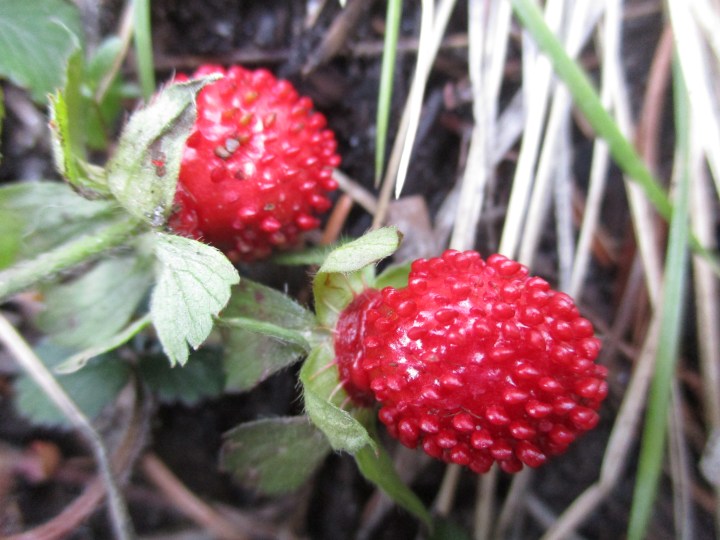
Under a bank of carpet roses that I am none too keen on, this grubby ground cover competes with more aggressive weeds. To me, it looks like common mock strawberry, Potentilla indica. I never gave it much though. It seemed to me that whoever had installed cheap and common carpet roses on that bank would have employed a comparably cheap and common ground cover.
The ground cover was more prolific in open spots that were too narrow for more of the roses, and from there, seemed to have migrated under the roses as a second layer of ground cover. It would not have been installed underneath intentionally. It did not occur to me that it may have grown from seed like so many other weeds there, or migrated in from the surrounding forest.
The white flowers did catch my attention though. I was not aware of a mock strawberry that bloomed with white flowers. I really was not concerned enough about it to investigate. This part of the landscape will be getting renovated soon anyway. The roses will be relocated to where they can not extend their thorny canes into an adjacent walkway. Agapanthus will replace them.
Now that I am seeing more of these odd strawberries, I am wondering if this low ground cover that I formerly had no regard for is actually the native wild strawberry, Fragaria californica. Not only should mock strawberry bloom with yellow flowers, but it should also produce more spherical berries. Now I will need to identify it before I either dispose of it, or merely relocate it.
I prefer to not salvage exotic species that exhibit potential to naturalize from landscaped areas into surrounding forests. If this ground cover is wild strawberry, it migrated from surrounding forests into a particular casually landscaped area.
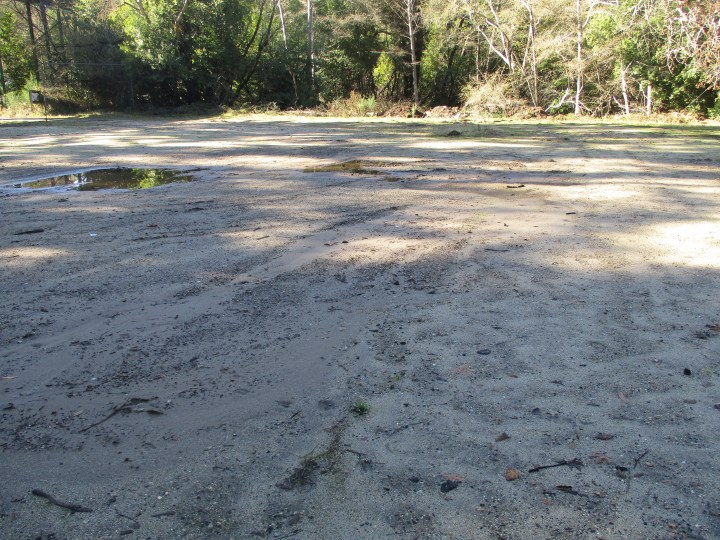 This . . . was a ball field. It might eventually be one again. The old backstop at the upper left corner of the picture is almost completely obscured under a thicket of blackberry brambles and a fallen boxelder. It would need to be replaced. So would the decommissioned irrigation system, all the bases, the basepath, the turf . . . and everything else that goes into a functional ball field.
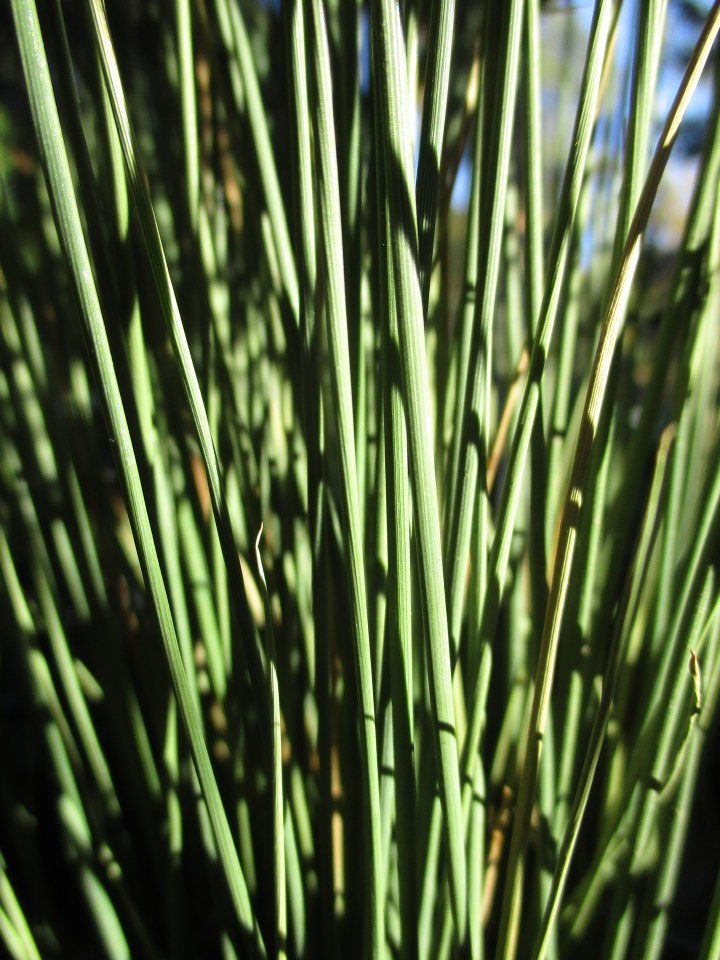 Not to be confused with the Canadian rock band from the 1970s, this rush, Juncus patens, is native to riparian areas between western Washington and San Diego County. It is also known as the common rush because it is, obviously, the most common species of the genus on the West Coast. It is only occasionally planted intentionally, but more often sneaks into well irrigated landscapes.
 Out in rural chaparral regions, where water is scarce, the big and bold California sycamore, Platanus racemosa, somehow seems to find the spots where groundwater is not too far below the surface of the soil. It is technically a riparian tree, that is just as comfortable competing with cottonwoods and willows along forested rivers and floodplains. It eventually get too big and messy for refined urban gardens, but is somewhat popular nonetheless.
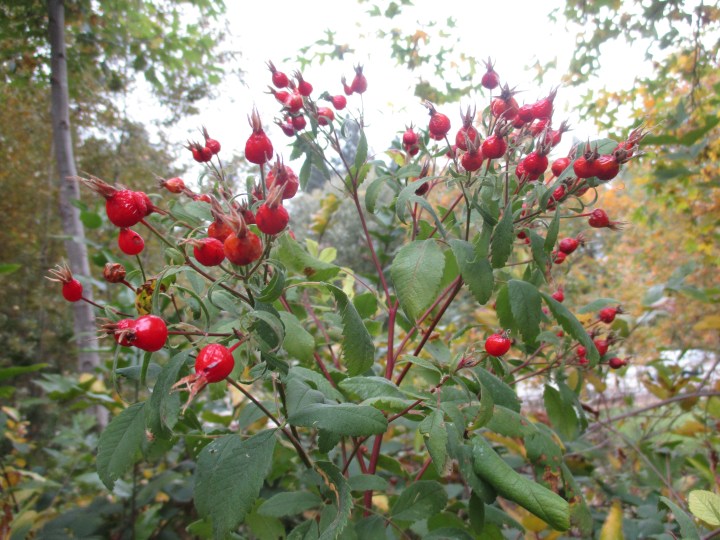 Chopped dried rose hips can be purchased from a supermarket in town that stocks an impressive variety of useful bulk herbs. They are used as a dietary supplement and remedy for several minor ailments. Although most of the copious vitamin C they contain while fresh is ruined by drying and storage, they are still popularly used as a remedy or preventative for colds and flu.
 California flora is remarkable. It all does what it must to live comfortably in every ecosystem, climate and geographical region here.
 The climate here is pretty cool, at least in winter. Right now, it is pleasantly warm. It does not often get uncomfortably cold or hot, and when it does, it does not stay like that for too long. In between the warmest days of summer, the nights typically cool off nicely. In between the coolest nights of winter, the days typically warm up nicely. Humidity is normally minimal. Rain is adequate in season.
 Felton League, the Facebook group of the homeless and their friends in Felton, California, briefly mentions the source of some interesting, but typically overlooked fruits that can be found in the wild or unrefined landscapes. Blackberries, American plums and elderberries collected from rural roadsides have produced award winning jellies for the Santa Cruz Mountains Harvest Festival.



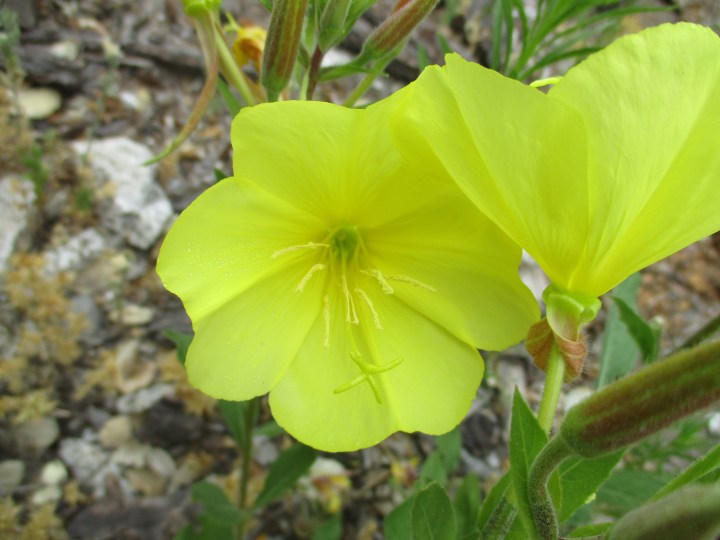
 If California poppy had not been designated as the California state flower, Matilija poppy, Romneya coulteri, might have been. It was nominated, but was less popular at the time, partly because it was familiar only to those near its native range in Southern California. Some of us know it as ‘fried egg flower’, because the big and floppy white flowers with yellow centers look like fried eggs.
 Tony Tomeo