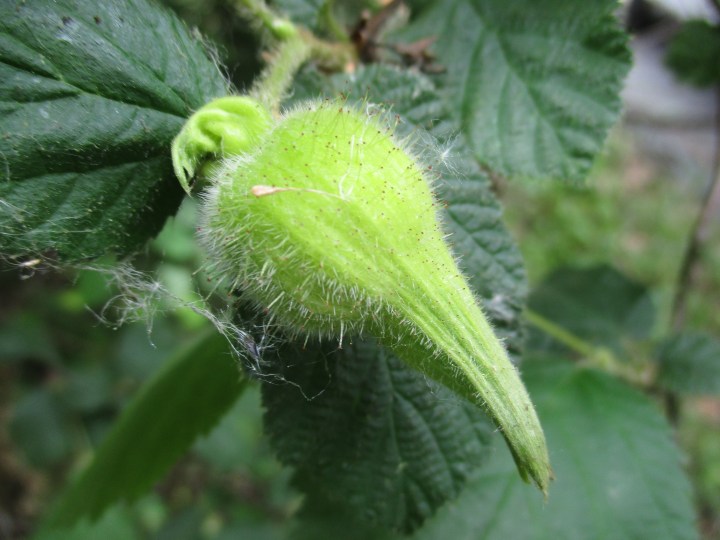
 Not just any nuts, but precisely the sort that I recently discussed with a colleague, as I explained how they do not grow here. The nuts that is. The big thicket forming shrubs that are supposed to produce them not only grow here, but are a relatively common native. I just rarely see even a single nut on them. I sort of wondered how they mange to procreate with such rare seeds that invariably get taken by unconcerned rodents or birds.
They are the beaked hazelnut, Corylus cornuta. You can see why they are known as such. The elongated nut husks look like Big Bird. The very rare nuts within are quite small with good rich flavor, like hazelnut concentrate, and develop only on the biggest and most distressed old hazelnut shrubs.
However, the young and healthy hazelnut shrub that produced the nut in this picture actually produced quite a few. They were just not close enough to each other for me to get more than one in a picture. A few other young and healthy hazelnut shrubs are doing the same at the same time. There are more hazelnuts now than I have seen collectively in many years. I can not explain why.
Some species of oak tend to produce an overwhelming abundance of acorns every several years or so, only to limit acorn production for the several years in between such abundance. All trees of the same species within a region somehow know to do this collectively at the same time. They do not do it often, but when they do, they do it together.
The oaks who do this supposedly produce just enough acorn to sustain a healthy squirrel population without promoting overpopulation. When they occasionally produce an excess of acorns, the squirrels instinctively bury many more acorns than they normally would, just because the acorns happen to be available. Since the squirrels can not consume all that they bury, many more stay buried to germinate and grow into trees later.
Almond
 It is no more in season now than the other stone fruits like apricot, cherry, plum and such, but this is the time of year that almond, Prunus dulcis, needs work. Established trees get pruned while bare and dormant. New trees, preferably bare root, get planted. The most popular modern cultivars available are self pollinating, and labeled as such. Old traditional cultivars require pollinators.
Almond is the ‘other’ stone fruit. Because it is a nut, it does not resemble the rest of the juicy and fleshy stone fruits like nectarine and peach. However, the resemblance to the stones of the stone fruits is obvious. It is, after all, a big seed. The fruity parts form tough hulls that spit open to reveal the dry nuts within. Almonds do not get picked, but instead get shaken or knocked from the trees.
Because the nuts are lightweight, almond trees do not need to be pruned as aggressively as other stone fruit trees. Because the nuts are not hand picked, the trees can be pruned upward as deciduous shade trees with spectacularly white spring bloom. Some cultivars can get more than twenty feet tall. Squirrels and crows take most of the nuts, but do not bother to clean up the hulls.
Almond
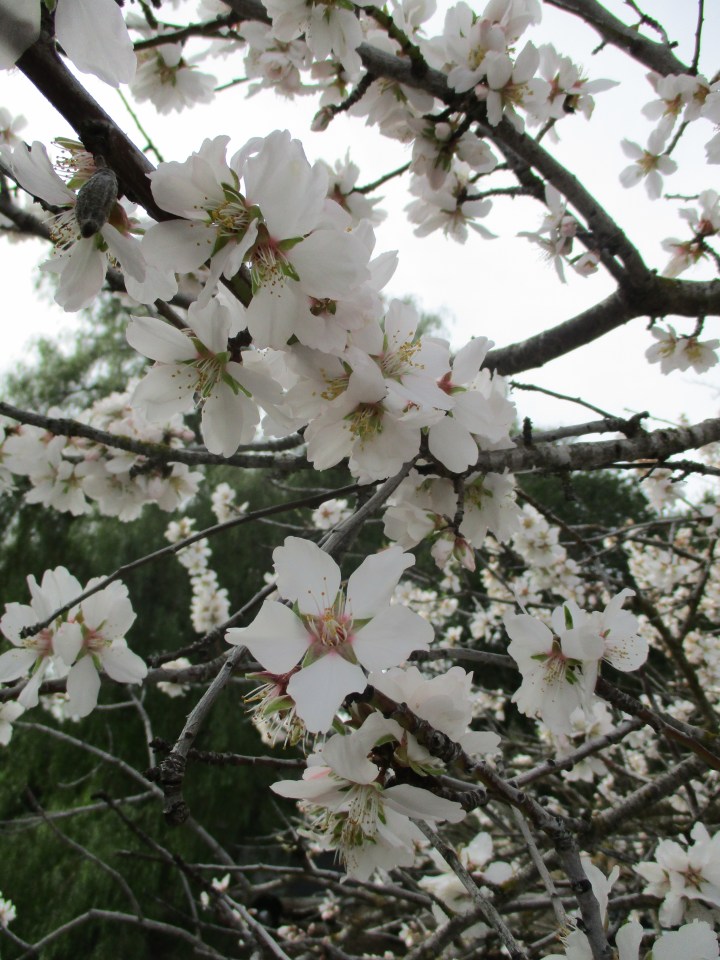 It is known more as a small to mid-sized shade tree that produces edible nuts, but almond, Prunus dulcis, also blooms magnificently as soon as the weather allows. Actually, it often blooms a bit earlier than it should. Nut production can be ruined if rain dislodges blossoms or developing nuts. The profuse white flowers are small but slightly larger than those of other related stone fruit trees.
Yes, almond is the same genus as apricot, cherry, plum, peach and the other stone fruits. The fruit is actually very similar, but instead of developing into sweet flesh, it merely forms a hull that dries and separates from the nut within. The nuts are the large seeds or stones, like peach pits that can be eaten. Hulled but unshelled almond nuts are about one or two inches long. Because the nuts get shaken from trees instead of picked, trees can be allowed to get about two stories tall.
Merry Christmas!
 Does anyone else think that it is odd that Baby Jesus got only some frankincense, myrrh and gold for His first Christmas? I mean, it was the first Christmas ever, and that was the best that anyone could do? Well, maybe those gifts were something important back then. Maybe it was a good heap of gold. It just seems to me that three ‘wise’ men could have procured better gifts. More than two thousand years later, some of us are disappointed if we do not get a new Lexus on Jesus’ birthday, after He got only frankincense, myrrh and gold. (Get your own birthday!)
Although I do not remember my first Christmas, I know that my parents and others got excellent Christmas gifts for us kids when we were young. Our stocking that hung over the fireplace were filled with a mix of nuts, mandarin oranges, cellophane wrapped hard candies and small wooden toys. This is a tradition that dates back to a time when citrus fruits and certain nuts were something fancy that needed to be imported to Northern Europe from Mediterranean regions.
Of course, citrus grows quite well in our region, and almonds and walnuts still grew in the last remnants of local orchards. Our great grandparents had two mature English walnut trees in their gardens. Only pecans and hazelnuts were exotic. I happened to like pecans because they are from Oklahoma. (I did not know where or what Oklahoma was back then, but I knew it was an excellent place.) Hazelnuts were from Vermont, which is twice as far away as Oklahoma is, if you can believe that!
The gifts under the Christmas trees were even more excellent! One year, I got packets of seed for a warm season vegetable garden the following spring. There were seed for pole beans, corn, pumpkins, cucumbers and zucchini. (The cabbage incident that I will write about later happened in the cool season garden the following autumn.) Under the Christmas tree at my grandparents house, I got all the gardening tools that I would need in my garden, including a small shovel, garden rake, leaf rake and hoe. But wait, there’s more! Under the Christmas tree at my great grandparent’s house, I got flower seed for bachelor button, alyssum and a few others, as well as bare root rhubarb plants (from my great grandfather’s rhubarb that he had been growing longer than anyone can remember). I had already learned about seed from my first nasturtiums (https://tonytomeo.wordpress.com/2017/10/07/dago-pansies/), so I could not have been more pleased with my cache of gifts.
For later Christmases, and also birthdays, I got all sort of other things that were much more excellent than frankincense, myrrh and gold, including an incense cedar (how appropriate) that my grandparents brought back from the summer house near Pioneer, and a young ‘Meyer’ lemon tree. My Radio Flyer wagon was the biggest and most excellent in the neighborhood, and was more than sufficient to haul all my gear around the garden with. My big watering can was a bit too big, and was too heavy for me to move when it was full of water.
I would not say that these gifts were extravagant. They were just . . . okay, so they were extravagant. It was a long time ago. Unfortunately, my parents figured out that their gifts were somewhat excessive just prior to buying me the Buick I wanted. The wagon is still around. My mother uses it to bring in firewood. She also uses the little shovel to clean ash from the stove.
(The gardening article that is regularly scheduled for Mondays is scheduled for tomorrow. The featured species that is regularly scheduled for Tuesdays is scheduled for Wednesday.)
 Tony Tomeo