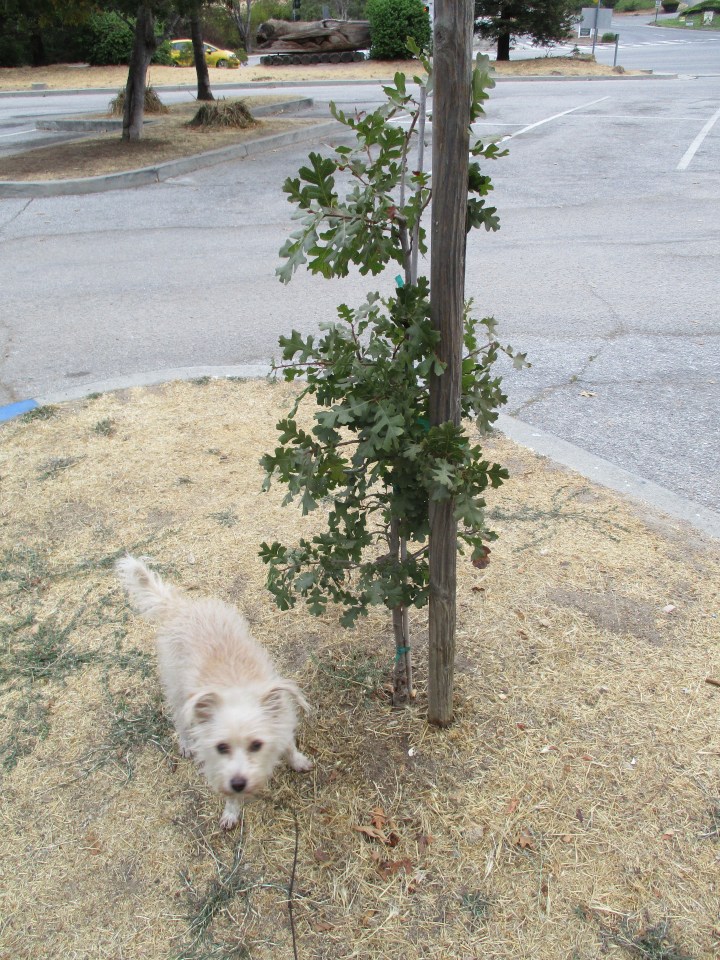
 There is NO news regarding the tiny Memorial Tree in Felton Covered Bridge Park that I so frequently provide updates for. It did not do much this year. I probably already mentioned this when it was busy not doing much in spring. It is in a difficult situation, where too many dogs do what dogs do to tiny valley oaks that are busy not doing much more than trying to survive without regular watering, out in a harshly exposed island in a parking lot. Once it gets going, it should do fine. It is only slow now, but is not unhealthy. It is doing exactly what it should be doing this time of year. By late autumn, it will try to defoliate. Valley oaks are never in a rush for that.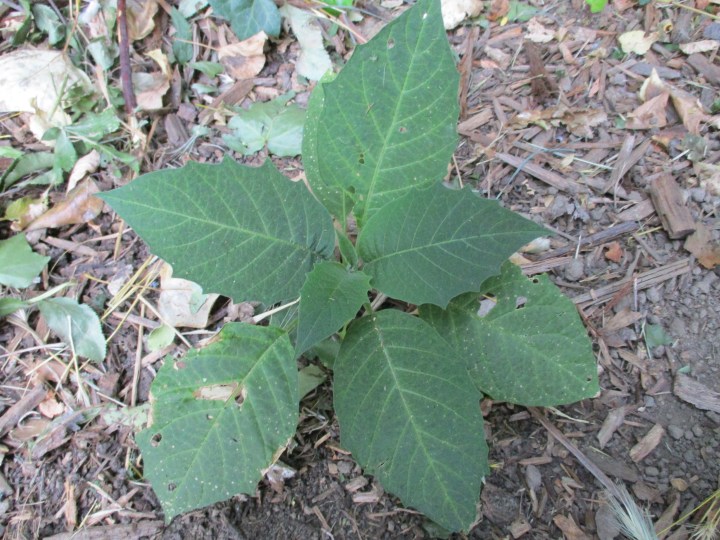
This angel’s trumpet is more interesting because it was seemingly deceased. As you can see, it is trying to recover . . . just in time for autumn. Unfortunately, there will not be sufficient time and warm weather for it to mature enough for the new stems to survive even a mild frost next winter. At least it will get a bit of time to recharge the roots so that it can regenerate a bit more vigorously next spring.
There is of course the possibility that it will not get frosted too severely in winter. It is somewhat sheltered by the canopies of nearby trees. We may even try to protect it under a box on the coldest nights.
Realistically though, the loss of such minor growth would not hurt it much. As it matures, it will likely lose much or most of its outer foliar growth annually each winter, and then replace it with new growth each spring. The priority for it now, or at least next spring, is to develop substantial stems that are above where ‘gardeners’ will cut it down with a weed whacker. Once it does that, it will have a relatively permanent framework of resilient trunks that it can get frosted back to.
The main problem since it was installed was not the frost, but unskilled labor with weed whackers. No matter how emphatically we explain to the ‘gardener’ that it is not a weed, his crew cuts it down a few times annually when no one is there to stop them.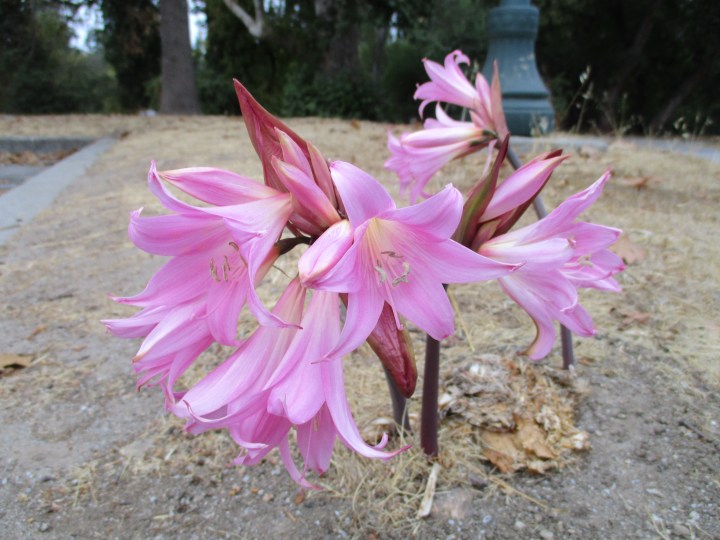
Naked ladies continue to bloom all over the region. These happen to be in the parking lot of Felton Covered Bridge Park. Several that were surplus in a neighbor’s garden were planted in the corners of the various islands. Unfortunately, because of their locations, most of their flower stalks get trampled and broken off. The picture below shows how exposed they are within an area of substantial traffic. The foliage that develops later does considerably better. It is too substantial to be trampled and ruined completely, and it gets a bit more substantial every year. However, the substantial foliage is not here yet to prevent the flower stalks from getting trampled.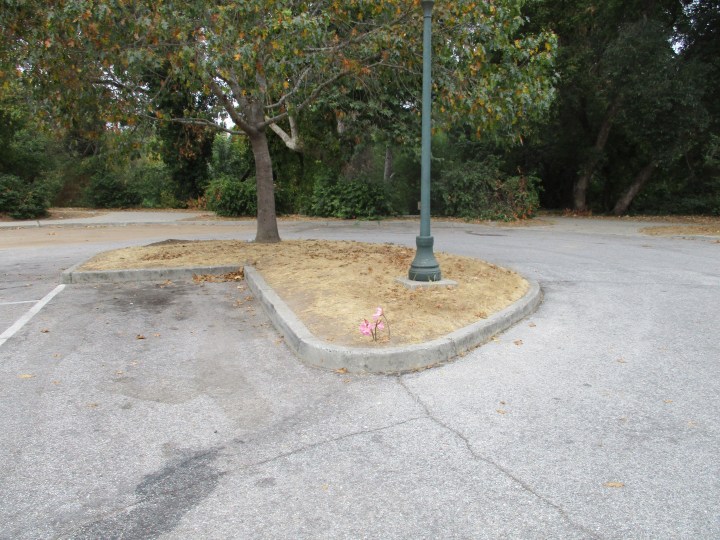
By the way, if you think that I wrote this post because of the (former) lack of a horticulturally oriented topic for today, you are correct.
Cork Oak
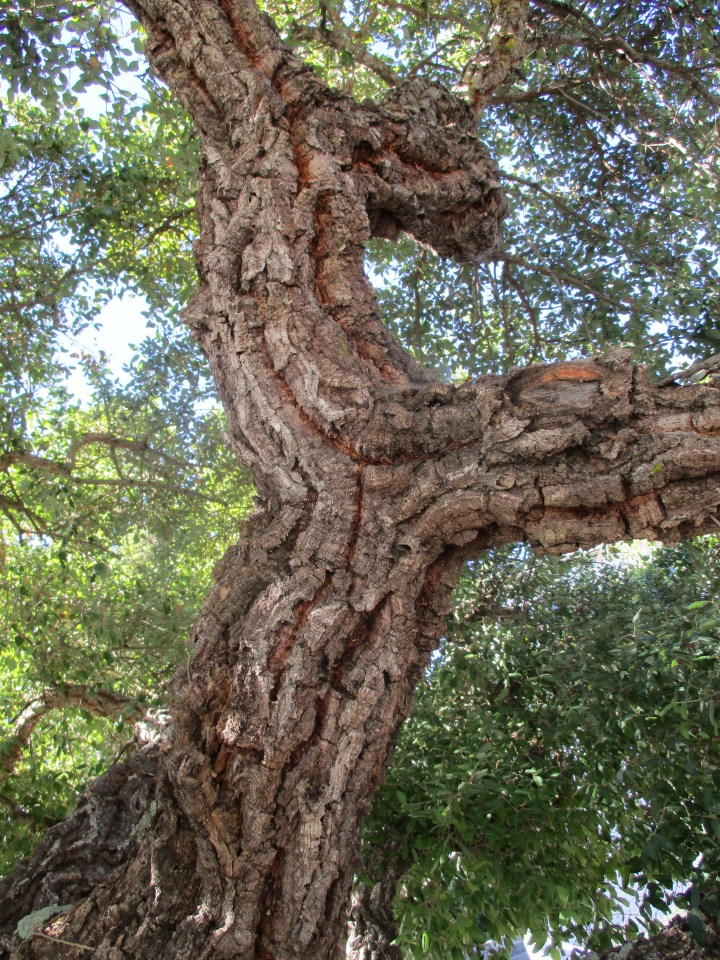 Like redwoods, the cork oak, Quercus suber, is a ‘pyrophyte’, which means that it survives forest fires that burn off competing vegetation. The trunks and main limbs are insulated with a very thick bark. Only the foliage and smaller stems burn off. After a fire, the upper limbs of cork oak regenerate new foliage while other less fortunate plants start over from their roots or seed at ground level.
The thick bark is really what cork oak is grown for. It is used for corks, gaskets, flooring, notice boards, cricket ball cores and too many other products to list. It is also quite handsome on the stout trunks and limbs of landscape trees. If only the acorns were not so messy, cork oak would be a nice drought tolerant street tree with complaisant roots. The hazy evergreen leaves are about two inches long. Old trees eventually get almost fifty feet tall.
 Tony Tomeo