Stumpery

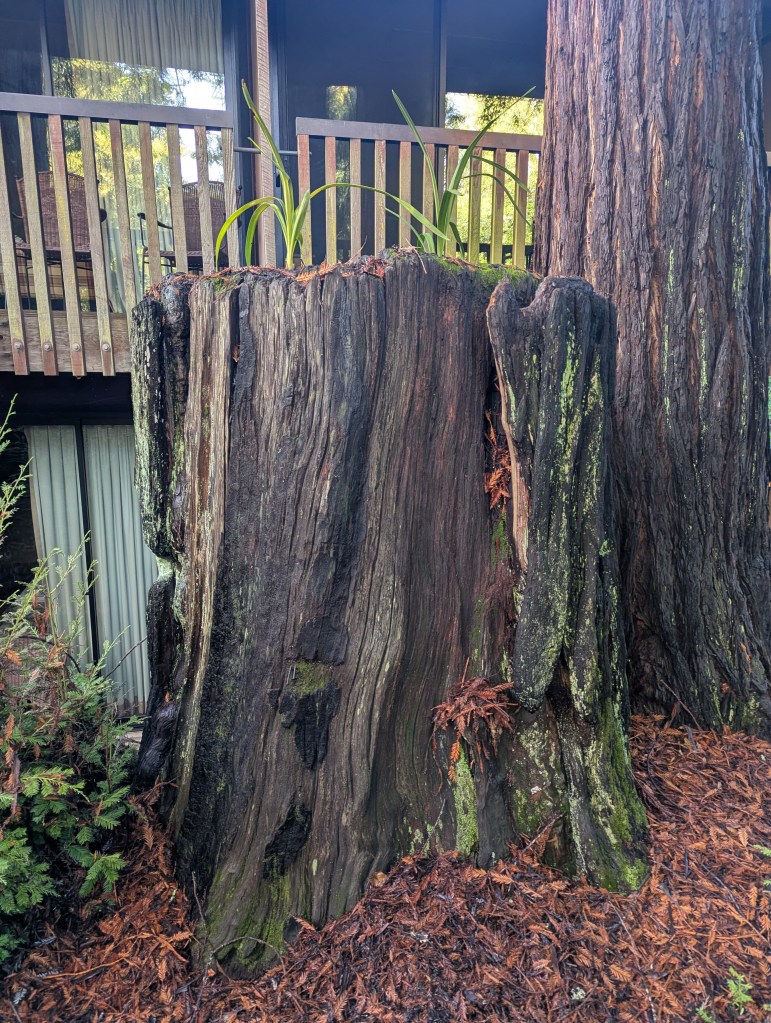
Redwoods give new meaning to stumperies. Their stumps are massive, and remain intact for decades. After all, coastal redwoods are among the largest trees in the world, and their wood is famously resistant to decay. Although redwoods had been harvested here for a very long time, most were harvested soon after 1906 to rebuild San Francisco after the Great San Francisco Earthquake and Fire. The stumps of some of them were subsequently hollowed by forest fire in the 1950s. An outhouse at home was built on top of one such hollow stump. A showers was built within another. A third is big enough to be built into a guest cabin. Stumps at work are not so useful, so remain only as monolithic garden sculpture. One short stump was planted with Billbergias a few years ago. More recently, we installed a few Cymbidium orchids on one short stump and one taller stump. The taller stump is about five feet wide and about eight feet tall, so looks rather silly with a pair of relatively small orchids protruding from the top. The orchids could be happy there, though. They should fill out and become more proportionate to the stump that they inhabit.
Too Late To Divide Cymbidiums

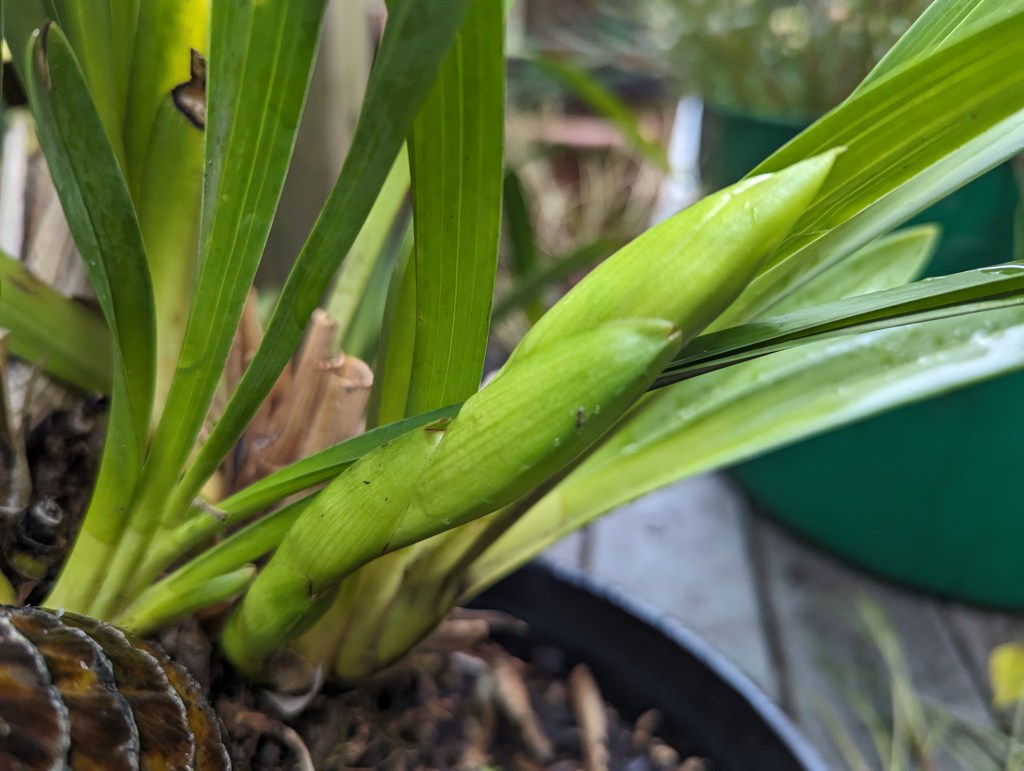
New floral shoots appeared almost immediately after the former bloom finished.

Cymbidium orchids perform quite well here, and seem to be happier with a bit of neglect. Actually, those with a tolerable bit of foliar blemishing or discoloration bloom better than those with exemplarily healthy and vigorous foliage. Those that get everything that they supposedly want, such as coarse chunks of fir bark to disperse their roots into, and regular application of fertilizer, are likely to produce an abundance of healthy foliage with only moderate bloom.

Only two cymbidiums inhabit my garden. I gave all others away many years ago. I acquired one of these two from a neighbor in the early 1990s, and have divided many copies of it since then. It remains potted within a bunch of leafy debris that I raked from my driveway under a massive valley oak many years ago. I suspect that the debris has decomposed to soggy muck at the bottom of the pot, although it remains friable on top, where I only rarely add a bit more leafy debris. I am not so keen on its simple pink bloom, but I continue to grow it because it has been with me for so long.

The other cymbidium was a gift from a colleague here. It originally grew ‘properly’ in a pot of coarse fir bark, but was removed from its pot many years ago, and left to die on top of a pot of potting soil that something else had already died in. It grew unattended there for a few years before coming here. It has bloomed splendidly and annually since its arrival. I want to divide it, but have not managed to do so between bloom phases. Its bloom continues for so long, that by the time it finishes, the next bloom phase is beginning. Fortunately, it is not too overgrown yet.

Finally! A White Cymbidium!

P00503-1
This is what a simple white Cymbidium orchid should look like.

Cymbidium orchids have been popular here for as long as I can remember. Back when horticultural commodities were still more commonly grown around the San Francisco Bay area, many genera of orchids, particularly Cymbidium, were grown in acres of greenhouses in the hills of South San Francisco. They are still grown near the coast of San Mateo and Santa Cruz Counties.

In home gardens, they are often pampered under the shelter of lath, where they are protected from frost and direct exposure to sunlight. Some Cymbidium orchids live and bloom for many years or decades, and sometimes get divided into more as they get overgrown, just like lily-of-the-Nile. Some live longer than those who originally grew them, and go live with someone else.

I never pampered my Cymbidium orchids. I grew all of them out in the garden, with only a bit of partial shade from larger trees. I never once potted any of them into the coarse fir bark that Cymbidium orchids supposedly need. I grew most in dirty and uncomposted oak leaves. I put some in rotting stumps to accelerate the rot. They were happy, and bloomed remarkably well.

None of mine were purchased. They were all acquired from neighbors, clients or colleagues. Of the many Cymbidium orchids that I have grown, none were white! Yes, I wanted a white one. I just do not admit to it.

After maintaining it for more than a decade, and bringing it from a former home hundreds of miles away, a colleague brought me this Cymbidium orchid. Although I did not want him to pass it along after so many years, I was pleased to take it, particularly since it blooms white. Then, it started to bloom, immediately after arrival! Ah, if only there were more people here to see it!

P00503-2
I do not know why the individual flowers are so huddled together.

Cymbidium Orchid

50218
Cymbidiums are the most familiar orchids.

Of all the many and varied orchids, cymbidium orchids are the most popular because they are the easiest to grow. They are naturally terrestrial, so can be grown in the ground if the media (soil) is coarse and rich enough. (epiphytic orchids that naturally grow in crotches of trees want coarse bark in well drained pots.) They are also more tolerant of cool weather than tropical orchids are.

Plants with slightly yellowish leaves tend to bloom better. If the foliage is too dark green, it may not be getting enough sunlight. Regular application of fertilizer may promote bloom, although some plants do not seem to be too demanding. Watering may need to be as frequent as every three days through summer.

The arching flower stalks that begin to appear over winter may bloom for two months. They can be three feet tall, so stand well above the strap shaped leaves that get about two feet tall. Each stalk has many waxy flowers that can be two or three inches wide, in almost any color but blue. Most flowers are pastel hues of pink, lavender, yellow, orange, chartreuse, tan or white, and are intricately spotted and blotched.

Orchids Have History In California

50218thumb
Breeding has done wonders with orchids.

It is funny how so many different plants get here from all over the world, and then become so popular so far from their natural homes that they seem to have always been here. It is now hard to imagine that some of the more popular cymbidium orchids actually came from tropical and subtropical Asia and northern Australia. Other orchids are from tropical Africa or South America.

As the Nineteenth Century turned to the Twentieth, orchids were popularized by those who profited from industry in the east, and then moved west to escape harsh winters. They arrived in the Mediterranean climate of the Santa Barbara region with resources to spend on outfitting luxury homes with comparably luxurious gardens and exotic plants. Orchids were a natural choice.

At homes in Montecito and Hope Ranch, cymbidium orchids were grown is mass plantings, and maintained by professional horticulturists. The popularity of orchids continued for decades. As the extensive orchid collections of England were threatened by the bombing and fuel shortages of World War II, collectors and horticulturists in California brought them here to be safe and warm.

Many of these refugee orchids were bred extensively by Californian horticulturists to produce many of the countless varieties that are now available. Production of blooming potted orchid plants and cut orchid flowers have become major horticultural industries in California. To this day, the Santa Barbara region produces more orchids than any other region in America. Modern tissue culture cloning technology has made it possible to propagate and grow more orchid plants at a faster rate than ever before. This makes them more affordable.

Even though mass plantings of cymbidium orchids are now rare, orchids are probably as popular as they ever have been, simply because they are so available to more people who can enjoy them. They are not limited to fancy gardens of luxury homes. Cymbidiums are still popular potted plants for sheltered porches. Small but flashy moth orchids are among the most popular of blooming potted plants for homes and offices.