Butterfly is like a more softly textured version of African iris, with pale pastel yellow bloom.
What was introduced as a seemingly fancier alternative to the common African iris is now almost as popular. Butterfly iris, Dietes bicolor (or Morea bicolor), is about as easy to grow, and nearly as resilient. Instead of white, the flowers are soft yellow with three prominent purplish brown spots with orange margins. The grassy evergreen leaves are a bit narrower and pliable.
Mature plants may get nearly three feet high and five feet wide. For those who do not mind digging and splitting apart the tough and densely matted rhizomes, large clumps are very conducive to propagation by division in autumn or winter. Deadheading (removal of stems that have finished blooming) promotes continued bloom and limits dispersion of seed that might otherwise grow new plants where they are not wanted. A bit of partial shade or minimal watering are probably nothing to worry about, but may inhibit bloom. Well exposed, well watered and well deadheaded butterfly iris should bloom from early spring until early winter.
As its common name suggests, it is a sprawling relative of common jade plant. Both are different species of the same genus. Carpet jade, Crassula nudicaulis var. platyphylla, grows only about six inches high. It sprawls slowly over the ground without getting much higher or lower. It roots where it sprawls, so can eventually develop significant colonies.
The evergreen foliage of carpet jade is a bit more dense than that of common jade plant. It is also a bit less glossy. Foliar margins blush a bit more through winter. Most popular cultivars become appealingly ruddy. Sun exposure enhances foliar color. However, frost can damage their exposed succulent leaves. Pale white winter bloom is unimpressive.
Carpet jade, like many succulents, is not very discriminating in regard to water or soil. It is likely to be more vigorous with regular irrigation. With less irrigation, it likely develops better ruddy foliar color. It provides appealing contrast to other small succulents with gray foliage. It performs well within pots, and may eventually cascade slightly over the edges.
It seems to be related to Boston fern because it is. Sword fern, Nephrolepis cordifolia, is a less refined species of the same genus. It does not want to live as a docile houseplant. Instead, it prefers room to grow and spread in the garden. It has potential to spread a bit vigorously though. Containment protects adjacent smaller perennials or bedding plants.
Sword fern foliage is the same light and slightly yellowish green as that of Boston fern. It generally stands more upright though. Rather than hang softly from planters, like Boston fern does, it leans outwardly. Its pinnately compound fronds can grow almost two and a half feet tall. Pinnae might be about an inch and a half long, with a slightly grainy texture.
Sword fern is not particularly discriminating about exposure, moisture or soil. It can cling to trunks of Canary Island date palms and infest their canopies epiphytically. Sword fern is greenest with regular irrigation and shelter from harsh exposure though. Its evergreen foliage can discolor and partially defoliate when distressed. Grooming might be tedious. Healthy colonies may hide their old foliage.
It is endemic to every Californian County except for only Imperial County. It is endemic to every American State except for only Hawaii. Yarrow, Achillea millefolium, gets around! It is also endemic to many temperate climates of Europe and Asia. Apparently, it is not very discriminating in regard to climate or soil. It is as happy at the coast as it is farther inland.
Wild yarrow mostly bloom white or with pink blush. Modern cultivars bloom various hues of yellow, orange, red, pink or pinkish lavender. A few of the most florific modern cultivars are hybrids with other species. Phases of bloom might continue from spring until autumn. Tiny flowers form dense corymbs as broad as five inches, on stems as high as three feet.
Ferny grayish or light green yarrow foliage has a softly fine texture. However, it develops compact and mounded form. Individual leaves are tomentous and as long as six inches. Foliar aroma is variable among cultivars. Some cultivars may be objectionably pungent. Propagation by division of any overgrowth is easiest prior to the end of the rainy season.
Sweet flag is a riparian perennial that performs well in saturated soil.
After many centuries of being grown for use in herbal medicine, sweet flag, Acorus gramineus, is still a popular evergreen perennial; but is now appreciated more for its low mounds of grassy foliage. ‘Ogon’, one of the most popular cultivars, has light yellow variegated foliage that contrasts well with deep green foliage, or brightens partially shaded spots in the garden. Individual clumps grow quickly to about eight inches tall and broad, and then spread slowly by producing more shoots. New plants are easily propagated by division. Sweet flag likes plenty of water, and does well in partially submerged pots in koi ponds, or poorly drained spots.
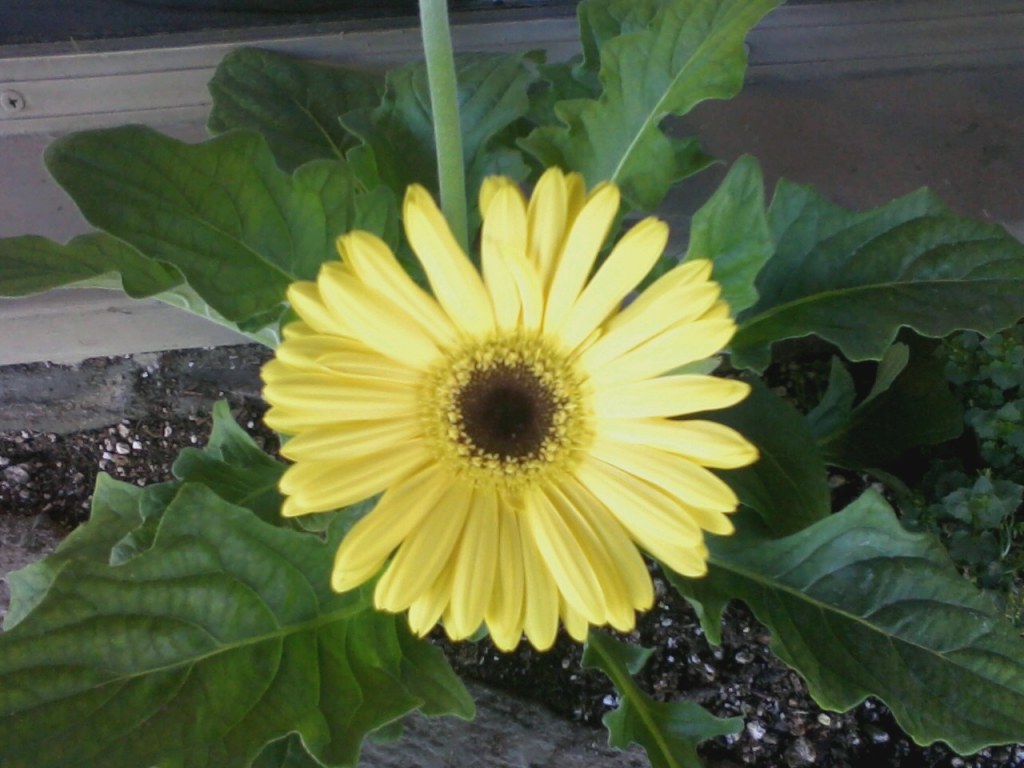
Transvaal daisy is very popular within the floricultural industries.
After rose, carnation, chrysanthemum and tulip, the fifth most popular cut flower is the Transvaal daisy, which is also commonly known as the gerbera daisy, Gerbera hybrida. The composite (daisy-like) flowers are typically about three to four and a half inches wide, in bright shades of yellow, orange, red, pink and white, with dark centers. They stand several inches high on bare stems, adequately above the lower, coarsely textured foliage. Transvaal daisies can bloom well for a month or more as potted houseplants in sunny spots, but rarely survive more than two months indoors. If planted in a sunny but not too harshly exposed spot in the garden as they begin to deteriorate, they can sometimes recover and continue to bloom as short lived perennials. They need good drainage but uniform moisture in organically rich soil.
This must be one of the sillier horticultural names. Tree houseleek, Aeonium arboreum, is neither a tree nor related to leeks. The biggest cultivars can not stand much more than three feet tall. Above that, their succulent foliage gets too heavy for their fleshy stems and fine roots. They perform well as houseplants only within very sunny situations.
Formerly common tree houseleek, with simple green foliage, is not so common anymore. Almost all popular modern cultivars are variegated or bronzed, with wide foliar rosettes. Variegation ranges from bright lemony yellow to creamy white. Bronze ranges from light brown to very darkly purplish. Foliar rosettes are about four to eight inches wide.
Plumply conical trusses of tiny yellow or chartreuse flowers bloom for spring. They are neither numerous nor brightly colorful, but are weirdly interesting. Fresh spring foliage is most colorful and lush. It can fade and partially shed during arid summer weather. New plants propagate very easily from dragging stems or cuttings of pruning scraps.
Annuals are nice, but so are a few more substantial or perennial plants.
Large pots, urns and planter boxes filled with ridiculously colorful blooming annuals are certainly nothing new. However, more small perennials and even a few small shrubs and trees are being planted along with the annuals, and allowed to stay indefinitely as fewer annuals get replaced around them as the seasons change.
These plants only need to be tolerant of confinement, regular watering and the comings and goings of the annuals around them. Upright plants should go in back, behind the lower annuals. Cascading and ground cover type plants should go in front.
Small forms of New Zealand flax and trunkless dracaena palms (Cordyline spp.) add texture, form and motion to large planters, but may eventually get too big if not properly pruned. Larger shoots can be pruned out to allow smaller shoots to take over. Alternatively, overgrown plants can be removed and put out in the landscape when they get too big.
Hollywood and Rocky Mountain junipers have striking form if pruned to show it off, and are easier to contain with selective pruning than reputed. Even without the interesting branch structure of junipers, arborvitaes are appreciated for their similar finely textured foliage and their rich green or yellow color. ‘Blue Rug’ juniper, a grayish ground cover juniper, cascades nicely from large planters.
Large succulents that tolerate water, such as good old fashioned jade plant and various aeoniums, offer bold texture and form in the background. They are easy to prune as they grow, and do not have aggressive roots. Low clumping aloes do the same in front.
Euonymus fortunei, English ivy, various iceplants and other ground cover plants do well cascading over the edges of large planters.
There really is not much limit to the variety of perennials and small shrubs and even trees that play well with others in planters of blooming annuals, and do not mind the confinement and regular watering. Annuals are still the best for flashy floral colors. Yet, the other plants excel in form, texture, foliar color and motion in the breeze.
This is one of the more complaisant of ornamental grasses.
A rather sloppy style of the 1970s combined with a weird color of the 1980s might explain the resemblance of hair grass, Muhlenbergia capillaris, to real hair. The lime otter-pop green color of the foliage, which looks so fresh in the garden, is actually quite dated for hair. So is the pleasantly soft texture. The sparse, fuzzy cloud of purplish pink bloom that hovers just above the foliage in autumn is extraordinary, although only slightly more contemporary for hair color. Happy hair grass plants that get plenty of water in sunny spots can get more than two and a half feet tall. Yet, the perennial foliage is so soft that it tends to fill in space between other sturdier plants instead of overwhelming them.
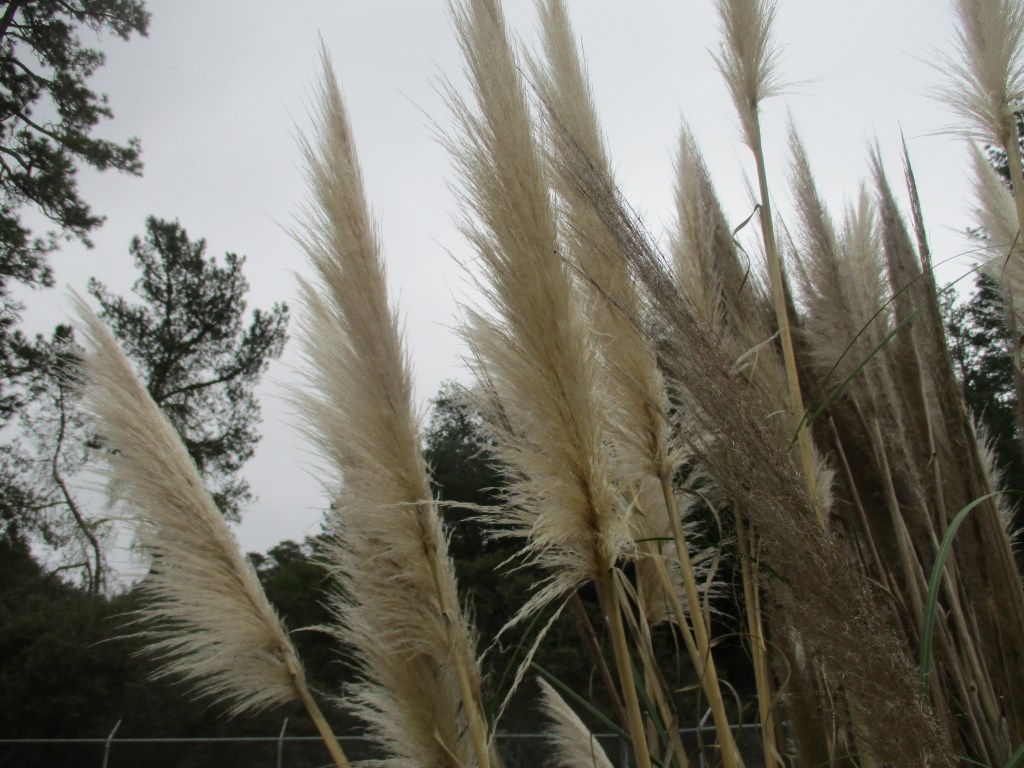
Pampas grass was once appreciated for its appealing foliar texture and strikingly elegant bloom.
Lawns are among the most useful of landscape features, but are also the most horticulturally incorrect. They require such constant maintenance and so much water that they give grass a bad reputation. Yet, the turf grasses that are used for lawn are actually a minority among grasses. There are so many more grasses, including a few turf grasses, that can add color, texture and the seldom considered asset of ‘motion’ to the landscape.
Most grasses move nicely in a breeze. Old fashioned pampas grass, with remarkably limber and long leaves, is one of the best for motion. As if the elegant foliage were not enough, billowy white flowers on tall sturdy stalks nod gracefully in season. (However, pampas grass gets quite large, has potentially dangerous foliage that can cause nasty paper cuts, and in rural areas, can escape into the wild to become an invasive weed.) Red fountain grass does the same on a smaller scale that is more proportionate to suburban gardens.
Red fountain grass also provides striking brownish red foliage. Blue festuca and larger blue oat grass, although insensitive to a breeze, provide really excellent pale blue foliage. The most popular variety of miscanthus grass is variegated with white. Hair grass is a weird yellowish green that resembles that of a rubbery fishing lure.
Besides the odd color, hair grass also has an oddly soft texture that allows it to spill over the edges of retaining walls and pots, with delicate autumn flowers that hover above like a swarm of gnats. Mexican feather grass seems somewhat coarse up close, but has the uniform texture of wheat at a distance. Switchgrass has a more rigid texture, and stands more vertically than other softer grasses. Feather reed grass does both, with flowers that stand vertically above the soft billowy foliage below.
There are as many different kinds of grasses as there are variations of color, texture and motion. Only a few are annual. Almost all are perennial. There are a few in between; perennials that die out in a few years. Most grasses are only a few feet tall. Some never get taller than a foot. Yet, a few get several feet tall.
Most grasses are at their best if they get cut to the ground every few years or even annually. However, some need no maintenance except only for watering. If satisfied with watering, some grasses can sow their seed to cover the outskirts of a landscape, and can be an appealing alternative to ground cover. There are even a few grasses that will naturalize without watering.




 Tony Tomeo