They can be quite a surprise when they bloom for late summer. The tops of their dormant bulbs previously seemed to be dead at the surface of the soil. Then, suddenly, their bare floral stems emerge to bloom without foliage. That is why Amaryllis belladonna is naked lady. Foliage grows a bit later in summer or autumn. It shrivels during late spring warmth.
Naked lady flowers stand about two feet tall, on simple green or brown stalks. Their mild fragrance is easy to miss. A profusion of bloom is only slightly fragrant during humid and warm weather. Their vividly pink color more than compensates. Fleshy seed that mature now that flowers are deteriorating are perishable. They prefer almost immediate sowing.
After naked lady flowers imitate lily flowers, their leaves will imitate lily of the Nile leaves. Naked lady and lily of the Nile are related, but neither are related to lily. The strap leaves of naked lady are more fragile than those of lily of the Nile. If damaged, they can lay flatly for quite a while. After defoliation during spring, dormant bulbs are conducive to division. It might delay bloom for that year.
Sixteen of the twenty-four mixed dinnerplate dahlias that I did not expect favorable performance from have survived! Only eight have failed to exhibit any indication of viability. Two thirds are growing. Only one third is not.
I am impressed. I expected less than half to survive. They arrived in embarrassingly shabby condition. I canned all of them regardless, including several that were obviously completely necrotic. I wanted to give all a chance to survive before discarding any. Those that were obviously completely necrotic are among those that have not exhibited any indication of viability. However, I am not ready to discard any yet. Although I still believe that some are completely necrotic, a few others may not be. As I dump any that do not at least try to grow prior to winter, I will inspect their tubers for any indication of viability, no matter how minor.
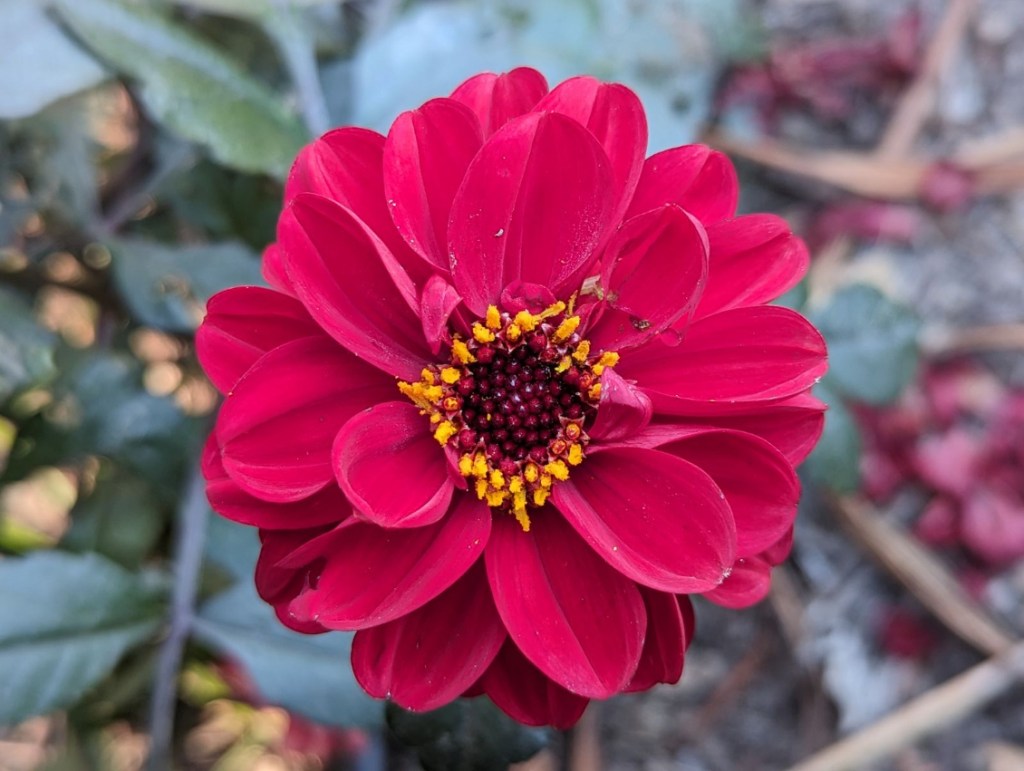
The survivors will be pampered. I want them to generate as much vegetative growth prior to frost as possible. That should sustain the regeneration of their wimpy tubers so that they will be ready to grow next spring. I am aware that even the healthiest may not survive winter if their tubers are inadequate.
Those that survive through winter are likely to grow and bloom as if they were always healthy. In a few years, they could be ready for division. Perhaps after a few more years, I will regret the procurement of so many.
In this mild climate, it is not necessary to dig dahlia tubers for winter. We only do so because it has become a habit, and perhaps to relocate the dahlias.
Dinnerplate dahlias are certainly not my favorite type, but they are more appropriate to the landscapes that they will inhabit than they types that I would prefer.
This is the most vigorous of the sixteen survivors.
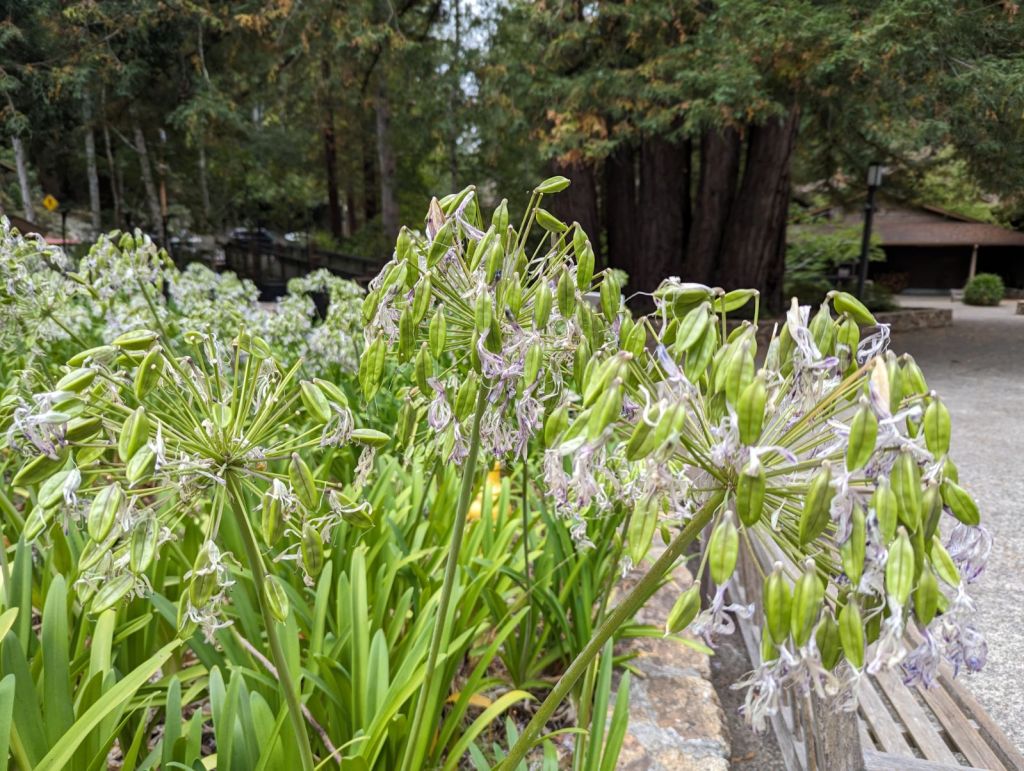
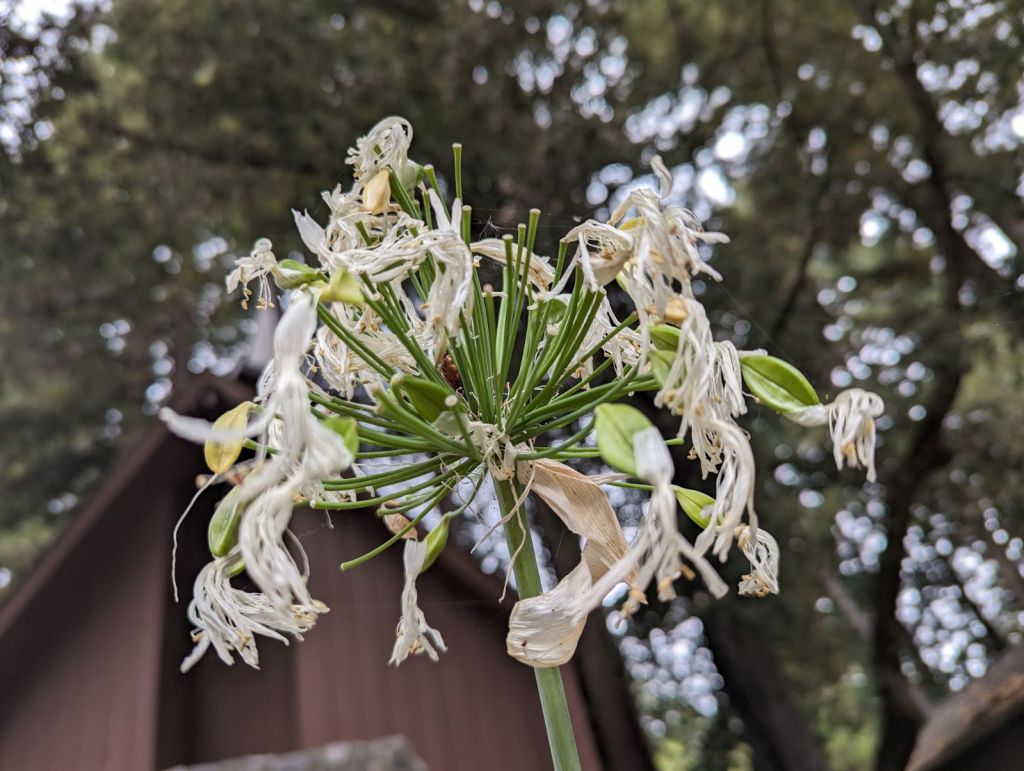
Three of these six are naked ladies, Amaryllis belladonna. Two of these six bloom white. Three of these six need deadheading. Three qualify as two categories. Two qualify as one category. One qualifies as none. None qualify as three. Alternatively, three are lily of the Nile, Agapanthus orientalis, two bloom blue, two bloom pink, and three do not yet need deadheading.
1. 1 – dead but neither naked nor white. Lily of the Nile, with few exceptions, is in need of deadheading at this time of year. All but one cloned colony here are mixed blue varieties.
2. 2 – white and dead but not naked. This deteriorating floral truss is one of merely three that bloomed within the one cloned colony of white lily of the Nile. This colony is young.
3. 0 – not naked, white or dead. This is the lowest score because bloom deteriorates a bit slower in the shade. Blue lily of the Nile could score no more than a single point anyway.
4. 2 – naked and dead but not white. This is the common naturalized naked lady here. It bloomed annoyingly bright pink, but is not the brightest pink. It should be deadheaded.
5. 1 – naked but neither white nor dead. This is a brighter pink naked lady that is not yet in need of deadheading because it blooms a bit later. It has slightly stouter brown stems.
6. 2 – naked and white but not dead. This is merely one of three highest scores, but is my favorite! I had wanted a white version for a long time. It seems to bloom late like #5, but blooms on a green stalk like #4. Its primary bulb already generated four pups, so will be relocated to a more prominent location to develop as a colony. It will not bloom much if split annually, but will multiply most efficiently by such technique. I want more of them!
In eastern North America where it grows wild as a native, garden phlox, Phlox paniculata, is modest but classic perennial that gets more than four feet tall with pinkish lavender flowers from late summer through early autumn. Modern garden varieties are mostly somewhat more compact with pink, red, light purple or white flowers. Many have fragrant flowers; and some have flowers with lighter or darker centers. Butterflies and hummingbirds dig them all.
Locally, garden phlox probably looks best with slight shade or among other lush plants, only because humidity is so minimal. Otherwise, it would be just as happy out in the open. In well watered gardens with rich soil, it sometimes self sows a bit, but rarely naturalizes continually enough to revert to a more natural (wild) state like it can in gardens on the west coast of Oregon and Washington. Garden phlox can be propagated by division of mature plants either after bloom in autumn or in spring.
Each flower lasts for only a day. That is why the common name of Hemerocallis is simply daylily. Each floral stalk provides several flowers that bloom continually for several days. As one flower deteriorates, another replaces it. Because floral stalks shed so continually, they are not very practical as cut flowers. They are splendidly colorful in gardens though.
Most popular daylily cultivars are products of breeding that is too extensive to document. That is why almost all lack species names. Their cultivars names generally suffice. Most daylilies bloom for a month or so. Also, most bloom best for early summer. A few bloom a bit earlier. Some bloom as late as autumn. Some can bloom randomly or twice annually.
Daylily bloom can be yellow, orange, red, pink, almost purplish or combinations of these. Yellow or pink can be so pale that it seems to be almost white. Flowers can stand as tall as three feet, on bare stem. Their arching grassy foliage stays somewhat lower, in dense mounds. Most cultivars are evergreen. Some are deciduous. They propagate by division. Some migrate by vigorous stolons.
Perennial pea is a somewhat naturalized exotic species here. It may not be aggressively invasive enough to be classified as a weed though. However, I would classify some of it that I can not exterminate from at least one of our landscapes as weeds. Once it gets established, it is very persistent.
It seems to prefer to grow on roadsides or fences. It is not so common in flat open spaces. It rarely gets big enough to overwhelm or otherwise damage other vegetation. It dies back when the weather gets too inhospitable for it. It regenerates when the weather is more comfortable.
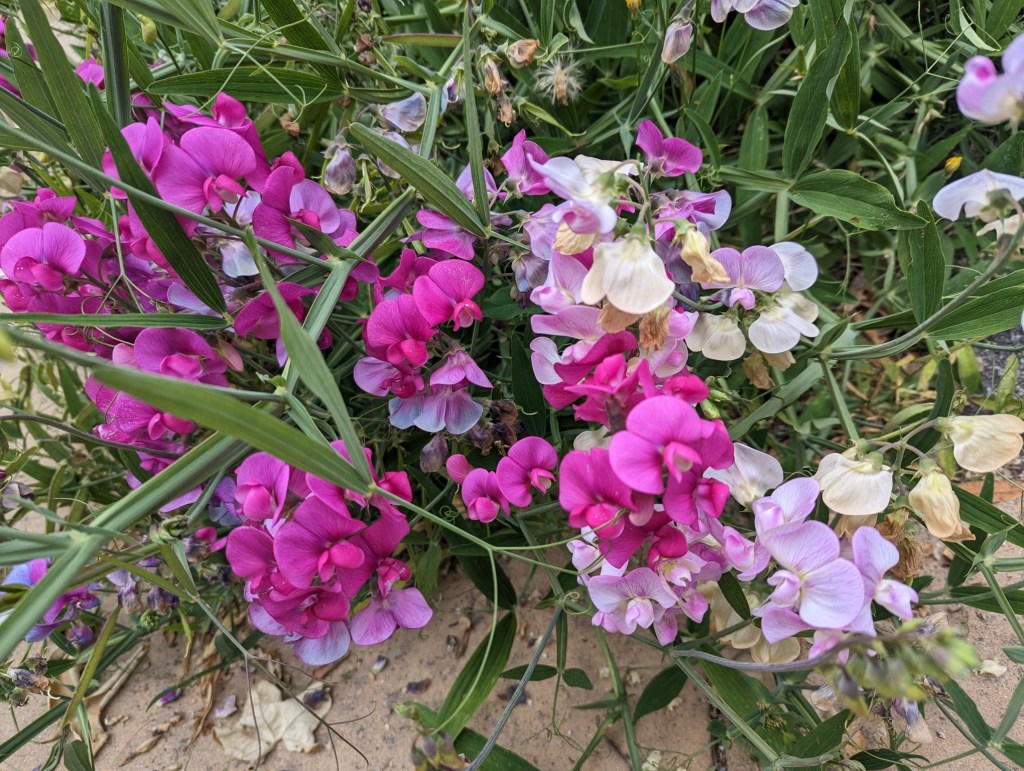
Perennial pea certainly is pretty. Almost all of it blooms with typical bright purplish pink flowers. A few uncommon specimens bloom with variations of lighter pink. White is even more rare. Only red is more rare than white. I have never seen it growing wild. Although seed for red perennial pea is available, I know of no one who has actually grown it.
Therefore, until someone can prove that red actually exists amongst naturalized perennial pea, white is the rarest color. It might also be my favorite. I can not decide. White is my favorite color. Also, perennial pea happens to look great in white. Yet, the familiar obnoxiously bright pink is so typical of the species. It is the color that everyone expects to see growing wild on local roadsides.
I was fortunate to find a specimen at work that blooms white. I grew a few copies of it, but kept them canned. I shared some with colleagues in other regions until only two remained here. I was not too alarmed when these last two were overwhelmed by other vegetation and died, since I thought I could grow more copies from the original specimen. That was until I found that the original was destroyed by excavation to mitigate erosion from last winter!
I believe that another specimen that blooms white lives nearby. Its particular colony has already finished bloom for the season. I must therefore wait for it to resume bloom, or look for errant bloom through winter. After getting so involved with it, perhaps it really will be my favorite.
Although not native, gaura, Oenothera lindheimeri, can almost naturalize as if it were. All it needs is occasional watering through summer. It performs better with regular watering. Individual specimens live for only about four years. Some may last for only a single year. However, their abundant progeny are likely to replace and perhaps overwhelm them first.
Gaura prefers sunny and warm exposure. Shade causes sloppy form. Naturalized gaura has potential to become weedy or invade other vegetation. Seedlings relocate efficiently. Cutting back old growth as it deteriorates through winter promotes vibrant spring growth. Concurrent removal of the shabbiest old specimens favors vigorous younger specimens.
Collective growth is mostly less than five feet deep, with wispy and lightly foliated stems. Basal leaves are bigger than tiny upper leaves. Airy flowers are only about an inch wide. Floral color is mostly pale pink. Seedlings of cultivars with white or richer pink bloom are not necessarily true to type. Neither are seedlings of cultivars with richly bronzed foliage. Bloom continues from very early spring until cooler wintry weather.
When it first appeared within one of the landscapes at work four years or so ago, I was not sure of its identity. I guessed that it was some sort of phlox only because it resembled phlox that I had seen in mail order catalogs many years earlier. No one knows where it came from or how it got there. Some sort of Campanula arrived within the same garden only a year or so earlier, and worked out nicely. Therefore, we decided to give what we thought was phlox the same chance to perform.
It performed splendidly! It matured rather quickly, and happened to fill a prominently bare spot. Its bloom is pure white and delightfully fragrant. After getting cut back for winter, it regenerated for spring.
Then, we started noticing that it had seeded while no one noticed. A few seedlings were appearing nearby. At first, we were pleased, but also concerned that it could become invasive. I pulled a few seedlings up from where I did not want them to grow, and was able to relocate them to better situations, but was not sure if I should have done so.
Fortunately, like the campanula, this new plox seemed to want to cooperate. After getting established, it did not seem to be invasive.
Now, it is one of my two favorite perennials within its particular landscape, along with Gladiolus papilio. I am confident that we can allow it to bloom fully without dispersing too many seed afterward. I am very fond of the strikingly bright white bloom and its rich fragrance. It would be great if more feral species developed as assets to their gardens instead of as weeds. I am pleased that we gave this phlox its chance to perform, and will likely relocate more to other landscapes.
This picture is from my Six on Saturday post for this morning.
Its name is so minimalistic and blunt in the language of the indigenous people who are most familiar with it. Others might know it as the giant highland banana. It seems to me that most of us who find it to be of interest know it by its botanical name of Musa ingens.
Oem, or giant highland banana, or Musa ingens, is native to the tropical montane forests of New Guinea. Because it is endemic to high elevations, it does not perform so well in the sort of continually hot and humid tropical climates that most other species of banana enjoy. It actually prefers the weather to get somewhat cool at night. Therefore, it is more likely to be happier here than in Southern Florida, Hawaii or coastal San Diego County.
Not many horticultural enthusiasts grow it anyway. Actually, I do not know of anyone else who grows it. I have seen only a few comments online regarding germination of the very rare and expensive seed. Furthermore, no one seems to be successful with germination. This particular species does not generate pups as readily as other species of the genus, and even if it did, there are no established specimens from which to procure such pups.
However, its lack of popularity is less likely a result of its rarity and difficulty to propagate, but more likely because of its massive scale. In the wild, oem can grow to a hundred feet tall! It may be limited to about half as tall within cultivation, and without competition from other tall trees, but that is nonetheless a potential to get fifty feet tall! That may not seem like much relative to other trees, particularly the redwoods that are more than a hundred feet tall, with potential to get three times as tall. The concern is that banana trees are not actually trees. They are merely humongous perennials. Their pseudostems do not grow for very long before they begin to deteriorate and collapse. Pseudostems of smaller sorts may complete the process within two years, but are easily removed afterwards. Fifty foot tall pseudostems take significantly more time to mature and then deteriorate, but are not so easily removed from refined landscapes. Arborists can not climb them to cut them into sections. They require space to fall harmlessly. They are full of water, so are very heavy.
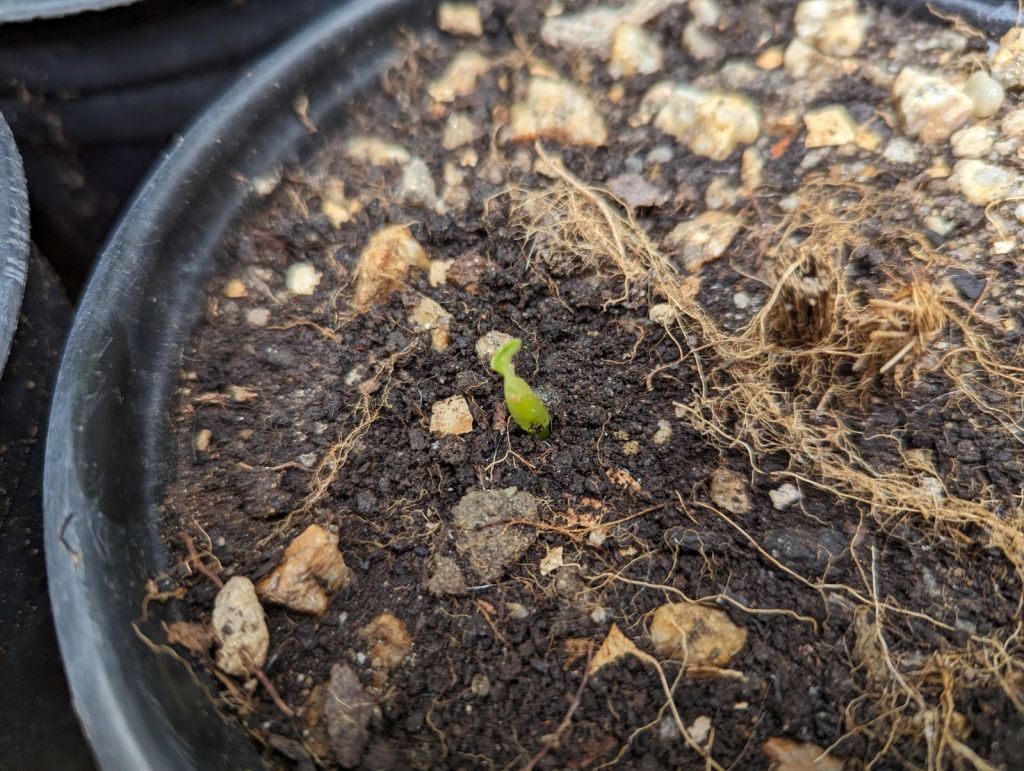
Now, oem lives here. It is merely a single dinky pup, but grows very efficiently. I have no idea of what to do with it. It can likely stay canned through this year, but may need to go into the ground next year. Not only does it need plenty of space, but it does not conform to the styles of any of the landscapes here. Consequently, it might eventually inhabit my home garden, regardless of its awkward appearance. This will likely get very interesting.
This warm season annual is actually a biennial. Cardinal flower, Lobelia cardinalis, may stay relatively short for its first summer. It might bloom four feet high for its second or third summer. By then, pups are easy to divide as new plants to replace the old. Most cardinal flower plants from nurseries are rather mature. They might grow tall for their first summer.
Common cardinal flower has rich cardinal red bloom and bright green foliage. ‘Alba’ has white bloom. ‘Rosea’ has pink bloom. ‘Queen Victoria’ has familiar rich red bloom above deeply bronzed foliage. Individual flowers are only an inch and a half from top to bottom, but are numerous. Basal leaves can be almost six inches long. Upper leaves are shorter.
Cardinal flower enjoys richly organic soil with regular irrigation. It dislikes getting too dry. It appreciates a bit of partial shade as the weather gets warmest after noon. Seed is easy to collect. However, seed from fancy cultivars is not necessarily true to type. Subsequent generations eventually revert to familiar rich cardinal red bloom and bright green foliage.