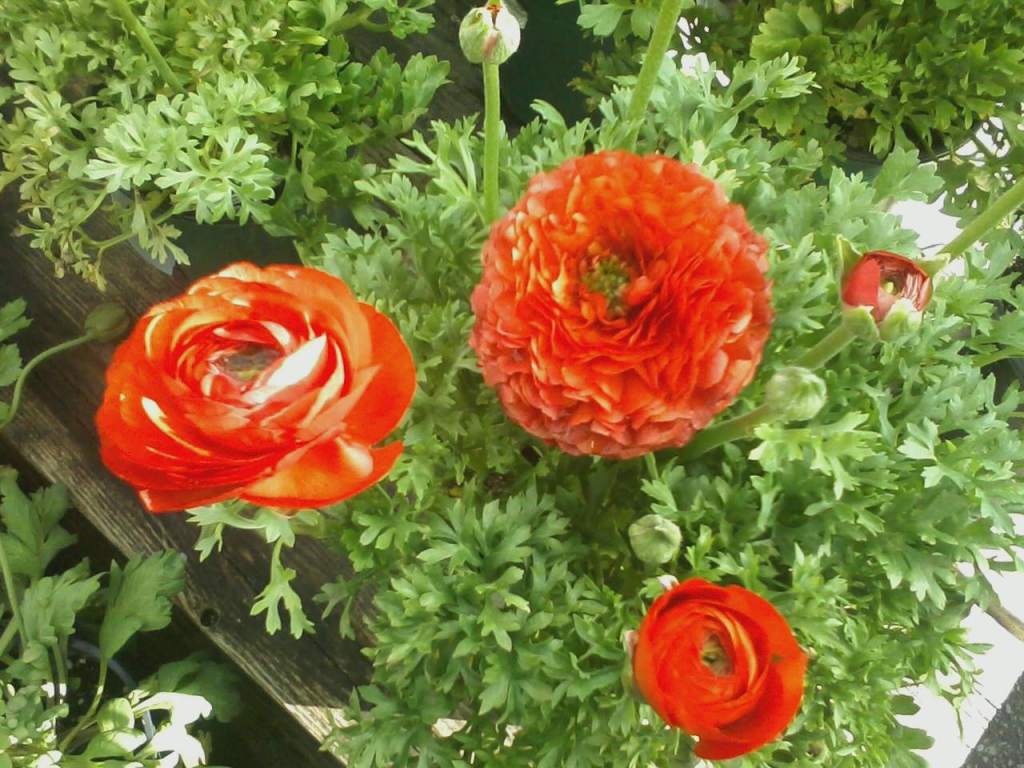
These potted ranunculus in a nursery are already blooming. Those planted while dormant last autumn may not have started yet.
If their dormant bulbs were planted back in October or November, ranunculus will soon be blooming. Those of us who missed the bulbs last autumn can already find blooming plants in nurseries. The bright yellow, orange, red, pink or white flowers are about three inches wide and seem to be outfitted with too many petals. They stand about a foot to a foot and a half tall, a few inches above the basal foliage that can get half a foot to a foot deep. The light green leaves resemble parsley, but are not as finely textured. Although perennial, ranunculus are most popularly grown as annuals because they tend to rot soon after bloom. They perform best with no more than a bit of shade, and rich but very well drained soil. They are more likely to survive as perennials if allowed to get rather dry as their foliage deteriorates after bloom.
As a companion plant, candytuft hides the less appealing lower growth of roses; or it can cascade from mixed planters.
Most roses that are grown for cut flowers are not very appealing in the landscape. They look better behind shorter perennials or shrubbery, with their taller flowering stems standing higher above. Mounding herbs like lavender, lavender cotton or rosemary, or small hedges of boxwood, dwarf hebe or Indian hawthorn obscurer their thorny undergrowth nicely. Candytuft, Iberis sempervirens, is a small perennial that gets just high enough to give a neat edge to a row of roses.
It gets gets about a foot deep, and can very slowly but eventually spread over a few square feet. The tiny, narrow and dark green leaves are less than an inch long. Inch wide trusses of minute white flowers resemble those of sweet alyssum, although lack fragrance. Sloppy plants can be restored by getting pruned almost to the ground.
Spring bulbs are making a comeback from their unceremonious internments last autumn. Some of the earlier sorts are visibly extending foliage above the surface of the soil. A few narcissus, daffodil and crocus are already blooming! Now it is time to plant late bulbs, or summer bulbs, which start to grow through warm spring weather, and bloom for summer.
Spring bulbs are generally the same as hardy bulbs of climates with cold winter weather. They are hardy to frost while dormant. Since chill is relatively mild locally, their hardiness is irrelevant. Conversely, some prefer more chill than they experience locally. Inadequate chill can compromise performance. Autumn planting maximizes their brief chill exposure.
Late bulbs are completely different from spring bulbs. Not only do they not require chill to perform, but some dislike it. Many of the most popular late bulbs that can naturalize here succumb to frost elsewhere. Instead of early planting for chill, as spring bulbs prefer, late bulbs prefer late planting to avoid chill. Their foliage emerges after the last threat of frost.
However, although they do not need or even appreciate chill, most popular late bulbs are resilient to the minor chill of local climates. Once established, they simply die back to the ground in response to the first frost of autumn. They maintain dormancy through winter to regenerate for spring. Some repeat this process for years, since the soil does not freeze.
Not all late bulbs are actually bulbs. Most are corms, rhizomes, tubers, tuberous roots, or other bulb-like perennials. Some, such as dahlia and canna, bloom through an extensive season. Some, such as lily and gladiolus, bloom only once. Planting in phases for a few weeks prolongs their bloom. Of course, they will synchronize for any subsequent bloom.
Canna and common white calla are two of the most reliable late bulbs. Crocosmia is too reliable, and since it can be invasive, it is rarely available. Common gladioli and various lilies are spectacular in bloom, but not reliably perennial. Dahlia is a very rewarding and reasonably reliably perennial summer bulb. It is spectacularly variable in color, form and texture.
For those who like pampas grass but lack space, miscanthus grass has similar texture, and moves softly in a breeze.
Even as the flower spikes and perennial foliage start to deteriorate over winter, Miscanthus sinensis provides distinctive texture and the element of motion if there happens to be a breeze. Mature specimens can be about six feet tall and broad. The feathery flowers are pale purplish pink when they first appear, then fade to light tan. ‘Zebrina’ has yellow stripes across their slightly wider leaf blades. ‘Variegata’ has white margins.
White blooming dragon wing begonia are still quite rare.
The modern hybrid of wax begonia and angel wing begonia, known as dragonwing begonia, wants to be out in the garden like wax begonia, but like angel wing begonia, needs to be sheltered from direct sun exposure in summer. This time of year, it also needs shelter from frost. It gets two or three feet high and wide, and makes quite an impressive display with abundant red or pink flowers against glossy foliage. A white blooming cultivar became available only recently. Pruning scraps are easy to root as cuttings.
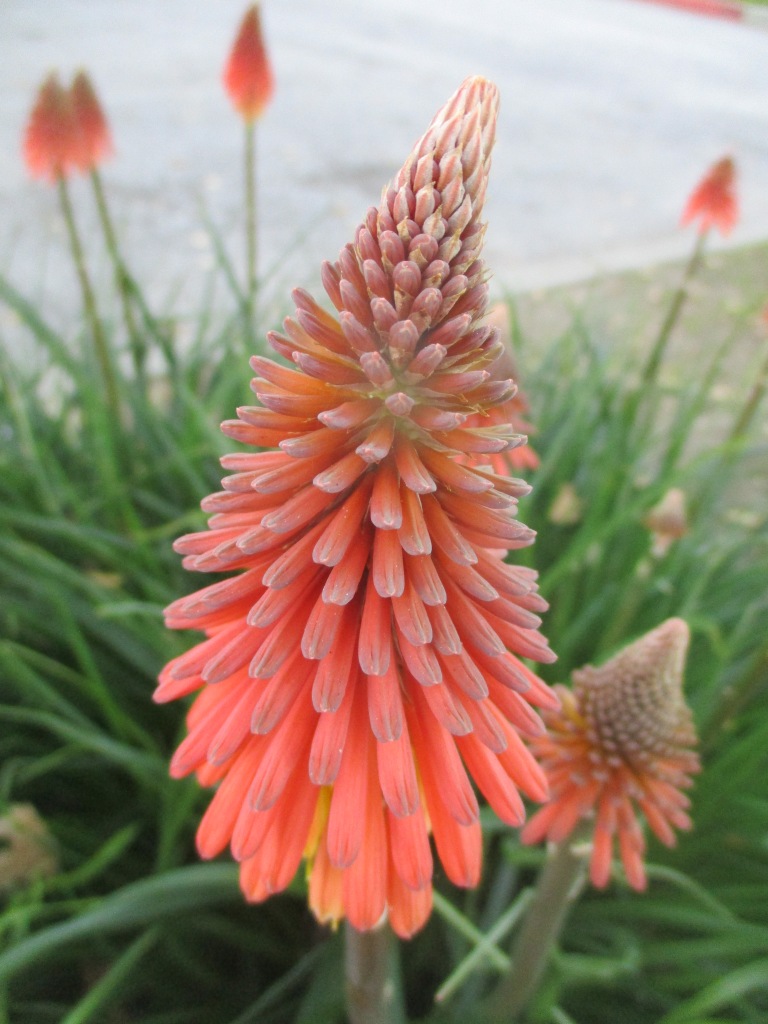
Technically, it should bloom during spring and summer. Torch lily, Kniphofia uvaria, does not seem to know that though. Some bloom for late summer. Most are presently in bloom. Old fashioned sorts that survive without irrigation may bloom through winter or whenever they want. Modern cultivars are likely more predictable and punctual with their schedule.
Torch lily, or red hot poker, blooms with densely conical floral spikes of many narrow and tubular flowers. Bare stalks boldly support bloom as high as five feet. The grassy foliage below forms dense mounds that should not get much higher than three feet. Established plants can survive without watering, but appreciate it through the arid warmth of summer.
Floral buds are generally orange as they develop, and then fade to yellow as they bloom and age. Since floral spikes bloom upwards from the bottom, they are yellow at the base, and orange at the tip, like candy corn. Some cultivars are more reddish orange at the tip, or creamy white at the base. Others are rather uniformly orange, yellow or creamy white.
The simple pink or sometimes red or white flowers of angel wing begonia are not as flashy as those of other begonias, and are not abundant enough to provide much color. During warm weather, they are merely a minor bonus to the striking foliage. As the name implies, the big and angularly lobed leaves are shaped like wings of angels. Upper surfaces are glossy and dark green with irregular silvery spots. Undersides are even glossier and reddish bronze. With support, the lanky cane stems can get more than twelve feet tall. However, because older tall canes produce runty foliage, they are often pruned out to promote more vigorous and lushly foliated young canes.
Because they are sensitive to frost, and also because they are ideal houseplants, angel wing begonias are typically grown in containers. They like rather regular but not excessive watering, and rich potting soil. Abundant sunlight enhances foliar color; but harsh exposure roasts foliage. Partial shade is not a problem.
Hostas go dormant and defoliate for winter, and regenerate for spring.
Many plants are deciduous in autumn and winter, which means that they defoliate or die back, and then refoliate or regenerate in spring. Many others are evergreen, which simply means that they are always foliated through all seasons. What many people do not realize is that evergreen plants replace their foliage just like deciduous plants do. They just do not do it in such distinct phases of defoliation, dormancy and refoliation.
Tropical plants like cannas and some of the various begonias really have no need for formal defoliation, since they are from climates that lack winter. In the wild, they continually and systematically shed old stems as they produce new stems. Locally, they tend to shed more than they grow during late autumn and winter. The large types of begonias tend to keep their canes for so many years that it is not so obvious. Where winters are colder, cannas freeze to the ground, only to regenerate from their thick rhizomes as winter ends.
Zonal geraniums may seem rather tired this time of year for the opposite reason. They expect late autumn weather to include frost that would kill them back to the ground where they would stay relatively dormant until warmer weather after winter. Just because their foliage is instead evergreen through winter does not mean that it should be. It lingers and often becomes infested with mildew and rust (fungal diseases) that proliferate in humid autumn weather.
However, zonal geraniums need not be pruned back just yet. Even if they eventually get damaged by frost, pruning should be delayed so that the already damaged older foliage and stems can shelter the even more sensitive new growth as it emerges below. They can get cut back after frost would be likely.
Evergreen pear can get very spotty once the warm weather runs out because the same damp and cool weather that inhibits its growth also promotes proliferation of the blight that damages and discolors the foliage. The damaged foliage eventually gets replaced as new foliage emerges in spring, but will remain spotty and discolored until then. Photinia does not get as spotty, but holds blighted foliage longer into the following summer. Ivy can be temporarily damaged by a visually similar blight.
A few of the fifty or so species of Yucca go by the names of Spanish bayonet or Spanish dagger. Both common names apply to Yucca gloriosa. However, only this single species is also the mound lily. Most other Spanish bayonet and Spanish dagger are from deserts or chaparrals. Mound lily is from southeastern North America, so likes periodic watering.
If that is not confusing enough, the curved leaf yucca, which had been Yucca recurvifolia, is now Yucca gloriosa var.(iety) tristis. It has distinctly pliable leaves with a matte surface texture, and is rarely variegated. Mound lily has stiffer and smoother leaves that are more likely to be variegated. It had been rare, but is becoming one of the more popular yuccas.
Although it does not grow fast, and takes many years to form stout trunks, mound lily can eventually get taller than six feet. Taller floral panicles rise above the densely evergreen foliage. The small and pendulous flowers are pale white, perhaps blushed with brownish purple and pink. The leaves are about a foot or two long and maybe three inches wide, with very sharp terminal spines.
Most coral bells are grown for their colorful foliage.
From Santa Barbara to Vancouver, and also in central Idaho, the humble native coral bells, Heuchera micrantha, is not much to look at, with compact rosettes of relatively small and bronzy rounded leaves with weird tomentum (hairs). In spring and early summer, and sometimes again in autumn, sparse trusses of minute brick red flowers hover about a foot above on wiry and slightly fuzzy stems. Old plants that get bare in the middle can be divided into several small plants in spring or autumn.
Modern cultivars are considerably more interesting, with more substantial foliage in various shades of green, gold, tan, brown, bronze and purplish bronze. The larger and variably lobed leaves can be two inches wide or slightly wider. The flowers stand as much as two feet high, but lack color. Most are pale greenish white. ‘Palace Purple’ has deep bronze or almost purplish foliage. ‘Ruffles’ has deeply lobed and ruffled green leaves. Unlike undemanding wild plants that can grow in cracks in exposed stone, modern cultivars like rich soil. Harsh exposure can scorch foliage, so a bit of partial shade is preferred.
Many coral bells have delightful bloom as an added bonus to their foliage.




 Tony Tomeo