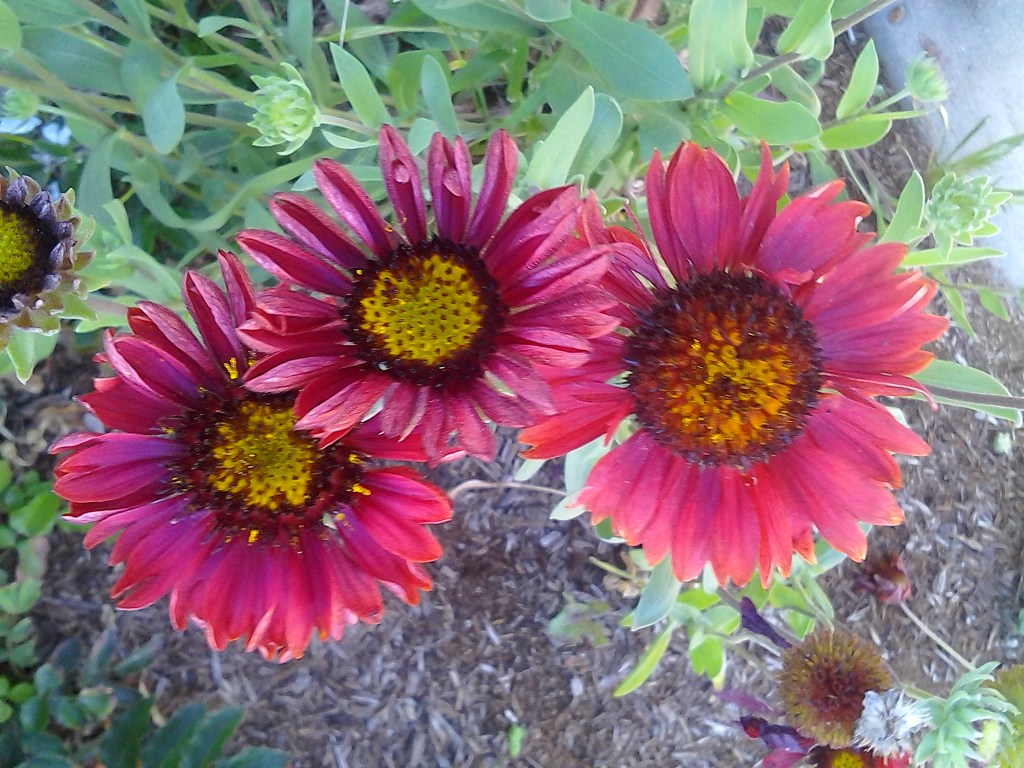
The bright colors and patterns of blanket flower, Gaillardia, resemble those of blankets made by native American Indians. The daisy flowers are typically two different shades of red, orange, yellow, brown or yellowish white. Not many varieties bloom with single colors. Taller varieties can get almost two feet tall, with slender but sturdy stems that are good for cutting. The narrow leaves are mostly basal, so do not crowd bloom.
The more popular varieties of blanket flower are perennial. Healthy plants can slowly get quite broad, and can self sow their seed to spread a bit farther. Annual varieties can not get as broad, but often self sow more efficiently than perennial types do. Once it gets growing, blanket flower does not need much water. However, regularly watered plants are already blooming. Modestly watered plants wait until summer.
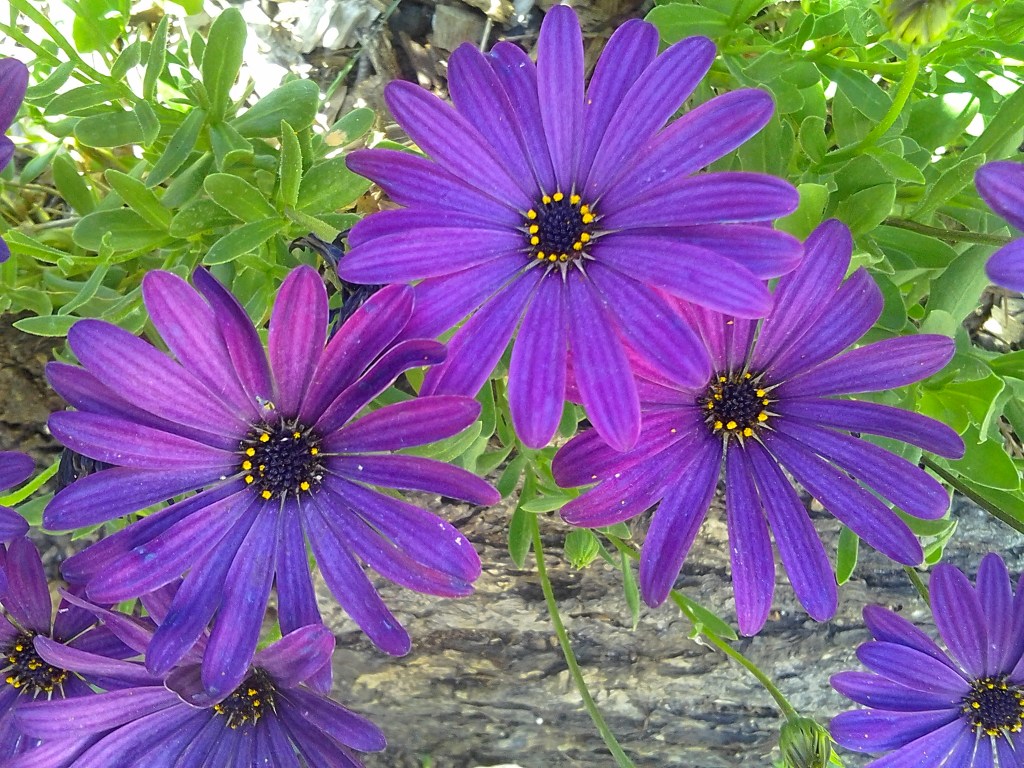
Only a few decades ago, the only familiar African daisies, Osteospermum spp., were the sprawling and often sparsely branched ‘freeway daisies’ with blue-eyed white or rarely light purple flowers. They made nice blooming ground cover that could be planted in drifts for a bit of color among the deep green of Algerian ivy on expansive freeway embankments.
Modern varieties are shrubbier perennials with more profuse bloom of white, cream, pink, purple, pale yellow or pale orange flowers, mostly with blue or purple centers. Some yellow flowers have yellow or cream centers. Some of the fancy types have spooned petals like some types of cosmos or chrysanthemums. After the primary bloom phase in spring, a few sporadic flowers may continue to bloom through summer until the secondary light bloom phase late in summer. However, the old fashioned ‘freeway daisy’ types do not always display a second bloom phase. Varieties with variegated foliage are still rather rare.
Even though African daisies can survive in inferior soil with minimal watering, they perform best with good soil and regular watering. Plants in containers can not disperse their roots like they want to, so are are more dependent on regular watering. Fertilizer prolongs bloom.
If only it did not like such regular watering, the common white calla, Zantedeschia aethiopica, would be quite a sustainable perennial. Once established, it can be difficult to get rid of, particularly in well watered gardens. Even unwatered plants that die to the ground through dry summer weather are merely dormant and waiting for rain to regenerate and bloom.
The remarkably elegant blooms stand about two or three feet tall, each with a single spathe loosely wrapped as a flaring cone around a spadix that supports the indistinguishable diminutive flowers. The bright white spathe is often more than four inches wide, and can be twice as wide in shade. The spadix is only about three or four inches long, and as yellow as Big Bird. The spongy dark green leaves are about a foot or two tall.
‘Green Goddess’ blooms with a longer and recurved spathe with a green tip and margins. Colorful callas are actually different specie. All parts of all types of callas are incidentally toxic.
The most familiar of the gazanias are the ‘trailing’ types commonly appreciated as ground cover. They are rather shallow, but dense enough to prevent most weeds from getting through. Their yellow or orange composite (daisy like) flowers bloom initially in spring, and then continue to bloom sporadically as long as the weather stays warm into autumn. Some trailing gazanias have interesting silvery foliage.
‘Clumping’ gazanias do not spread efficiently or thoroughly enough to be practical as ground cover over large areas, but bloom a bit more profusely with bigger flowers in shades of yellowish white, light yellow, bright yellow, orange, brownish orange and brownish red. The foliage gets a bit deeper to form irregular but dense low mounds. Clumping gazanias can be lined up as an informal border around blooming annuals or perennials, or incorporated individually into mixed urns or vertical gardens.
Gazanias are not too discriminating about soil quality or frequency of irrigation. They only need good sun exposure. Trailing gazanias are rather easy to propagate by cuttings made from scraps from pruning around the edges. Clumping gazanias do not get pruned as much, but are easy to propagate by division from dense clumps.
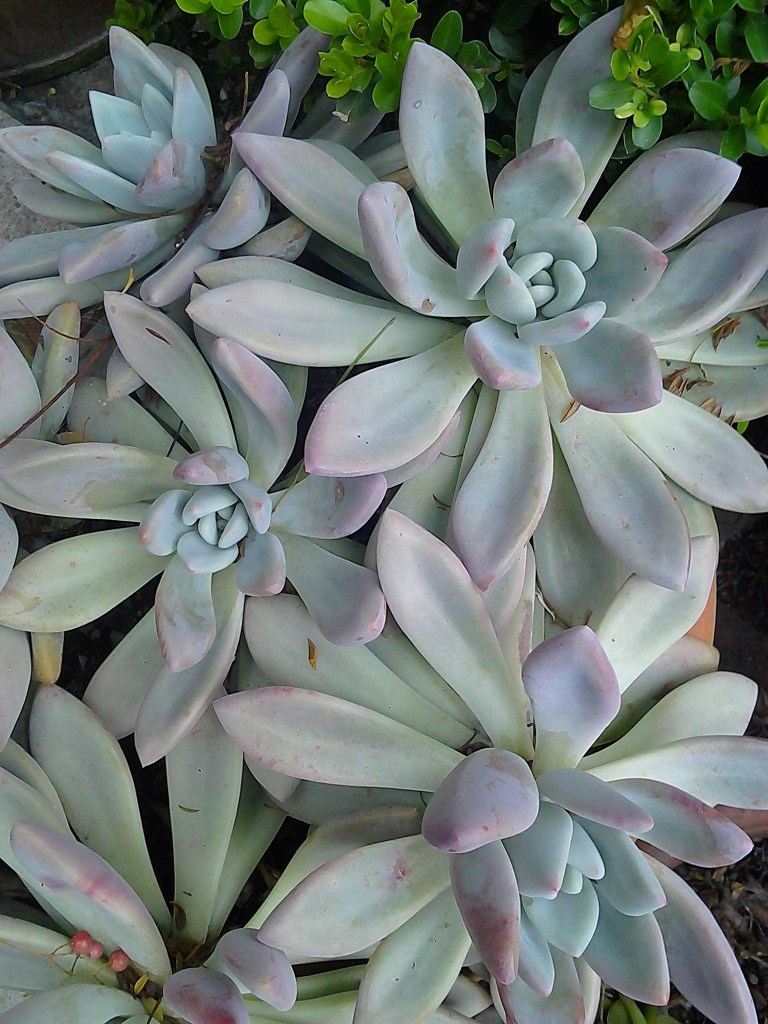
There are so many different personalities of Echeveria! This one only slightly resembles the more familiar ‘hen and chicks’ types.
Some but not all of of the many succulent plants known as ‘hen and chicks’ are varieties of Echeveria. Likewise, some but certainly not all Echeveria are known as ‘hen and chicks’. Echeveria are so variable that many do not seem to be related, although all have dense rosettes of succulent leaves. Some have very narrow leaves like miniature yuccas. Others have warty broad leaves. Foliage can be simple green, yellowish, bluish, gray, bronze, bronzy purple or variegated. The edges and tips of leaves of many varieties are blushed with red or purple that is more colorful in winter, or with complete sun exposure. Most Echeveria will tolerate light shade. Propagation is very easy from division of pups, stem cuttings and even leaf cuttings.
It is difficult to believe that this stout trunk outfitted with sharp spines is a euphorb, related to leafier poinsettias.
Cacti have thick, fleshy stems outfitted with nasty spines instead of leaves. Agaves and related aloes have stout, fibrous stems that are mostly obscured by thick, fleshy leaves. (Only a few somewhat rare aloes develop bare trunks and stems.) What they have in common is that they all are succulent plants, collectively known as succulents.
There are all sorts of other succulents. Humongous saguaro cactus have hefty trunks and limbs. Diminutive impatiens (like busy Lizzie) are grown as annuals for their colorful and very abundant flowers. Many succulents have succulent stems. Many have succulent leaves. Some, like the common jade plant, have both succulent leaves and stems. Trailing ice plants, leafy begonias, and sculptural euphorbs (related to poinsettias) are all succulents.
Many succulents store water in their succulent parts because they live in dry climates. Because moisture is such a commodity where they live, cacti protect their succulent stems with sharp spines. Agave protect their leaves with sharp teeth. Euphorbs are equipped with caustic sap, and many also have spines like cactus have. Fortunately, most succulents are not so unfriendly.
Almost all succulents are remarkably easy to propagate from cuttings or by division. In the wild, pieces of prickly pear cactus that fall onto the ground will begin to develop roots through the rainy weather of autumn and winter, and be ready to grow into new plants by spring. In the home garden, cactus cuttings should be left out for a week or more so that the cut ends will ‘cauterize’ (Actually, they just dry out a bit.) and be less susceptible to rot once they get plugged into the ground or pots to grow roots. Alternatively, clumping cactus that develop multiple main stems from the base can be divided, although the spines make handling them difficult.
Most aloes and some agaves produce basal shoots known as pups, that can be split from the main plants to grow into new separate plants. Agaves that do not produce pups while young typically start to produce pups after a few (or many) years, as they mature enough to bloom. Many of the larger types produce an abundance of pups after bloom, since the main shoot dies as flowers deteriorate. If desired, one or more of the pups can be left in place or planted back to replace the parent plant.
Most other succulents are even easier to propagate. Small cuttings can be plugged wherever new plants are desired. Some can even be grown from leaf cuttings!
Rhody’s Roady is a topic that I wanted to brag about a while ago, but postponed because of Brent’s pointless pictures. Now, there are other more interesting subjects. Well, it was not exactly a horticultural topic anyway. Rhody’s Roady is merely his Buick Roadmaster. It is not actually described within the context of this Six on Saturday, and is only slightly visible in the first picture. However, it did take us on a road trip to the Pacific Northwest where we finally got to Tangly Cottage Gardening. I was supposed to deliver some canna there months ago! Half of these pictures show gifts that I received while there, including two very important items taken directly from their landscapes in town!
1. Cedar Lodge, surrounded by various cedars, pines, firs and oaks, is where Rhody and I stayed initially. Rhody is to the lower left of this picture. His Roady is to the lower right.
2. Western white pine and incense cedar seedlings were too compelling to ignore. These eventually would have needed to be grubbed out from a roadside berm, so came with us.
3. Ilwaco, in Washington, was our next destination. Tangly Cottage Gardening presented me with this potted ‘Coral and Hardy’ Watsonia, and the bagged red and orange cultivar.
4. Allium christophii and schubertii, which were grown for plant sales, were gifts as well! These are my first Alliums! I had postponed trying any for too long, so this is fortuitous!
5. White grape hyacinth may look like the dinkiest component of these gifts from Tangly Cottage Gardening, but happen to be something that I had been wanting for a long time!
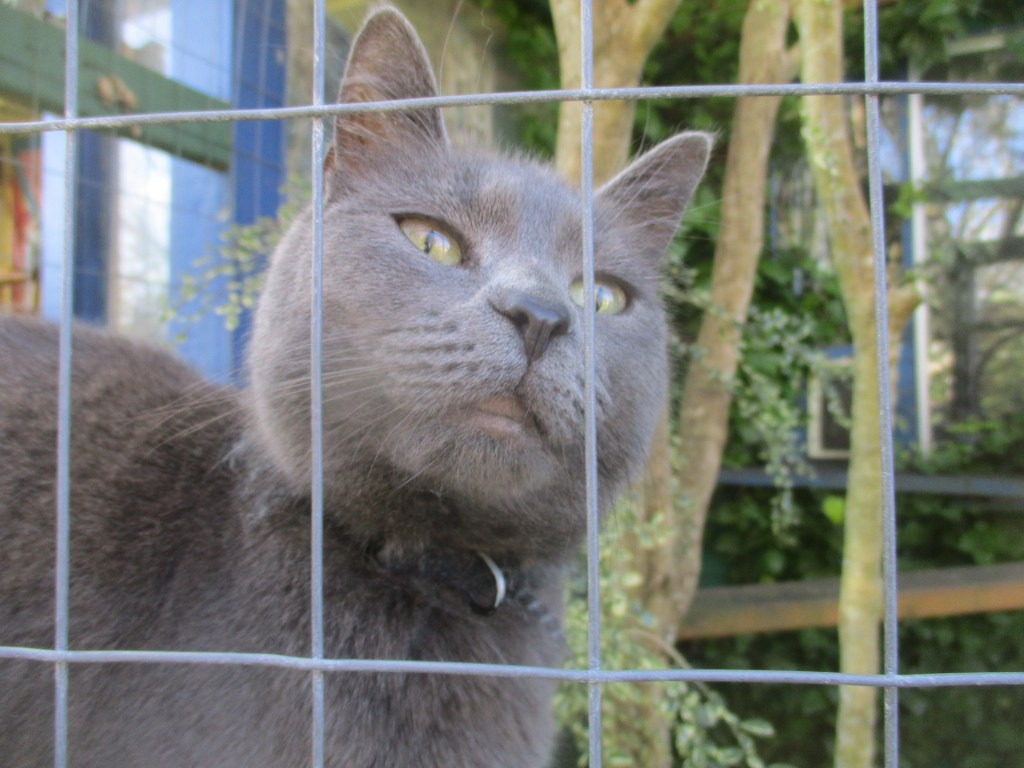
6. Nickel the kitty reminded me that I should have taken more pictures. I met both Fairy and Skooter but somehow neglected to get pictures! More can be seen at Tangly Cottage.
Alyssum is popular because of its lightly fragrant and lacy white bloom that lasts through most of the year. It seems to be more perennial than it actually is because it sows seed to replace aging plants. Candytuft, Iberis sempervirens, is a bit less prolific with bloom and fragrance, but otherwise resembles alyssum. Without seeding, it can be nicely perennial.
Candytuft does not get much larger than alyssum although it supposedly has potential to get almost a foot high and a foot and a half wide. Shearing after bloom phases enhances foliar density and subsequent bloom. Primary bloom occurs during late winter, spring, or perhaps early summer. Minor random bloom is possible at any time, particularly autumn.
Plants propagate readily by division of small tufts of rooted stems from within established plants. Alternatively, creeping outer stems develop roots if simply pressed into the soil or held down with stones. Pruning scraps are tiny and awkward to handle, but can grow as cuttings. When disturbed, candytuft exudes an aroma similar to that of related cabbages, which might be objectionable to some.
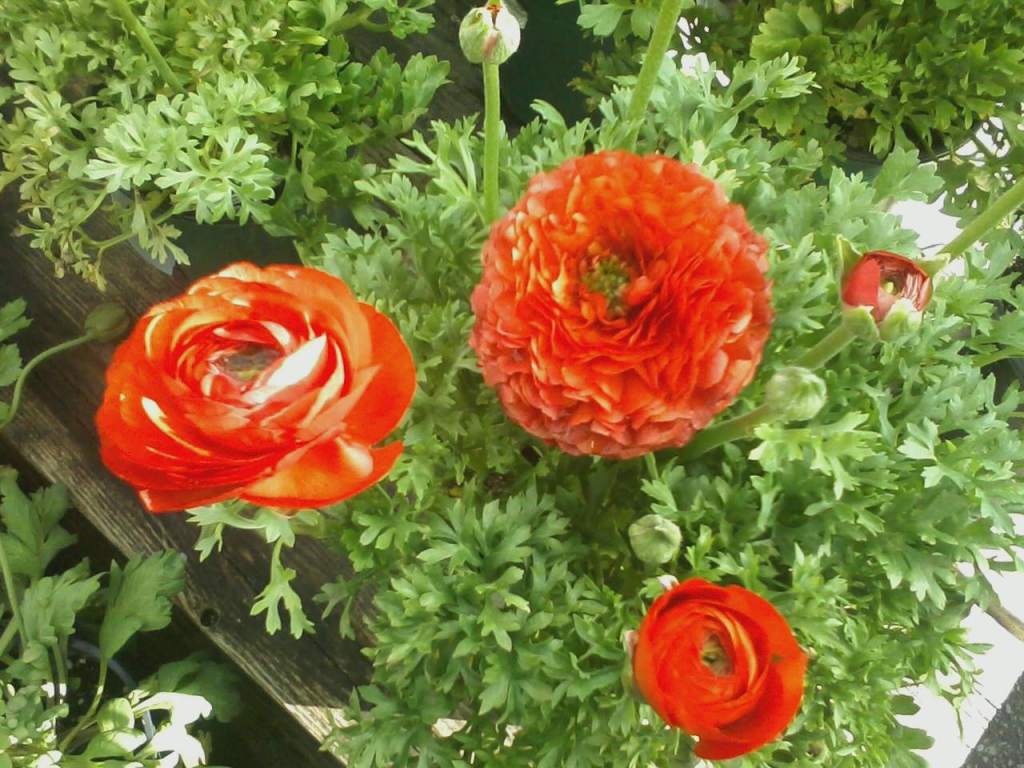
These potted ranunculus in a nursery are already blooming. Those planted while dormant last autumn may not have started yet.
If their dormant bulbs were planted back in October or November, ranunculus will soon be blooming. Those of us who missed the bulbs last autumn can already find blooming plants in nurseries. The bright yellow, orange, red, pink or white flowers are about three inches wide and seem to be outfitted with too many petals. They stand about a foot to a foot and a half tall, a few inches above the basal foliage that can get half a foot to a foot deep. The light green leaves resemble parsley, but are not as finely textured. Although perennial, ranunculus are most popularly grown as annuals because they tend to rot soon after bloom. They perform best with no more than a bit of shade, and rich but very well drained soil. They are more likely to survive as perennials if allowed to get rather dry as their foliage deteriorates after bloom.
As a companion plant, candytuft hides the less appealing lower growth of roses; or it can cascade from mixed planters.
Most roses that are grown for cut flowers are not very appealing in the landscape. They look better behind shorter perennials or shrubbery, with their taller flowering stems standing higher above. Mounding herbs like lavender, lavender cotton or rosemary, or small hedges of boxwood, dwarf hebe or Indian hawthorn obscurer their thorny undergrowth nicely. Candytuft, Iberis sempervirens, is a small perennial that gets just high enough to give a neat edge to a row of roses.
It gets gets about a foot deep, and can very slowly but eventually spread over a few square feet. The tiny, narrow and dark green leaves are less than an inch long. Inch wide trusses of minute white flowers resemble those of sweet alyssum, although lack fragrance. Sloppy plants can be restored by getting pruned almost to the ground.