Mexican Snowball

Mexican snowball is strikingly pallid blue.

The silly common name actually suits its plump rosettes of pale bluish succulent leaves. Mexican snowball, Echeveria elegans, forms small colonies that might resemble stashes of snowballs. Individual rosettes are circular, and a bit wider than tall. The widest are four inches or so across. The evergreen leaves are as neatly radial as scales of a pine cone.

Some may know Mexican snowball, and various other species of Echeveria and related Sempervivum, as hen and chicks. Big rosettes can produce so many small pups around their edges that they are reminiscent of mother hens surrounded by their huddled chicks. These pups are quite easy to separate for plugging into pots or elsewhere in the garden.

Mexican snowball is happiest in sunny situations with rather regular watering, but should tolerate a bit of shade and lapses of watering. For small trees in big pots, it can cover the surface of the potting media nicely. Pups plugged into crevices of stone walls might grow into clinging colonies. Tiny pink flowers with yellow tips bloom on wiry stems about now.
Jupiter’s beard

Jupiter’s beard tolerates only minor shade.

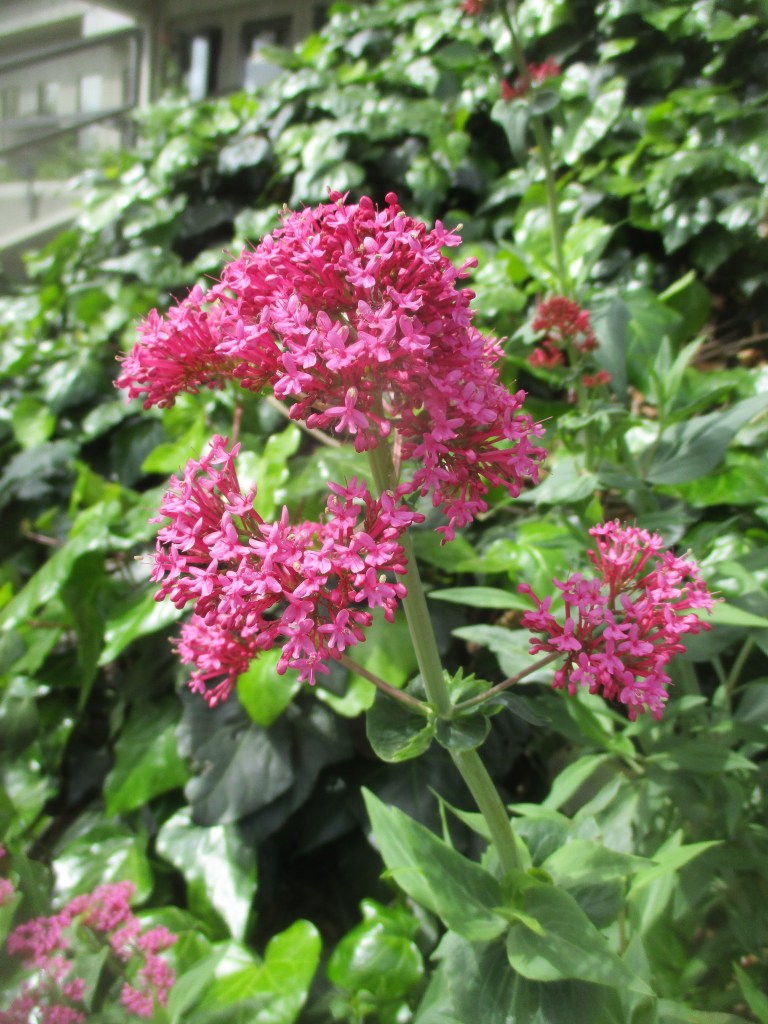
It is rare in nurseries, but common in and near old gardens. Jupiter’s beard, Centranthus ruber, was popular at least a century ago, and is now naturalized. It migrates so liberally, and transplants so easily, that there should be no need to purchase it. Those who grow it in established colonies may be happy to share. Specific cultivars can be elusive though.

Bloom is typically pinkish red, but can be brick red, purplish red, purplish pink, pale pink, or white. Individual flowers are tiny, but abundant, in rather dense and somewhat conical trusses. Bloom begins in spring and becomes more profuse until warm summer weather. A cool situation can inhibit primary bloom, but promote sporadic bloom through summer.

Jupiter’s beard prefers sunny exposure. Although a bit of shade can preserve foliar color and extend sporadic bloom through summer warmth, it compromises profusion of bloom. The slightly rubbery evergreen foliage of bloomed stems deteriorates slowly. Removal of older stems after bloom eliminates shabby growth, and also promotes fresh new growth.

Peony

Peonies are unusually happy this year.

The fact that peonies do not perform well in such mild climates does not dissuade some of us from growing them. After all, they can sometimes be found in local nurseries and even farmers’ markets as if they belong here. Tubers of more of the countless varieties can be purchased online or from mail order catalogs while dormant in autumn. Unfortunately, without much winter chill, few peonies perform as they should.

Peonies can be white or various shades of pink or red, with considerable variation of flower structure. Tree peonies that bloom yellow are the most likely to be wimpy without winter chill. All peonies are good cut flowers. After spring bloom, the distinctively coarse and rich green foliage stays until autumn dormancy. The more popular herbaceous peonies should not get more than three feet tall and broad. Tree peonies do not actually grow into trees, but develop woody stems that can hold flowers nearly six feet high. Larger flowers may need support.

Because plants get established so slowly, they should not be moved or disturbed. Small new plants can be divided from larger plants while dormant, but take a few years to actually bloom. Peonies like rich soil and regular watering, where they do not get crowded or shaded by other plants.

Lithodora

Lithodora has more names than colors.

Both the common and botanical names of lithodora are variable. Many know it as purple gromwell. The botanical name can be either Lithodora diffusa or Glandora diffusa. Many of the cultivars lack their species name after one of these two genus names. There might be less variety with the cultivars than with the names! Floral color is the primary variable. 

White blooming ‘Alba’ is uncommon. After all, lithodora is popular for its rich blue bloom, which ranges from light sky blue to indigo. As the name implies, ‘Blue Star’ flowers have a white edge around a blue center. ‘White Star’ flowers have blue around white. Flowers are tiny but profuse in sunny situations. The dense evergreen leaves are likewise small.

Mature plants are generally only a few inches deep and perhaps two feet wide. They can eventually get more than six feet wide by rooting as they migrate. Although they grow too slowly for large scale ground cover, they work nicely in a sunny atrium, around boulders, or with mixed perennials. Lithodora is susceptible to rot in pots or if watered to frequently.

Grape Hyacinth

Grape hyacinth is very reliably perennial.

Are they reliably perennial or invasive? In ideal situations, old fashioned grape hyacinth, Muscari armeniacum, can get a bit too eager to proliferate and migrate. Not only do their bulbs divide efficiently, but their seed disperse beyond bulb colonies. However, bulbs do not migrate too rapidly for containment. Thorough deadheading inhibits seed dispersion.

Grape hyacinth provides some of the earliest spring bloom. Floral spikes of tiny rounded flowers do not get much more than six inches tall, but are delightfully abundant. The rich blue color is exquisite. Hybrids and other species can bloom with pale pink, pale purple, white, yellow, or various shades or tints of blue. The grassy foliage is somewhat rubbery.

If they do not migrate efficiently enough, established colonies of grape hyacinth are easy to divide in autumn. Of course, it will be necessary to mark their locations as their foliage dies back at the end of spring. Division is easier and faster than growing new plants from seed. If hybrids produce seed at all, it may not be viable. If it is, it may not be true to type.

Deadheading Spring Bulbs Conserves Resources

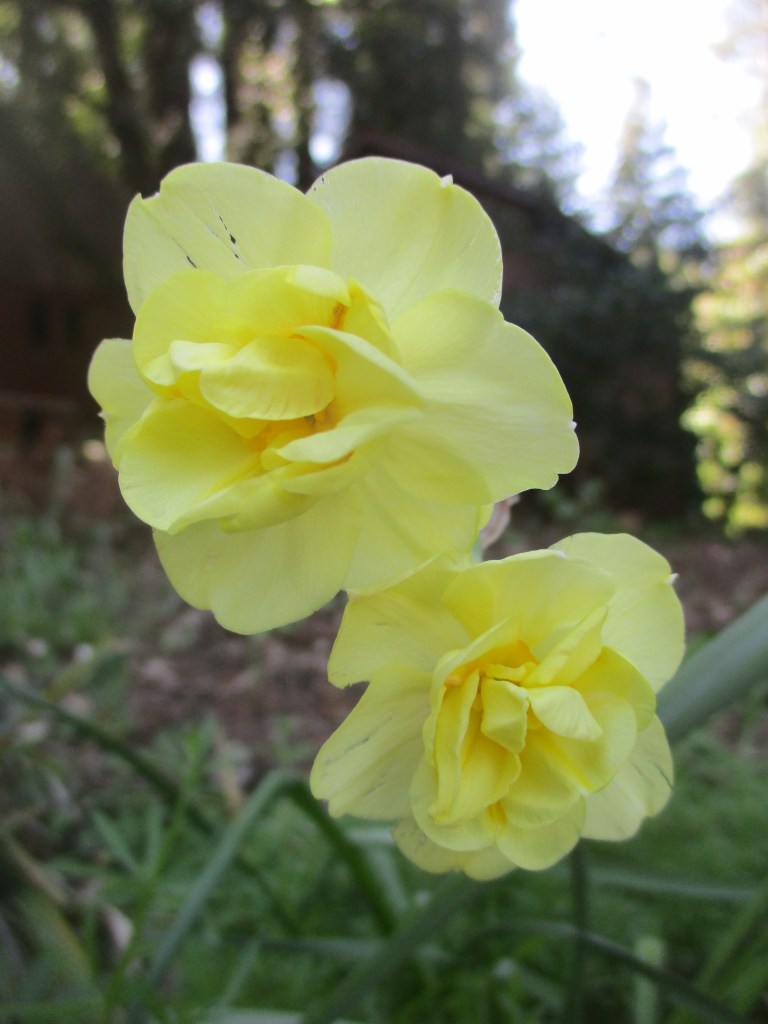
What happens when daffodils finish blooming?

Now that the various spring bulbs have finished blooming, or will soon, many will benefit from deadheading. The techniques are simple, and actually benefit many plants besides spring bulbs. In the most basic terms, deadheading is merely the removal of deteriorating flowers after bloom. Ideally, it should happen prior to the development of seed structures.

A most obvious advantage of deadheading is that it eliminates unappealing carcasses of finished flowers. This neatens the appearance of remaining foliage. The foliage of some spring bulbs shrivels soon after bloom, but remains intact through the process, to sustain development of new bulbs. It is easier to ignore without prominently shabby floral stalks.

Deadheading also conserves and redirects resources that would otherwise sustain seed production. Such resources can instead promote vegetative growth, including production of new bulbs to replace the old. Furthermore, depriving bulbs of seed provides an added incentive for vegetative regeneration. If unable to survive by one means, they try another.

Some bulbs are more reliant on deadheading than others. Grape hyacinth and snowdrop are too profuse with bloom for minor seed production to inhibit their performance. In fact, they produce viable and genetically stable seed, which could be an advantage if more of the same are desirable. Although seed production is limited, seed disperses extensively.

Dutch crocus are an example of sterile hybrids that are unable to produce viable seed, or waste associated resources on such efforts. Other extensively bred bulbs that are not so sterile may not be true to type. Consequently, their progeny are likely to be very different. Freesia do not require deadheading, but can produce feral seedlings with insipid bloom.

Lily, narcissus, daffodil, tulip and hyacinth are some of the popular spring bulbs that now are ready for deadheading. Summer bulbs and perennials will get their turn later. Canna, dahlia and perennials that continue to bloom through summer will be tidier, and perhaps bloom more abundantly with efficient deadheading. They need not wait until next year to express their gratitude.

Snowflake

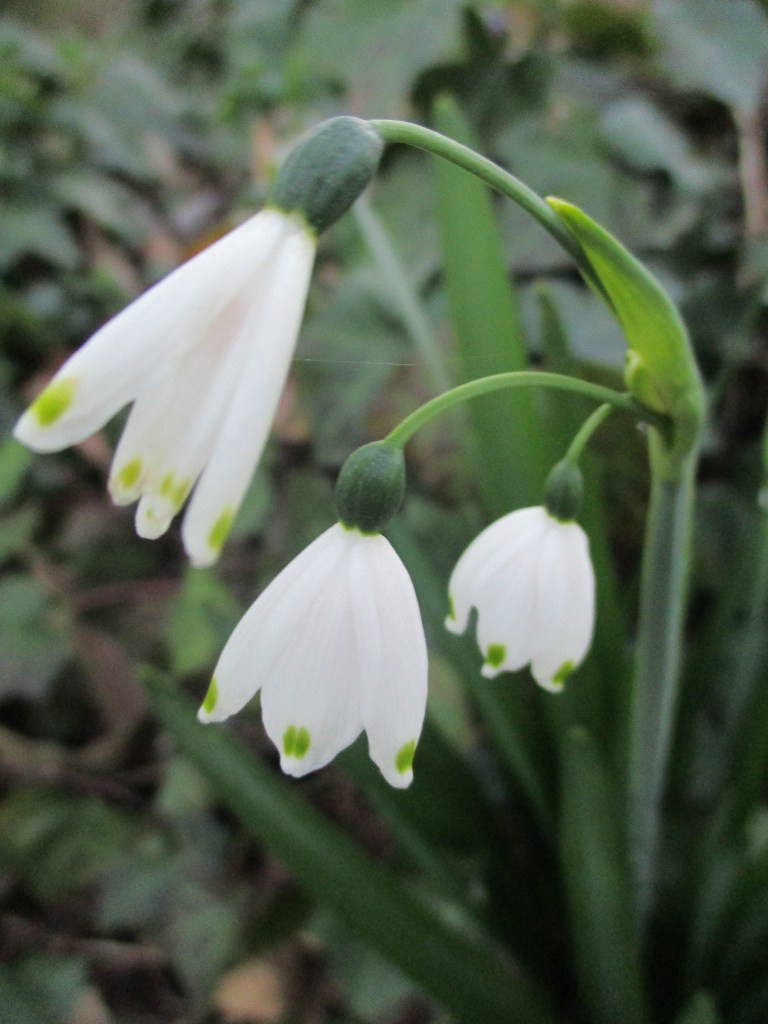
Snowflake might be mistaken for snowdrop.

Some of us here on the West Coast know it incorrectly as ‘snowdrop’. That is actually the common name of the many cultivars of Galanthus that are so very popular in other regions. ‘Snowflake’ is the correct common name for Leucojum aestivum. Of course, most of us accept either name. The real snowdrop is not so popular here anyway. It blooms better with more chill than it gets locally.

Snowflake does not seem to need much chill at all. It performs so reliably here that it can slowly spread. A few may even self sow in damp situations. Leucojum vernum is another snowflake, with single or paired flowers instead of three or more on each arching stem. Leucojum vernum blooms before Leucojum aestivum. Both are supposed to bloom later in spring, but are in bloom now.

The somewhat rubbery foliage of snowflake resembles that of daffodil, but is a bit darker green. Individual leaves are about a foot tall and an inch wide, and stand rather vertically. Floral stems do not get much higher, but lean slightly outward with the weight of bloom. Their individual flowers are quite small and pendulous, with single yellowish or green dots near the tips of each of six tepals.

Dahlia

Dahlias look nothing like this yet.

There is nothing simple about dahlia. Some are short bedding plants that behave as annuals. Tree dahlias develop big and lanky canes that can get as high as ground floor eaves, only to replace them during the next summer. The most popular dahlias are lushly foliated perennials with striking and extraordinarily colorful bloom. Most are taller than bedding dahlias, but less than six feet tall.

Dahlias can bloom just about any color except blue. However, most purple dahlias tend to be rather reddish or pinkish. Green dahlias are rare, and tend to be rather yellowish. Floral form is wildly variable! So is floral size. Some dahlia flowers get no wider than two inches. Larger sorts get about ten inches wide, so must be staked. Dahlias might be as variable as related chrysanthemums.

Dormant dahlia tubers can go into the garden as early as late autumn here. Most start in winter though, to be less susceptible to rot while waiting for spring. After blooming through summer, dahlia growth succumbs to frost late in autumn. Division of crowded dormant tubers every few years promotes healthier spring regeneration. There is no need to dig and store tubers through winter here.

Summer Bulbs After Spring Bulbs

Summer bulbs start late in winter.

It was easy to bury spring bulbs so discourteously in shallow graves last autumn. None of them got proper funerals. Perhaps cool season annuals obscured their interment sites. No one needed to know they were there. It seemed like a perfect crime, until now. They are back like the undead. After all, they were not dead when interred. They were merely dormant, and likely plump and healthy.

Crocus, snowdrop, narcissus and some of the other related daffodil might already be blooming. Otherwise, their foliage is emerging above the soil. They do not necessarily wait for the soil to get warmer later in winter. Hyacinth and tulip will bloom a bit later. Delayed planting delays bloom, but only for the first season. Established spring bulbs from previous seasons will bloom as they like.

Spring bulbs, including corms, rhizomes, tubers and tuberous roots, prefer early interment for a reason. They appreciate a good chill through winter. Although most get refrigerated artificially prior to sale, they certainly do not mind a bit more chill. Besides, they also appreciate early root dispersion, even while still dormant. They prefer to bloom early, but unfortunately, also finish bloom early.

Summer bulbs are very different. They go into the garden later because they do not require chill. Furthermore, many types are sensitive to minor frost if they begin to grow too early in winter. Since they start growth later than spring bulbs, summer bulbs generally bloom later. However, some bloom for extensive seasons. A few summer bulbs bloom from early summer until frost in late autumn.

Dahlia, canna and old fashioned white calla are the more reliable of summer bulbs to plant now. Old fashioned white calla may be rare in nurseries. Smaller, more colorful, but less vigorous callas are more popular. Such summer bulbs are more sustainable than spring bulbs, and can perform for many years. Gladiolus and various lily are spectacular summer bulbs, but bloom once annually.

Incidentally, unlike the spring bulbs, most summer bulbs are actually corms, rhizomes, tubers or tuberous roots.

Angel Wing Begonia

This is not the common Angel Wing begonia. I just found it online, in the pictures that are not protected by copyright. I could not find my picture. Storage has been a problem.

The simple pink or sometimes red or white flowers of angel wing begonia are not as flashy as those of other begonias, and are not abundant enough to provide much color. During warm weather, they are merely a minor bonus to the striking foliage. As the name implies, the big and angularly lobed leaves are shaped like wings of angels. Upper surfaces are glossy and dark green with irregular silvery spots. Undersides are even glossier and reddish bronze. With support, the lanky cane stems can get more than twelve feet tall. However, because older tall canes produce runty foliage, they are often pruned out to promote more vigorous and lushly foliated young canes.

Because they are sensitive to frost, and also because they are ideal houseplants, angel wing begonias are typically grown in containers. They like rather regular but not excessive watering, and rich potting soil. Abundant sunlight enhances foliar color; but harsh exposure roasts foliage. Partial shade is not a problem.