Snowflake

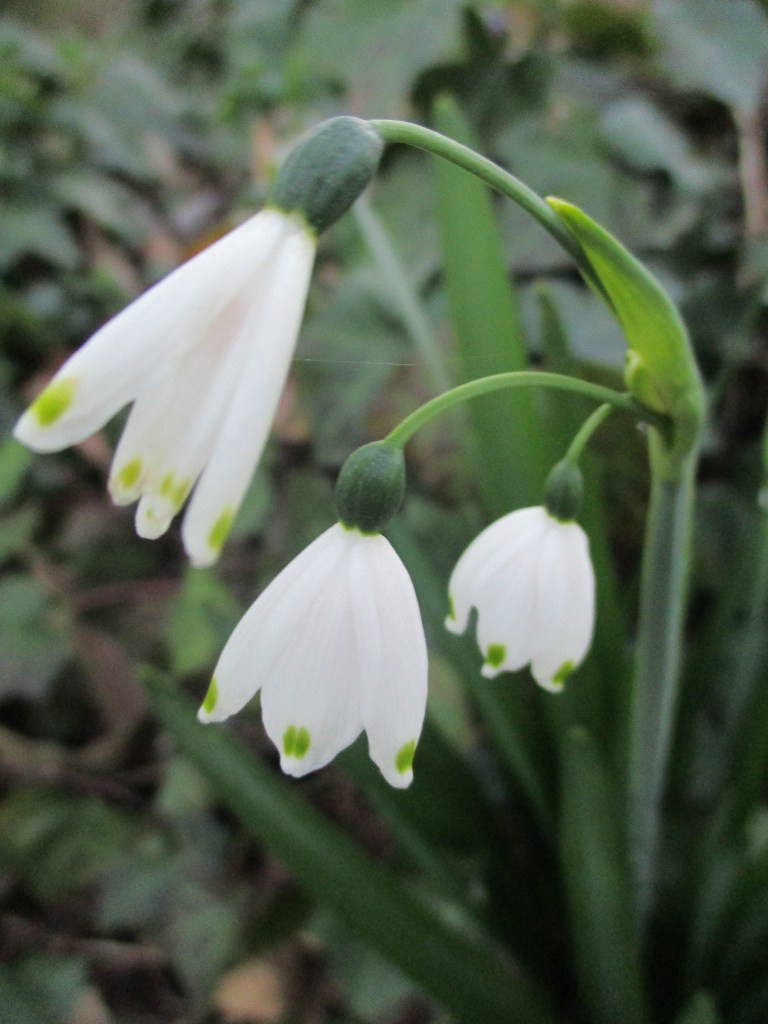
Snowflake might be mistaken for snowdrop.

Some of us here on the West Coast know it incorrectly as ‘snowdrop’. That is actually the common name of the many cultivars of Galanthus that are so very popular in other regions. ‘Snowflake’ is the correct common name for Leucojum aestivum. Of course, most of us accept either name. The real snowdrop is not so popular here anyway. It blooms better with more chill than it gets locally.

Snowflake does not seem to need much chill at all. It performs so reliably here that it can slowly spread. A few may even self sow in damp situations. Leucojum vernum is another snowflake, with single or paired flowers instead of three or more on each arching stem. Leucojum vernum blooms before Leucojum aestivum. Both are supposed to bloom later in spring, but are in bloom now.

The somewhat rubbery foliage of snowflake resembles that of daffodil, but is a bit darker green. Individual leaves are about a foot tall and an inch wide, and stand rather vertically. Floral stems do not get much higher, but lean slightly outward with the weight of bloom. Their individual flowers are quite small and pendulous, with single yellowish or green dots near the tips of each of six tepals.

Dahlia

Dahlias look nothing like this yet.

There is nothing simple about dahlia. Some are short bedding plants that behave as annuals. Tree dahlias develop big and lanky canes that can get as high as ground floor eaves, only to replace them during the next summer. The most popular dahlias are lushly foliated perennials with striking and extraordinarily colorful bloom. Most are taller than bedding dahlias, but less than six feet tall.

Dahlias can bloom just about any color except blue. However, most purple dahlias tend to be rather reddish or pinkish. Green dahlias are rare, and tend to be rather yellowish. Floral form is wildly variable! So is floral size. Some dahlia flowers get no wider than two inches. Larger sorts get about ten inches wide, so must be staked. Dahlias might be as variable as related chrysanthemums.

Dormant dahlia tubers can go into the garden as early as late autumn here. Most start in winter though, to be less susceptible to rot while waiting for spring. After blooming through summer, dahlia growth succumbs to frost late in autumn. Division of crowded dormant tubers every few years promotes healthier spring regeneration. There is no need to dig and store tubers through winter here.

Summer Bulbs After Spring Bulbs

Summer bulbs start late in winter.

It was easy to bury spring bulbs so discourteously in shallow graves last autumn. None of them got proper funerals. Perhaps cool season annuals obscured their interment sites. No one needed to know they were there. It seemed like a perfect crime, until now. They are back like the undead. After all, they were not dead when interred. They were merely dormant, and likely plump and healthy.

Crocus, snowdrop, narcissus and some of the other related daffodil might already be blooming. Otherwise, their foliage is emerging above the soil. They do not necessarily wait for the soil to get warmer later in winter. Hyacinth and tulip will bloom a bit later. Delayed planting delays bloom, but only for the first season. Established spring bulbs from previous seasons will bloom as they like.

Spring bulbs, including corms, rhizomes, tubers and tuberous roots, prefer early interment for a reason. They appreciate a good chill through winter. Although most get refrigerated artificially prior to sale, they certainly do not mind a bit more chill. Besides, they also appreciate early root dispersion, even while still dormant. They prefer to bloom early, but unfortunately, also finish bloom early.

Summer bulbs are very different. They go into the garden later because they do not require chill. Furthermore, many types are sensitive to minor frost if they begin to grow too early in winter. Since they start growth later than spring bulbs, summer bulbs generally bloom later. However, some bloom for extensive seasons. A few summer bulbs bloom from early summer until frost in late autumn.

Dahlia, canna and old fashioned white calla are the more reliable of summer bulbs to plant now. Old fashioned white calla may be rare in nurseries. Smaller, more colorful, but less vigorous callas are more popular. Such summer bulbs are more sustainable than spring bulbs, and can perform for many years. Gladiolus and various lily are spectacular summer bulbs, but bloom once annually.

Incidentally, unlike the spring bulbs, most summer bulbs are actually corms, rhizomes, tubers or tuberous roots.

Angel Wing Begonia

This is not the common Angel Wing begonia. I just found it online, in the pictures that are not protected by copyright. I could not find my picture. Storage has been a problem.

The simple pink or sometimes red or white flowers of angel wing begonia are not as flashy as those of other begonias, and are not abundant enough to provide much color. During warm weather, they are merely a minor bonus to the striking foliage. As the name implies, the big and angularly lobed leaves are shaped like wings of angels. Upper surfaces are glossy and dark green with irregular silvery spots. Undersides are even glossier and reddish bronze. With support, the lanky cane stems can get more than twelve feet tall. However, because older tall canes produce runty foliage, they are often pruned out to promote more vigorous and lushly foliated young canes.

Because they are sensitive to frost, and also because they are ideal houseplants, angel wing begonias are typically grown in containers. They like rather regular but not excessive watering, and rich potting soil. Abundant sunlight enhances foliar color; but harsh exposure roasts foliage. Partial shade is not a problem.

Dormancy And Defoliation Are Advantageous

Kahili ginger is finished blooming, and should get cut back once the foliage succumbs to frost.

Many plants are deciduous in autumn and winter, which means that they defoliate or die back, and then refoliate or regenerate in spring. Many others are evergreen, which simply means that they are always foliated through all seasons. What many people do not realize is that evergreen plants replace their foliage just like deciduous plants do. They just do not do it in such distinct phases of defoliation, dormancy and refoliation.

Tropical plants like cannas and some of the various begonias really have no need for formal defoliation, since they are from climates that lack winter. In the wild, they continually and systematically shed old stems as they produce new stems. Locally, they tend to shed more than they grow during late autumn and winter. The large types of begonias tend to keep their canes for so many years that it is not so obvious. Where winters are colder, cannas freeze to the ground, only to regenerate from their thick rhizomes as winter ends.

Zonal geraniums may seem rather tired this time of year for the opposite reason. They expect late autumn weather to include frost that would kill them back to the ground where they would stay relatively dormant until warmer weather after winter. Just because their foliage is instead evergreen through winter does not mean that it should be. It lingers and often becomes infested with mildew and rust (fungal diseases) that proliferate in humid autumn weather.

However, zonal geraniums need not be pruned back just yet. Even if they eventually get damaged by frost, pruning should be delayed so that the already damaged older foliage and stems can shelter the even more sensitive new growth as it emerges below. They can get cut back after frost would be likely.

Evergreen pear can get very spotty once the warm weather runs out because the same damp and cool weather that inhibits its growth also promotes proliferation of the blight that damages and discolors the foliage. The damaged foliage eventually gets replaced as new foliage emerges in spring, but will remain spotty and discolored until then. Photinia does not get as spotty, but holds blighted foliage longer into the following summer. Ivy can be temporarily damaged by a visually similar blight.

Curve Leaf Yucca

Curve leaf yucca can be variegated.

Some perennials are too easy to grow. Curve leaf yucca, Yucca recurvifolia (or Yucca gloriosa ‘Tristis’), is remarkably resilient. It migrates slowly but surely. If it becomes obtrusive, it is difficult to contain and remove. Removal of foliar rosettes above does nothing to slow the roots below. The roots merely produce new foliage. Of course that can be a distinct advantage for harsh conditions.

The striking foliar form resembles that of other species of Yucca, except that it reliably arches softly downward. Foliage is not as soft as it seems though. Each leaf terminates with a sharp spine. Sharp edges can cause wicked paper cuts. Foliar color is bluish gray. Although, variegated cultivars are increasingly popular. Old plants can develop trunks that slowly grow more than six feet tall.

Tall and elegant spikes of relatively small creamy white flowers stand grandly above the evergreen foliage in late spring or summer. Bloom is best with warm and sunny exposure, and lasts a long time. Viable seed is rare. Propagation by division of some of the many pups is simple though. Popular variegated cultivars exhibit more docile growth with fewer pups, but bloom less abundantly.

Dividing Perennials Equates To Multiplying

Yuccas can get divided after bloom.

This seems like bad algebra. Horticulturally, dividing and multiplying really are the same. Division is the separation of crowded perennials into smaller but more numerous portions. It multiplies the number of individual plants. The smaller portions perform better than they did while crowded. Division is both a method of vegetative (clonal) propagation, and a form of healthy social distancing.

Many perennials are ready for dividing about now. They finished blooming through spring or summer, and are going dormant for winter. Some defoliate. Division is not so disruptive to them while they rest. Cool and damp weather keeps them hydrated. They can disperse roots and resume growth as winter ends, as if nothing ever happened. They should bloom right on schedule next year.

The most popular perennials grow for many years before getting overgrown enough to benefit from division. Some may technically never need dividing. They manage to perform adequately even as dense thicket growth. For some, division is primarily for propagation. Only a few perennials appreciate annual division. Perennials that bloom in autumn or winter prefer division in early spring.

Pigsqueak will bloom later in winter. Dividing it now with other perennials would inhibit and retard the blooming process. It will be ready for dividing before winter ends, so can settle in with the last winter and spring rain. The same applies to Japanese anemone, which might still be blooming now. Dividing these two perennials is typically for propagation or containment, rather than crowding.

Lily of the Nile and African iris do not need dividing often, but when they do, it can be a major chore. For moderate crowding, it is relatively easy to pluck many individual shoots without disturbing remaining shoots. However, it is typically more practical to dig bulky colonies, divide them into individual shoots, and then plant the shoots. African iris shoots work best in groups of five to twelve.

Lily of the Nile, with dividing earlier than later, disperses roots in winter, to bloom for summer.

Coral Bells

Coral bells can bloom again in autumn. (This is not my picture.)

From Santa Barbara to Vancouver, and also in central Idaho, the humble native coral bells, Heuchera micrantha, is not much to look at, with compact rosettes of relatively small and bronzy rounded leaves with weird tomentum (hairs). In spring and early summer, and sometimes again in autumn, sparse trusses of minute brick red flowers hover about a foot above on wiry and slightly fuzzy stems. Old plants that get bare in the middle can be divided into several small plants in spring or autumn.

Modern cultivars are considerably more interesting, with more substantial foliage in various shades of green, gold, tan, brown, bronze and purplish bronze. The larger and variably lobed leaves can be two inches wide or slightly wider. The flowers stand as much as two feet high, but lack color. Most are pale greenish white. ‘Palace Purple’ has deep bronze or almost purplish foliage. ‘Ruffles’ has deeply lobed and ruffled green leaves. Unlike undemanding wild plants that can grow in cracks in exposed stone, modern cultivars like rich soil. Harsh exposure can scorch foliage, so a bit of partial shade is preferred.

Most coral bells are grown more for their colorful and low foliage than for their bloom. (Both pictures here were obtained online. I can not find my pictures.)

Many Perennials Want Seasonal Grooming

Peacock orchid bloom late, but eventually succumbs to frost and must be groomed.

Here on the west coast, autumn and winter weather is so mild that the native coral bells are already starting to develop new foliage on top of the old foliage from this last year. Technically, they are evergreen, so the old foliage does not need to be shed; but if it is not too much to ask, some types look better with a bit of grooming.

Other perennial plants that are from climates with stronger seasons and colder winters are not quite so evergreen. Many shed all of their foliage and are completely bare for at least part of the winter. Only a few, like cyclamen, are at their best through autumn and winter.

Dried watsonia foliage should be removed now if it has not been removed already. It is not so easy to pluck off like gladiola foliage is, so it should be cut off with shears. Because new foliage for next year develops before the old foliage of this past year is completely brown, it is often necessary to cut the old a few inches above the ground in order to avoid damaging the new.

The so called ‘evergreen’ daylilies can be even messier. New foliage is rather delicate, so it is easily tattered by the removal of old foliage. The ‘deciduous’ types may seem to be less appealing because they are bare for part of autumn and winter, but are so much easier to groom by simply removing all of the deteriorating old foliage as soon as it separates easily from the roots.

Deteriorating flowers can be removed from cannas; but their lush foliage can stay until it starts to deteriorate later in winter. Even if it survives winter, it should eventually be cut to the ground as it gets replaced by new growth in spring.

The many different iris have many different personalities. Most should be groomed sometime between summer and late autumn, although Dutch iris were groomed much earlier. Bearded iris that do not get divided can be groomed simply by plucking off big old leaves to expose smaller new shoots below.

Some dahlias bloom until they get frosted. Most though, are already finished. They do not need to be cut back all at once, but can be cut back in phases as leaves and stems dry and turn brown.

Chrysanthemum

Chrysanthemums are just right for autumn.

Mild autumns and arid summers keep chrysanthemums on a different schedule here than in most other regions. They can get planted in spring to grow through summer and bloom through autumn; but because they can take a bit of work, they are more often planted while blooming in autumn. Although commonly grown as autumn annuals, they are perennials that can regenerate next spring, grow through summer, and bloom even better the following autumn.

Centuries of development in Japan have produced more varieties of chrysanthemums than can be documented. There are really some weird types grown for cut flowers or by hobbyists. Garden varieties are mostly limited to simpler flowers that do not need much thinning or staking. Color ranges through all sorts of hues and shades of yellow, orange, red, pink and bronze, as well as a few purplish colors, cream and white. Many have yellow centers. The aromatic foliage is alluring to some, but objectionable to others.