These Bulbs Are Not Incandescent

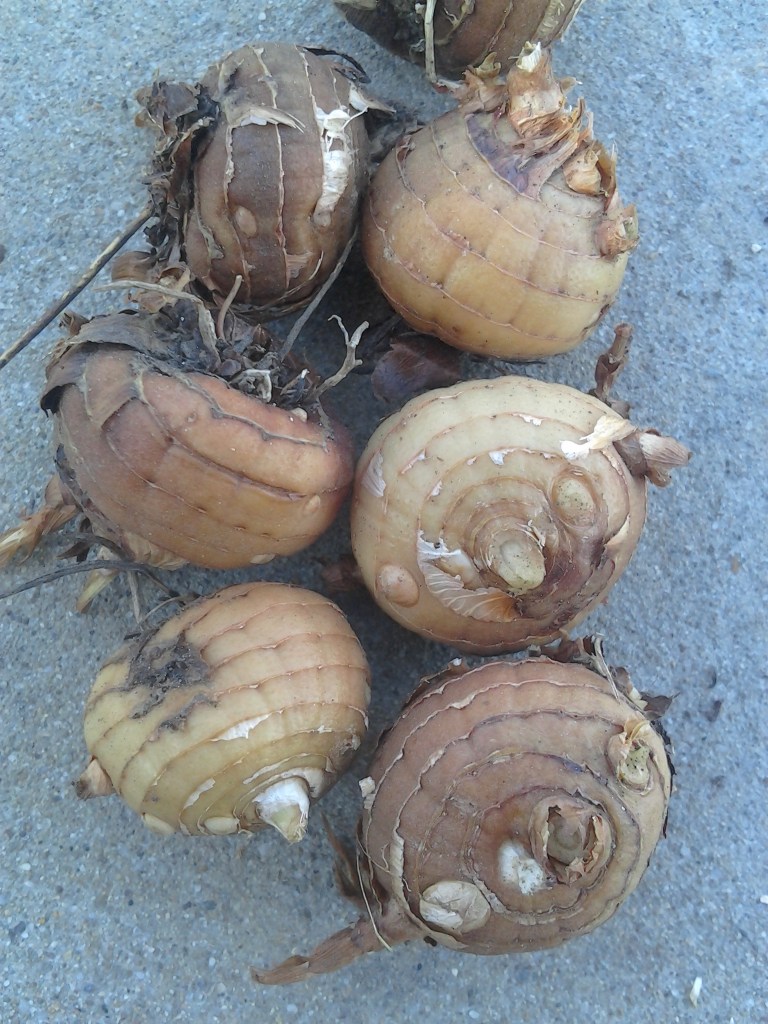
Bulbs do not look too impressive.

It may seem to be too early to be concerned with narcissus, daffodil and grape hyacinth, but this is when their bulbs go into the garden. Once established, these familiar examples, as well as early bearded iris, can be the most reliable for colorful bloom at about the same time early each spring. Crocus and freesia bloom just as early, but may not naturalize as reliably. Lily, tulip, hyacinth, anemone and ranunculus really prefer cooler winters to bloom reliably after their first spring, even though they are worth growing for just one season.

Bulbs, including corms, rhizomes, tubers and tuberous roots, can be found in nurseries when it is time for them to be planted. Gladiolus are not yet available only because they are summer blooming bulbs that should be planted a bit later than spring bulbs. None of the bulbs are much to look at while dormant, and are even less impressive once they get buried out of sight, but they have already stored up everything they need for the blooms that we expect from them next year. Once hidden below the surface of the soil, seemingly dormant bulbs secretly disperse their roots into the surrounding cool and moist soil to be ready to bloom as soon as weather allows.

In their first year, some bulbs can be planted in groups at different times to coincide with the expected durations of their particular bloom cycles. For example, if the flowers of a particular type of bulb can be expected to last two weeks, a second phase of the same bulbs can be planted two weeks after the first phase. As the first phase finishes bloom next spring, the second phase should begin bloom. However, phasing is only effective for the first season, since all bulbs of any particular variety will be synchronized by their second season.

Anemone, ranunculus and bearded iris each bloom synchronously, regardless of when they get planted, so are immune to phasing. Fortunately, the many varieties of bearded iris have different bloom seasons. Some bloom as early as narcissus. Mid-season varieties bloom shortly afterward, and are followed by late varieties. Some modern varieties bloom early, and then again after the late varieties!

Abyssinian Gladiolus

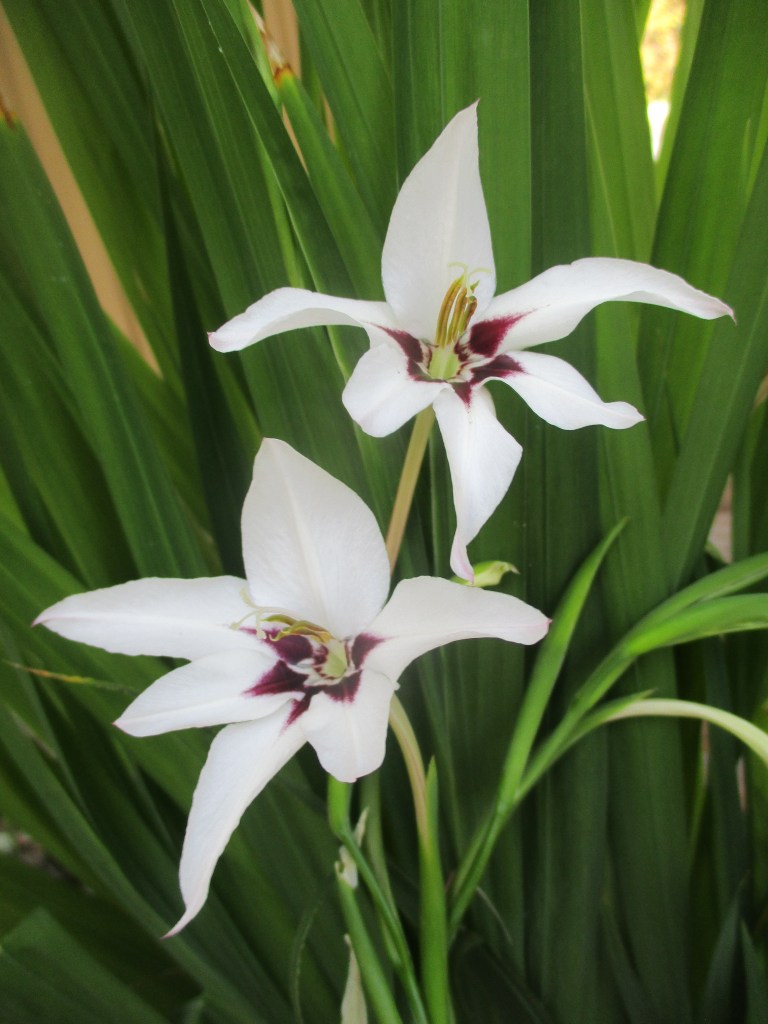
Abyssinian gladiolus might still be blooming.

Summer bulbs and bulb like perennials bloom after spring bulbs. They therefore prefer later planting. Abyssinian gladiolus, Gladiolus murielae, is likely unavailable in nurseries while spring bulbs are seasonable. Their bulbs should be obtainable and ready for planting later, while other summer bulbs are in season. Abyssinian gladiolus blooms late in summer, or may still be blooming now.

Abyssinian gladiolus is more discreet than the more common hybrid gladiolus. It is also more reliably perennial. In favorable conditions, bulbs might multiply enough to be somewhat invasive. The narrow leaves stand more than two feet tall. Floral stems can be three feet tall, to loosely suspend a few white flowers with garnet red centers. Each mildly fragrant flower is about two inches wide.

The bulbs, which are technically corms, prefer organically rich soil that drains well. Digging and storing them through the locally mild winters is unnecessary. After many years, established colonies of bulbs might migrate upward and closer to the surface of the soil. Digging dormant bulbs that have gotten too shallow to stand upright while foliated, and burying them deeper, improves stability.

Angelonia

This annual can actually be perennial.

Angelonia is one of those warm season annuals that can actually survive through winter as a pernnial to bloom again next spring. It may even want to continue to bloom untill frost. The flowers can be blue, purple, red, pink or white, and look something like small snapdragon flowers. Most have spots or stripes of an alternate color or two in their throats. Some modern varieties have fragrant flowers. Plants can get a foot or two tall, and almost as wide. In sheltered spots, angelonia can be cut back as soon as it starts to look tired in autumn. Exposed plants might be happier if cut back significantly later, as winter ends. Old growth may be unsightly for a while, but can protect interior stems and roots from frost. Besides, pruning stimulates new growth that will be more susceptible to subsequent frost.

Kahili Ginger

Kahili ginger blooms as summer ends.

It is not the ginger that is so popular for culinary purposes, but it is the most popular for home gardens in the West. Kahili ginger, Hedychium gardnerianum, is so vigorous and easy to grow that it has potential to be invasive in ideal situations. Fortunately, it does not produce many of its sticky seeds locally. It therefore migrates primarily by dispersing rhizomes, which are not noxiously fast.

The delightfully fragrant bloom begins late in summer, and will finish soon. As many as forty small pale yellow and red flowers radiate from each cylindrical floral truss. Blooms stand neatly vertical, even if the stems supporting them lean. As cut flowers, they last only for a few days. Deadheading after bloom eliminates unwanted seed (if that is a concern), and unclutters the tidy foliage below.

However, with or without deadheading, the lush foliage is only temporary after bloom. It deteriorates as the weather cools through autumn. Cutting the herbaceous canes to the ground before they get too unsightly will expose some of the thick rhizomes. New canes will grow a few feet tall next spring and summer. On the canes, each leaf extends in the opposite direction of the leaf below it.

Autumn Sage

50909
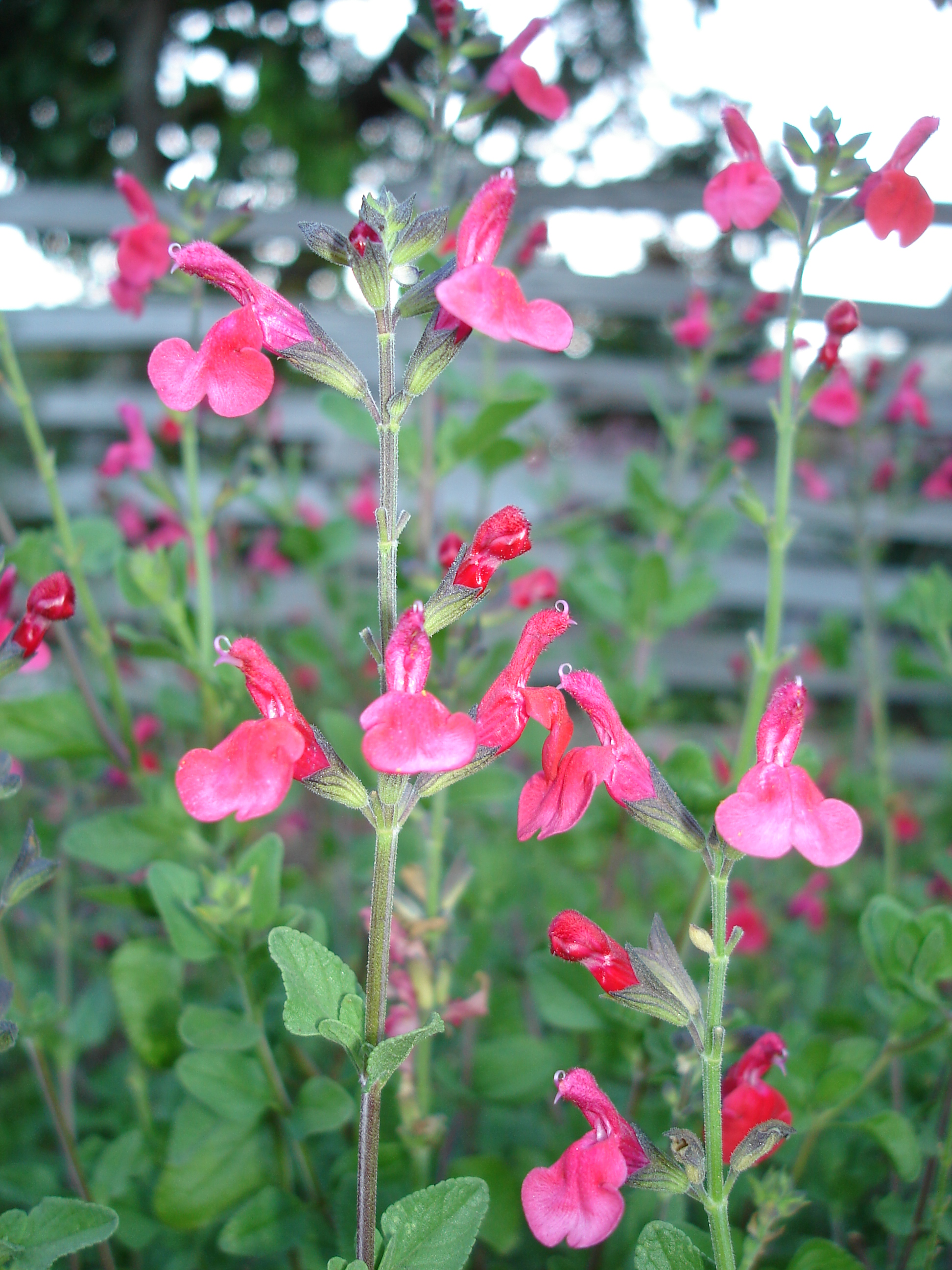
Salvia greggii is a modest sage.

Perhaps in the wild, it blooms in autumn. Where it gets watered in home gardens, even if watered only occasionally, autumn sage, Salvia greggii, blooms all through summer as well. If pruned back severely over winter, it starts to bloom even sooner in spring. The tiny flowers are red, rose, pink, peach, very pale yellow, lavender or white. Some poplar cultivars have bi-colored flowers.

Compact autumn sage that does not get much more than a foot tall is uncommon. Larger cultivars get four feet tall and broad, with more open growth. Most get about three feet high and a bit wider. Without severe winter pruning, stems can eventually get twiggy, with sparse foliage on the exterior. The tiny aromatic leaves are less than an inch long, and visually resemble oregano.

Even though it is not native to California, autumn sage is popular for native landscaping because it does not need much water. Just like native sages, it attracts butterflies and hummingbirds.

Sea Foam Statice

50819+
Statice flowers last fresh or dried.

Many of us who already grow sea lavender, Limonium perezii, might wonder why it is a topic for August. In the mildest spots, it gets more credit for blooming in winter while most other plants are dormant. Yet, it is actually classified as a summer blooming perennial because it blooms more reliably though summer in most places.

Bluish purple blooms stand more than two feet tall, just above coarse mounds of evergreen basal foliage that gets more than two feet wide. Each billowed bloom contains many tiny flowers. Larger blooms are too heavy to stand upright, so they lay down on the foliage. The weirdly wavy leaves are on such long petioles (leaf stalks) that they may lay down too.

Established plants do not need much attention or water. Faded bloom should be pruned away. It is not practical to remove all of the faded foliage. Every few years or so, old plants can be reinvigorated by getting divided. Newly divided rhizomes will need to be watered regularly until they disperse their roots. Sea foam statice likes full sun exposure.

Plumbago

50812+
Few blooms are this blue.

There are not many flowers as blue as those of plumbago, Ceratostigma plumbaginoides. Individual flowers are not much more than half an inch long, but can be quite abundant until autumn. Each of the many terminal flower clusters is on a rather reliable schedule, so that new flowers begin to open as older flowers begin to fade.

Thin stems stand only about half a foot to a foot above underground rhizomes. Individual plants get about 3-feet wide, but realistically, will slowly spread farther if conditions are right. They do not spread fast enough to be invasive, but can get into some unexpected spots if not controlled. The simple leaves are about two inches long.

The main problem with plumbago is that it is deciduous, so it dies back to the ground in autumn. The weather is too mild here to produce the good fall color seen where autumns are cooler. Plumbago is a popular bulb cover because new growth, although slow to develop, emerges just in time to obscure fading foliage of early spring bulbs like daffodil and tulip.

Plumbago also works well with stone, since the stone is still appealing without the foliage through winter. The wiry stems weave nicely through otherwise bare cobbles, or spill slightly over low stone walls. Even though shade inhibits bloom, plumbago makes a nice informal ground cover under open shrubbery.

Six on Saturday: Suburbia II

As I said last week, the Santa Clara Valley is the best place in the entire Universe for horticulture. That is where these pictures came from. Although I planted only the Ilex aquifolium of the second picture, I collected all six of these plants from various sources over the years. They have been quite happy here. I will now be taking more copies or originals of all but Ilex aquifolium.

1. Juniperus virginiana – is my favorite this week. I know it is uninteresting to those who are familiar with it, but it happens to be one of only a few that I brought from Newalla in Oklahoma.P00808-1

2. Ilex aquifolium – is the only one this week that I actually purchased from a nursery, while in school in San Luis Obispo in the late 1980s. It is uncommon (and unpopular) here. I still dig it.P00808-2

3. Viola odorata – came from Santa Clara while I was in high school. (I thought) I wanted it because it blooms white. It is not very pretty, but I can not get rid of it. Violets should be ‘violet’.P00808-3

4. Pelargonium hortorum – is not the original that I found in a compost pile in Montara in about 1980, but is very likely the same ‘unimproved’ species or whatever it is. I found it downtown.P00808-4

5. Agapanthus orientalis – from Watsonville in 1992, is one of my two favorite agapanthus; because it is white, but is otherwise identical to my original blue agapanthus from the late 1970s.P00808-5

6. Amaryllis belladonna – came from Hoot Owl Creek in Oklahoma. It lived in the same garden with my Iris pallida! I know it is no more interesting that these others here, but it has history!P00808-6

This is the link for Six on Saturday, for anyone else who would like to participate:

https://thepropagatorblog.wordpress.com/2017/09/18/six-on-saturday-a-participant-guide/