Santa Barbara Daisy

50729-c
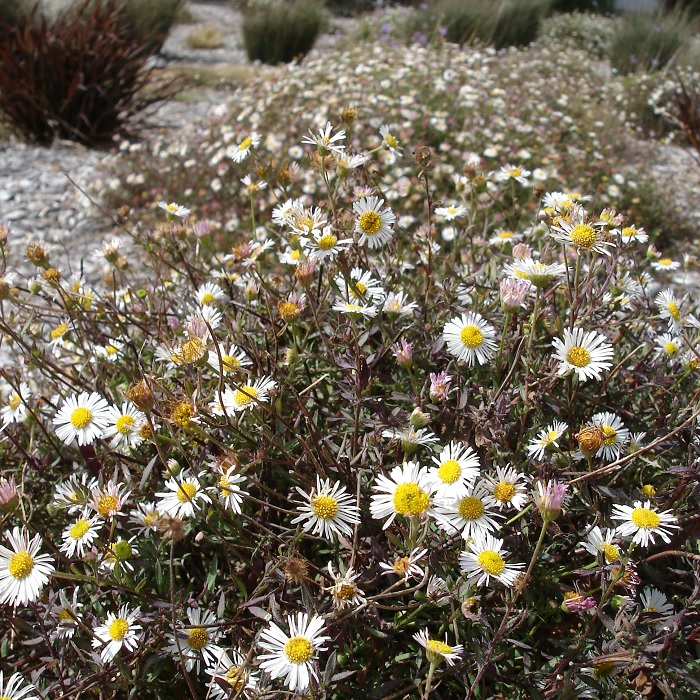
Some of us know Santa Barbara daisy by the less appealing name of ‘fleabane’.

Santa Barbara was not exactly its first choice. Santa Barbara daisy, Erigeron karvinskianus, is not even native to California. It is actually from Central America. It just happens to do very well here, and can naturalize if conditions are right. It can be rather grungy through summer in the wild, but with a bit of watering, it can bloom nicely all year.

The thin stems can spread a few feet without getting more than a foot deep. If even shallower growth is preferred, older plants can be cut down or pulled up as they get replaced by their own offspring. The narrow leaves are quite tiny. The white or slightly pinkish flowers are not much bigger, less than half an inch wide, with prominent yellow centers.

Santa Barbara daisy is also known as Mexican fleabane, both because it is actually native to Mexico, and also because it is supposedly useful for repelling fleas. The problem with using it to repel fleas is that only its smoke is effective. There are probably other herbal alternatives that work just as well without being a fire hazard.

Lily Of The Nile

00805
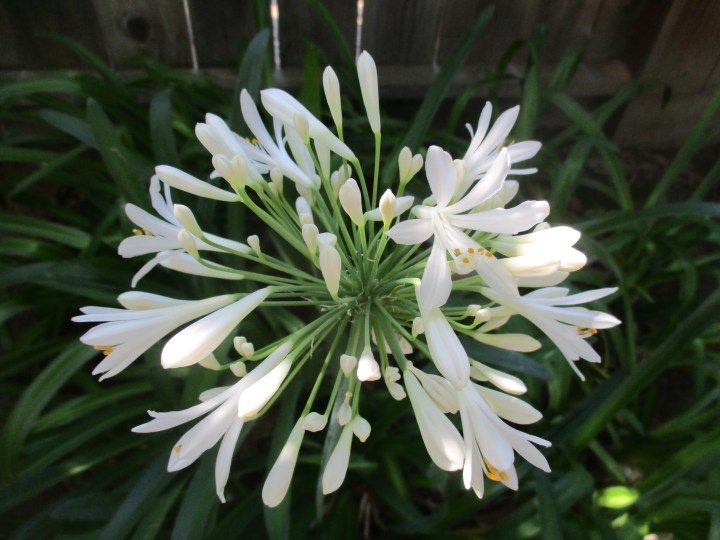
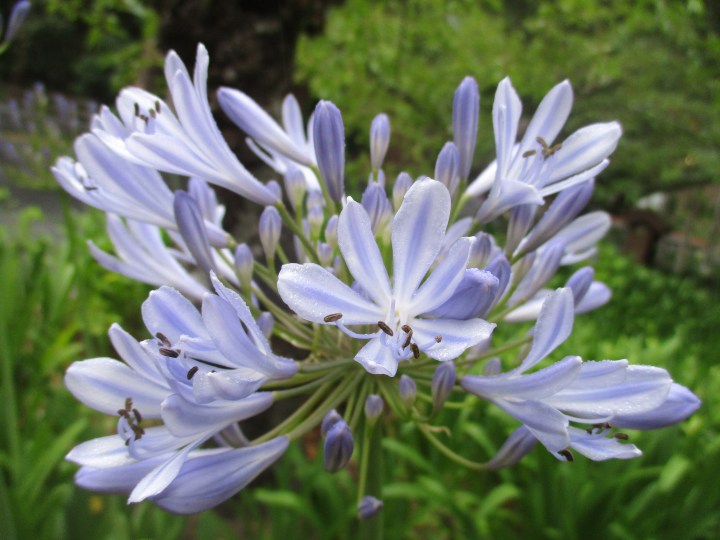
Agapanthus bloom looks like Independence Day.

It is no lily, but it does live on the banks of the Nile River. Lily of the Nile, Agapanthus africanus, endures both long dry summers and winter flooding. While inundated, it clings to the silty soil with a sturdy network of rubbery roots. Densely mounding foliage regenerates as floodwater recedes. If conditions get exceptionally warm and dry, foliage may eventually shrivel after midsummer bloom.

Home gardens are certainly more hospitable than the floodplains of the Nile River. The luxuriant foliage of lily of the Nile is evergreen locally, even if irrigation is minimal. The rubbery leaves get as long as two feet, arching outward from basal rosettes. New foliage obscures deteriorating old foliage. Plants that get too congested to bloom well might benefit from division of individual rosettes.

Lily of the Nile blooms around Independence Day, with round floral trusses that resemble exploding fireworks. Each blue or white bloom stands about two to four feet high, on slim and bare stems. Individual florets are small and tubular. ‘Storm Cloud’ blooms with darker blue or purple. Agapanthus orientalis may exhibit bigger blooms and coarser foliage. ‘Peter Pan’ stays low and compact.

Fourth of July

P00704K
Lily of the Nile are floral Fourth of July fireworks.

Fireworks, Fourth of July parades, and the associated crowds are of course canceled for this year.

Lily of the Nile does not mind. It blooms in time for the Fourth of July regardless of what the rest of us are doing, or not doing. That is one of the two reasons why some of us know it as the ‘Fourth of July flower’. The other reason is that the nearly spherical floral trusses resemble exploding skyrocket fireworks. They are mostly blue, with some white. All that is missing is red.

The bloom in this picture is not exactly exemplary. It would have been larger, rounder, and likely more advanced in bloom if it had developed in a sunnier location. There are enough of them that we do not notice that most are somewhat diminutive. In autumn, many of the overgrown plants will be relocated to a sunnier situation where they can bloom as they would prefer too.

Lily of the Nile was the first perennial that I grew a significant quantity of. While in junior high school, a neighbor instructed me to remove a healthy colony of lily of the Nile that had grown obtrusively large in only twenty years. I could not just discard it, so chopped it into more than sixty pups, and planted it all over the neighborhood. Much of it is still there. A bit of it is here.

Back then, it was known as Agapanthus orientalis. In school, I learned it as Agapanthus africanus. I still do not know if they are two different species, or if one is just a variety of the other. I do know that mine are distinctly different from common sorts, with bigger and rounder floral trusses. The others have straighter stems that support their blooms batter, and finer foliage.

Covering New Ground Or Old With Groundcover

50506
Mock strawberry covers shallowly but densely.

As the simple name implies, ‘groundcover’ covers the ground. Groundcover plants stay lower than shrubbery, and function something like mulch. They insulate shallow roots of other plants, inhibit weeds, and some groundcovers inhibit erosion. Besides all their utilitarian functions, they provide appealing foliage, and some bloom nicely.

Lawn is probably the most common groundcover, and is also the most useful; but that is an entirely different and involved topic! Other groundcover plants are spreading perennials, plants with sprawling stems, or vines grown without support. Most are evergreen, since defoliated plants do not cover much of anything too well.

Gazanias and iceplants are popular perennial groundcovers. Their old stems tend to die out and decompose as efficiently as new stems pile up over them, which is why they do not get too deep. Gazanias can eventually get bald spots that need to be patched with new plants, or ‘plugged.’

(The debris from pruning the edges of easily rooted perennial groundcovers can be processed into cuttings known as ‘plugs’, which can go directly into bald spots. Plugs can be taken from dense spots if no edging is necessary. They should be watered regularly, or plugged in autumn to take advantage of rain while roots develop.)

Groundcover forms of ceanothus (wild lilac), juniper and contoneaster are really shrubs that extend their stems more horizontally than vertically. Honeysuckle and both Algerian and English ivies are vines that spread over the ground until they find something to climb. Their stems root into the ground wherever they need to.

Since most groundcover plants are naturally understory plants that grow below larger plants, many tolerate considerable shade. Periwinkle and the ivies are remarkably happy in partial shade. However, vines, particularly the ivies, will climb walls and trees for more sunlight if they get the chance.

Many of the perennial groundcovers and some of the vines are neater if mown or cut low annually. Periwinkle does not need to be mown, but can get rather unkempt before new growth overwhelms the old through winter. Mowing eliminates the old stems, and makes the new growth fluffier. Dwarf periwinkle stays too low to mow.

Fan Aloe

50610
Some aloes should have more fans.

most aloes are tough perennials that do not need much water. Unfortunately, they do not have many fans. Maybe that is why fan aloe, Aloe plicatilis, makes it’s own. The plumply succulent leaves are distichously arranged, which is a fancy way of saying that they are either to the left or to the right, flaring out to form foliar fans.

Individual leaves are just as distinctive as their arrangement is. They are not tapered and pointed like those of other aloes. Instead, they are about an inch and a half wide from end to end, with weirdly blunt tips. They get almost a foot long. The soft gray color contrasts nicely with coral flower spikes that bloom at the end of winter.

It grows slowly, but fan aloe is one of the few aloes that eventually grows into a big shrub with several sculptural trunks on a flaring base. In their native habitat in South Africa, old specimens grow as small trees more than ten feet tall. Branches that need to be pruned away can be rooted as cuttings after the cut ends dry out a bit.

Dragon Lily

00610
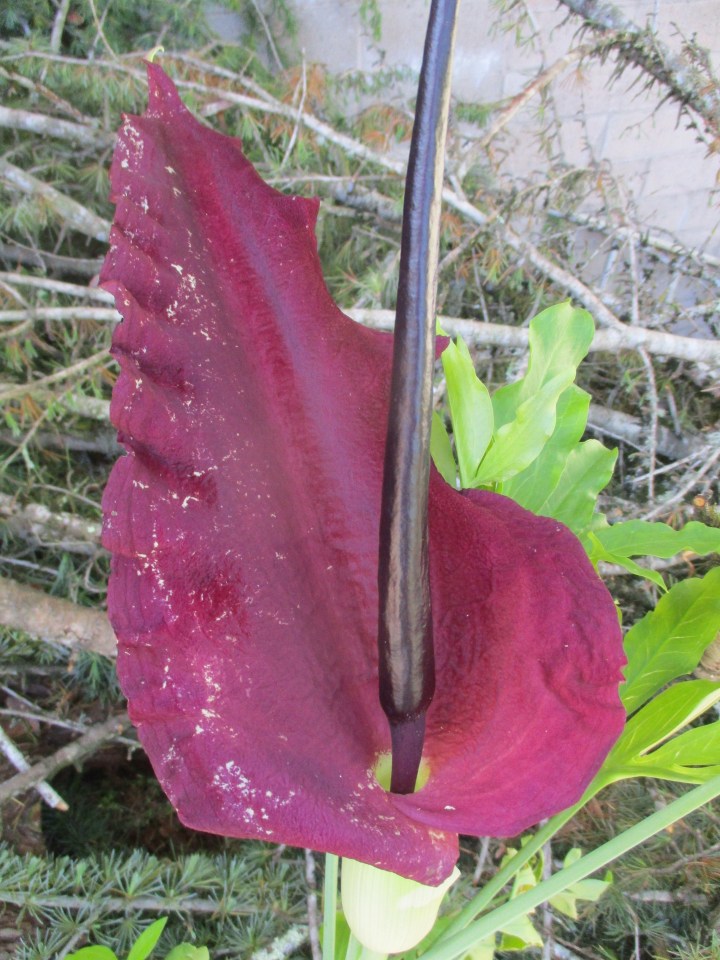
Dragon lily is striking and stinky.

Dracunculus vulgaris make a sinister impression by botanical name alone. Common names include dragon lily, dragon arum, dragonwort, black dragon, snake lily, stink lily and voodoo lily. That makes it sinister enough to be compelling. Although rare in nurseries, dormant tubers are available in season by mail order. Alternatively, established colonies happily share a few dormant tubers.

Dragon lily is quite easy to grow. It appreciates rich soil and regular watering, at least until it gets established. Once settled in, it might be satisfied with only monthly watering until it goes dormant in late summer. Because it prefers humid climates, it wants shelter from wind here, and may like a bit of partial afternoon shade. It is so adaptable that it unfortunately naturalized in some regions.

The fragrance of dragon lily attracts insect pollinators that are drawn to dead animals. Those of us who enjoy unusual plants find it amusing. Everyone else thinks it stinks. Blooms that produce the fragrance are spectacular, with a big and flared purplish red spathe around a slender black spadix. They may stand nearly three feet tall, among lightly blotched and deeply lobed palmate leaves.

Bedding Plants That Defy Seasons

00603thumb
Some seasonal annuals are really perennials.

Bedding plants that go into the garden in spring are generally warm season or summer annuals. They should perform through summer until the weather gets too cool for them the following autumn. Bedding plants that go into the garden in autumn are generally cool season or winter annuals. They should perform through winter until the weather gets too warm for them late the following spring.

That sounds simple enough. Each type of bedding plant performs best within a specified season. Since they are annuals, they complete their life cycles within a single season within a single year. Of course, it is not so simple here where seasons are as unique as they are. Winter is mild. Summer is arid. Some bedding plants that are annuals in harsher climates may survive as perennials.

For example, busy Lizzie and wax begonia are warm season annuals in most climates. They succumb to frost as weather cools in autumn. Locally, they can survive through winter if sheltered from mild frost. Any that survived through last winter can regenerate now. As bedding plants, they will not be as uniform as they were last year. However, their variability would be fine for mixed bedding.

If sheltered and warm enough, wax begonias may actually continue to perform right through winter. If they dislike the aridity of summer, they can even perform slightly better through winter than they do through summer. Their best performance is often about now and again in autumn, between the two extremes of summer and winter. They challenge their designation as a warm season annual.

Even some of the bedding plants that really are annuals may not behave as such. Alyssum and nasturtium can disperse seed to replace themselves before they finish. They are not true to type, so their progeny eventually revert. Nonetheless, simple yellow and orange nasturtium and white alyssum are splendid for many relaxed gardens. Nasturtium might perform better in summer or winter.

Bedding plants usually know more about what they should be doing than those who are managing and manipulating them.

Bugle Lily

50513
Bugle lilies are like lean gladioli.

It would be accurate to guess that bugle lily, Watsonia pyramidata, is related to gladiola. It is not as impressive as gladiola is, but it is much more reliable. The relatively simple blooms become more abundant as bulbs multiply each year. Conversely, after blooming so flamboyantly in their first year, only a few gladiola bloom for a second year.

New bugle lily bulbs (corms) that were planted early last autumn grew through winter to bloom about now, in white and pastel hues of pink, rosy pink, lavender, orange and almost red. The small flowers are neatly arranged on narrow floral spikes that stand about three or four feet tall. The upright and narrow leaves get only about two or three feet tall.

After bloom, foliage slowly browns through warming summer weather, so should be cut to the ground when it becomes unsightly. While bulbs are dormant through summer, they do not need to be watered much, and can rot if soil stays too damp. Crowded colonies of bulbs can be divided and spread around as summer ends.

Pacific Coast Iris

00429
Bigger and bolder Pacific Coast iris.

Various species of iris that are native to exposed coastal hillsides are uncommon in nurseries. Even nurseries that specialize in native species grow only a few. Iris douglasiana was probably the most popular of these years ago. Its slender flowers are various shades of steely blue, like faded denim. Nowadays, most Pacific Coast iris are hybrids of various native and a few exotic species.

The color range of these modern hybrids is impressive. Many bloom with rich shades of blue, purple, burgundy, rusty red, orange, gold, yellow or rosy pink. Softer and pastel shades include coral pink, lavender, creamy white and bright white. There is even sky blue that is almost comparable to the color of well faded denim. Flowers are more substantial than those of their ancestors though.

Bloom is sometimes significantly early, or as late as May. Otherwise, it should happen about now. Each floral stalk supports about two or three flowers that bloom in succession. Floral stalks tend to lean outward from the center of mature plants, and curve to hold their bloom upright. Bloom typically stands less than two feet high. Their slender and arching dark green leaves stay even lower.

Blue Spruce Stonecrop

50415-
This stonecrop seems to be coniferous.

It may not be as useful as those marketing it say it is, but blue spruce stonecrop, Sedum reflexum ‘Blue Spruce’ is a nice grayish component to pots of mixed perennials. It contrasts nicely with golden foliage, and looks great with the chartreuse foliage of closely related ‘Angelina’ stonecrop. The limber stems cascade a few inches over the edges of tall urns and hanging pots.

The succulent leaves are quite small, and as the name implies, look like plump blue spruce needles. The succulent stems do not stand much higher than six inches before flopping over. They do not get much wider than high initially, but have a sneaky way of rooting where they touch the ground to cover more area. Yellow flowers bloom just above the foliage in summer.

What blue spruce stonecrop does not do well is uniformly cover large areas of hard or dry soil. It can spread nicely, but is patchy, with thin spots and thick spots. It is really only reliable as ground cover over small areas. It prefers to be watered occasionally, even though it does not need much water. It also likes relatively loose or friable soil, even though it does not need rich soil.