If it appears to be related to burrow’s tail, it is because pork & beans is the same genus.
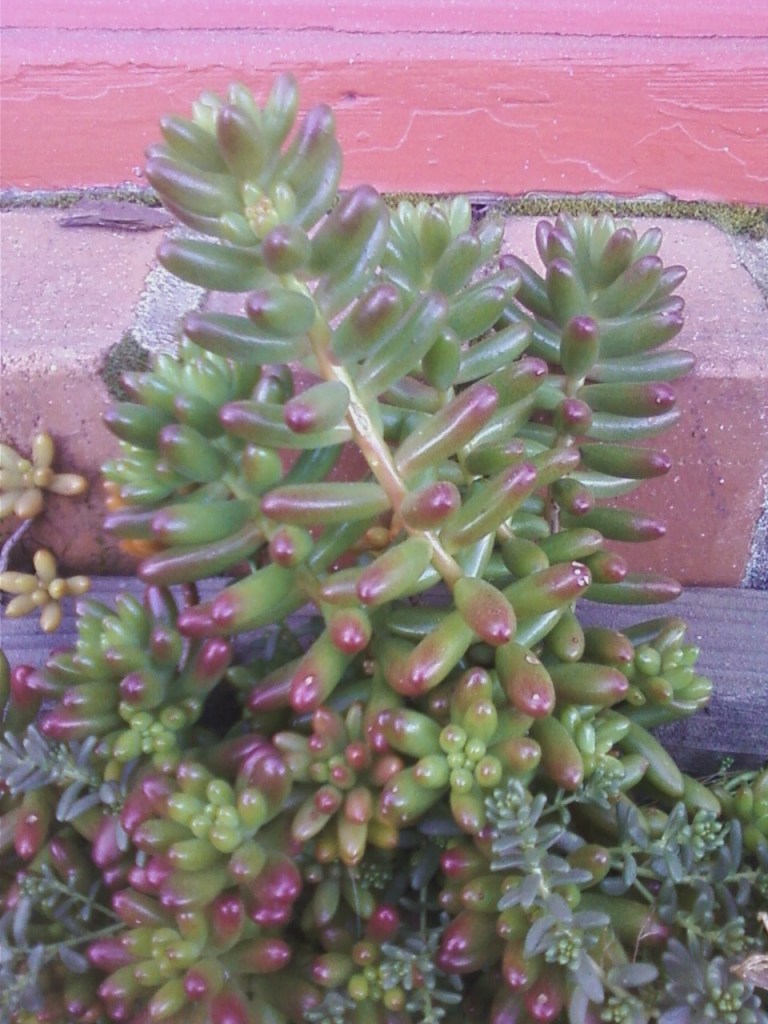
The tender succulent foliage of pork and beans, Sedum rubrotinctum, is as squishy as it appears to be, so is safest where it will not be disturbed. Although it sprawls around without getting much deeper than six inches, it does not fill in reliably enough to be a real ground cover over a large area anyway. It can instead add color and texture in small doses between larger plants or stones. It is a nice addition to urns of mixed perennials, rock gardens and dish gardens. It propagates very easily from stem cuttings or even leaves that break off, so can be tucked into gaps in stone walls.
The plump three quarter inch long leaves resemble jelly beans more than pork and beans, since they are green where shaded. More exposed foliage is more bronzy red or brown, especially at the tips. Small clusters of tiny yellowish flowers are held above the foliage on reddish brown stems in spring.
Strelitzia nicolai, is giant bird of Paradise. Unlike the more familiar bird of Paradise, with basal foliage and its distinctive orange flowers, this species develops several tall trunks and less colorful but interestingly large white flowers. We recycled several into one of the landscapes here from a home garden in Morgan Hill about two years ago. Originally, they were three somewhat mature groups, with rather tall trunks. Then, they were divided into individual trunks and pups. Ultimately about sixteen were installed into the landscape, with a few spare pups canned as spares, just in case some of the others do not recover from their division. I predicted that those with tall trunks would not last long before replacing themselves with basal growth, and then shedding their unusually tall trunks. Not only are they not developing basal growth yet, but their upper foliage on top of their lanky tall trunks is actually growing and developing into new foliar canopies. They sort of look like silly palm trees that are getting less silly as they continue to grow. I mean that they actually look rather appealing, and probably look more appealing to those who do not know what they should look like. They seem to be pretending to be faux palm trees. I can do nothing about their behavior, and even if I could, I would not. I want to see what they do next. I suspect that they will eventually perform as expected. I also suspect that, because they are already so tall, that, for as long as they retain it, their upper foliage will never be as lush as it would be if lower. That is normal for the species, and how those who maintain such specimens know when to cull the taller trunks by cutting them to the ground.
Coral bell foliage is as pretty as its delicate flowers for which it is named.
Even though their delicate trusses of tiny hanging flowers on one or two foot tall wiry stems make good cut flowers and attract hummingbirds in spring and early summer, coral bells, Heuchera micrantha, is more often grown for its colorful foliage. Contrary to their common name, the flowers (of this species) are more often pale or greenish white anyway. Their foliage can be all sorts of shades of green, gold, tan, brown, bronze, and purplish. The rounded and lobed leaves have somewhat raspy tomentum (hairs) and can be about two and a half inches wide. ‘Ruffles’ has more ruffled and deeply lobed leaves. ‘Palace Purple’ is a very popular cultivar with distinctive deep bronze or purplish foliage.
Mature plants can be divided in spring to make more plants every few years or so. Where protected from frost, division can be done in late autumn. Coral bells can also be propagated by cuttings. Rich soil and good exposure are preferred; but partial shade is best in warm spots.
Such silvery foliage contrasts exquisitely with bronze foliage.
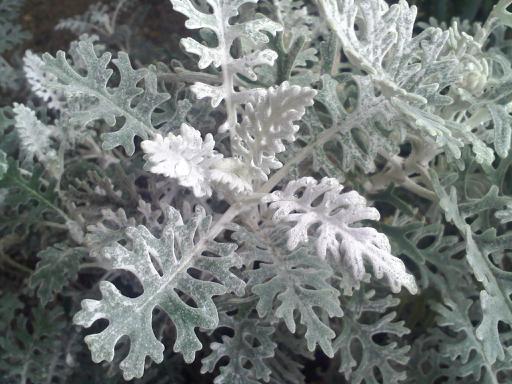
The relaxed trusses of small yellow composite (daisy-like) flowers of dusty miller, Senecio cineraria, can bloom at any time except when winter gets too cold. They are still blooming now. Yet, who cares? Dusty miller is grown more for its fuzzy white foliage than for bloom. It actually looks best and fluffier if occasionally shorn and pruned to remove blooming stems before they bloom. Individual leaves are intricately lobed. Mature plants get taller and wider than two feet. Dusty miller likes full sun exposure, good drainage and moderate water. Too much water causes rot and discoloration.
Where winters are too cool or damp for much else to bloom, hellebore are more popular. The most popular are Helleborus X hybridus, which are hybrids of a few similar species. Most are direct descendants of Helleborus orientalis. They are more resilient to frost than to arid warmth during summer. Actually, that is very likely why they are less popular here.
Locally, hellebore are useful for cool, damp or partly shady situations. However, they are not as substantial as ferns. Also, they can get a bit wimpy as the weather warms through summer. Although evergreen, they shed some of their older yellowing foliage. They grow most during late autumn, winter and perhaps early spring. They crave richly organic soil.
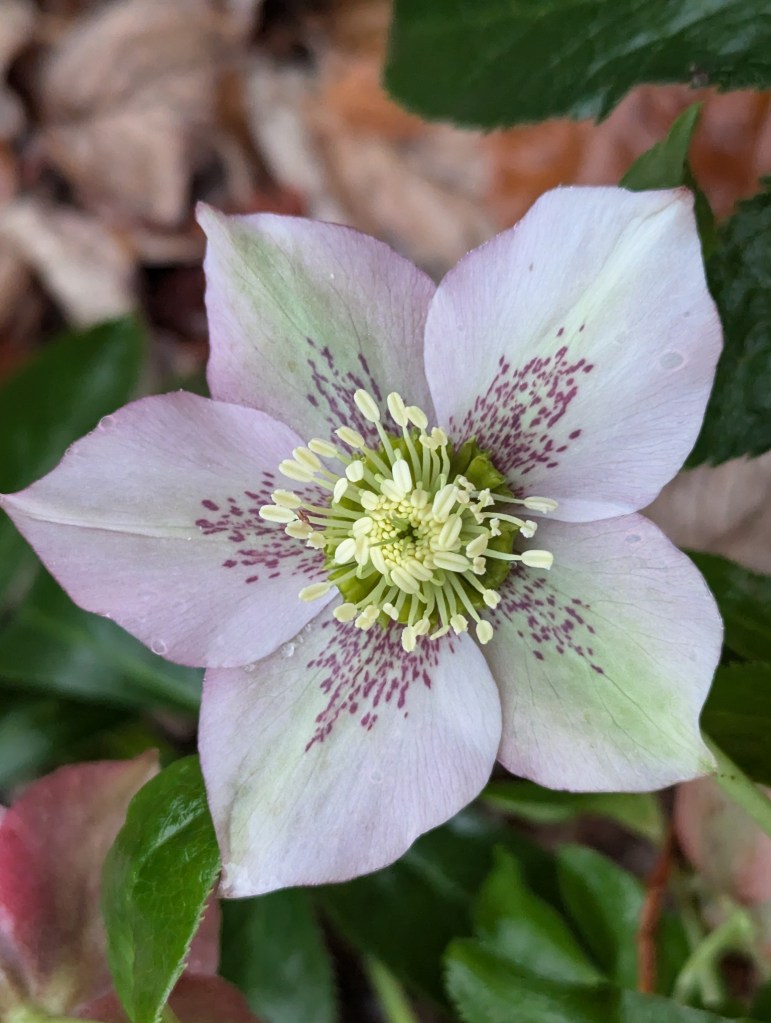
Floral color is typically subdued but interesting. Most common hellebore flowers are pale pink or almost grayish white with spots. Alternatively, they can be rusty red, maroon, pale green, yellow, gray or almost black. Some exhibit more or less spots, blotches, stripes or picotee edges. Double flowers are rufflier than single flowers are. All hellebore are toxic, and for some, can cause dermatitis.
From spring until autumn, semperflorens begonia, which is also known as fibrous, bedding or wax, begonia, is a warm season annual. They actually start to deteriorate as the weather gets cool this time of year. However, they do not necessarily need to be pulled out as their season ends. In sheltered locations or with protection from frost, they actually survive through winter as perennials. They are so easy to propagate by cuttings or division of overgrown plants that tired older plants can replace themselves with their own babies before they get too ugly.
The small flowers of semperflorens begonia can be white, red, or various shades of pink in between. Foliage is more often green or bronze, but can be reddish or variegated. The largest plants get only a foot tall. Denser dwarf types are half as tall. Semperflorens begonia likes rich soil and regular watering (when it is not raining). They prefer partial shade, but will take full sun if mixed with other plants that keep things cool and humid.
Begonia boliviensis ‘Santa Cruz’ is significantly bigger than it was when I wrote about it three months ago. If I had known that it would have performed so well, I would have groomed it for better form. It grew upright at first. I just let it do so because I wanted to make a cutting from the tip when it got pruned back. However, because it leaned over and branched as it should, it did not get pruned back. It could have developed a better and lower form if I had tended to it better, but I am too pleased with it now to complain that it is a bit more upright than it should be. I do not mind that I did not get a cutting from the primary stem that I did not cut back because there are now many more stems that I can get cuttings from, simply be grooming out a small bit of superfluous growth from within. I could get many more than I want if I were to actually prune this specimen back for winter. It is getting to be too exemplary to cut back for winter, though. Nor do I want to leave it out to get frosted, as I might do with other begonias. The horticulturist who procured it will shelter it from frost, and perhaps groom it a bit after winter, but otherwise try to retain as much of this growth as possible for a head start next spring. I am curious to see what it does. Will it shed most of this growth as it resumes growth from below next spring; or will it grow from near the tips of where it stopped growing this year? I did not expect to be so impressed by this modern cultivar of Begonia.
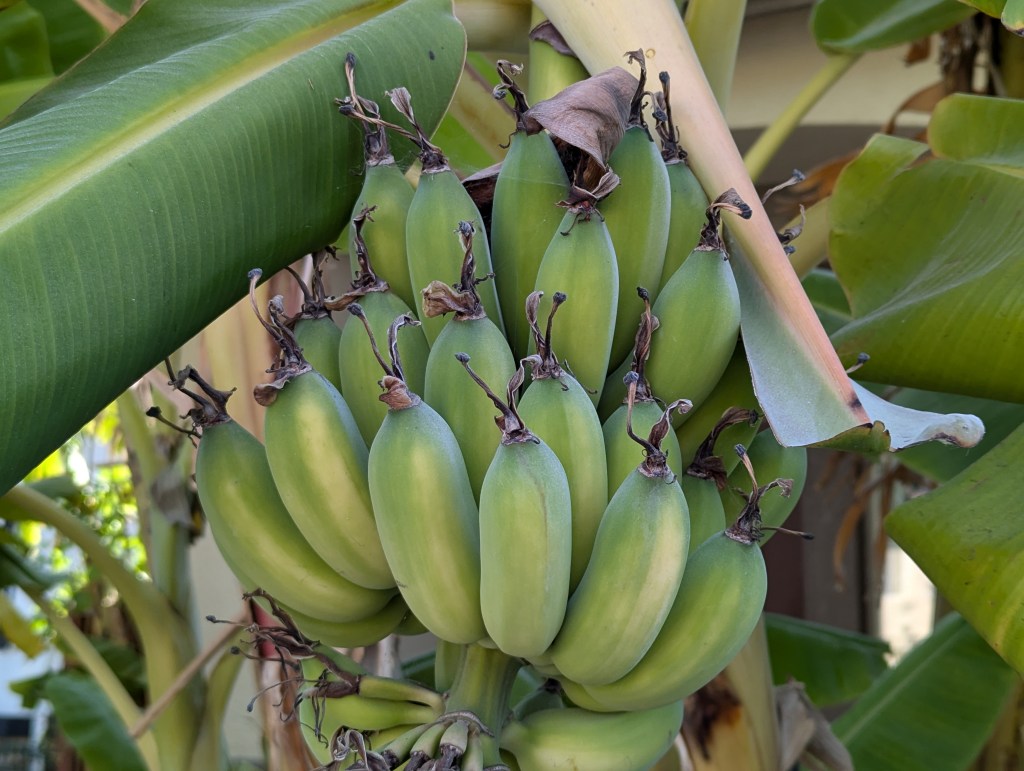
Karpooravalli bananas after removal of their edible male flowers below.
Pronunciation is only slightly easier than when I first tried to read it. Spelling still necessitates cheating, which I do not feel at all guilty about. Karpooravalli is a big name! I must get acquainted with it though, since it will likely be with me for the rest of my life.
Yes, it is another cultivar of banana, which is something else that I do not feel at all guilty about. I have no intention of retaining all of the other twenty or so cultivars that are already here. In the future, I will likely give away most of them to colleagues, without retaining pups. I actually already have plans to install at work the two that are least likely to produce edible fruit, and never grow either in my own garden again.
Karpooravalli banana pups
These four new pups of Karpooravalli arrived last Monday, just two days after eight unidentified pupping pups and a single pup of ‘Blue Java’ which is also known as the ‘Ice Cream’ banana. Like these previously most recent acquisitions, as well as another ‘Blue Java’ pup and another unidentified pup that were acquired together last year, these four pups of Karpooravalli are from a private garden. All of the other cultivars here are from nurseries, and most were tissue culture plugs that never actually grew in soil.
That is the dilemma. Cultivars from nurseries are expendable. I can give them away without retaining any copies and not miss them. However, cultivars from private gardens have history, even if I am unaware of it. They are important to someone.
I can give away the recently acquired pup of ‘Blue Java’ only because another pup of it from another important source is already established here, and I knew when I took it that it would not be staying. Also, I can give away almost all of the other unidentified pups that came with it because there are already too many to retain. However, I will retain at least one of them because I know that the cultivar was important to the person who shared it. Likewise, I will retain my first copy of ‘Blue Java’ and the unidentified pup that came with it because they are important to the person who shared them.
Karpooravalli is fortunately one of the more reliably productive cultivars here, and provides sweet fruit with remarkably rich flavor. It is gratifying to know this now because I will grow it for as long as I can tend the garden. This particular Karpooravalli is very important to the person who grew it in her garden for a few decades before sharing it with me, so it is important to me now. I know that I will eventually need to share it with others as it multiplies in the future, but I will prefer to share it with those who respect its importance.
Before I was in kindergarten, I acquired my rhubarb from my paternal paternal great grandfather, and my Dalmatian iris from my maternal maternal great grandmother. Both are growing well in my garden now, and always will. I acquired my common lily of the Nile and the first of my common zonal geranium a few years later. Much of what inhabits my garden now has been with me for many years. Yet, I acquired my first Japanese iris, persicaria and goldenrod as recently as late last winter from Tangly Cottage Gardening. Perhaps it is never too late to start another important tradition.
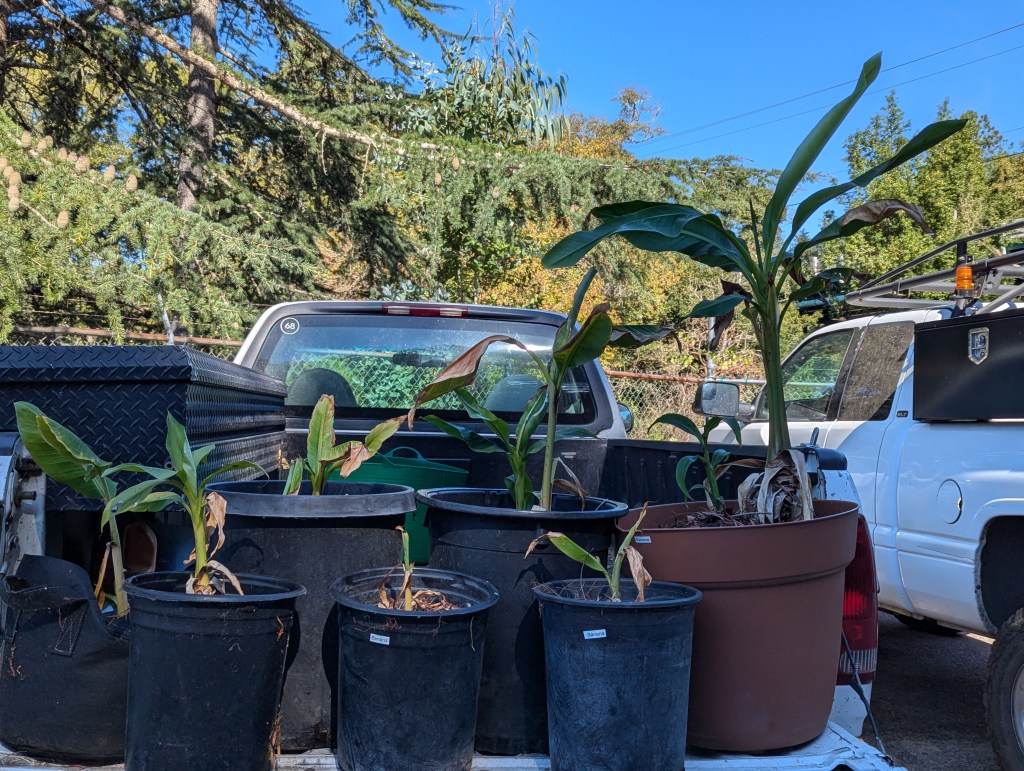
Yes! We have more bananas! I can explain. Although there are as many as twenty cultivars of banana here, almost all are individual pups or tissue culture plugs. (Of these twenty, three are unidentified. Of these three, one is likely a redundant copy of one of the other cultivars, one seems to be completely necrotic without possibility of recovery, and only one is notably distinct.) All but a few arrived earlier this year, so have not yet generated pups. ‘Double Mahoi’ has doubled by generating a single pup. ‘Golden Rhino Horn’ arrived as a pair, and one of the pair is only now beginning to generate another pair of pups. Otherwise, there are no spare pups to share. The only spare pups of ‘Double Mahoi’ and ‘Golden Rhino Horn’ (the one which lacks new pups) may be leaving in the next few days. Whatever remains of these two will most certainly go to another colleague at the end of winter. Another colleague would like to add any spares, regardless of cultivar, to his garden. However, until just now, I could not help in that endeavor. The few in the picture above just arrived from Gilroy because they were in need of a new home. The pup to the far left is ‘Blue Java’, which is also known as ‘Ice Cream’, is redundant to a copy that is already here, so can be shared with a colleague. The others, which are sufficiently numerous for all of us to get copies, are unidentified, which merely means that if they produce fruit, it will be a surprise. Even if their fruit is not palatable, their foliage is good for forage and compost. For the colleague who would like to add any spares regardless of cultivar, they can live in a riparian area of his garden that is too steep, damp and shady for gardening. These pups may not look like much in the picture, but their corms are quite plump, so will provide an abundance of foliage after they get into the ground and the weather warms after winter. Soon afterward, they will generate more pups, but we can worry about that later.
Sniveling works! Perhaps I should say that it can potentially be effective, and is sometimes more effective than expected. I certainly do not want to make the impression that I recommend it. Nonetheless, and contrary to the typical ‘Horridculture’ theme for Wednesdays, I can not deny recent favorable developments that, although not direct results of my snivelling about my lack of a white Japanese anemone, Anemone (or Eriocapitella) hupehensis, two weeks ago, somehow seem to be relevant to it. Firstly, someone at work brought me a pair of copies of an unidentified cultivar of Japanese anemone that is described as being very similar to that which is already here, with slightly pinkish pale gray bloom. Although not the right color, it is the right species. I intend to grow both the new and the old, and even if they are indistinguishable from each other, will continue to grow both because of their different but important origins. Secondly, a new landscape at a new home in the neighborhood includes several specimens of the most enviable and splendidly white ‘Honorine Jobert’ Japanese anemone! Those installing the landscape are completely unaware of the significance, and, as might be expected from such ‘landscapers’, actually told me that these Japanese anemones are the native bush anemone, Carpenteria californica. Why argue? I now know where I can get copies of ‘Honorine Jobert’ Japanese anemone after it has grown through next year. The other horticulturist here is acquainted with those who will live at the new home seasonally, so will have no problem procuring copies for me. As I intended to do with all of the now overly abundant canna and bearded iris, I plan to limit the number of cultivars of Japanese anemone to the original that was already here, the recent gift that might be the same as the original, and the ‘Honorine Jobert’ that I have yet to acquire.