Historic Bloom

‘Stuttgart’ Canna to the left and an unidentified tall Canna with red bloom and green foliage to the right

It is not as important as it sounds. Two varieties of Canna bloomed for the first time here during the past few weeks. They are important only to me because of their origins. With very few exceptions, such as the still elusive ‘San Jose’ bearded iris, I do not pursue rare or unusual species, varieties or cultivars. Actually, most of my favorites are quite common, and most that are rare here are common where they came from. I obtained some from places I have travelled to. Most were gifts from friends, neighbors and colleagues. The Canna to the left is ‘Stuttgart’ from Tangly Cottage Gardening. This is its second season here, but it did not bloom successfully before autumn chill last year. It is the second of three different Canna musifolia here. The first has moderately bronzed foliage. The third has simple green foliage. ‘Stuttgart’ has the most distinctive foliage that is variegated with variable white bands. All three bloom with similarly subdued and pastel orange flowers, but for this first bloom, ‘Stuttgart’ is blooming with a bit more peachy pink. The Canna to the right was a gift from a friend of a friend last winter. It is the third red Canna here, but the first is an unidentified compact cultivar that gets only about half as tall with garishly big flowers, and the second is ‘Australia’ with darkly bronzed foliage. This new unidentified cultivar is quite tall with simple green foliage, which is actually what I prefer for my own garden. (Although, I like the short cultivar also because it has been here longer than anyone can remember; and I like ‘Australia’ because everyone else likes the impressively darkly bronzed foliar color. Furthermore, I like the moderately bronzed Canna musifolia because it has also been here for a very long time; and I like the simple green Canna musifolia because it was a gift from a neighbor, and it is the biggest Canna here.)
Campanula

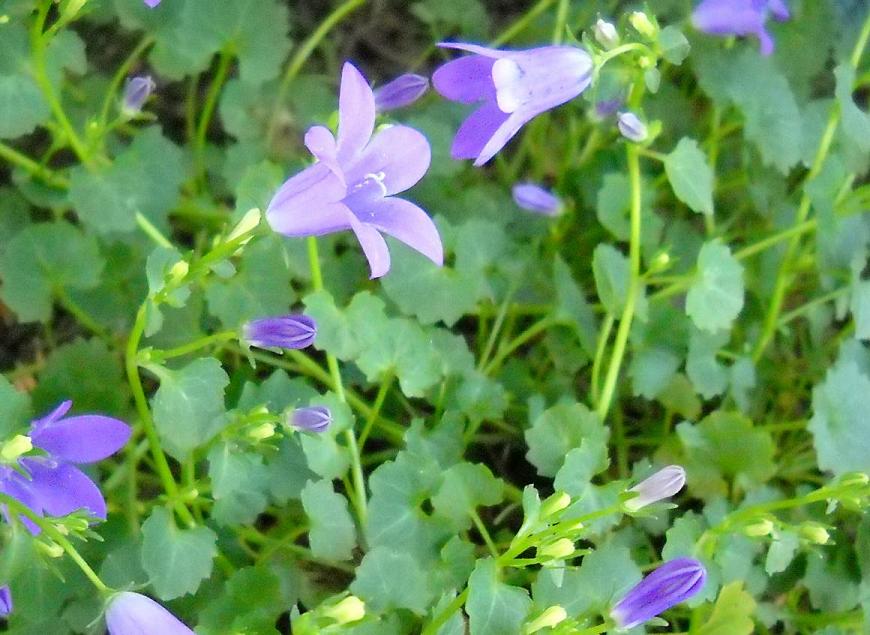
Many home garden Campanula are easier to identify by cultivar name than by species.

Of the hundreds of varied Campanula (Campanula spp.) that can be found in the wild, almost all of the few grown in gardens are small scale ground covers or creeping perennials, with blue or white bell or star shaped flowers. Most campanula fill in nicely between clumping perennials, and will spread wherever they have other plants or features to shelter them, although they are rarely reliable as ground cover for exposed areas. Campanula can be grown from seed, but is easiest to propagate by division. Pieces trimmed off from around the edges or pulled out of shrubbery also root very easily.

See Anemone

Anemone hupehensis

Japanese anemone, Anemone hupehensis, which is now Eriocapitella hupehensis, is one of several species that I had been wanting to grow for a very long time. Like peony, goldenrod, Joe Pye weed, Indian paintbrush, beautyberry and fancy hybrids of clematis, they are prominent features of fancier gardens in other regions. Some of such species do not perform well here. Others are merely unpopular, but might perform well here if they get the chance. I see them all only in pictures, so can not distinguish what their respective situations are. The only anemones that I had ever encountered while young were sea anemones on nearby beaches. In college, I met poppy anemones, which we know merely as anemone, but found that they are not as reliably perennial as they are purported to be. Japanese anemone had been elusive, until I met a very established and perhaps invasive colony of it in an old landscape near Oakland less than fifteen years ago. I figured that if it can be as happy as it was in a relatively coastal climate, it could be happier here with a bit more chill during winter. Until then, I assumed that minimal chill was a limiting factor to their performance here. ‘Honorine Jobert’ seemed to be the epitome of single white Japanese anemone, but I had not seen any white cultivars, even those with double flowers, that were not alluring. Then, I discovered an unidentified cultivar of Japanese anemone on the edge of a rose garden here. It survives as a remnant of a preceding perennial garden, but does not perform well now that redwood roots have become so aggressive. Furthermore, its floral color is unimpressive. It is not white, but is not quite pink either. Heck, it is not even white blushed with pink. I do not know how to describe it. Initially, it seemed to be only slightly pinkish pale gray. Ick! This year, it seems to be slightly more pinkish than it had been, which makes it slightly less disappointing. However, now that I know it is here, I will not try any other Japanese anemone until I at least try to grow this one well. I am confident that if I relocate bits of it to a garden where it does not need to compete with other vegetation, it will bloom with a more appealing shade of pink. I will not mind that it is not white if it does that much. Then, if it can perform well, I will know that I can grow a white cultivar of anemone also. There is no rush though. Although white happens to be my favorite color, and Japanese anemone happens to excel at white, pink can be appealing also. This is my very first Japanese anemone, and regardless of how unimpressive it is now, I am pleased with it.

Bedding Dahlia

Bedding dahlias can perform as perennials.

Dahlias are as variable as related chrysanthemums. Rare tree dahlias can grow ten feet tall from the ground annually. Most popular dahlias grow less than half as high with more lavish bloom. Bedding dahlias are less than a foot and a half tall with smaller but profuse flowers. They are popular as warm season annuals, but can be perennial like the others.

Bedding dahlias are neither as ornate nor as diverse as those that are better cut flowers. They compensate with foliar density and floral profusion. Their flowers are less than five inches wide, and could be about half as wide. Their floral color range is limited to yellow, orange, red, pink and white. Floral variegation can add another color of the same range.

Bloom continues through summer and autumn, until frost. Deadheading promotes better bloom. Dormant tubers may remain in their gardens through winters here. They could rot, though, while their soil remains cool and damp. If dug and stored for winter, they prefer to return to their gardens prior to spring warmth. Dormant tubers propagate well by division.

Blue Marguerite

Not many flowers are as blue as blue marguerite is.

            Like all sorts of daisies, gazanias, ice plants and so many of the familiar flowers in the Compositae family, blue marguerite, Felicia amelloides, is endemic to South Africa. Their flowers are the colors of the flag of Sweden though, with clear blue petals around bright yellow centers. These inch wide or slightly wider flowers bloom on well groomed plants most of the time, except during cool weather. Plants that do not get dead headed (groomed of deteriorating flowers) take breaks between bloom phases. The simple inch long leaves seem to be glossy, but almost have the texture of a cat’s tongue.    

            Mature plants may be taller than a foot and broader than four feet. Their somewhat woody stems are not as substantial as they should be, so can break easily, leaving awkward holes in otherwise well rounded shrubs. Unfortunately, the healthiest plants may live for only a few years. Distressed plants actually last a bit longer. Aggressive pruning at the end of summer or just before spring can restore old deteriorating plants for a while.

            Blue marguerite likes well drained soil, good sun exposure and somewhat regular watering. It is most often used as a colorful and shapely perennial, but is colorful enough for pots and urns of mixed perennials or annuals.

Sustainability Sometimes Needs Help

Some perennials naturally last longer than others.

            As much as I like to remind everyone of how easy it is to perpetuate many of their perennials for ever, and to share with their friends, neighbors, children, grandchildren, great grandchildren and so on, there are just some perennials that are not meant to last. I do not mean that they can not last; only that they are not as easy to sustain as others are. For most of these not so easy to sustain perennials, the original plants actually die completely, so will only be sustainable if replacement copies are propagated by cuttings or layers before the demise.

             Many of the very easy to grow daisies and daisy relatives are actually not as self sustaining as they should be. Clumping gazanias can actually rot out in the middle after a few years. Before this happens, it is rather easy to propagate replacement plants from division of mature clumps, or to take small cuttings, even though clumping gazanias do not often need to be pruned. Alternatively, side shoots can be layered (pressed into the soil to form roots) right next to parent clumps. Only a few replacements are necessary, but without them, clumping gazanias eventually die out.  

            Even trailing gazanias can eventually die out. Because they sometimes need to be pruned around the edges, there is a regular supply of material to make cuttings to patch bald spots. To get bigger cuttings, I actually like to delay edging until the plants look shabbier than they should around the edges; but my neighbors do not mind. (At least they do not tell me if they mind.)

            Shrubby marguerite daisies (not blue marguerites) and euryops likewise need to be replaced every few years. If there is enough space, outer stems that lay on the ground can be layered. It is best to bury each layered stem in a small hole, and then hold it down with a stone or brick. The layered plants may not be so symmetrical when the parent plants die out, but should fill out nicely. The fourteen euryops in the long park-strip in front of my home did not have enough space for layering, so died a slow, miserable and unsightly death until I finally removed them. If I had planned better, I would have taken cuttings to replace them.

            It is a surprise when pink breath of Heaven (Coleonema or Diosma pulchrum) or coyote brush dies suddenly, because they are really woody shrubs. (Although coyote brush is actually of the family Compositae like gazanias and daisies, etc.) Various ceanothus live longer, but not much longer. These woody shrubs are not so easy to layer, and quite difficult to root from cuttings, so often get replaced with new plants from the nursery, or different plants.  

Four O’Clock

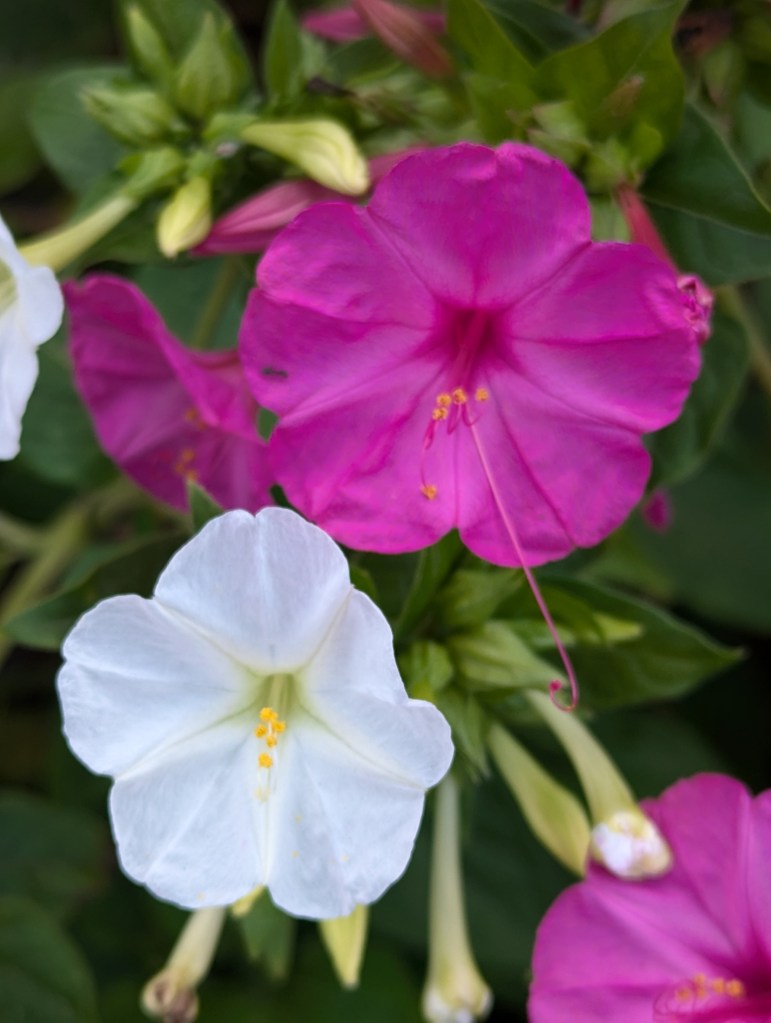
Two colors on one four o’clock.

Punctuality is not one of its primary attributes. Four o’clock, Mirabilis jalapa, is supposed to unfurl its flowers about four o’clock. It is more likely to do so a bit later here because of aridity. Flowers can remain open and mildly fragrant all night, but might close after about noon. Four o’clock grows vigorously with summer warmth, but also appreciates humidity.

Floral color ranges through various hues of pink, red, orange, yellow and white. Flowers commonly exhibit stripes, spots or patches of other color within this range. Flowers with completely different colors can bloom on the same stems. Simple bright pink flowers are typically the most fragrant. Other colors and mixed colors may lack fragrance completely.

Most four o’clock grow in their gardens without invitation. They sneak in as seed, but are too pretty to be weeds. They grow tuberous roots to overwinter as their foliage and stems later succumb to chill. Stems do not stand much more than three feet tall, but may sprawl twice as wide. Below their lush foliage, these lanky stems are vulnerable to disturbance and wind.

Six on Saturday: More About This Later

Brevity is not always easy with Six on Saturday. I might elaborate on some of these later. There is no common theme. These are merely six random pictures from last week.

1. Sambucus nigra ‘Black Lace’ European black elderberry got ‘Madonna’ as a pollinator only this year. ‘Madonna’ will not bloom until next year. ‘Black Lace’ makes a few berries anyway. I hope that they are prettier when more abundant. I can elaborate about it later.

2. Amaryllis belladonna, naked lady is demonstrating is preference for sunny exposure. This row of bulbs extends from left to right across this picture, but blooms only half way, with no transition to where bulbs are too shaded to bloom. I can elaborate about it later.

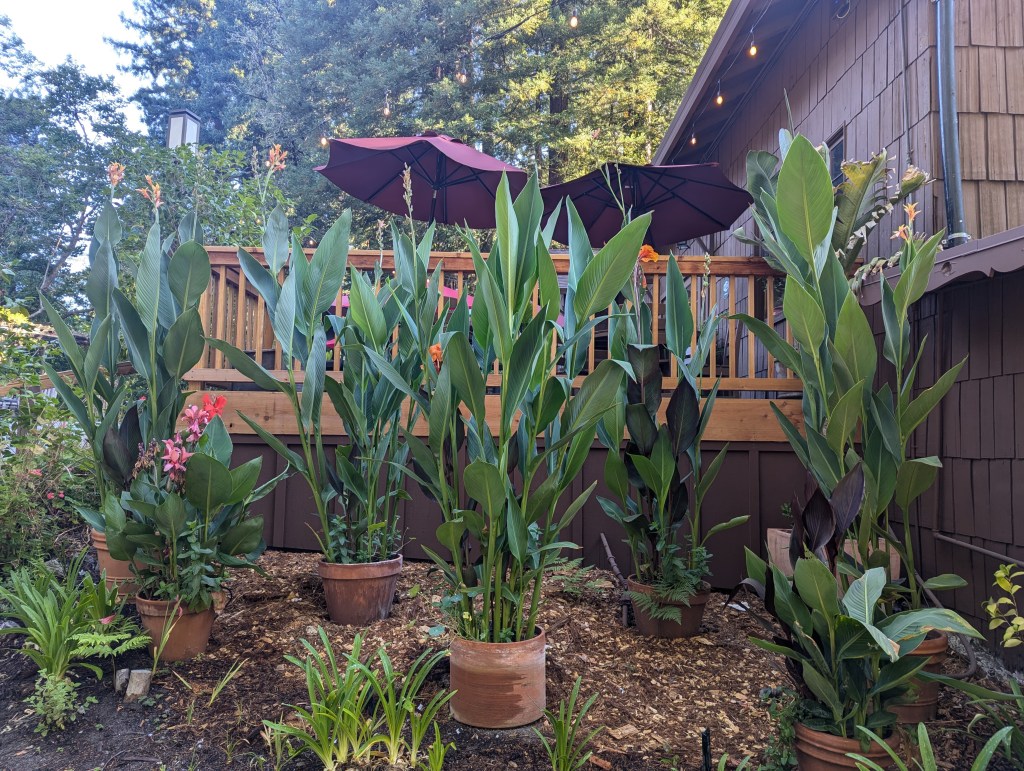
3. Canna musifolia, canna, which has been very fun to grow, was a gift from a neighbor, but not practical for our landscapes. These, with a few fancier cultivars, were potted here temporarily until a new landscape develops this autumn. They earn many compliments.

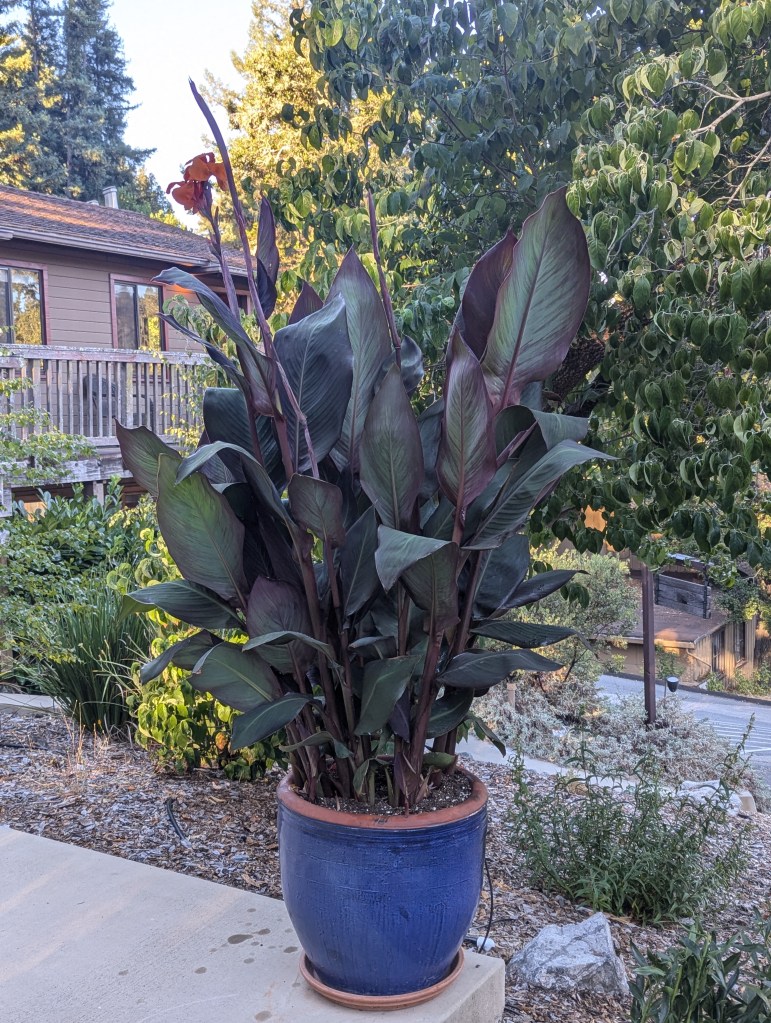
4. Canna X generalis ‘Inferno’ canna arrived with Canna musifolia. I think that it looks like ‘Wyoming’. Without a plan, we put this specimen into this ugly cobalt blue pot from a very dead Ficus benjamina houseplant that someone left for us, and now it looks RAD!

5. Hymenocallis festalis, Peruvian daffodil had been in the nursery for too long when we finally put all ten into three landscapes shortly before bloom. It is supposedly as reliably perennial as some of the more reliable types of Crinum. If so, it should be more popular.

6. Dahlia ‘Tabasco’ dahlia was purchased as a bedding dahlia, which implied that it is as disposable as annuals. However, this is its third season. It was originally red with orange stripes. Then, it was yellow with orange blotches. Now, it is this delightfully simpler red.

This is the link for Six on Saturday, for anyone else who would like to participate: https://thepropagatorblog.wordpress.com/2017/09/18/six-on-saturday-a-participant-guide/

Bromeliads Are . . . Weird.

Tillandsias, to the left and right, as well as Spanish moss, which hangs downward throughout, are types of bromeliads.

After certain botany classes, some of my Cal Poly colleagues and I found it difficult to enjoy eating certain fruits and vegetables like we did previously. Simple things like pineapples, figs, potatoes and Brussels’s sprouts were much less appealing, or even unappealing, once we discovered what they really are. Yet, we also gained a bit more respect for these seemingly weird plants. Even though their adaptations do not always make sense to us, and some adaptations are a bit outdated by a few thousand centuries, or much more, many plants are remarkably adapted to their particular situations within their natural environments.      

Pineapple is still one of my less favorite ‘fruit’. However, the related bromeliads, of the family Bromeliaceae, are fascinating. Almost all are ‘stemless perennials’ with basal rosettes of foliage. (Their ‘stems’ are actually out of sight below their foliage.) Most are epiphytes that live within the canopies of larger trees or on exposed rock formations, sustained by whatever organic matter that happens to fall onto them from above. They are consequently very well adapted to confinement in pots, so can be quite happy as houseplants. A few bromeliads that live in deserts or other comparably harsh environments actually resemble yuccas.

Some people like to water large bromeliads  in the ‘reservoirs’ formed by the densely set leaves at the middles of the foliar rosettes. In the wild, these reservoirs naturally collect rainwater to use during drier weather. Bromeliads can either absorb moisture directly from their reservoirs through their leaves, or they release some of the water between their foliage to their roots below as their leaves lose turgidity (wilt slightly) because of a lack of rainfall or humidity. Either way, bromeliads really know how to conserve and ration water accordingly.

Many bromeliads are appreciated for their unusually colorful and often strangely textured foliage. Many have very interesting or downright strange flowers that mostly stand high above their foliage. The flashiest bromeliads have all of the above ; oddly textured and colorful foliage with interesting flower trusses outfitted with bracts (modified leaves that adorn flowers) that are so colorful that it is difficult to know where the foliage ends and the flowers begin.   

Garden Verbena

Garden verbena sort of resembles lantana, with more variety of color.

When I first saw ‘Peaches ‘N Cream’ garden verbena, Verbena X hybrida, that was trendy in the early 1990’s, I thought that the variable shades of pale pink and nearly white of its flowers were too dull. Then I saw the flashy bright red, purple, blue and fluorescent pink of other modern varieties at the time, and gained a new appreciation for the more subdued color range, including white and more ‘normal’ pink. The flower color range may not be very extensive, but it is diverse.

Even though it is commonly grown as an annual, garden verbena is actually a short term perennial. It is a traditional component of mixed flower urns and planter boxes, but does not necessarily need to be replaced along with other annuals. Like English ivy and ferns that are so often planted with annuals, garden verbena can be salvaged, at least for a few seasons, as annuals come and go. It looks good in hanging pots or large urns where its slightly cascading form can be appreciated. In good soil, garden verbena can become a colorful small scale ground cover.

Mature plants do not get much more than six inches deep or two feet wide. Their coarsely dentate leaves are about two inches long. Their flat, two inch wide trusses of small flowers bloom mostly in summer. Hard pruning at the end of winter helps restore plants in spring, and keeps plants healthy longer. Mildew can become a problem in humid areas, particularly if air circulation is inhibited by crowded foliage.