Bromeliads Are . . . Weird.

Tillandsias, to the left and right, as well as Spanish moss, which hangs downward throughout, are types of bromeliads.

After certain botany classes, some of my Cal Poly colleagues and I found it difficult to enjoy eating certain fruits and vegetables like we did previously. Simple things like pineapples, figs, potatoes and Brussels’s sprouts were much less appealing, or even unappealing, once we discovered what they really are. Yet, we also gained a bit more respect for these seemingly weird plants. Even though their adaptations do not always make sense to us, and some adaptations are a bit outdated by a few thousand centuries, or much more, many plants are remarkably adapted to their particular situations within their natural environments.      

Pineapple is still one of my less favorite ‘fruit’. However, the related bromeliads, of the family Bromeliaceae, are fascinating. Almost all are ‘stemless perennials’ with basal rosettes of foliage. (Their ‘stems’ are actually out of sight below their foliage.) Most are epiphytes that live within the canopies of larger trees or on exposed rock formations, sustained by whatever organic matter that happens to fall onto them from above. They are consequently very well adapted to confinement in pots, so can be quite happy as houseplants. A few bromeliads that live in deserts or other comparably harsh environments actually resemble yuccas.

Some people like to water large bromeliads  in the ‘reservoirs’ formed by the densely set leaves at the middles of the foliar rosettes. In the wild, these reservoirs naturally collect rainwater to use during drier weather. Bromeliads can either absorb moisture directly from their reservoirs through their leaves, or they release some of the water between their foliage to their roots below as their leaves lose turgidity (wilt slightly) because of a lack of rainfall or humidity. Either way, bromeliads really know how to conserve and ration water accordingly.

Many bromeliads are appreciated for their unusually colorful and often strangely textured foliage. Many have very interesting or downright strange flowers that mostly stand high above their foliage. The flashiest bromeliads have all of the above ; oddly textured and colorful foliage with interesting flower trusses outfitted with bracts (modified leaves that adorn flowers) that are so colorful that it is difficult to know where the foliage ends and the flowers begin.   

Garden Verbena

Garden verbena sort of resembles lantana, with more variety of color.

When I first saw ‘Peaches ‘N Cream’ garden verbena, Verbena X hybrida, that was trendy in the early 1990’s, I thought that the variable shades of pale pink and nearly white of its flowers were too dull. Then I saw the flashy bright red, purple, blue and fluorescent pink of other modern varieties at the time, and gained a new appreciation for the more subdued color range, including white and more ‘normal’ pink. The flower color range may not be very extensive, but it is diverse.

Even though it is commonly grown as an annual, garden verbena is actually a short term perennial. It is a traditional component of mixed flower urns and planter boxes, but does not necessarily need to be replaced along with other annuals. Like English ivy and ferns that are so often planted with annuals, garden verbena can be salvaged, at least for a few seasons, as annuals come and go. It looks good in hanging pots or large urns where its slightly cascading form can be appreciated. In good soil, garden verbena can become a colorful small scale ground cover.

Mature plants do not get much more than six inches deep or two feet wide. Their coarsely dentate leaves are about two inches long. Their flat, two inch wide trusses of small flowers bloom mostly in summer. Hard pruning at the end of winter helps restore plants in spring, and keeps plants healthy longer. Mildew can become a problem in humid areas, particularly if air circulation is inhibited by crowded foliage.

4:00

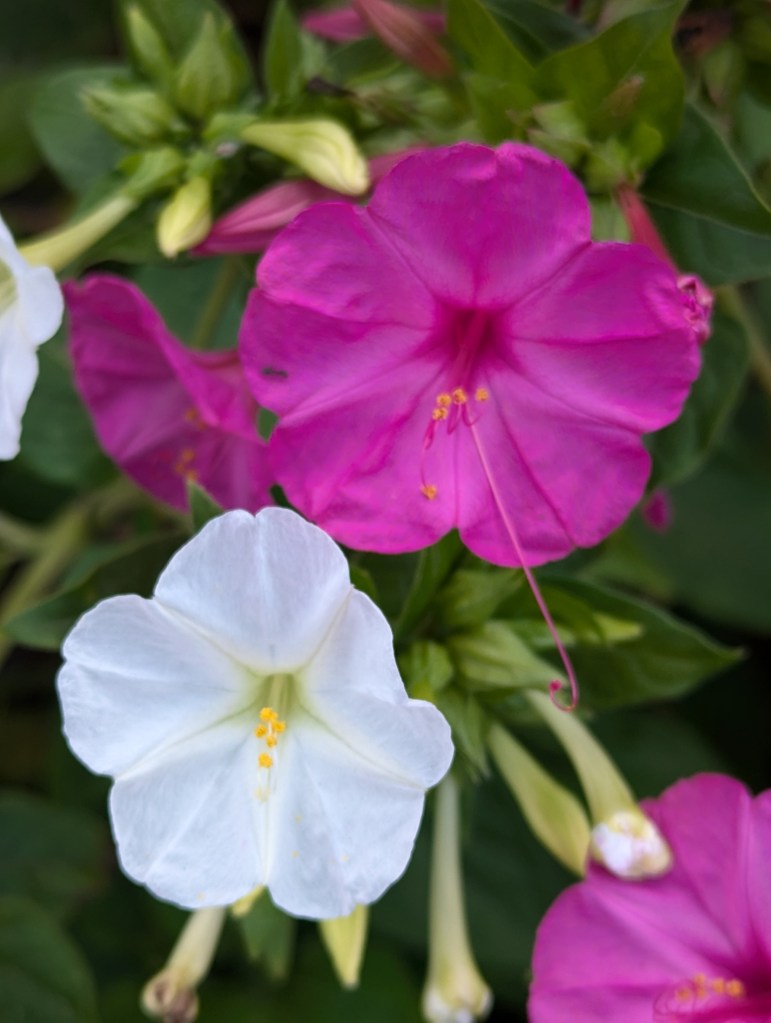
Mirabilis jalapa is known more commonly as four o’clock. It is spelled with letters rather than as 4:00 with numbers. This refers to the time in the afternoon when its bloom should be at its best. These pictures were taken prior to nine in the morning though. Apparently, it does not adhere to a strict schedule. I took these pictures because I was so impressed with the performance of these particular specimens. Those with yellow bloom above are so large that I came from across the road to confirm their identity. I do not expect this species to grow so large. They are about as big as small oleander! Those with white and pink bloom below are actually the same plant. The species commonly blooms with flowers of different colors, but such colors are typically not so divergent as clear bright pink and clear white. They are more typically blotched with colors of each other, such as white flowers with a few pink blotches in conjunction with pink flowers with a few white blotches. This species is somewhat naturalized here, but politely so. Although it generates copious seed, it is not migrating very far from where it is established.

Poor Man’s Rhododendron

Poor man’s rhododendrons is less colorful but more perennial than the more popular busy Lizzie Impatiens walleriana.

The nursery industry is so innately unsatisfactorily lucrative, that to us nurserymen, a ‘poor man’s rhododendron’ is any rhododendron that we grow. To everyone else, it is Imaptiens sodenii, a tender perennial that gets to six feet tall and wide or even larger on plump, softly succulent stems. It succumbs to even mild frost in winter, but regenerates rapidly by summer. It prefers partial shade, and can roast if too exposed to direct sunlight on warm days. Too much shade is rarely a problem.

The two inch wide flowers are typically very pale shades of pink, lavender or slightly blushed white. At least one modern variety has brighter white flowers with reddish pink centers. Bloom continues as long as weather is warm. The seed capsules are not much to look at, but explode to disperse their seeds when disturbed. The soft, rich green leaves are about three to six inches long.

Ice Plant

Other types of ice plant bloom with different colors.

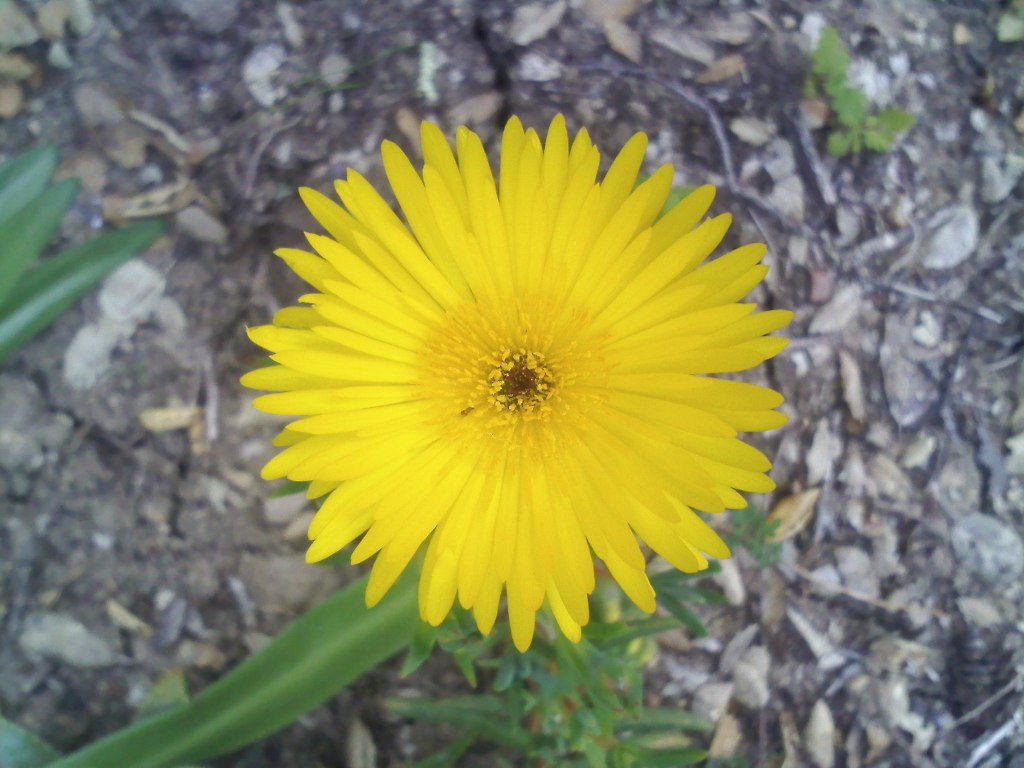
The bright orange, inch and a half wide flowers of Lampranthus aurantiacus, a type of ice plant, should bloom between winter and spring, but a few are brightening my garden right now. This bright yellow flower in the picture is that of the variety ‘Glaucus’, which I grew from a cutting last year. My single low mounding plant is about a foot wide now and will eventually spread to about two feet wide, and can get about a foot deep. Stems can root where they lay, forming new plants that will spread farther. To accelerate the spread, more plants are very easy to propagate from small cuttings. Lampranthus aurantiacus has narrow, inch long leaves, and a relatively shrubby basal branch structure.

Perennial Gladiolus

Gladiolus papilio, butterfly gladiolus

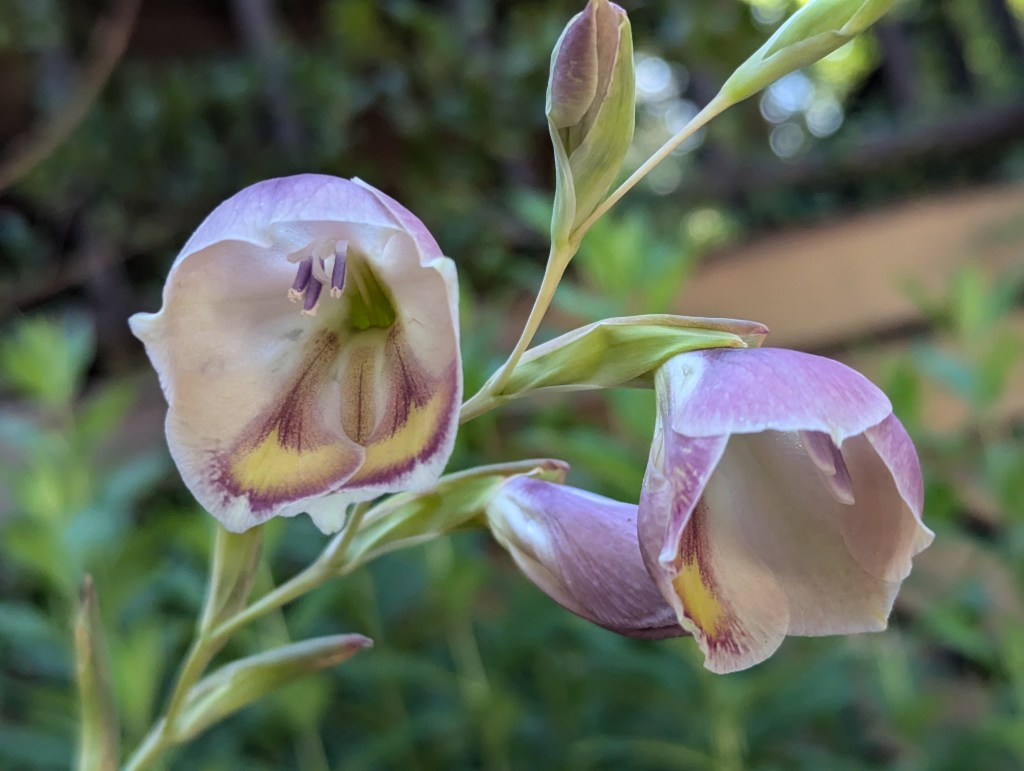
Gladiolus papilio, butterfly gladiolus has been performing very well, and, unlike the more common fancy hybrid gladiolus, it has been very reliably perennial. It multiplies and migrates like a wildflower. I know that I brag about it more than I should, and I just posted a picture of it for Six on Saturday last Saturday, but it happens to be one of my favorite perennials now. It was a gift from Tangly Cottage Gardening in the autumn of 2018, almost six years ago. Prior to that, I had been wanting to grow perennial gladiolus for quite a while, although I was not familiar with such species. I was only familiar with the common fancy hybrid sorts, which are generally not reliably perennial. Gladiolus murielae, Abyssinian gladiolus that arrived a few years ago as a gift from a neighbor may eventually inhabit a different portion of the same landscape that the butterfly gladiolus inhabits. It neither multiplies nor migrates as much as the butterfly gladiolus, and is a bit more garish in bloom, but is both reliably perennial and compatible with wildflowers, and technically, is probably more appropriate to that particular refined landscape. Various cultivars of Watsonia, bugle lily, most of which also came from Tangly Cottage Gardening, could also inhabit the same landscape. There is no rush to decide anytime soon, and the refined landscapes at work are constantly evolving. Within my home garden, I can be less concerned with how visually compatible some of such species and cultivars are, and be more concerned with growing what I enjoy. After all, that is how I acquire so many odd species and cultivars with so much history and from so many important gardens, and even from so many natural ecosystems. It is what makes my home garden so important to me.

Sweet Spot

Saccharum officinarum ‘Pele’s Smoke’ sugarcane

‘Pele’s Smoke’ sugarcane has grown enough for installation into the landscapes. I am not certain how happy they will be here through winter, but we will find out. Frost is mild here, but is supposedly enough to kill them to the ground. I expect that. Even if they do not die to the ground, I would prefer to cut them down by the end of winter regardless. Survival of their basal growth is more of a concern. I want them to regenerate next spring. It is difficult to imagine a species as vigorous as this being so vulnerable to the locally mild frost, but all the information that I find about it insists that it is marginal here. There are so many canned specimens that it would be no problem to shelter some through winter to replace any that do not survive in the landscapes. Later, if they get depleted, it would be no problem to take cuttings from those in the landscapes in autumn, and shelter them through winter to put back into the landscapes in spring. However, that is just too much unnatural intervention for me. If they are not happy here, they I do not want to force them. I enjoyed growing them while I did. I got the cuttings from grooming a specimen in Brent’s garden. I was not very careful with them, and did not process them very efficiently because I knew that I would get more than I could accommodate. Ultimately, after sharing a few with friends and neighbors who are aware of the risks, thirty new specimens remain here. Fifteen are in #1 can, including the first three that were just installed into the landscapes. Another fifteen are in four inch pots, which is annoying one less than a full flat of sixteen.

Six on Saturday: Glad

Butterfly gladiolus will not bloom for a while. Abyssinian gladiolus may not bloom at all. Hybrid gladiolus, though, are already finishing. I got these few pictures while I can, and will likely get pictures of butterfly gladiolus as they bloom later. I am glad to do so. They are my favorite gladiolus. They are more like wildflowers than overly bred hybrids. Also, they are very reliably perennial. I hope that the Abyssinian gladiolus perform also. They are also supposedly reliably perennial, but are not in a very good situation here. I should relocate them, perhaps closer to where the butterfly gladiolus are so happy. The hybrids are earning my appreciation too. I was not aware that they had potential to be perennial.

1. Gladiolus papilio, butterfly gladiolus is my favorite, because it is from Tangly Cottage Gardening, is approved by Skooter, is reliably perennial, and it blooms like a wildflower.

2. Its foliage is rather grassy, which is more compatible with other wildflowers than wide leaves of more garish hybrid gladiolus. The corms multiply and migrate quite efficiently.

3. Gladiolus murielae, Abyssinian gladiolus is my second favorite, even while it is not so much to see. It is a gift from a neighbor. It should bloom for autumn, but I have doubts.

4. Hybrid gladiolus are the most colorful, but are not reliably perennial. However, these and two others have been blooming well here for several years, and actually multiplying.

5. This orange with yellow hybrid gladiolus was one of the first two to bloom again after a few years of producing only foliage. The yellow gladiolus joined them a few years later.

6. This purple hybrid gladiolus is the other of the first pair to resume bloom, although it does not multiply as much as the yellow gladiolus that resumed bloom a few years later.

This is the link for Six on Saturday, for anyone else who would like to participate: https://thepropagatorblog.wordpress.com/2017/09/18/six-on-saturday-a-participant-guide/

Thrift

Thrift performs well in coastal climates.

When I see common thrift, Armeria maritima, in nurseries now, I wonder what such a diminutive perennial would be useful for. Their densely compact mounds of narrow evergreen leaves rarely get more than four inches deep, and take their time spreading to less than a foot wide. Then I remember how thrift visually softened the straight edges of my father’s brick patio and retaining walls, and fit so nicely into the tight spots. If allowed to do so, thrift creeps slowly over edges of pavement and stepping stones, but is not too eager to overwhelm them.

If it eventually gets overgrown, thrift is easily cut back to the edge of pavement at the end of winter, and will green over its raw edge by spring. The bits and pieces that are left over from cutting back the edges can be plugged back into other areas and will eventually develop roots if initially watered regularly. Once established, thrift stays healthier if allowed to dry somewhat between watering. Bald spots that may naturally come and go as mature plants die out in the center and then regenerate fill in faster if outer edges get cut back.

The dense round clusters of tiny flowers stand above the foliage on bare stems about four to eight inches high. The flowers are almost always bright pink, but are sometimes white or reddish pink. Bloom is most profuse in spring and may continue sporadically all year. 

Perennial Annuals

New Guinea impatiens (with ivy geranium) from last year.

Annuals complete their entire lifespans within a single year.

Perennials survive for more than a single year.

Biennials grow vegetatively during their first year, and then bloom, disperse seed and die during their second year, but that is another story.

Most species that are appreciated as annuals here actually have potential to be perennials, even if only short term perennials. They are only replaced annually because it is easier than maintaining them through their dormant season.

For example, busy Lizzy is a warm season annual that gets installed for spring and replaced with cool season annuals for autumn. However, if cut back and sheltered from frost, it can survive through winter to perform for the following spring and summer. Actually, it can survive perennially like this for quite a few years, and as it ultimately deteriorates, it can replace itself with its own cuttings or layered stems.

Brent did this with New Guinea impatiens from last year. He neglected to replace them for winter (which is quite brief there), and then noticed that they resumed growth as winter ended. Now, they are huge and even more spectacularly florific than they were last summer.

The picture above shows where I camp out in his backyard when I go to Southern California. Most of the white bloom to the right is actually ivy geranium that cascades below the New Guinea impatiens, but most of the white bloom to the left is New Guinea impatiens above ivy geranium. (White on white was not quite as monotonous when each of the two species maintained its distinct form last year.)

Small terrace at the western margin of the garden.

This other pair of potted dwarf Alberta spruce surrounded with the same New Guinea impatiens above, with a close up below, flanks the steps to a small terrace at far western margin of the garden.

These New Guinea impatiens are huge because they resumed growth from last year.