It is more like an iris (of the floral sort, not the ocular sort) than a grass.
Contrary to its common name, blue eyed grass, Sisyrinchium bellum, is not a grass at all, but is like a diminutive iris. The modern cultivars that are more commonly found in nurseries are somewhat more colorful than the wild plants that are native to coastal areas between about Santa Barbara and Portland. Yet, even these are rather subdued, with small half inch wide blue or light purple flowers delicately suspended above bluish grassy foliage that may be as low as only a few inches, and is rarely higher than a foot. They bloom best in sunny but not too hot areas. Once established, blue eyed grass is not too demanding, but naturalizes and slowly spreads more reliably if watered occasionally through summer. However, they can rot if watered too generously or too frequently.
Daffodil bloom from bulbs that were installed last autumn.
The elegant white callas that are just about to bloom in my garden have their origins in the ‘old country’. I obtained them from the garden of my great grandfather Tomeo in my ancestral homeland; Sunnyvale, near San Jose. I am told that my great grandfather planted them decades ago, and had been trying to get rid of them almost as long. I suppose that means that these callas are easy to grow.
My belladonna lilies that got planted two autumns ago are about as old, since they came from the garden of my mother’s mother in Santa Clara, right near Sunnyvale, and were in her mother’s garden prior to that. These bulbs just keep on growing, blooming and multiplying. Although I do not like their bright pink color much, I can not argue with their reliability.
Bulbs and bulb like plants that can take care of themselves and thrive with minimal or no attention are always welcome in my garden. Bright orange crocosmia is perhaps just as reliable, or should I say ‘persistent’, as callas are, and like callas, should be planted about now. Yellow, red, and orange with red flowering varieties are also available. Pink, red, orange, yellow and salmon cannas are in season too. They are easier to contain, but are likewise prolific.
Some of my other favorites that get planted about now for summer bloom want more attention, but are certainly worth it. Dahlias can naturalize if conditions are right for them, but will more likely do better if dug, divided and replanted in enriched soil at least every few winters. They are remarkably easy to propagate. Asiatic lilies likewise prefer to be dug and replanted as their soil becomes depleted, but are not likely to regenerate year after year if ignored.
Honestly though, some of the other summer blooming bulbs and bulb like plants that get planted about now are rather risky. I like to grow gladiolus because they happen to be among my favorite flowers. However, unless they get well amended soil and fertilizer, they do not perform very well, if at all, after their first year. Liatris is not much more reliable. Tuberous begonia is still a mystery to me, since I have not been able to prevent them from rotting in their first year!
Of the many bulbs and bulb like plants that get planted in autumn that are now blooming, grape hyacinth, snowdrop, watsonia, bearded iris, daffodil and narcissus are the most reliable and likely to naturalize, particularly with rich soil and regular watering. Daffodil and narcissus do not spread as well as the others, but are probably the most resilient. With a bit more effort, freesia and crocus can be persistent. In some situations, freesias have actually been known to naturalize as effectively as grape hyacinth.
Other early bloomers (that get planted in autumn) are more demanding. The anemones that I planted in about 1990 survived neglected in my garden for nearly a decade, but probably produced more flowers in their first year than in all subsequent years combined. Ranunculus and hyacinth may do the same if conditions are not just right for them. Tulips are perhaps the most profusely colorful of spring bulbs, but are sadly grown mostly as annuals, since they rarely do much more than produce foliage after their first year.
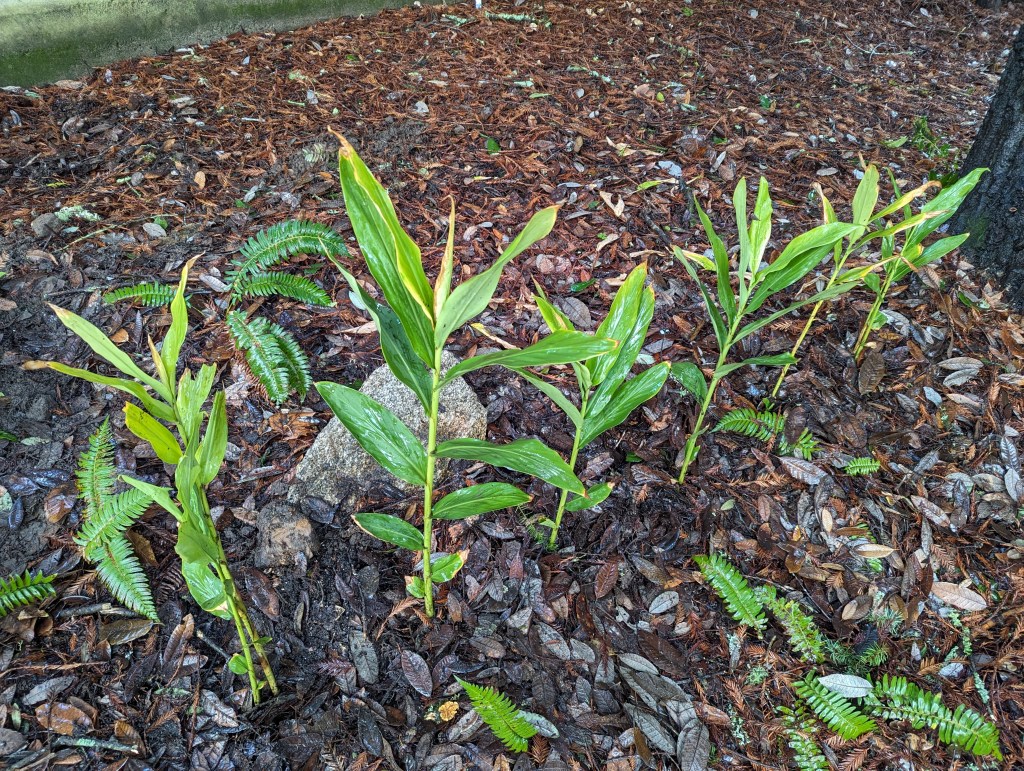
At least seven gingers live here. Five are ornamental. Two are culinary. None have yet died back as they should for winter.
Now that it is time to divide them, I do not know what to do with their intact foliage. For this white butterfly ginger from Forest Garden, I divided the rhizomes and installed them into the landscape with their healthy foliage still attached. I do not want to cut it back until it succumbs to frost. I suppose that it can remain as long as it is healthy. It is likely promoting healthier secondary growth. Because none of the gingers are crowded yet, it should not be difficult to selectively groom out older growth as new growth develops. I doubt that older foliage absolutely must be pruned away during winter. If it were that important, the rhizomes would shed it naturally, with or without frost.
This is a mild climate, with very mild frost; but gingers should still die back for winter regardless. Cannas certainly do, even without significant frost. Even some of the banana trees were somewhat unhappy about the chill.
Actually, the banana trees seem to be bothered more by chill than the gingers. Is this normal? Angel’s trumpet, cup of gold vine and blue ginger (which is not related to ginger) also expressed more displeasure than the gingers.
I really should have sheltered some of these species better. Actually, I probably should not be growing so many species that are so sensitive to chill and frost. I will be going to Southern California again in about April, so could bring back even more tropical species. It is a bad habit.
Technically, the average last frost date is about a month and a half from now. Technically, a bit of frost is possible even after that.
Both alocasias and colocasias are striking foliar plants. Alocasias generally develop big leaves that point upward. Colocasias generally develop even bigger leaves that hang downward. Alocasias are generally more colorful, perhaps with striking foliar patterns. Also, most tolerate more shade than colocasias. Of course, these are generalizations.
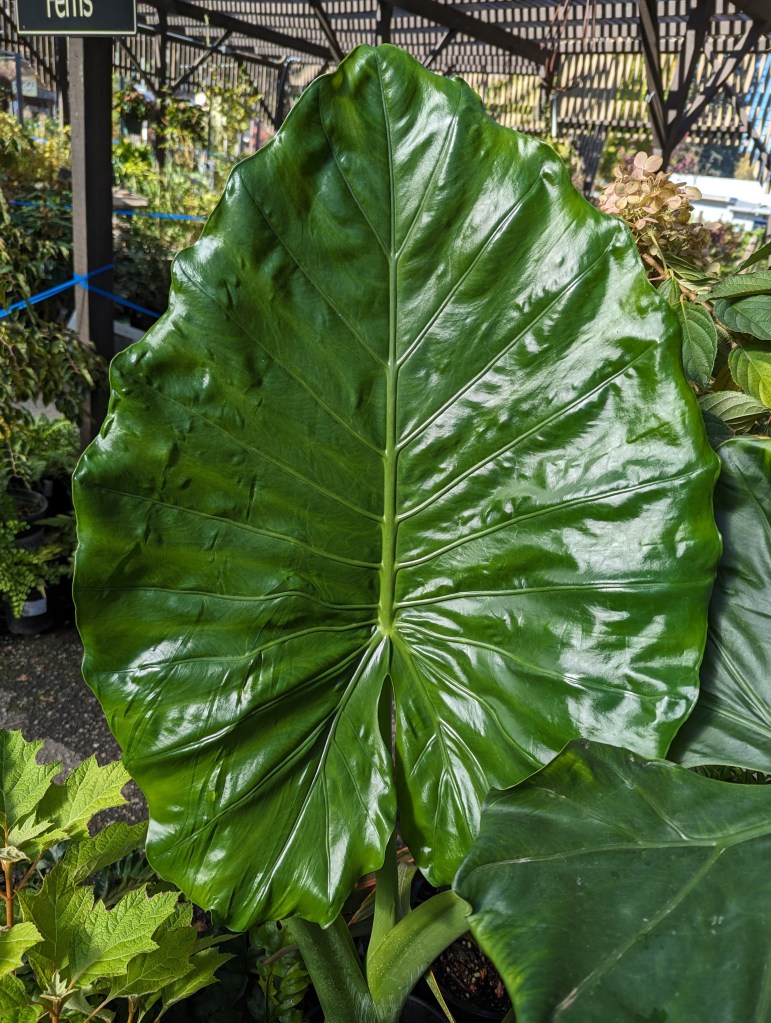
Asian taro, Alocasia odora, resembles colocasias as much as alocasias. Its big cordate leaves may point only slightly upward, and might sag downward. They can grow two feet long and a foot wide, on petioles as long as three feet. Collectively, foliage can get more than five feet tall. It is bright but monochromatic green, similar to that of Kermit the Frog.
Asian taro is only occasionally available from nurseries. Small plants are too delicate for nurseries to market too many of them for too long. Their dormant bulbs are more likely to become available with summer bulbs. They can be wider than three inches! They grow slowly though, especially while weather is cool. Foliage may not appear for two months.
This is no ordinary daffodil. I realize that it looks just like the daffodils that I posted a picture of two Saturdays ago, and it could actually be the same variety, but it is quite distinct. I acquired this particular daffodil in about summer of 1986. It could have been a year or two earlier or later, and might not have been summer. The foliage was not completely shriveled as it should have been during summer, but it lasts longer in the coastal climate that I took it from. I really do not remember when I acquired it, but I know that it was a long time ago, about the summer of 1986.
Although we have not been acquainted for as long as I have been acquainted with my paternal paternal great grandfather’s rhubarb and my maternal maternal great grandmother’s Dalmatian iris, both of which I acquired prior to kindergarten, we have significant mutual history.
I ‘borrowed’ several large clumps of bulbs from an abandoned flower field to the east of my Pa’s home in Montara. The clumps were very overgrown and very crowded, but still in their original rows, as they had been arranged for cut flower production many years prior. Shortly afterward, all of the other bulbs were somehow and seemingly pointlessly removed from the field by an excavator. A monster home was built on the highest part of the field, with a view of the field, which remained completely uncultivated afterward. No one knows how or why all the daffodil bulbs were removed so completely, but none were ever seen again. The naturalized field of daffodils seemed like it would have been an attribute to the home.
Over many years, the bulbs grew at most of the homes that I lived in, until the last few years, after I left the last of them at a former home in town. Then, after bringing a few roses here from my old rose garden at a previous home, I noticed that a few bulbs came with them. I thought that they were fancier daffodils, but now that this one bloomed, it is obvious that they are the familiar daffodils from Montara.
Mexican weeping bamboo is more appealing in abundance.
Like junipers, bamboos have gotten a bad reputation from only a few of their problematic specie. Many of the traditional running bamboos really are too aggressively invasive. However, there are many clumping bamboos that are much more adaptable to confined and refined garden areas. Even these complaisant bamboos remain uncommon though, both because of the unpopularity of bamboos, and because they are not so easily produced.
Mexican weeping bamboo, Otatea acuminata aztecorum, is certainly one of the more interesting of these clumping bamboos. Their limber inch and half wide stems are not nearly as rigid as those of most other bamboos are, and may bend down to the ground under the weight of their abundant and remarkably finely textured foliage. The four or five inch long leaves may be only an eighth of an inch wide. Both the stems and foliage move nicely in even slight breezes.
Established plants are somewhat resilient to neglect, but can get rather yellowish and will likely stay less than ten feet tall without regular watering. With regular watering and monthly application of nitrogen fertilizer, such as lawn fertilizer, during warm weather, they can get twice as tall. Old canes should be pruned to the ground as they begin to deteriorate. There should be plenty of fresh new stems to replace them.
Modern dracaena palms are more compact, more colorful and more user friendly than old fashioned sort.
(This article was deferred from yesterday morning.)
While hoping to find some of the uncommon yuccas that I still lack, I instead encountered some of their friendlier kin in a local nursery. Even though dracaena palm, Cordyline australis, is an old fashioned plant that was probably considered to be too common until the past few decades, many more colorful modern cultivars are restoring its appeal. Classic dracaena palm has olive drab foliage. The nearly as traditional bronze dracaena, ‘Atropurpurea’, has reddish bronze foliage. The more contemporary ‘Red Star’ though is deeper purplish red. ‘Pink Stripe’ has bronzy green leaves with pink edges. ‘Sundance’ has pink in the middle with green edges.
Modern cultivars also stay shorter so that their abundant foliage can be appreciated on a more personal level. The individual sword shaped leaves are about three feet long and three inches wide, a bit larger than traditional dracaena palm leaves. However, I actually prefer the traditional dracaena palms that can get taller than twenty feet and spread nearly half as wide, with sculptural bare trunks and high branches.
Any dracaena palm that gets too tall can be cut back to a more proportionate height. One of my colleagues recommends cutting about a quarter through trunks a year or more prior to cutting back, to stimulate new shoot growth just below the cut. The new growth prevents the trunks from being bare immediately after getting cut back. Overgrown heavily branched trees should first be thinned to decrease their weight before cutting partly through their trunks. Young plants can be cut back to the ground to regenerate with multiple trunks.
Billowy trusses of tiny pale white flowers add interest at the end of spring, particularly against darker foliage. I am told that the flowers of modern cultivars are slightly fragrant. However, against the olive drab foliage of older dracaena palms, I think that the blooms look rather dusty, and do not smell any better.
Bearded iris should bloom for early spring, not winter.
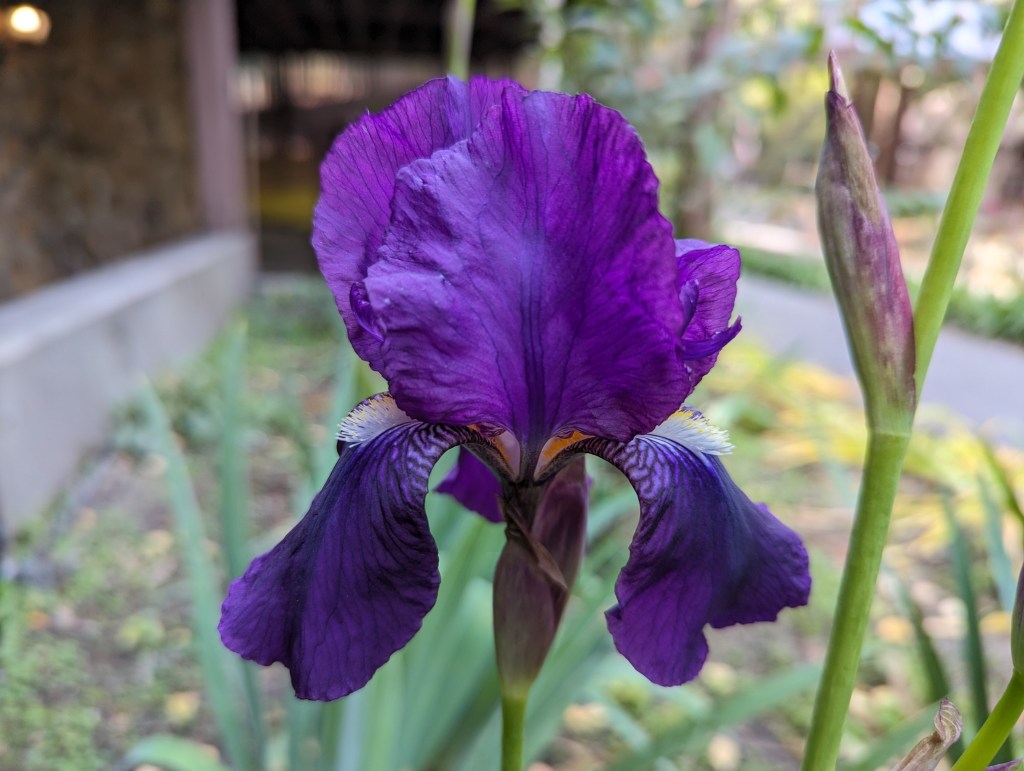
Each of the several bearded iris that I grow have history. Their origins are more significant than their performance. None were merely purchased. I obtained my first, which is actually Dalmatian iris rather than bearded iris, from the garden of my maternal maternal great grandmother when I was about five years old, before I was in kindergarten.
Some of the seventeen or so that inhabit my garden may be added to a designated iris garden at work as they multiply. Some of the eight or so that inhabit the designated iris garden at work may be added to my garden as they multiply. I will likely procure at least two additional cultivars when I return to the Pacific Northwest later in winter, as well as Louisiana iris from another source.
The most abundant of the bearded iris within the designated iris garden at work were recycled from where they had become too abundant in a home garden in Santa Cruz. They are unidentified. I suspected that they might be a simpler species, rather than a hybrid bearded iris, because they resemble my simple Dalmatian iris. Their floral stems are similarly slender. The leaves are similarly somewhat narrow. The fragrance is similar. The main differences are that the floral stems are a bit shorter, the flowers are rich purple rather than lavender blue, and instead of blooming promptly and thoroughly only for early spring, they bloom sporadically throughout spring, and again about now.
After posting a picture of them last winter, I was informed that they could be ‘Rosalie Figge’. They conform to the description of the cultivar, although they bloom for winter rather than autumn. They were blooming a month ago, and are still blooming now. Although I do not care what they are, it would be nice to know.
The thick clumps of evergreen grass-like foliage of mondo grass, Ophiopogon japonicas, make a nice lumpy ground cover for small spaces. Because it is rather tolerant of shade, and actually prefers partial shade to full sun, it works nicely under Japanese maples or highly branched overgrown rhododendrons. It gets only about half a foot deep. Narrow stems with small pale purplish blue flowers that bloom in summer are not too abundant, and are generally obscured below the foliage, but can actually get taller. ‘Silver Mist’ is variegated with white.
New plants are easily produced by division of large clumps. Overgrown or tired looking clumps can be shorn down at the end of winter, before new growth begins. Slugs and snails can be problematic.
While it seems that anything can be found online, it is baffling to see what can not be found online. Horticultural concerns seem to be particularly lacking. Perhaps those who enjoy horticulture innately dislike the internet. Perhaps they are merely too busy in their gardens to bother getting online too much.
‘Pele’s Smoke’ has been one of the more popular cultivars of sugarcane for home gardens for quite a while, but I can not determine how wide its canes are. Eucalyptus pulverulenta and Eucalyptus cinerea seem to have traded their names since the 1980s, but now, no one seems to know which is which, or if either ever was the other. No one can explain how seed from sterile banana cultivars are available online. Anyone can say anything. There is no accountability.
Alocasia and Colocasia are as baffling now as they were when I mentioned the difficulty with choosing between the two about a month ago. I am still inclined to procure Colocasia gigantea for a riparian landscape at work. However, I am now inclined to also procure Alocasia macrorrhiza. Both are quite appealing. I think that I would like to grow both within the same landscape so that I can compare them later. It would be easier than trying to compare vague information about them that I can find online. Realistically, since I would grow them from corms, both are quite inexpensive. If necessary, I can later relocate whichever is less appealing than the other.
This would not be my first occasion of not relying on the internet. I am working with ‘Pele’s Smoke’ sugarcane presently, and will be pleased with it regardless of how it behaves. I grow both Eucalyptus pulverulenta and Eucalyptus cinerea; although by mistake, since I procured one because I thought it was the same as the other. All of the cultivars of banana that I grow were procured as pups or plugs, since I do not trust seed. Ultimately, I will be pleased with both Alocasia and Colocasia.