Six on Saturday: Shabby Spring II

Some of these Six are leftovers from last week. Some might have been late last week, and are a week later now. African daisy and calla bloom somewhat randomly, so technically, may not qualify as late. Likewise, candelabra aloe does not bloom quite as randomly, but is not always punctual either. I should be more observant of bloom schedules. Evergreen clematis and bridal wreath spirea are more likely to be blooming late. I am more certain that flowering quince should have bloomed earlier. Only calla and candelabra aloe were grown here. The others were originally acquired from nurseries many years ago, so I can not gloat about growing them. Incidentally, Rhody and I will leave for Washington early Wednesday morning, so my next two ‘Six on Saturday’ posts should be from there.

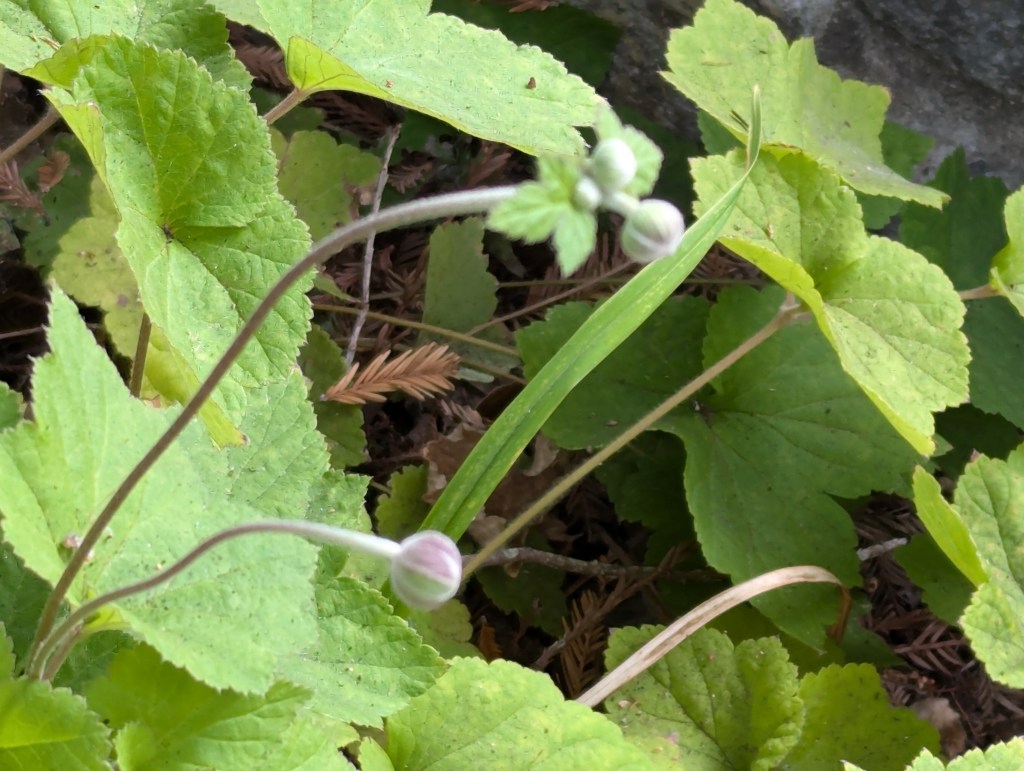
1. Clematis armandii, evergreen clematis bloomed while I was not looking. This picture is from last week. Bloom lasted a bit longer than expected, but is presently deteriorating.

2. Osteospermum ecklonis, African daisy also bloomed last week, but of course, is rarely without bloom. It blooms a bit more profusely in phases between now and late summer.

3. Aloe arborescens, candelabra aloe typically blooms for late winter. These vivid orange flowers are resilient to wintry weather, and contrast splendidly with blue California lilac.

4. Zantedeschia aethiopica, calla grows wild within a portion of one of the landscapes. It could do the same elsewhere if we were to relocate some of it, which is why we rarely do.

5. Spiraea prunifolia, bridal wreath spirea seems to be blooming late. I do not know for certain because I do not remember when it typically blooms. Foliage develops afterward.

6. Chaenomeles speciosa ‘Double Take Orange’ flowering quince also develops its foliage after bloom. I am more certain that it is blooming late. It typically blooms with forsythia.

This is the link for Six on Saturday, for anyone else who would like to participate: https://thepropagatorblog.wordpress.com/2017/09/18/six-on-saturday-a-participant-guide/
Six on Saturday: Shabby Spring

This should have been done earlier. While most who participate in Six on Saturday have been posting pictures of early spring bloom, I have been posting less colorful pictures of dormant corms, their barely visible new spring growth, some windmill palm foliage and a sliced weirdly yellow beet. Some of the few flowers that I posted pictures of were oddly pallid, which was sort of why I thought they might be interesting. Now that I am posting floral pictures, early spring flowers are beginning to deteriorate. The first two are rather shabby. The third has not been quite right for a few months. I should have found fresher flowers.

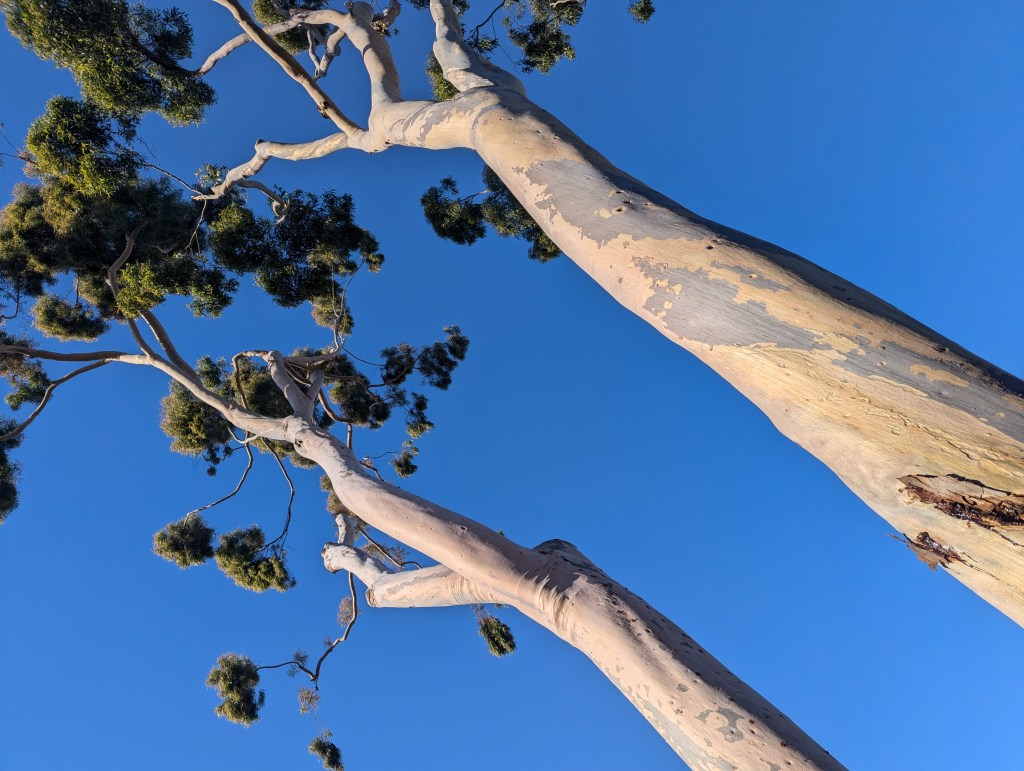
1. Eucalyptus cinerea or pulverulenta, florist silver dollar got an identity crisis. I learned it as cinerea. I am now told that it is pulverulenta. Regardless of its name, bees enjoy it. We thought we added another tree of the same species nearby, but it is the other species.

2. Tecomaria capensis, cape honeysuckle really was prettier earlier. Its bloom is not too profuse, but it is distinctly orange. Goodness, I really should have taken a better picture.

3. Rosmarinus officinalis, rosemary is badly infested with mites, but blooms regardless. It is right across the road from the silver dollar, and just as popular with the honeybees.

4. Lavandula stoechas, Spanish lavender is the only lavender that self sows here. It does not become invasive though. Its bloom may be blue, pink, white or, obviously, lavender.

5. Tulbaghia violacea, society garlic is one of my least favorite of perennials. It stinks! It is not so much to look at either. It has been here for many years though, and will not die.

6. Grevillea rosmarinifolia, rosemary grevillea seems as popular with hummingbirds as rosemary and silver dollar is with bees. Hummingbirds are prettier than this odd bloom.

This is the link for Six on Saturday, for anyone else who would like to participate: https://thepropagatorblog.wordpress.com/2017/09/18/six-on-saturday-a-participant-guide/
Six on Saturday: Winter to Spring

Spring is beginning to express itself. Only one of my six thinks that it is still winter. After a mild winter, I expected this sooner.

1. Colocasia gigantea ‘Thailand Giant’ elephant ear is the only one of these six to remain dormant. I still must determine if two will go directly into a landscape or get canned like the other two next week. I actually purchased these corms, but do not feel guilty about it.

2. Alocasia macrorrhiza ‘Borneo Giant’ elephant ear is another guiltless purchase. It has a very similar name and is from a similar region as the ‘Thailand Giant’ elephant ear, but grows from smaller rhizomes rather than fat corms. It is already generating new growth.

3. Musa acuminata ‘Double Mahoi’ banana was one of several items that I brought back from Los Angeles last year. After taking several small pups from it, I gave the original to a neighbor. Then, all the pups seemed to die! Now I am pleased that they are recovering.

4. Actinidia deliciosa, fuzzy kiwifruit cuttings are generating foliage. I hope that they are also generating roots. They are a male pollinator for a female cultivar that grew last year from a single pruning scrap that an associate here neglected to remove from his pickup.

5. Platycerium bifurcatum, staghorn fern looks weird as it extends new foliage. Actually, it always looks weird, which is its primary allure. I am concerned that such fresh foliage can be damaged by cold rain. It likes rain and humidity but in conjunction with warmth.

6. Viburnum tinus, laurustinus is the only floral feature of these six. I am not so keen on it, but am learning to appreciate it because its early spring bloom is popular where harsh weather through winter inhibits other bloom. It is simple white, without any pink blush.

This is the link for Six on Saturday, for anyone else who would like to participate: https://thepropagatorblog.wordpress.com/2017/09/18/six-on-saturday-a-participant-guide/

Six on Saturday: Strange Times

Some flowers are blooming strangely this year. Well actually, one bloomed strangely last year, and is now blooming normally. Flowers that prefer more winter chill than they can experience here are blooming quite nicely this year, even after less frost than last winter. I can neither make sense of it all, nor complain about it. I mean, it may be strange, but it is strange in a good way. We added a windmill palm that I mentioned two weeks ago to a landscape. I like palms, especially this palm, but I am not sure that I like them here with the redwoods. Palms are strange with redwoods.

1. Trachycarpus fortunei, windmill palm is strange because it is one of only three palms here. Palms and redwoods should not mix. It remains canned, so will be removed as the unseen angel’s trumpet behind it grows. I featured it two weeks ago, before it came here.

2. Hyacinthus orientalis, hyacinth is not so strange either, but it performs strangely well and reliably with only minor chill. Several have been blooming like this for several years.

3. Bergenia crassifolia, pig squeak is blooming strangely late with a strangely light pink floral color. Otherwise, it blooms a bit better now that a sycamore that shaded it is gone.

4. Ribes sanguineum, red currant is blooming with a strangely light pink floral color too. It is not much more than white, but is not white. All are this same strangely pallid color.

5. Brugmansia X cubensis ‘Charles Grimaldi’ angel’s trumpet did just the opposite. After blooming strangely pallid peachy orange since spring, it now blooms yellow as it should.

6. Helleborus orientalis, Lenten rose is blooming strangely well this year. Typically, only a few bloom like this. Now, many are. This is one of a uniform colony that is likely feral.

This is the link for Six on Saturday, for anyone else who would like to participate: https://thepropagatorblog.wordpress.com/2017/09/18/six-on-saturday-a-participant-guide/

Six on Saturday: Hello Yellow

White is my favorite color. I sometimes post six pictures of exclusively white flowers for Six on Saturday. Also, I posted six pictures of exclusively red flowers merely to show that I could. I might have tried other colors as well. I do not remember trying yellow though. California bay gave me the idea, although its bloom is rather unimpressive. Silver wattle is much more colorful. So is daffodil. Dandelion is merely a weed; but technically, silver wattle is also. Ultimately, I got four pictures of yellow flowers, a picture of an aberrative beet, and a picture of someone who might qualify as golden retriever light gold, which at least sounds yellow. He can not see most colors anyway.

1. Acacia dealbata, silver wattle is an aggressively naturalized exotic species. It certainly is pretty though. It typically blooms earlier, and maybe by New Year’s Day farther south.

2. Umbellularia californica, California bay does not bloom as prettily. Its flowers are too tiny, too sporadic and too high in its canopy to be prominent, but it blooms nonetheless.

3. Taraxacum officinale, dandelion, like silver wattle, is also an aggressively naturalized exotic species. It infests most lawns, and blooms to toss its seed whenever it wants to.

4. Narcissus pseudonarcissus, daffodil continues to bloom. Several are still budded. If it were not so variable with its bloom schedule from year to year, I would say that it is late.

5. Beta vulgaris, beet should be red, not yellow. ‘Detroit Dark Red’ is best! This seems to taste about the same, but looks like a sick carrot! I loathe carrots! Why do this to a beet?

6. Rhody remains unimpressed. He is no more interested in beets than carrots. He could be more concerned about the first of a few storms that should arrive in only a few hours.

This is the link for Six on Saturday, for anyone else who would like to participate: https://thepropagatorblog.wordpress.com/2017/09/18/six-on-saturday-a-participant-guide/

Six on Saturday: Palm Springs

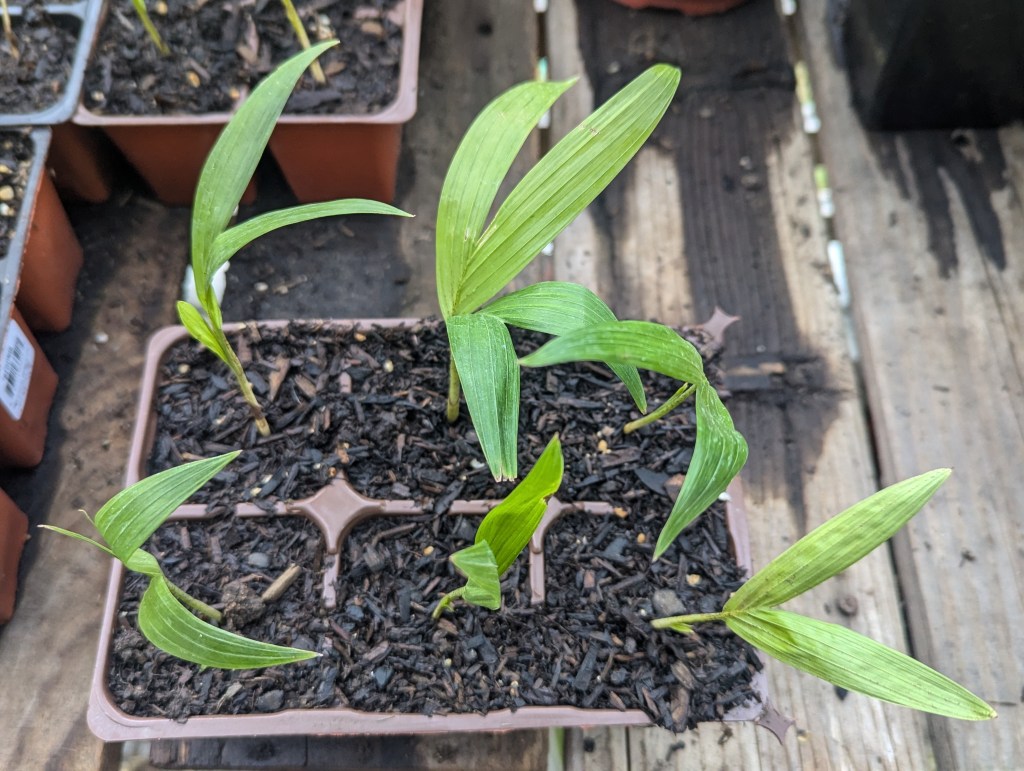
Palms spring up anywhere they want to. Only the fourth and sixth of my Six on Saturday are not feral. Incidentally, the last three are not my pictures; and Brent sent the last two. His curbside Mexican fan palm is at least one of the parents of my pair of seedlings here.

1. Washingtonia robusta, Mexican fan palm, which I wrote about earlier, was too pretty to stay in the recovery nursery where no one can see it. We put it here temporarily, until a pup from the Agave ovatifolia, whale’s tongue agave that bloomed and died here, gets large enough to replace it. It is canned within the big pot for ‘efficient’ removal, but is so heavy that I have no idea of how to get the can out of its pot. It will be a bit heavier later.

2. Wicked spines on its petioles contribute to the difficulty of relocating this heavy palm.

3. Trachycarpus fortunei, windmill palm is also too pretty to stay unseen in the nursery. It will also get groomed and relocated temporarily to a landscape next week. This young palm grew in the garden of the mother of childhood friends, so I am very protective of it.

4. Palms and redwoods do not mix well. A colleague wants this windmill palm gone. It is about twenty four feet tall. That ladder is eight feet tall. It will be difficult to relocate, but I do not want it cut down and killed. Like the others, I have no idea of what to do with it.

5. Brent’s curbside Mexican fan palm looks embarrassed with its silly uplighting. That is the moon above. This palm, which is a Memorial Tree for Brent’s brother, was about ten feet tall when relocated here because it grew under electrical cables several blocks away.

6. Bedford Drive, nearer to the original location of Brent’s curbside Mexican fan palm, is flanked by very old and alternating Mexican fan palms and Phoenix canariensis, Canary Island date palms. They were grandly uniform until the Canary Island date palms began to succumb to pink rot during the 1980s. The Beverly Hillbillies started their shows with a scene of their arrival in town on a similarly flanked street three blocks to the northeast.

This is the link for Six on Saturday, for anyone else who would like to participate: https://thepropagatorblog.wordpress.com/2017/09/18/six-on-saturday-a-participant-guide/
Six on Saturday: Tree Circus

‘Crazy Great Ideas From Crazy Green Thumbs 6’ featured four sculptural tree specimens that had been relocated to Gilroy Gardens, which was formerly Bonfante Gardens, from the now defunct Lost World, which was formerly Tree Circus. While getting gasoline for Morgan in Scotts Valley, I stopped at the former site of Tree Circus for these six pictures. Not much remains to suggest that Tree Circus was ever there. Of these six pictures, only one shows real vegetation, which is a single London plane, Platanus X acerifolia, with a pair of trunks, which form an arch. (Incidentally, Crazy Green Thumbs sent me seed for poinciana and esperanza, which I featured for Six on Saturday almost two years earlier.)

1. Tree Circus Center now occupies the former location of Tree Circus, and subsequently, the Lost World. Progress can be so trivializing. Notice the emblem at the top of this sign.

2. The emblem depicts this last tree of the Tree Circus, which was a pair of trees that got grafted together and separated and grafted together. Notice the plaques to the lower left.

3. This upper plaque very briefly explains the history of Tree Circus and the Lost World, although without mention of what happened afterwards. Notice the other plaque below.

4. This lower plaque features illustrations of a few of the many sculpted trees of the Tree Circus, although woefully weathered. Notice the illustrations to the far right and far left.

5. This illustration to the far right shows the only other tree of the Tree Circus to remain at the site, although it is now gone. Notice the caption, ‘Protected for future generations’.

6. This illustration to the far left shows one of the Tree Circus trees that was exhibited in the context of ‘Crazy Great Ideas From Crazy Green Thumbs 6’ by Crazy Green Thumbs.

This is the link for Six on Saturday, for anyone else who would like to participate: https://thepropagatorblog.wordpress.com/2017/09/18/six-on-saturday-a-participant-guide/
Six on Saturday: Bucket List

Hyacinth Bucket of ‘Keeping Up Appearances’ might say, “It’s ‘Bouquet’.” However, this really is about the contents of two buckets, two cans, a bin, and a terracotta pot, without flowers. Most of these items must be processed prior to the end of the rainy season.

1. Agave ovatifolia, whale’s tongue agave bolted and bloomed too soon after installation. It is monocarpic, so died an ugly death while trying to replace itself with fresh new pups. I planned to later select the biggest pup to replace its original. Unfortunately, a gardener who did not know what they are pulled them all with nearby weeds. I scrounged through the debris to find these. Incidentally, I must still find homes for Agave americana pups.

2. Chrysanthemum X morifolium, mum contrarily will not die. It was abandoned after a wedding, but then potted into a landscape as it bloomed again. Removal for replacement as it again finished bloom revealed that each of these many stems is rooted individually.

3. Agapanthus orientalis, lily of the Nile is getting to be rather tedious. These shoots are of the same batch that I featured last week, and that I processed more than a month ago. I processed too many, so must now get the leftovers into the ground before winter ends.

4. Forsythia X intermedia, forsythia will bloom soon, but for the moment, is dormant. I relocated an old specimen that was always in the way. These spare twigs can be forced.

5. Actinidia deliciosa, kiwifruit vines grew easily from a broken bit that I found in a load of debris that someone left here last winter. They are female without pollinators though. These are dormant pruning scraps of its male pollinator, and should grow just as easily.

6. Rain was falling yesterday and is forecast to continue lightly through most of Monday.

This is the link for Six on Saturday, for anyone else who would like to participate: https://thepropagatorblog.wordpress.com/2017/09/18/six-on-saturday-a-participant-guide/

Six on Saturday: Old School

Bauhinia punctata, Tupidanthus calyptratus, Olmediella betschleriana and Oreopanax capitatus are a few species that Brent and I studied in school during the late 1980s, then encountered only very rarely afterward. Actually, neither of us have encountered a single specimen of Oreopanax capitatus since 1990. Brent managed to procure a Tupidanthus calyptratus for his driveway. I may eventually procure a Bauhinia punctata. Nowadays, I work with Cocculus laurifolius and Pittosporum crassifolium, which, previously, I had not seen since school. Agapanthus orientalis and Juniperus chinensis ‘Kaizuka’ could be just as old fashioned, but never really got scarce. Perhaps I should post more pictures of species here that are actually rare instead.

1. Agapanthus orientalis, lily of the Nile has been very popular and even common longer than anyone can remember, and still is. This picture of these divided and plugged shoots is here because I neglected to post it as I discussed them in Six on Saturday a month ago

2. Juniperus chinensis ‘Kaizuka’, Hollywood juniper was passe prior to when Brent and I were in school, but older specimens remain. They are like sculptural small cypress trees.

3. Cocculus laurifolius, laurel leaved snailseed is a species that we studied in school, but have seen in only a few situations since then. I happen to be acquainted with a few now.

4. Pittosporum crassifolium, karo is very similar in that regard. It might have been more popular a long time ago, but lost popularity as more interesting species were introduced.

5. Pittosporum crassifolium, karo produces annoyingly abundant and annoyingly sticky seeds. ‘Pittosporum’ translates to ‘pitchy seed’. If they germinate, they do not do it here.

6. Rhody’s Roady got its new license plate with the colors of 1969. ‘O’ is for ‘Occidentale’, which is Rhody’s last name. It is irrelevant to an Isuzu or a downtown shopping district.

This is the link for Six on Saturday, for anyone else who would like to participate: https://thepropagatorblog.wordpress.com/2017/09/18/six-on-saturday-a-participant-guide/
Analysis

There is so much more to this picture than the kitty.

As Brent mentioned when he sent me this picture, which was included with my ‘Six on Saturday’ post earlier this morning, “There’s a lot going on in the picture.”

Slightly above the exact center of the picture, to the left of the tip of the kitty’s right ear, a Mexican fan palm peeks through a small void in the vegetation. It is at the curb of a home on the west side of the next street to the east. It is what Brent would have taken a picture of if he had zoomed in as intended. It leans to the right and south, as tall Mexican fan palms do there in response the the Santa Ana Winds.

The foliage of the queen palm above and to the left demonstrates that the Santa Ana Winds were blowing when the picture was taken.

The trunk that extends upward through another smaller void in the vegetation below the queen palm foliage is of another Mexican fan palm at the curb in front of Brent’s Jungalow. It is in alignment with the other Mexican fan palm to the east. Its canopy is obscured by that of the queen palm.

The foliage above and to the right of the primary Mexican fan palm, but below and to the right of the queen palm, is pink trumpet tree, which blooms spectacularly bright pink for spring.

The defoliated thicket of stems below and to the left of the primary Mexican fan palm is a large plumeria, which Brent, while very young, acquired from an elderly neighbor. He got it at about the same age that I was when I acquired my Dalmatian iris and rhubarb. More than a dozen other plumeria grow and bloom in a row that extends parallel to the walkway, in front of and behind the large specimen that is visible.

The somewhat yellowish foliage below and to the left of the plumeria is an impressively large Mexican lime that is somehow productive within all that shade.

The strange foliage that hangs outwardly from a dark central mass above and to the left of the Mexican lime, and left of the queen palm is a large colony of staghorn fern that is much closer to the window. Some sort of weird begonia foliage is below and to the left of it. California sycamore foliage is above it.

The top of a tall Indian laurel hedge is visible to the upper right of the picture. Some sort of odd dracaena and odd fern are visible to the lower left corner. Much but not all of the remaining vegetation is a mixture of understory palms, including various bamboo palms, Raphis palms and kentia palms. The spiral stairs lead to an upper deck, which has a splendid view of the rest of the garden that extends to the left, beyond the view of this picture. Finally, on the spiral stairs, is this kitty.