Six on Saturday: Nursery Schooled

Horticulture can be such a bad habit. (Where have I heard that before?) Once one learns how to grow horticultural commodities, it is difficult to stop. Pruning scraps get processed into more cuttings. Self sown seedlings get relocated instead of discarded. Extra pups (divisions) get salvaged as if the garden can accommodate more. There are several acres of landscapes here, but it is not enough for what we could grow.

1. While dividing a bunch of Morea bicolor, I found a single shoot of Morea iridioides. How did that get in there? I should have discarded it. Perhaps it will grow to become something useful.P00725-1

2. Pruning scraps of zonal geraniums got plugged as cuttings, but then did not get separated as they grew. There may be a dozen in there. They are nice, but we really do not need any more.P00725-2

3. When composting just is not good enough, plug cuttings instead. There may be a dozen Ponderosa lemon cuttings here. One is too many. They are not grafted, so will be on their own roots.P00725-3

4. Boston ivy is fortunately not as abundant as I thought it would be. We wanted four, so I plugged a hundred cuttings. It seemed to make sense at the time. Most did not survive. Plenty did.P00725-4

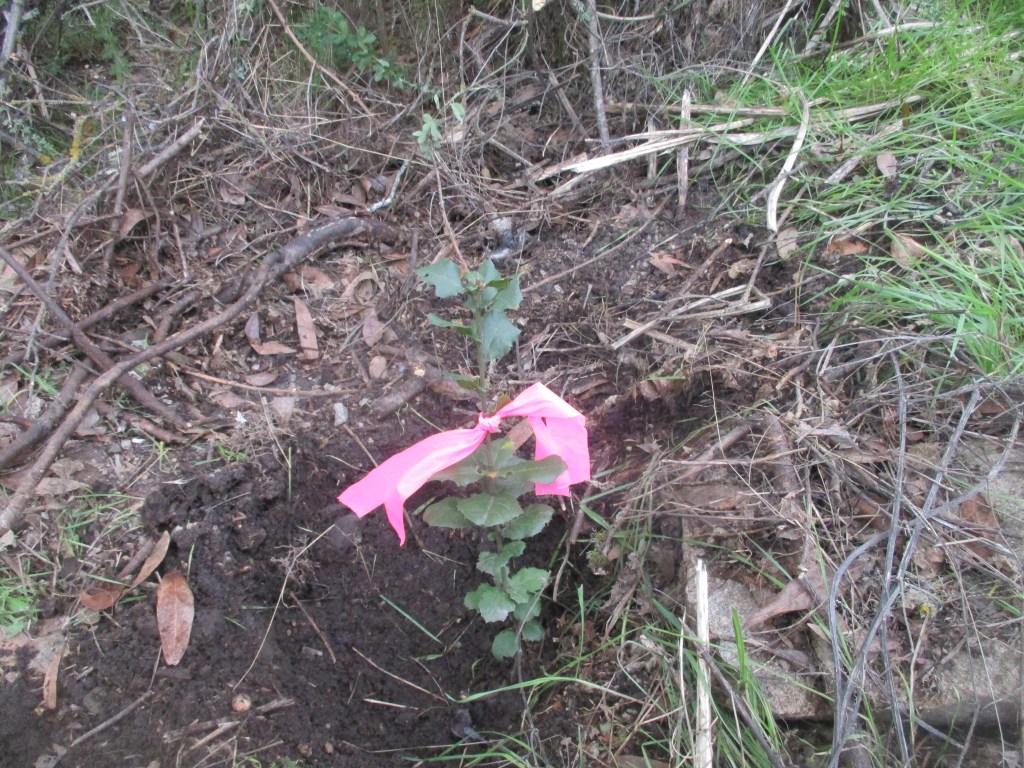
5. This self sown bigleaf maple is not in the nursery, but I want it to be. It should not remain where it is. I may dig and can it this autumn, as if there is a situation into which to install it later. P00725-5

6. These summer squash are not from the nursery, but from right downstairs. They are happy with all the runoff they get from above. Neighbors have been getting many pounds of squash.P00725-6

This is the link for Six on Saturday, for anyone else who would like to participate:

https://thepropagatorblog.wordpress.com/2017/09/18/six-on-saturday-a-participant-guide/
Weeds?

P00711K-1
Although I can not be certain, I believe that this is prickly lettuce.

Pretty weeds do not get my attention like they do for others. They look too much like weeds to me. If I want to appreciate them, I must do so with intention. Sometimes, I do actually try. I did happen to notice these two weeds. However, now that I got their pictures, I have no use for either of them. Neither is readily useful for the gardening column. I will just share them here.

The yellow flower pictured above is most likely prickly lettuce. I really do not know. I know it as yellow chicory; but chicory does not bloom yellow. Some people think of it as dandelion, since the flowers are similar. These flowers stand much higher though, with only minimal foliage below. For the picture, I plucked this flower and stuck it in the ground to keep it still in the breeze.

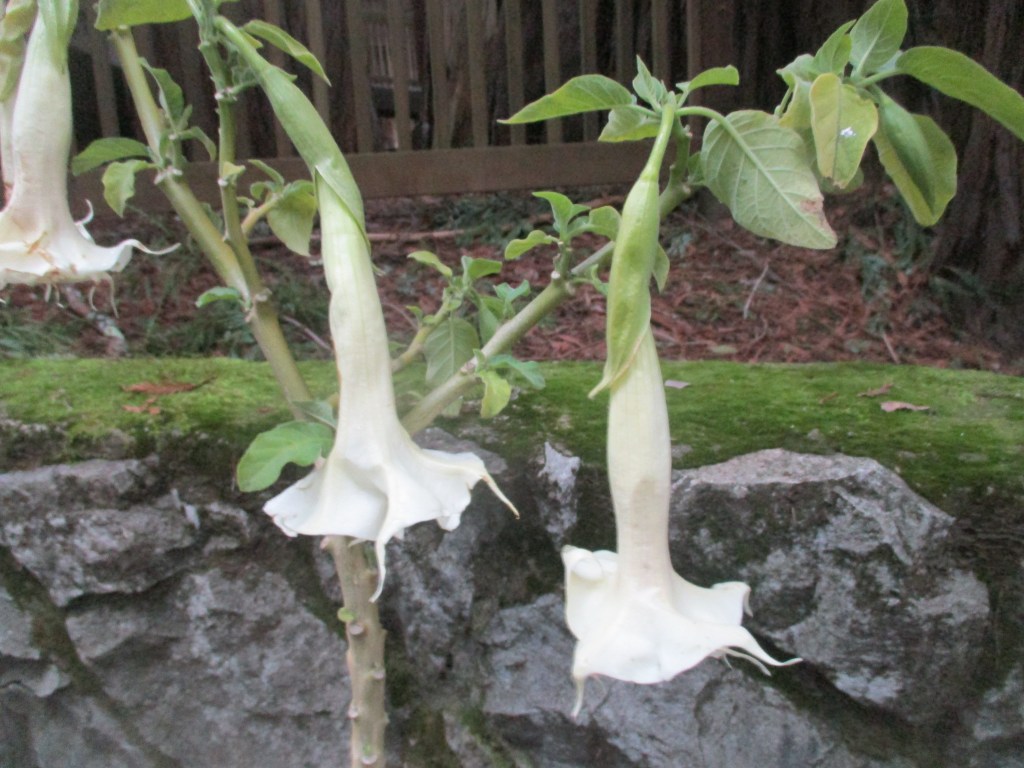
The white flower pictured below is common bindweed. When I was a kid, I knew it as morning glory. In this close up picture, it looks like a fancier garden variety of morning glory, although the flower is much smaller. Real morning glory happens to look good in white, like this one does. If it is fragrant, I have never noticed. It tends to creep along the ground more than it climbs.

It sometimes seems silly to me that others so easily notice how pretty weeds such as these are, especially while there are so many more flowers that are prettier. Then, I realize what others must think of what I consider to be pretty. For example, the pollarded blue gum with aromatic blue foliage that I enjoy so much, is the same species that gives all eucalypti a bad reputation.

Besides, these flowers were the prettiest in the otherwise bare meadow where I found them.

P00711K-2
Bindweed looks like miniature morning glory.

Six on Saturday: Closeups II

This is the more foliar counterpart to the closeups for my Six on Saturday from last week. Some are closer than others. Some would be more easily identifiable without captions than others. All are quite random. All these subjects are in the storage nursery; but only #1 and #5 will eventually find homes in the landscapes here. The others will likely go into one of my own gardens. I have no idea of what to do with #2.

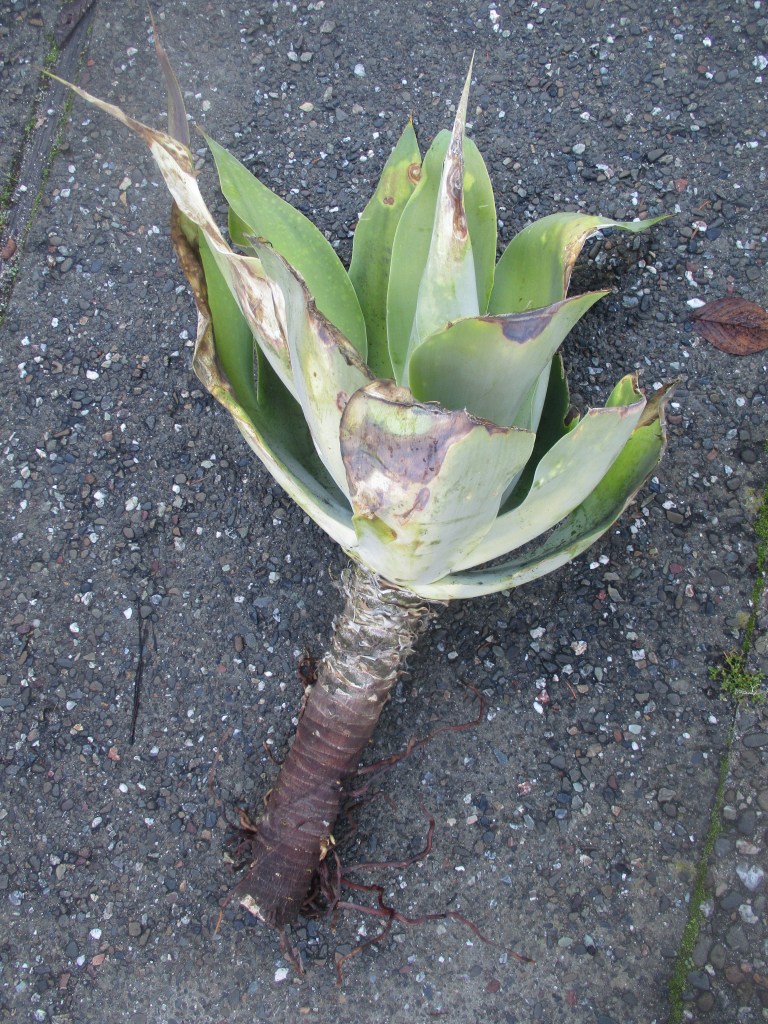
1. Agave pedunculifera – provided the most abstract picture of the six. The name is only a guess. Someone else might have been able to identify it as something else if more of it were visible.P00711-1

2. Eucalyptus globulus ‘Compacta’ – compact blue gum – was my second choice for juvenile blue gum foliage. It was easier to reach because it is more . . . compact. The other blue gum is tall.P00711-2

3. Cinnamomum camphora – camphor – is light yellowish green most of the time, and then gets slightly blushed with new growth late in spring. This young tree started late in partial shade.P00711-3

4. Trachicarpus fortunei – windmill palm – provided the second most abstract picture of the six. It is more recognizable though. Mediterranean fan palm is darker. Other fan palms are light.P00711-4

5. Picea sitchensis – Sitka spruce – was brought from Smith River, on the coast just south of Oregon. It does not seem to mind being so far from home. The happy new growth is impressive.P00711-5

6. Juniperus virginiana – Eastern red cedar – is my favorite this week because I brought it from Oklahoma. Cedrus deodara – deodar cedar – is the real cedar that provided the background.P00711-6

This is the link for Six on Saturday, for anyone else who would like to participate:

https://thepropagatorblog.wordpress.com/2017/09/18/six-on-saturday-a-participant-guide/

Six on Saturday: Closeups


This is not how we normally look at these flowers, stems and vegetables (fruits). They might look strange out of context. That was sort of intended. ‘Six on Saturday’ allows more freedom of creativity than the simple illustrations that I use for the gardening column. The last two are closeups of the same two gladiolas that were featured last week. Perhaps they show color better.

I should try this again for next week.

1. Lily of the Nile is the ‘Fourth of July Flower’. It blooms for the Fourth of July, and the florets radiate from the center of their floral truss like fireworks. I will write more about this at noon.P00704-1

2. Epiphyllum stems, like the stems of other cacti, do all the work of foliage. Because they are flat, they actually look like big and weirdly arching leaves. New tip growth is still rather blushed.P00704-2

3. Zucchini is too productive. I neglected to go down to harvest it for two days or so, and then found that some fruits had gotten as big as bowling pins. They are fortunately not too tough yet.P00704-3

4. Red willow is a weedy tree that I should not be growing intentionally. This is special though. I brought its cuttings from Reno. It will be coppiced, and not allowed to grow as a real tree.P00704-4

5. Gladiola got enough attention last week that I got closer pictures of them this week. This one seemed to be more purple or less blue last week, with just a bit of white, like elderly Grimace.P00704-5

6. Gladiola are more fun when someone else selects bold colors that I would not consider. This flashy orange and yellow bloom is exquisite, and looks like Grimace’s friend, Ronald McDonald.P00704-6

This is the link for Six on Saturday, for anyone else who would like to participate:

https://thepropagatorblog.wordpress.com/2017/09/18/six-on-saturday-a-participant-guide/

Six on Saturday: Housebound


This is not a good week for my Six on Saturday. The first three are of pansies; and the last two are of gladiolus. That is not much variety. Posting six pictures of different cultivars of roses or rhododendrons is somehow different and more interesting.

I did not get out enough to get many good pictures this week. I work inside for part of the week, and needed to stay in for Thursday as well. I got outside only on Wednesday and Friday.

1. Pansies are slowly succumbing to the warmth of spring and early summer. They can continue to perform as long as they like, we will not be replacing them with any warm season annuals.00627-1

2. Pansies are even prettier up close. Foliage was unusually sparse among this group, even prior to spring. Pansies had never stayed so late before. I would not have guessed that they could.00627-2

3. Pansy is one of the favorite flowers of my colleague down south. Although he does not use many at work, or even in his home garden, he always grows one pot full of them through winter.00627-3

4. Alstroemeria, which are also known as Peruvian lilies, do very well here. I do not remember if this is pink or ‘peachy’. I believe it is ‘peachy’. There are also yellow alstroemeria here.00627-4

5. Gladiola is one of my favorite summer bulbs, but I have not planted any in many years. They are not reliably perennial here. However, this orange gladiola has bloomed for several years.00627-5

6. Gladiola, now that I think about it, is actually my favorite summer bulb, rather than just one of my favorites. This purple gladiola has bloomed as long as the other, only in a different area.00627-6

This is the link for Six on Saturday, for anyone else who would like to participate:

https://thepropagatorblog.wordpress.com/2017/09/18/six-on-saturday-a-participant-guide/
Six on Saturday: Bark


Rhody said, “Cornus florida bark is rough.” He likely intended to say, “Dog would bark, ‘ruff!’.”

This is not about Rhody though. It is about these six pictures of bark of some of the more significant trees that I work with. All are native here. Only the sycamore was installed intentionally into a landscape. All of the others grew wild. There are so many interesting trees here that it was not easy to limit these pictures to just six. I actually took more pictures that were omitted.

Furthermore, a picture of Rhody is not included.

1. Platanus racemosa – California sycamore is bigger and bolder than other American sycamore. Trunks of mature trees are massive and gnarled, with this distinctively blotchy gray bark.P00613-1

2. Pinus ponderosa – Ponderosa pine is the grandest of pines. The massive trunks seem to be comparable to those of Douglas fir. Bark often flakes in bits that resemble jigsaw puzzle pieces.P00613-2

3. Quercus agrifolia – Coast live oak is second only to valley oak in regard to grandeur. Unlike valley oak, it is evergreen. Smooth gray young bark eventually becomes darker and furrowed.P00613-3

4. Pseudotsuga menziesii – Douglas fir is the majestic State Tree of Oregon, and a main timber crop there. Locally, it mixes with various ecosystems. Corky bark is rather finely furrowed.P00613-4

5. Acer macrophyllum – Bigleaf maple is the most imposing maple of the West. As the name implies, the leaves are bigger than those of any other maple. Bark gets sort of checked with age.P00613-5

6. Sequoia sempervirens – Coastal redwood is the grandest of all, and it happens to be the tallest tree in the World. Also, it is the state tree of California. The ruddy bark is distinctly fibrous.P00613-6

This is the link for Six on Saturday, for anyone else who would like to participate:

https://thepropagatorblog.wordpress.com/2017/09/18/six-on-saturday-a-participant-guide/

Post Script: For the first time, I am violating the recommended limit of six pictures to include this extra (but unnumbered) picture of Rhody for those who would be otherwise disappointed.P00613-7

Six on Saturday: Leftovers


It is not easy to discard seedlings and cuttings that have potential. We are supposed to sow several seed for vegetable plants where we ultimately want only a few, which typically produces a few extra. Feral seedlings for other types of plants commonly appear in the garden. I happened to grow a few seed that were marginally old, but that I did not want to discard. Nor do I want to discard deteriorating but lingering cool season annuals from last winter.

1. Since no new warm season bedding plants are going into the landscapes, cool season bedding plants are lingering until they succumb to the warmth. This pansy is not ready to give up yet.P00606-1

2. ‘Roma’ tomato seedlings that got plucked to favor stronger seedlings got plugged in cells for later. They got sown very late, and plugged even later, but might become a nice second phase.P00606-2

3. Extra summer squash seedling were also too good to discard. The main plants are producing now. This one should find a home quick. Since it can produce all season, no phasing is needed.P00606-3

4. Ponderosa pines make extras too. This seedling got plucked along with other weeds, but was too exemplary to discard. (For the record, someone else salvaged it; so I can not be blamed.)P00606-4

5. This is too blurry and dinky to look like much, but is a seedling of California fan palm. The seed was so old that I doubted its viability. I am very pleased with it, even if is the only survivor.P00606-5

6. White California poppies are rare in nature. This one was left in the landscape while many of the orange poppies were removed along with weeds. There is another only a few yards away.P00606-6

This is the link for Six on Saturday, for anyone else who would like to participate:

https://thepropagatorblog.wordpress.com/2017/09/18/six-on-saturday-a-participant-guide/

Six on Saturday: Rhody’s Rhodies II


As mentioned last week, the first five of these pictures are now two weeks old. They are too pretty to discard for lack of punctuality. However, it was necessary to delete one so that the most important, although less horticultural, sixth picture could be included. Not much of the bloom remains now.

1. Color seems odd for this one. It did not seem so greenish to me when I got the picture. In fact, it seemed more pale, and almost white. I know the camera sees it more accurately than I do.P00523-1

2. #1 from last week, which may have been ‘Mrs. G. W. Leak’, looks like this. I did not notice earlier. I would have otherwise deleted this instead of what I deleted to leave room for #6 below.P00523-2

3. If #4 from last week did not look like ‘Anah Kruschke’, it is because this one is. I knew I got a picture of it, but somehow switched the two. This is the only one that I can identify this week.P00523-3

4. Color is something that I am not proficient with. I do happen to prefer this color to other purple rhododendrons. I do not know if it is purple or lavender, or if lavender is just pastel purple.P00523-4

5. Of all the rhododendrons here, only a few are as richly red as this one. Of those few, this one is the second largest specimen, and most prolific in bloom. It is usually one of the last to bloom.P00523-5

6. Rhody! It is not much, but it proves that I at least tried to get a picture of what we all came here for. I deleted a good picture of another rhododendron to do it! Rhody would not cooperate.P00523-6

This is the link for Six on Saturday, for anyone else who would like to participate:

https://thepropagatorblog.wordpress.com/2017/09/18/six-on-saturday-a-participant-guide/

Six on Saturday: Rhody’s Rhodies I


Rhody actually had nothing to do with the rhododendrons. They have been her for decades. The youngest were added in the late 1990s. We know none of their identities. It does not matter. Bloom is spectacular. These pictures are from last Friday, so are a week old already. Six more will be two weeks old for next week. I just can not miss sharing them here for Six on Saturday.

1. Mrs. G. W. Leak – The spots are not pronounced enough. The foliage is not a good match either. Otherwise, the floral color and form are about right. Branch structure seems to match too.P00516-1

2. Trude Webster – This is just a guess. The leaves are not big enough. Bloom is a bit too brightly colored, and its spots are a bit too pronounced, although floral form seems to be about right.P00516-2

3. Lem’s Monarch – This one is questionable. Flowers are usually more white with reddish pink edge. However, they do not look quite like the real thing. Foliage happens to be a good match.P00516-3

4. Anah Kruschke – Like the others, the color is off for this one this year. It is normally a bit richer purple. I am fairly certain about its identity. The foliage and branch structure conform too.P00516-4

5. Rhododendron catawbiense – I am rather certain about the identity of this one. Everything about it is as it should be, even the foliage. This is probably my favorite of these particular six.P00516-5

6. Taurus – Of all of these six, this one is the least likely to be what I refer to it as. Only the floral color is correct. Floral form, foliage and branch structure are not. I do like the name though.P00516-6

This is the link for Six on Saturday, for anyone else who would like to participate:

https://thepropagatorblog.wordpress.com/2017/09/18/six-on-saturday-a-participant-guide/

Six on Saturday: (First) Rose Parade 2020


The landscapes are in surprisingly good condition after more than a month of neglect. Weeds are horrendous, but no more so than expected. They and the lawns are the priorities. Significant progress was made just in the last three days that we have been able to work. As busy as we are, I managed to get some nice floral pictures. Rhododendrons are still blooming, but will be the topic for next week.

1. Of the mere four cultivars here, this is my least favorite. The color and profusion of bloom are excellent. I just dislike how the floral form resembles those of the trendy David Austin roses.P00509-1

2. This cultivar is the only one that is in shrub form. All the others are tree roses (or standards). The profuse bloom resembled ‘Double Delight’ last year, but is completely different this year.P00509-2

3. Close up, it is more rich bright pink than distinctly reddish pink with white. It is fragrant like ‘Double Delight’ should be, although it does not seem to be as fragrant now as it was last year.P00509-3

4. The first (#1 above) is also different from how it bloomed last year. Its petals are not so densely packed. There are plenty of buds behind the maturing flowers. Performance is exemplary.P00509-4

5. Is this purple? Not only is its color odd, but it is grafted onto the same rose trees as the white roses (#6 below). It is too weird for my taste. Everyone else likes it. That is more important.P00509-5

6. As mentioned above, this cultivar is grafted onto the same rose trees as the purple roses (#5 above). To me, it seems to be the common ‘Iceberg’. I do like white, even if it is just ‘Iceberg’.P00509-6

This is the link for Six on Saturday, for anyone else who would like to participate:

https://thepropagatorblog.wordpress.com/2017/09/18/six-on-saturday-a-participant-guide/