Although it classifies as a tree, mugo pine, Pinus mugo, is more like shrubbery. Old trees may be only a few feet tall, and maybe twice as wide. Not many are more than eight feet tall. Their form is densely rounded. Foliage is deep forest green. Stiff paired needles are only about one to two inches long. Plump cones are not much longer, and are quite rare.
Mugo pine, although native to the Alps, is a traditional feature of Japanese gardens. Yet, it is rare within other types of gardens. It does not grow fast or big enough to be practical for much more than aesthetic appeal. It does excel at that, though, by developing such a distinctly rounded form. It can work well as foundation planting or a short informal hedge.
Mugo pine is not particularly discriminating about local soils or climates. It merely craves sunny and warm exposure. Mature specimens do not need much water, but are healthier with occasional irrigation. Mugo pine appreciates room for unrestricted growth. Shearing deprives it of its natural form and texture. If necessary, selective pruning may be tedious.
Most live Christmas trees grow too big for home gardens.
One of the problems with driving my favorite vehicles that were old long before I learned to drive them is that I spend considerable time waiting for a bus or walking. The cool thing about that is that I get to seem so much scenery that I would otherwise drive past. While waiting nearly an hour for a bus at the Cavallero Bus Terminal in Scott’s Valley, I went across the street to see the landscape of the somewhat new Post Office, which has actually been there for many years now.
The landscape is a bit sparse in front (I think because of architectural modifications after the landscape was designed), so was outfitted with recycled live Christmas trees. Although none of these particular trees seem happy in the local climate or sandy soil, I had wanted to get better acquainted with them for some time. They are an odd assortment of spruce and fir that are rare here.
The more typical concern with the more common live Christmas trees is not that they are not well suited to local climates and soils, but that they actually do too well and grow much larger than expected. Except for the small rosemary, holly and English ivy ‘trees’, most coniferous evergreen live Christmas trees are young pines that get remarkably large; and some waste no time doing it! The most common live Christmas trees are Italian stone pines, which happen to be the two very large and broad trees in Blaney Plaza in downtown Saratoga!
Canary Island pines, which had been more common than they are now, do not get quite as broad, but do get very tall and messy. Years ago, Aleppo, Eldarica and Monterey pines all took their turns being popular live Christmas trees. Each of them grows large enough to require significant garden space.
This is of course not a problem for the few live Christmas trees that happen to get planted where they have plenty of space. However, those that get planted where they do not have room to grow can cause serious problems. Because they seem so cute and innocent while they are young, and are so often expected to stay cute and innocent, many often get planted dangerously close to houses, where they can displace porches, walkways and even foundations! Large pines, particularly Italian stone pines, are also too messy and potentially combustible (if not pruned and groomed regularly) to be too close to houses.
Sadly, large pines do not like to stay in containers too long. They can be pruned for a few years, but eventually get congested roots. (Bonsai techniques of root pruning can maintain even the largest types of pines in containers indefinitely, but not many of us know these techniques.) Small pines, like Austrian black, Japanese black and Scott’s pine (which has no relation to Scott’s Valley), as well as other small coniferous evergreens, like certain junipers, can stay in containers much longer, but these are the sort that are small enough to get planted in the garden, so do not necessarily need to stay in containers anyway.
If space is not sufficient, pines and other live Christmas trees that eventually get too large really should be given to friends and neighbors who have space to accommodate them. Fortunately, most do not require much attention once they get established after two years or so.
Dwarf Alberts spruce is more like a conical shrub than a tree.
Most of the familiar conifers, or ‘cone-bearing’ plants, are large trees like pines, spruces, cedars and cypresses. They are practical trees only with sufficient space, and where their debris and constant evergreen shade will not interfere with lawns or other plants below. Their less familiar compact specie and cultivars (cultivated varieties) that grow as smaller trees or large shrubbery are actually more proportionate, and therefore more useful for refined landscapes.
There are actually several small specie of pine, like Scots, Austrian black, dwarf Swiss stone, mugo, and the various Japanese red, black and white pines. Some of the most compact cultivars grow as dense shrubbery. Others grow as small to mid sized trees with the personalities of larger pines.
There are fewer compact spruce to choose from. Dwarf Alberta spruce, which is a very compact cultivar of white spruce, is perhaps the smallest and most symmetrical, growing as a dense and strictly conical shrub. Columnar and pendulous cultivars of blue spruce grow in opposite directions, upright and downward, but stay compact enough to be grown as sculptural specimens or shrubbery. There are also pendulous white and Norway spruce.
Several compact cultivars of western red cedar and northern white cedar (Thuja spp.) are popularly grown as tall hedges. They are not actually cedars (Cedrus spp.) and are more often known by the common name of ‘arborvitae’. There are even more Asian arborvitaes (Platycladus spp.) to choose from; many of which have bright golden foliage. ‘Swane’s Golden’ Italian cypress is narrower and denser than the arborvitaes, but not as brightly colored.
Despite the bad reputation of certain cultivars that were planted too extensively decades ago, many junipers are very practical and sculptural coniferous shrubs, as well as ground covers and even small specimen trees. Some ground cover types stay less than a foot deep. Shrubby and small tree types are at their best where they have room to grow without pruning. If ‘Hollywood’ juniper is too old fashioned, the various Rocky Mountain junipers and Eastern red cedar (again, not really a cedar) are worth investigating for their distinctively picturesque forms.
Chamaecyparis are perhaps the most variable of the evergreen coniferous shrubs and trees. Although there are naturally only a few specie which grow into substantial timber trees, there are countless cultivars that are compact enough for residential gardens. Most stay less than thirty feet tall. Many stay less than half as tall. Most have rich deep green foliage; and many have bluish, greyish or golden foliage.
Chamaecyparis are known by a few different but inaccurate common names, including ‘cypress’, ‘false cypress’ and ‘cedar’. (Although the Alaskan cedar is now classified as a cypress, Cupressus or Callitropsis nootkatensis.) Like almost all other conifers, they are best where they can grow naturally without major pruning or shearing to compromise their naturally appealing forms and textures. The most diminutive cultivars are excellent for bonsai and rock gardens, or even in urns of mixed perennials.
It is unfortunate that most live Christmas trees grow too large for compact home gardens. Japanese black pine, Pinus thunbergii, which is very rarely available as a live Christmas tree, does not get much taller than twenty feet locally. Although it can slowly get about as broad, its sculpturesque branch structure adapts to pruning for containment if necessary.
Japanese black pine is a notably versatile pine. Most pines are excurrent (with a primary central trunk) or develop another similarly uncompromising form. Few are as cooperative with such casual form and relatively contained size as the Japanese black pine is. In the wild, it grows taller than a hundred feet. Yet, it is also very popular for bonsai and niwaki.
The evergreen foliage is richly deep green. The paired needles are about four and a half inches long, and perhaps stiffer than they appear to be. The cones are about two or three inches long, and nicely symmetrical. Fresh foliage and fresh or dried cones are useful for home decor. Even young trees have handsomely flaky bark, which darkens with rain.
Most shrubs and many perennials get larger than the diminutive mugo pine, Pinus mugo. The most common type grows very slowly as a dense and rounded mound only a few feet tall and maybe twice as wide. Only a very old specimen might reach an eave. The paired dark green needles are about one or two inches long. The symmetrical brown cones are a bit shorter. Mugo pine is also known as Swiss mountain pine and because of a misprint in the eighteenth century, mugho pine. Although native to mountains in Europe, mugo pine is most popular in Japanese gardens and for bonsai. Because it grows so slowly, it can be happy in planters and large pots. In large urns of regularly changed flowering annuals, it can be a nice permanent and evergreen centerpiece.
For spacious landscapes, Canary Island pine, Pinus canariensis, became more common than Monterey pine through the 1970s. New trees became less popular as old trees demonstrated how big they get! However, as seemingly docile live Christmas trees, they still often sneak into gardens that are not big enough for them. Their short blue juvenile needles suggest that they stay small.
They instead get quite tall. Old trees can get more than a hundred feet tall, even if their canopy gets no wider than twenty feet. Their rich brown bark is distinctively and coarsely textured. Their thin and long needles are somewhat pendulous, with a rather fluffy appearance. They are in bundles of three. Although individual trees are not very broad, their shade can get too dark for other plants.
Canary Island pine is a stately tree, but is not easy to accommodate. It produces copious foliar debris that can shade out lawn and ground cover, and accumulate on shrubbery. In unrefined areas, without other plants, foliar debris suppresses weeds. However, too much can be combustible. Such grand and resilient trees suit parks, and are ideal for freeway embankments and interchanges.
From coastal regions around the Mediterranean Sea, the Aleppo pine, Pinus halepensis, came to be right at home on and near the coast of California. Once established, it can survive quite happily on rainfall. Trees that get too much water can actually get too heavy with foliage, and may eventually get disfigured if limbs break.
Shade under an Aleppo pine is not too dark. The light and sometimes yellowish green foliage is rather wispy, comprised of thin paired needles that are about three inches long. The sculptural trunks almost always lean to one direction or another, and often divide into multiple trunks once they grow out of reach. Bark is light gray with light brown striations.
Young trees can get big rather fast. They tend to be somewhat conical, or at least upright, until they get to be about forty feet tall. Then, they tend to shed lower stems and develop irregular branch structure with rounded tops as their growth rate slows. Only a few old trees in ideal situations slowly get to seventy feet tall. Seedlings sometimes appear where they are not wanted.
Even though it can get about fifty feet tall and wide, Italian stone pine, Pinus pinea, often gets planted as a small living Christmas tree into confined urban gardens. It gets so big so fast that it can get to be a serious problem, as well as expensive to remove, before anyone notices. It is really only proportionate to large public spaces such as parks or medians for big boulevards. The bulky trunks typically lean one way or another. The long limbs spread laterally to form an unusually broad and flat-topped canopy.
The paired needles are about four to six inches long. However, small living Christmas trees are still outfitted with juvenile foliage that looks nothing like adult foliage. Juvenile needles are single, very glaucous (bluish) and only about an inch or an inch and a half long. Adult foliage may not develop for a few years. The four or five inch long cones mature slowly for three years. Squirrels and birds like the big seeds, which would otherwise be known as pine-nuts if people could get them first.
(Apologies for this inadequate illustration of Italian stone pines damaged by traffic. It was the only picture of Italian stone pine I could find.)
By modern standards, the public schools that I attended in the early 1970s would be considered to be bleak and primitive. The building were utilitarian and simple, from about twenty years earlier. The landscaping was comparably simple, with a big lawn and proportionately big shade trees. A screen of alternating Monterey pine and Monterey cypress was hedged on the southern half of the eastern boundary of the schoolyard. The only deviants to the simplicity were a few significantly older trees on the northern half of the eastern boundary of the school yard. There were two coastal redwoods, a Canary Island date palm, a cedar, and a spruce of some sort. They were all quite mature, and were likely remnants from an old farmhouse that was there before. Perhaps they wanted us to be aware that everything changes.
On the way to kindergarten, back when children were allowed to walk to school, I weaseled my way underneath the first Monterey pine and Monterey cypress on the southern end of the fence line, and fell asleep. I do not remember how long I stayed there, but it was long enough to get in serious trouble with my very worried kindergarten teacher. After that, I could only visit those two trees in passing, and perhaps stop only briefly to smell the foliage or shake some of the rain away.
Nearly four decades later, but only a few years ago, I was assigned the grim task of composing the arborist report that would justify the issuance of a permit to remove that same Monterey pine, which was the last that remained of the hedged trees that I remember. I did not know that when I went to the site. I was just told that it was a ‘pine’.
Visiting the old school was not a pleasant experience. The entire site was surrounded with a prison like fence and saran screens to obscure the view inside and out. There were no open gates. I needed to be escorted to the tree by a professional chaperone. Much of the schoolyard had been very synthetically landscaped with microtrees and pretty flowering shrubbery that was intended to impress parents rather than appeal to children. It is bad enough that there are no orchards or open spaces remaining in the region, but it is worse that children are deprived of the open lawns and trees and natural spaces that my generation had taken for granted on the grounds of our school. Are children even allowed to climb trees anymore? Do they know what dirt is? Can they observe a chrysalis split open to reveal a new butterfly before the gardeners shear the shrubbery and take the learning experience away? It was saddening.
Once I realized that the tree that I was expected to condemn was my old friend, I asked the chaperone, who seemed to know a bit about facilities at the site, why anyone would want the now mature tree to be removed. I knew that it had been mutilated while young, but was impressed with how it somehow recovered and developed a well structured trunk. I thought that perhaps someone noticed something that I was missing in my inspection. People who are not arborists are sometimes alarmed by something that is perfectly normal for a tree, such as furrowed bark, or slight seasonal foliar discoloration.
The chaperone explained that the tree needed to be removed simply because it did not conform to the style of the rest of the landscape. I waited for the rest of the answer, but that was it. The tree did not conform.
Nothing gave me more pleasure than to explain that after my evaluation of the health, stability and structural integrity of the subject, I could find no justification for removal.
I was dismissed.
Yes, it was worth it.
However, I knew that for the right price, another arborist would be pleased to condemn the tree. The picture of what remains suggests that the arborist who did so was not even professional enough to get his crew to finish the job. How does this dead stump conform to the rest of the landscape?
Those old trees, the redwoods, palm, cedar and spruce, were right. Everything changes.
The Monterey pine that would not conform is gone now, but it was right too.
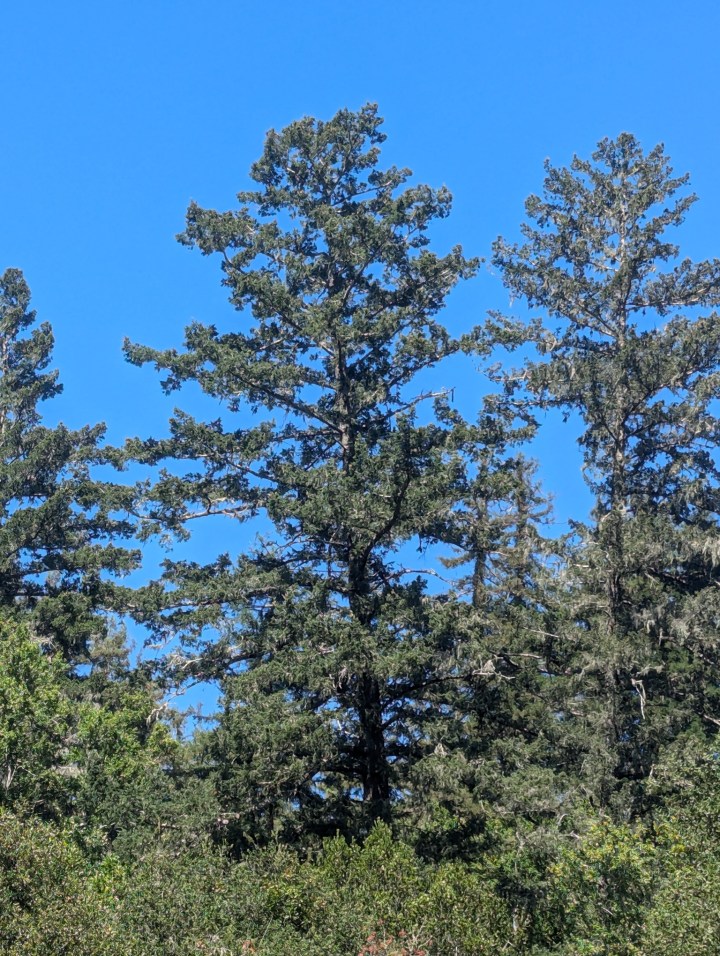
Relative to other pines and evergreens that are commonly grown as living Christmas trees, the uncommon and even rare Austrian pine, Pinus nigra, would be a better option. If it gets planted too close to the home, as Christmas trees often do, it does not get big enough to cause major problems. Although much bigger in the wild, local trees may take decades to reach second story eaves.
The species is divided into two subspecie, which are each divided into three regional varieties, which is a fancy way of saying that individual trees may have distinct personalities. Generally, they resemble Japanese black pine, with similar irregular branch structure, but are more dense, and may get a few pendulous stems with age. The dark green needles are slightly shorter and stouter.
The Austrian pine was likely named as such when much of its natural range was still within the Austro-Hungarian Empire, which has since been subdivided into the countries east of the Adriatic Sea. Other larger parts of the range are in Turkey and Spain. Only a small colony lives within Austria, west of Vienna. Austrian pine likes full sun and warmth like it would get naturally back home.



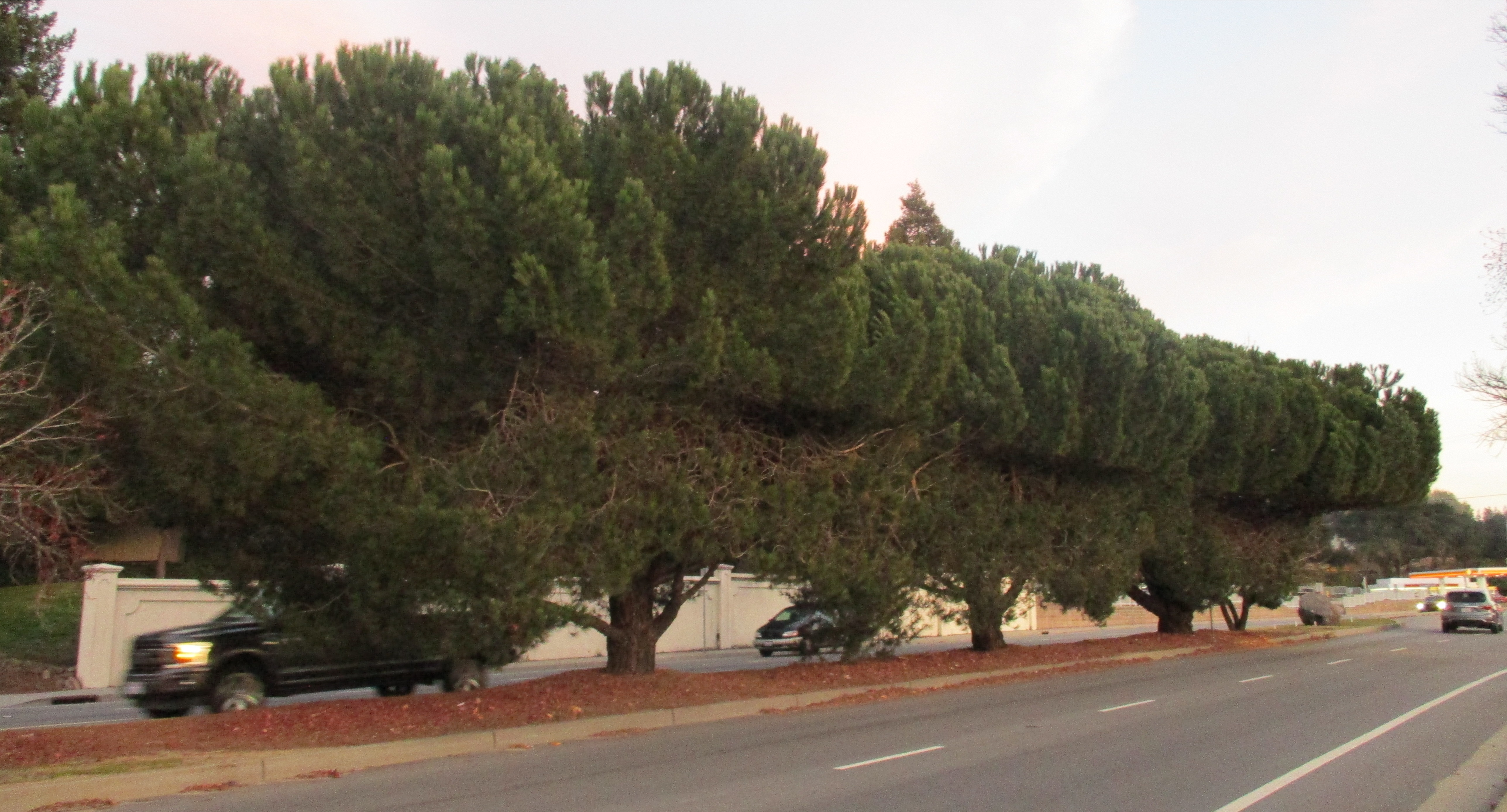 Even though it can get about fifty feet tall and wide, Italian stone pine, Pinus pinea, often gets planted as a small living Christmas tree into confined urban gardens. It gets so big so fast that it can get to be a serious problem, as well as expensive to remove, before anyone notices. It is really only proportionate to large public spaces such as parks or medians for big boulevards. The bulky trunks typically lean one way or another. The long limbs spread laterally to form an unusually broad and flat-topped canopy.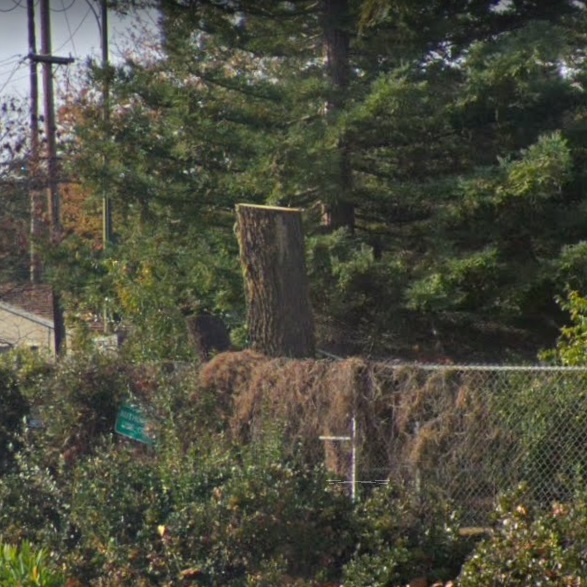
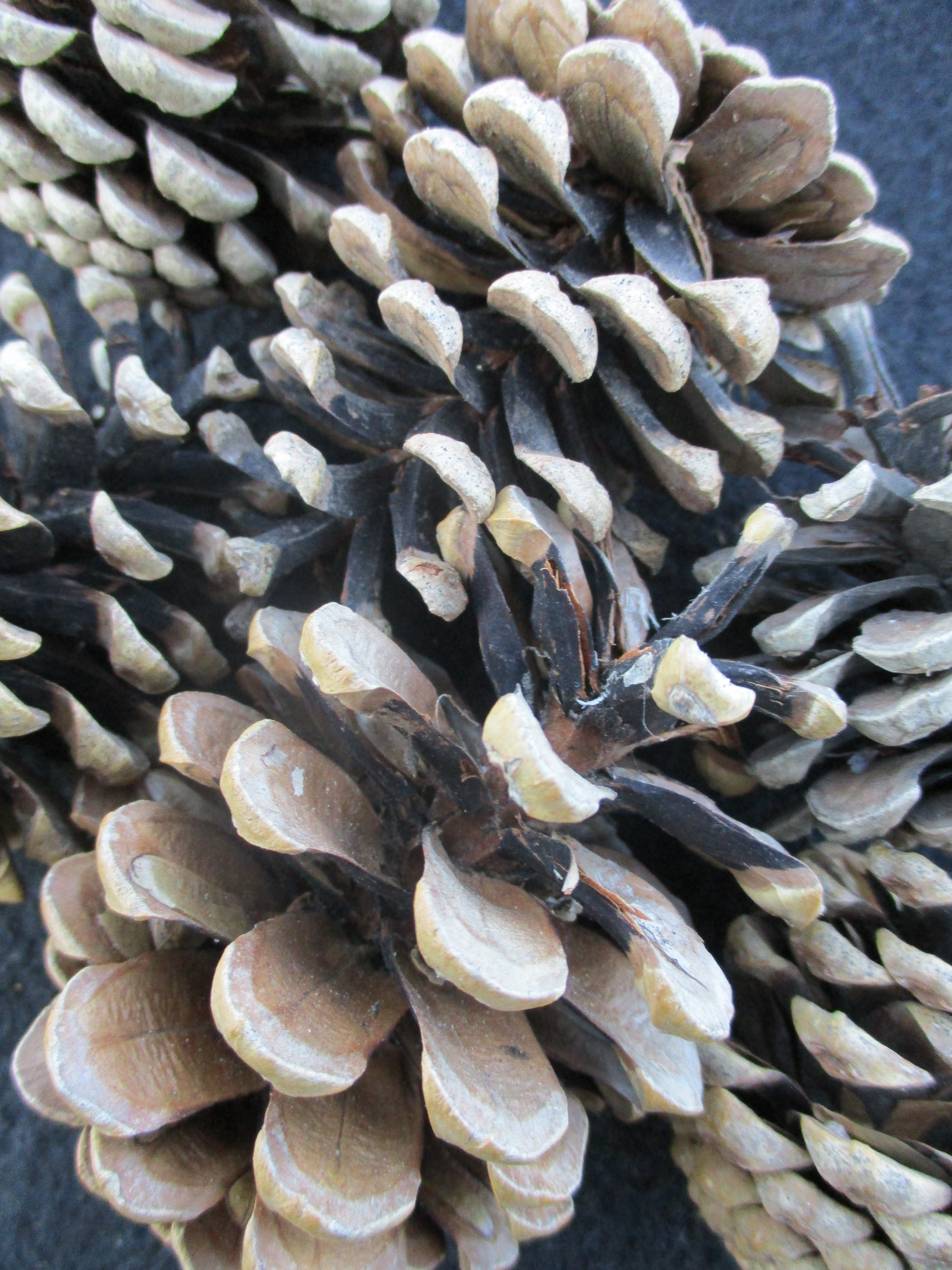 Relative to other pines and evergreens that are commonly grown as living Christmas trees, the uncommon and even rare Austrian pine, Pinus nigra, would be a better option. If it gets planted too close to the home, as Christmas trees often do, it does not get big enough to cause major problems. Although much bigger in the wild, local trees may take decades to reach second story eaves.
 Tony Tomeo