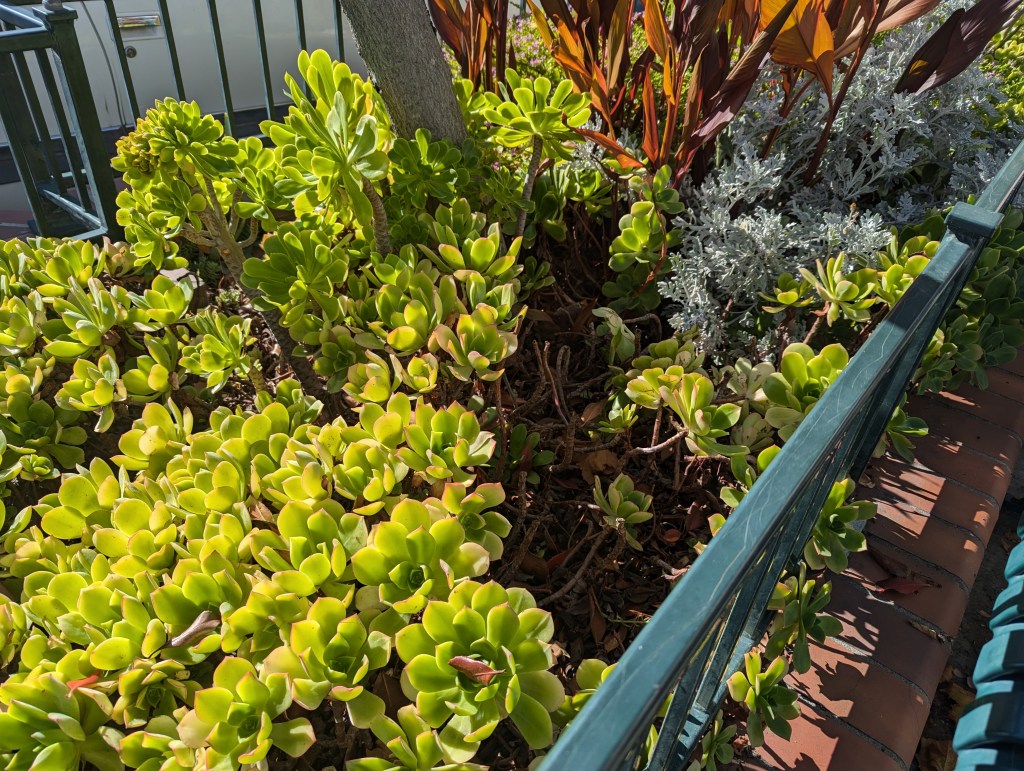
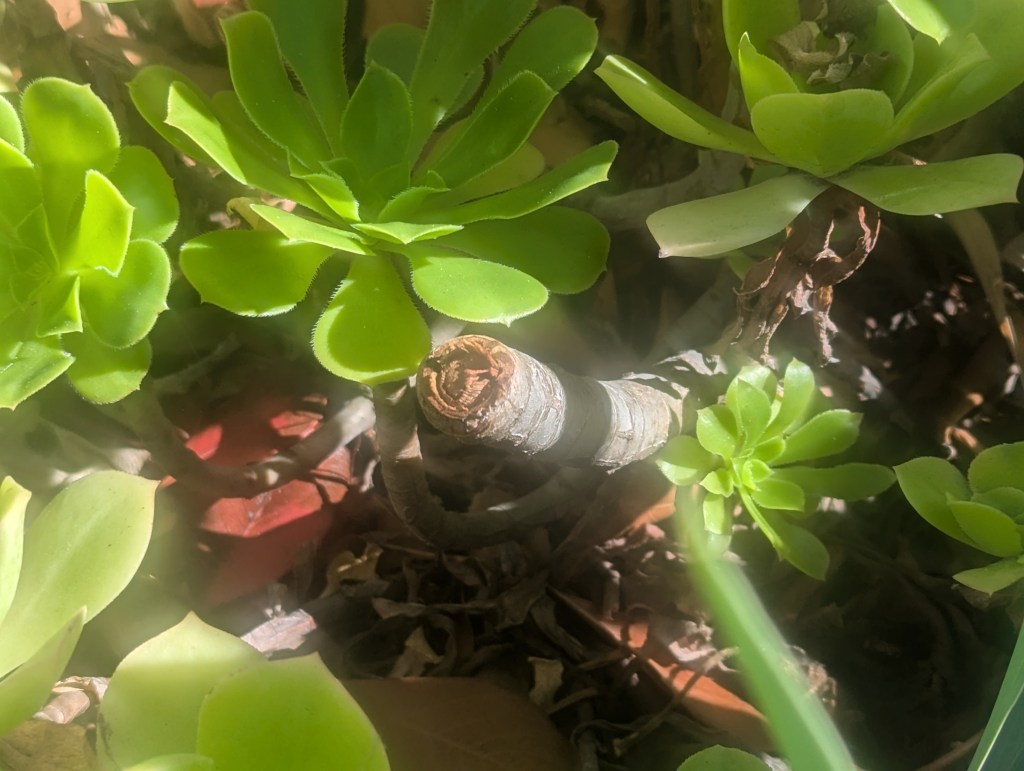
Nasturtiums were a good choice for my downtown planter box, or so I thought. I know that people pick flowers from such planter boxes. I figured that nasturtiums bloom so abundantly that no one could possibly pick all the flowers from them. Technically, I was correct. Technically, not all of the flowers were picked. However, there were times when only a few of the abundant flowers remained. I replaced them with some sort of compact aeonium like perennial that I can not identify. It forms dense mounds of yellowish green succulent foliage that I figured no one would bother. I do not mind when I notice a few pieces missing. There is enough to share. What I do mind is that someone clear cut harvested enough to leave this bald patch. The left half of the picture demonstrates what it should look like. What is worse is that there is so much of it extending outside of the railing that would not have been missed if it had been taken. Also, as the picture below shows, the more prominent common aeonium is not exempt from such pilferage. So, why do I bother? Well, I still enjoy my downtown planter box.
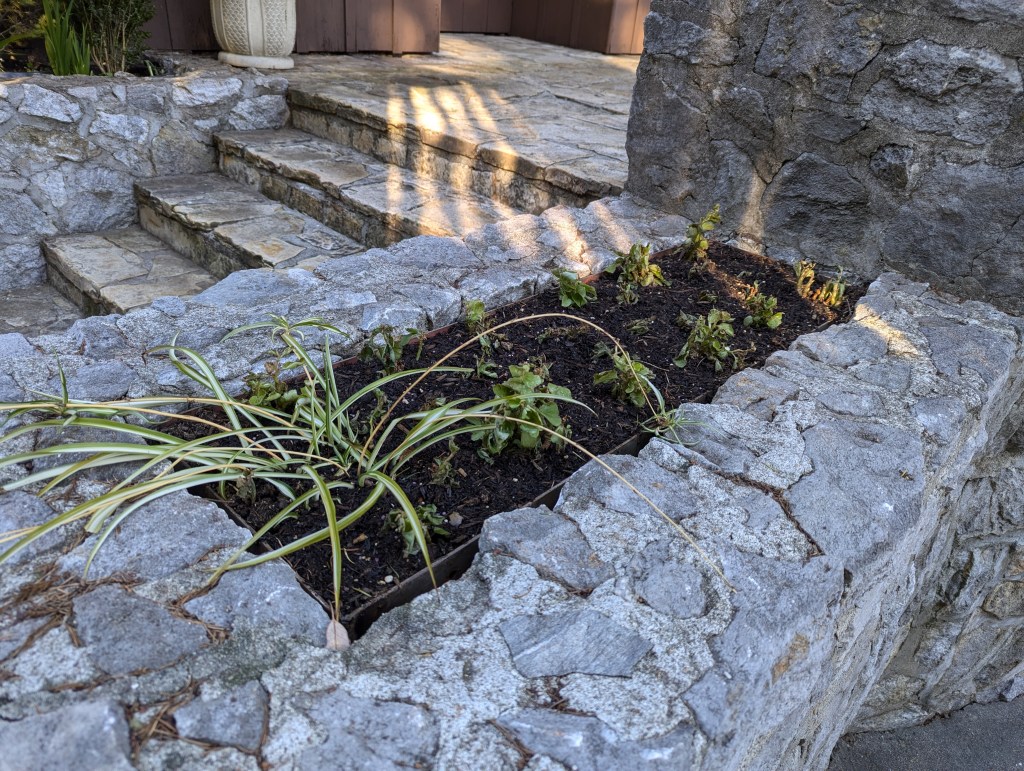
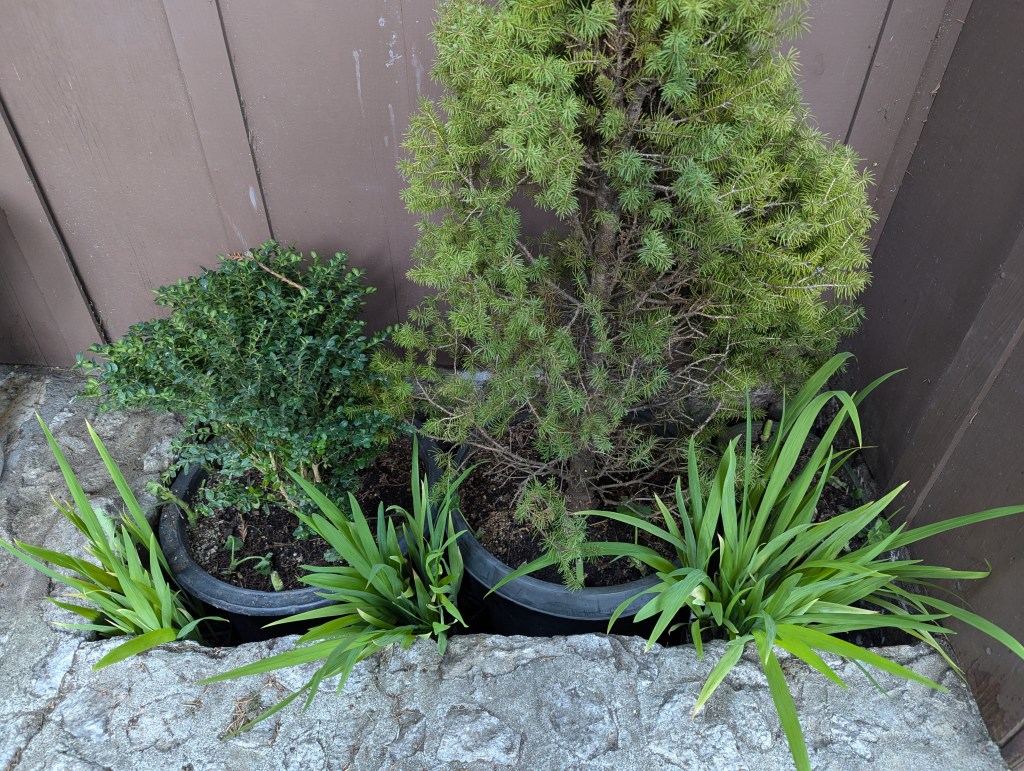
El Catedral de Santa Clara de Los Gatos is merely the Mount Hermon Memorial Chapel, which is a more proportionate name that does not trivialize its Memorial status. I prefer it to seem grander than it is. Also, I maintain a strict standard for its minimal landscape. All of its flowers bloom exclusively white. However, most of its flowers have been rather pekid because of aggressive invasion of consumptive redwood roots into irrigated areas. Because I can not stop the encroachment, I removed the soil from four primary planters. Within the front pair of planters, I suspended customized planter boxes. Within the rear pair of planters, I suspended a few nursery cans that contain new plants. Redwood roots can not reach into these planters or cans. The recycled vegetation still looks shabby, but should perform better than ever for this summer.
1. Chlorophytum comosum, spider plant, with Begonia X semperflorens–cultorum, wax begonia, are icky through winter, but should perform better than ever by spring without aggressive redwood roots. Their planter within their planter is visible at the front corner.
2. Picea glauca var. albertiana ‘Conica’, dwarf Alberta spruce, and Buxus sempervirens, English boxwood, are within #15 cans within their planters. Crocosmia X crocosmiiflora are in 4″ pots. It is trashy, but is for their own protection from aggressive redwood roots.
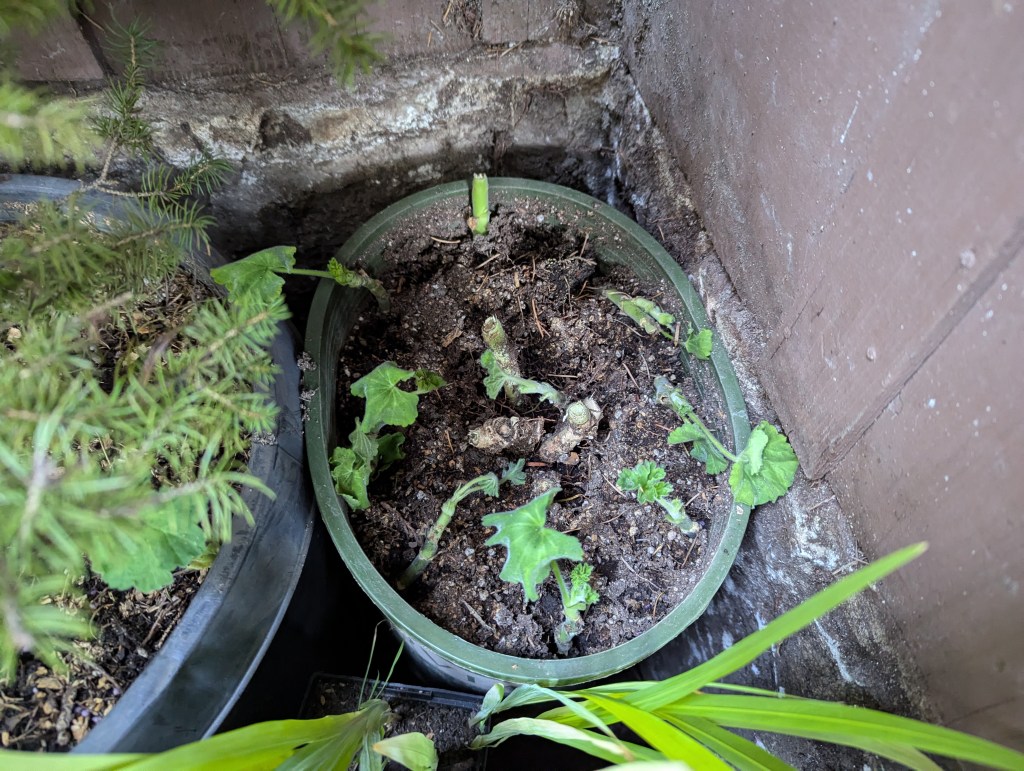
3. Pelargonium X hortorum, zonal geranium, within a #5 can that is obscured to the far right of the items described above, is merely cuttings from what was here prior. They, as well as several more within the cans of the other items, should grow to obscure the cans.
4. Pelargonium X hortorum, zonal geranium, that was here prior to this renovation was abundant enough to provide many more cuttings that we could utilize. These few should obscure these bare bases of a pair of lemon cypress, Cupressus macrocarpa ‘Goldcrest’.
5. Collectively, it should look sharp for summer. The Crocosmia X crocosmiiflora is just temporary until the zonal geranium grows to replace it. I do not want their bright orange bloom within this exclusively white garden. Everything in this new landscape is recycled.
6. It only looks puny from across the road because the stone wall is so big and ominous. It will be prettier as the zonal geranium and wax begonia begin to bloom for late spring. The cypress may not conform to a white garden, but their color is foliar instead of floral.
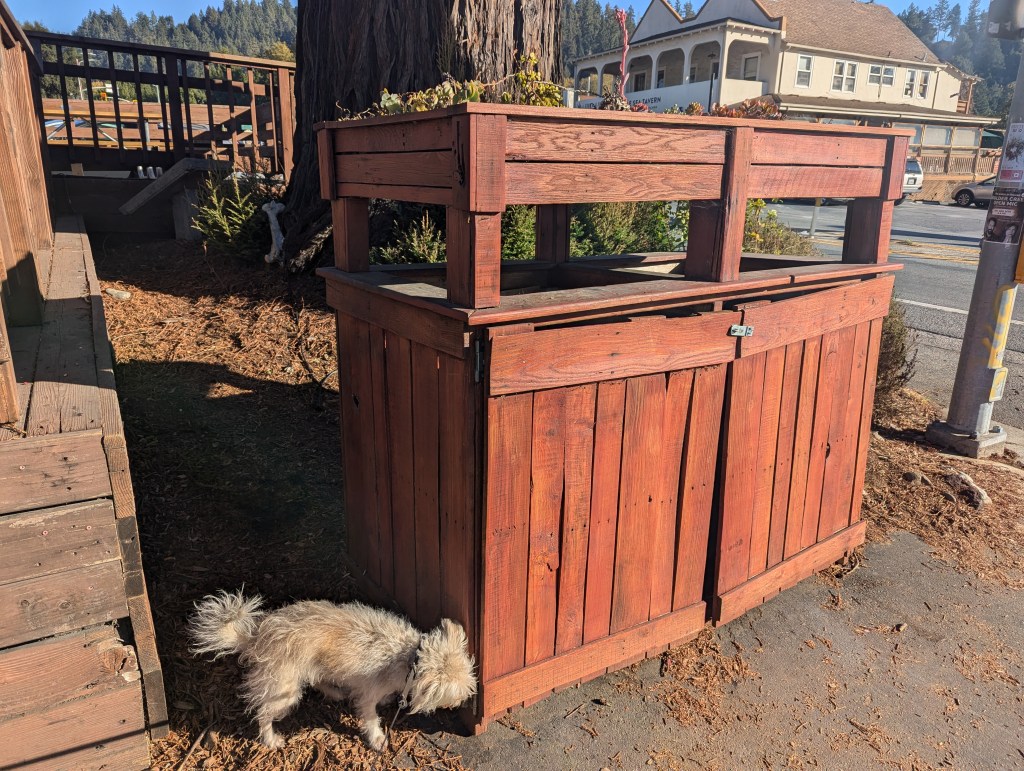
Public trash receptacles are a good concept. Without them, some of us would be more likely to litter. Contraptions such as this are most likely a good concept too, since they are somehow more visually appealing than exposed trash cans. Also, they are unlikely to fall over and spill as exposed trash cans sometimes do. Originally, one half of this receptacle was designated for trash, and the other half was designated for recyclables. This is another good concept, but was very unfortunately discontinued because it is so commonly ignored that someone must sort through less than efficiently sorted trash and recyclables. The only obvious component of this device that may not have been such a good concept is the planter box that hovers above it. Once outfitted with a nice collection of succulent perennials, it was left to survive as well as it can, which has not been very well. Succulents were likely selected for this particular application because they are supposedly ‘drought tolerant’. However, only some are drought tolerant, and only because they extend their roots as they must in order to find moisture, which they are unable to do while confined to this hovering planter box. Although they have been surviving, they have not been very happy about it. I suspect that someone must sometimes give them water, but these succulents want a bit more. Realistically, they would be happier in the ground behind the trash receptacle. There is certainly plenty of vacant space for them there, and they would be more visually appealing where they would actually be more visible than they are above average eye level. If some sort of vegetation is desirable above the trash receptacles, small shrubs or vines in the ground next to them would be happier than succulents above them. It would have been better to maintain the space that is already in need of maintenance than to add more.
These containers are almost completely obscured by their contents.
Container gardening is one of those trends that I could do without in my own garden. Even though I know that it is actually very practical for several reasons, I prefer to grow as much as I can directly in the ground because I do not want to take care of contained plants. However, even with only minimal potted plants around my garden, the steep embankment above my driveway has reminded me of one of the many reasons why people like to grow plants in large or hanging pots, elevated planters or window boxes. There are just so many plants that look so good cascading out of containers.
The lily-of-the-Nile that I planted on top of part of the embankment to hold the soil together actually look really cool leaning over the top edge, and would look just as good in large planters. The smaller ‘Peter Pan’ lily-of-the-Nile is more proportionate to smaller urns. Since these do not hang over the edges too far, they look even better mixed with more pendulous plants like trailing rosemary, verbena, ivy geranium and dwarf periwinkle. Upright plants like fuchsia and smaller types of New Zealand flax in the middle of mixed plants add good contrasting form. Dracaenas (Cordyline spp.) were traditional vertical accent plants of Victorian gardening.
Low planters and pots, as well as many hanging pots, are very often best outfitted with traditional cascading annuals like lobelia, sweet alyssum, petunia, portulaca and my favorite, nasturtium. Even if annuals that do not cascade are the central features of mixed planters, cascading plants around the edges really maximize the show by spreading even more flower color over the exteriors of the containers. Colorful perennials like fibrous begonias, busy Lizzie, campanula, fleabane, scaevola and dusty miller may not cascade as well as the annuals, but add width, and probably cascade adequately for ‘artfully’ designed pots that are too appealing to obscure completely.
In sheltered lanais and porches, spider plant, burro tail and wandering Jew are classic solitary perennials for hanging pots. What orchid cactus lacks in form and foliage, it makes up for with bold flowers.
The largest pots and planters can benefit from simple ground covers like shore juniper and English ivy, perhaps dressed up with flowering annuals. Gazanias can provide their own flowers, so can instead be dressed up with the colorful and textural foliage of blue fescue or another grassy perennial. Asparagus densilforus has such bold texture and form alone that it does not necessarily need the color of annuals.
Ornate pots and planters can be as decorative as the plants within them, and provide extra accommodation for more plants.
Like so many fads too often are, container gardening is overrated, and is actually contrary to the currently most faddish of fads; sustainability. Plants in containers need more regular watering than those that can disperse their roots more extensively into the ground. Those that are so indulged also want fertilizer to be applied more regularly, but are more likely to be damaged if fertilized too generously. Because confinement is stressful, plants in containers are innately more susceptible to disease and pests. Some plants need more pruning for confinement.
Then there are the problems with the containers. If exposed to sunlight, thin plastic containers get warm enough to cook roots within. Pots that do not drain adequately or that sit in their own drainage basins can stay saturated enough to kill roots. Water in drainage basins allows mosquitoes to proliferate. Seepage from large pots can rot decks and stain pavement. Self watering containers work nicely for houseplants (if used properly!), but lack drainage, so can not be used out where they are exposed to rain.
The advantages to container gardening are actually quite limited. Containers are obviously needed for houseplants, and where exposed soil is not available, like on balconies. They are also convenient for plants that want better soil than they can get in the garden, especially if the rest of the garden is responsibly landscaped with sustainably undemanding plants that do not require soil amendment or regular watering. Frost sensitive plants can be moved easily to sheltered locations if contained. Flashy plants like orchids and tuberous begonias that get displayed prominently while blooming can be concealed while not so impressive.
Of course there are many pendulous plants like Boston fern, spider plant, string or pearls and burro’s tail that really are at their best in hanging pots. It is also hard to deny that there are all sorts of artsy containers, like colorfully glazed pots and sculptural concrete urns, which are appealing enough to justify growing plants in them, even if just to show off the fun containers. Bonsai requires containers, but that is another big topic!
The minute bright pink flowers of Mexican heather, Cuphea hyssopifolia, are less than a quarter inch long, but are enough to get the attention of the hummingbirds who really dig them. Flowers can rarely be more purplish or even more rarely white. The limber stems are well foliated with finely textured and narrow leaves that are not much more than half an inch long. Mature plants are typically lower but a bit wider than two feet. Overgrown plants can be pruned severely at the end of winter to regenerate over summer.
Ornate pots and planters can be as decorative as the plants within them, and provide extra accommodation for more plants.
Like so many fads too often are, container gardening is overrated, and is actually contrary to the currently most faddish of fads; sustainability. Plants in containers need more regular watering than those that can disperse their roots more extensively into the ground. Those that are so indulged also want fertilizer to be applied more regularly, but are more likely to be damaged if fertilized too generously. Because confinement is stressful, plants in containers are innately more susceptible to disease and pests. Some plants need more pruning for confinement.
Then there are the problems with the containers. If exposed to sunlight, thin plastic containers get warm enough to cook roots within. Pots that do not drain adequately or that sit in their own drainage basins can stay saturated enough to kill roots. Water in drainage basins allows mosquitoes to proliferate. Seepage from large pots can rot decks and stain pavement. Self watering containers work nicely for houseplants (if used properly!), but lack drainage, so can not be used out where they are exposed to rain.
The advantages to container gardening are actually quite limited. Containers are obviously needed for houseplants, and where exposed soil is not available, like on balconies. They are also convenient for plants that want better soil than they can get in the garden, especially if the rest of the garden is responsibly landscaped with sustainably undemanding plants that do not require soil amendment or regular watering. Frost sensitive plants can be moved easily to sheltered locations if contained. Flashy plants like orchids and tuberous begonias that get displayed prominently while blooming can be concealed while not so impressive.
Of course there are many pendulous plants like Boston fern, spider plant, string or pearls and burro’s tail that really are at their best in hanging pots. It is also hard to deny that there are all sorts of artsy containers, like colorfully glazed pots and sculptural concrete urns, which are appealing enough to justify growing plants in them, even if just to show off the fun containers. Bonsai requires containers, but that is another big topic!
Container gardening is overrated. The endemic soil here is not so bad that nothing will grow in it. What is now suburban gardens was formerly famously productive farmland! Soil amendments make the soil more comfortable to plants with more discriminating taste. Plants that are too discriminating are probably not worth accommodating. With few exceptions, planters are unnecessary.
Plants naturally want to disperse their roots into the soil. Drought tolerant plants disperse their roots even more extensively. That is how they find enough moisture to be drought tolerant. If deprived of such root dispersion, they are always reliant on watering. Plants prefer the insulation of soil too. Many types of planters can get uncomfortably cool in winter, and uncomfortably warm in summer.
Besides, planters clutter landscapes, and occupy space on hardscapes. Decks rot. Patios stain.
The main advantage of planters is their portability. Plants that are sensitive to frost can move to shelter before the weather gets too cool. Plants that are spectacular only while blooming can move for more prominent display during bloom. For those who have not settled into a permanent home, plants in planters are able to relocate. Planters on patios or decks can move about like furniture.
Houseplants obviously grow in planters because not many houses contain enough soil for them to live in. Houseplants can move about just like planters in the garden. That is helpful for those that need a better exposure for winter than they enjoy for the summer. Some might like to go into the garden during mild weather, or for a rinse in light rain. Cascading plants can hang from the ceiling.
Planters can effectively confine invasive plants as well. Montbretia is so invasive that some people will not grow it without containment. (Deadheading to prevent seed dispersion is important too.) Horseradish often grows in tubs for confinement, as well as to facilitate harvest. It is easier to dump the potting media from a planter, and separate the roots out, than to dig roots from the ground.
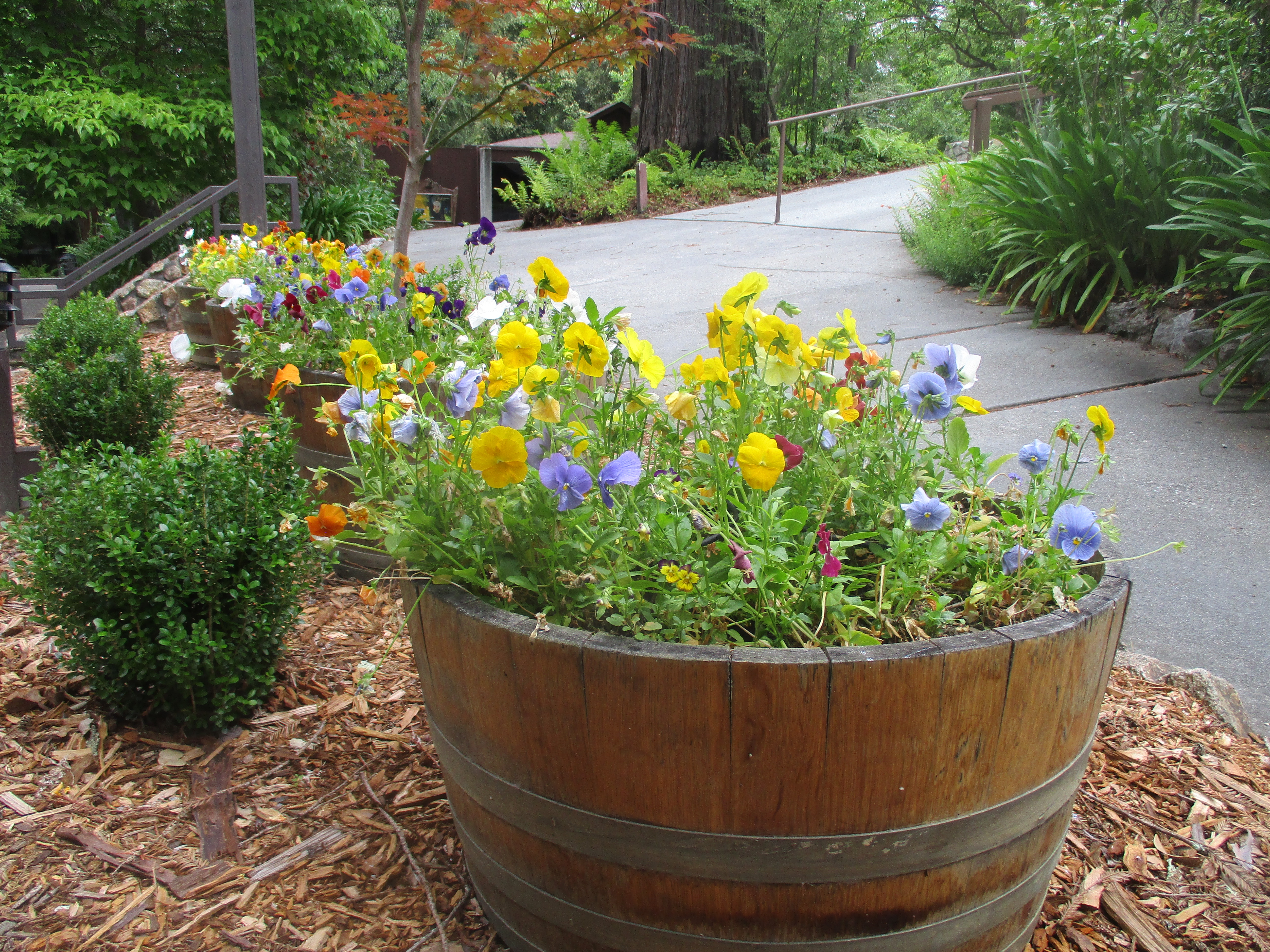
Half barrels are a bit elevated, and seem to show off their flowers better.
With conservation of water being so important right now, annuals are not a priority. Many of us are trying to use as little water as possible, and only to keep the more significant trees, shrubbery and perennials alive until winter. Lawn and annuals are usually the first to succumb, mainly because they use more water than anything else.
They are also somewhat expendable. Lawn is certainly expensive, but realistically, can be replaced as soon as water becomes available. Hopefully, new lawns will be more conservative with water, like they should have been since the last “drought” (and the one before that). Annuals are planted annually (duh), so they get replaced anyway.
Annuals as bedding plants over large areas were already somewhat passé before the last few dry winters. Even the more indulgent landscapes used annuals merely as relatively modest borders around or in front of more substantial, but less consumptive, perennials and shrubbery. Pots and planters are already more appropriate.
Some of the trendiest big pots are so ornate that they do not need flowers to provide more color. Besides, with a few striking perennials for colorful foliage or form, there is not much space left for annuals. What matters with annuals is that fewer in a pot can be flashier than more in the ground. Fewer annuals mean less water is required.
Elevated planters may not be as ornate, but display flashy annuals just as effectively. Petunia, million bells, lobelia and alyssum can cascade over the edges, to be colorful both on top and on the sides. Marigold, zinnia, celosia and any interesting foliar or sculptural perennials get a bit more height. It all helps to get a bit more out of less.
Pots and planters are not necessarily less work. They just need less water than larger beds, because they are smaller. Relative to their area, they actually need more water, and must be watered very regularly to sustain the confined roots within. Hanging pots need the most water. All confined plants benefit from fertilizer.
Pavement serves a purpose in a landscape. So does decking. They are the flooring of the outdoor spaces that are used for outdoor living. Patios and decks are where we barbecue and dine. Walkways and porches are how we get around the exteriors of our homes. Driveways are where we park cars. For what they get used for, they are better than turf grass, ground cover or bare soil.
So why is it so trendy to clutter pavement and decking with potted plants that would really prefer to be in the ground? It would be more practical to pave less area, and leave more space to plant things in the ground. There would be no damp pots staining concrete or rotting decking. There would be less area to rake or blow, with fewer obstacles in the way. Watering would be much easier.
Well, as it turns out, there are a few plants that should be potted. Houseplants are the most obvious. After all, not many homes have exposed soil where houseplants can be grown on the inside. Even if they did, it is still easier to keep houseplants potted for portability. Plants such as orchids and Christmas cactus, can live in the garden most of the time, and then come in while blooming. Portability is also important for tropical plants that need protection from even mild frost. It might be easier to move them than to cover them.
There are also a few plants that are contained because they are invasive. Mint and horseradish are culinary plants that are so famously invasive that not many of us would bother growing them if they were not so much better fresh from the garden than purchased from elsewhere. Rather than allow them to escape, mint is popularly potted, and horseradish is commonly grown in deep tubs.
Container gardening and growing plants in pots is something that we do for out own convenience, or just because it looks good cluttering otherwise useful parts of the landscape. With only a few exceptions, plants prefer to be in the ground, where they can disperse their roots as extensively as they like. They are healthier, and need less attention. To them, container gardening is unnatural.




 Pavement serves a purpose in a landscape. So does decking. They are the flooring of the outdoor spaces that are used for outdoor living. Patios and decks are where we barbecue and dine. Walkways and porches are how we get around the exteriors of our homes. Driveways are where we park cars. For what they get used for, they are better than turf grass, ground cover or bare soil.
 Tony Tomeo