Coprosma X kirkii

Variegated Coprosma X kirkii has very glossy light green leaves with white margins that look great cascading over retaining walls.

Coprosmas are so innately undemanding and complaisant to all sorts of conditions, that some types self sow and thrive untended in riparian or coastal environments. If they were more aggressive, they would likely naturalize (proliferate as if native) where the soil does not get too dry through summer. With such glossy foliage that looks like plastic, they might be appealing weeds.

Coprosma X kirkii is a resilient ground cover that mostly stays less than two feet deep and five feet wide, although overgrown plants can get three feet deep. Varieties with colorful or variegated foliage probably stay too small to be reliable ground cover over large areas, but make nice edging, or can cascade nicely from raised planters or urns.

Tomato

Tomato champions the warm season vegetables.

Like most warm season vegetables, tomatoes, Solanum lycopersicum, are actually seed bearing fruit. They are both the most diverse and the most popular home grown produce. Grape tomatoes are smaller than little grapes. ‘Beefsteak’ can get wider than five inches. Although mostly red, some are yellow, orange, pink, green, brown, purple or pallid white. 

The most popular varieties of tomato for home gardens are indeterminate. They produce fruit sporadically throughout the season, on irregularly sprawling stems. Tomato cages or stakes support their growth. Shrubbier determinate varieties seem to be more productive only because all of their fruit develops within a brief season. They work well for canning.

Small tomato plants in cell packs and four inch pots, which are available from nurseries, should grow efficiently in the garden as the weather warms through spring. Varieties that are unavailable as small plants can grow from seed in cold frames through late winter, to be ready for the garden after last frost. Directly sown seed can be vulnerable to mollusks.

‘Marjorie Channon’ Pittosporum

Finely textured and variegated foliage is the main attribute of ‘Marjorie Channon’ pittosporum. The small leaves are only slightly undulate.

Pittosporum tenuifolium (or nigricans) has been employed as a resilient shorn or unshorn hedge for decades. The more contemporary cultivar ‘Marjorie Channon’ though, is grown more for variegated foliage. The light green leaves have creamy white borders and undulate margins. Mature unshorn shrubs get only eight feet high and broad, and are not quite as dense as the straight species. They may not be so useful as large hedging, but can provide striking contrast and depth to deep green foliage.

Camellia

Many camellias have already finished bloom.

While other bloom might be lacking through late winter, camellia, Camellia japonica, can help compensate. Although generally not as profuse as spring and summer bloomers, its individual flowers display elegantly against luxuriantly glossy evergreen foliage. Lack of sturdy stems for cutting is no problem for a few flowers simply floating in a shallow bowl.

Centuries of breeding has produced more than two thousand cultivars of camellia. Floral form can be single, semi-double, double, formal double, paeony, anemone or rose, so is quite variable. Floral color ranges from pure white to deep red, with many hues of pink in between. Stripes, speckles, blotches or picotee margins are within the same color range. 

Camellia generally develops as nicely dense shrubbery that stays lower than the eaves. Some cultivars stay even lower. A few slowly mature as small and perhaps sparse trees. Individual flowers are about three inches wide. Some are smaller. A few are comparably bulky. Camellia sasanqua is a separate species with smaller but more abundant flowers.

Ranunculus

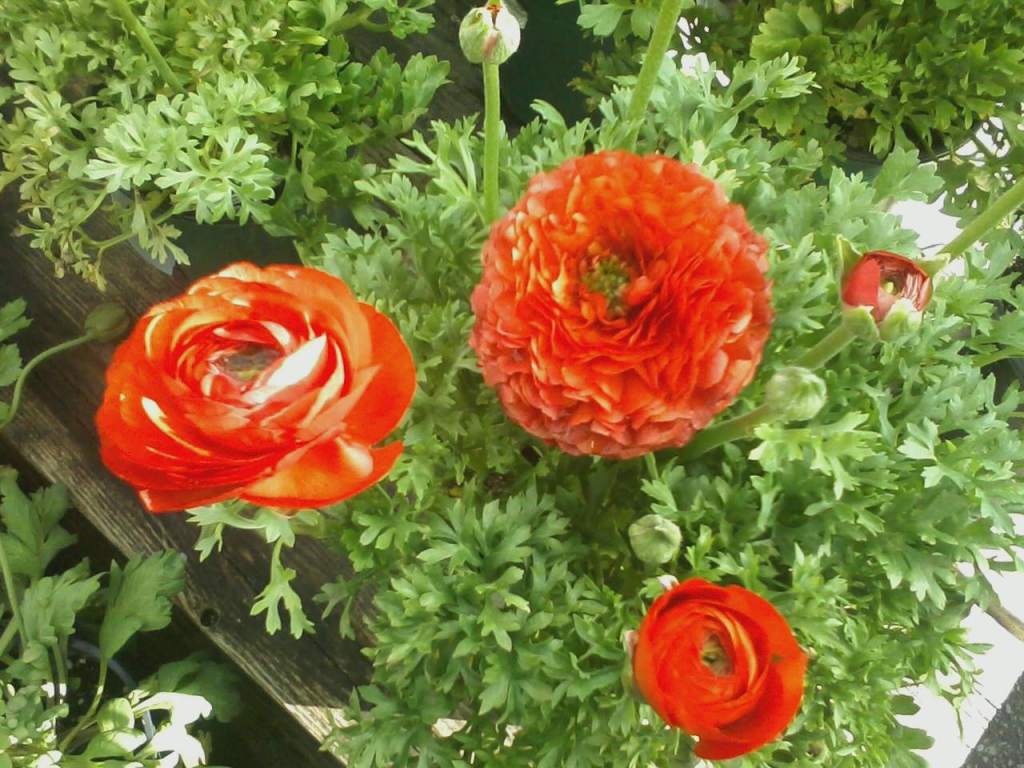
These potted ranunculus in a nursery are already blooming. Those planted while dormant last autumn may not have started yet.

If their dormant bulbs were planted back in October or November, ranunculus will soon be blooming. Those of us who missed the bulbs last autumn can already find blooming plants in nurseries. The bright yellow, orange, red, pink or white flowers are about three inches wide and seem to be outfitted with too many petals. They stand about a foot to a foot and a half tall, a few inches above the basal foliage that can get half a foot to a foot deep. The light green leaves resemble parsley, but are not as finely textured. Although perennial, ranunculus are most popularly grown as annuals because they tend to rot soon after bloom. They perform best with no more than a bit of shade, and rich but very well drained soil. They are more likely to survive as perennials if allowed to get rather dry as their foliage deteriorates after bloom.

Alyssum

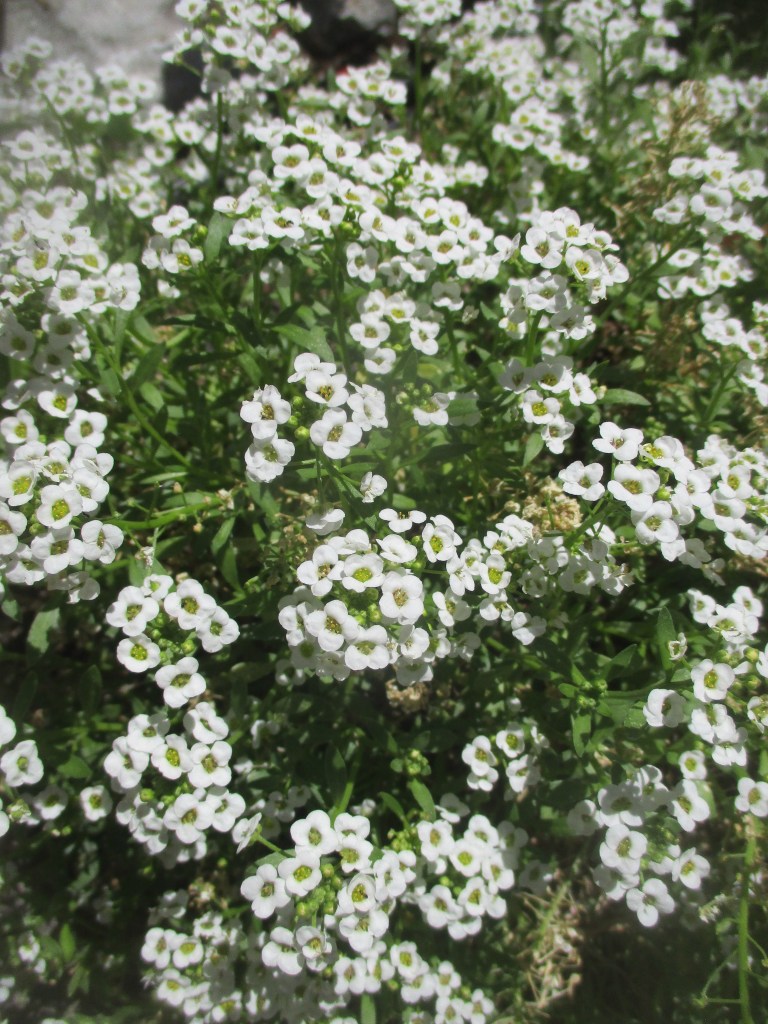
Alyssum can self sow quite freely.

Without becoming invasive, common alyssum, Lobularia maritima, can almost naturalize in favorable situations. It disperses seed profusely, so often appears where it is an asset to the garden. Since it is so docile, it subordinates to more vigorous plants that it mingles with. It does well on loosely set stone walls. If necessary, it is easy to remove or relocate. 

Common alyssum blooms with tiny but profuse white flowers. If they naturalize, varieties with pink or purple bloom eventually revert to white bloom after a few generations. Some varieties revert slower than others. Although popular as a warm season annual, alyssum can continue to bloom through next winter. Individual plants may survive for a few years.

Mature alyssum plants might get a bit higher than half a foot, but will get no higher than a foot. If they perform for more than a year, their progeny may begin to replace them before they get shabby. After removal, shabby plants, with a bit of shaking over bare spots, may share their last seed. Alyssum grows easily from seed, and is available in cell packs too.

Osier Dogwood

The soft yellow or rusty red bare stems of osier dogwood have better color where exposed to cold and sunlight.

New spring foliage will soon be obscuring the rusty red or light yellow stems of osier dogwood, Cornus sericea (or Cornus stolonifera). Because this odd dogwood is grown for these distinctively colorful stems instead of blooms, it can be pruned harshly before foliation, to promote more twiggy growth for next winter. Unpruned plants form thickets five to ten feet high and ten or more feet broad. The flowers are actually rather pathetic relative to those of other dogwoods, since they lack colorful bracts. Where exposed to frost, the opposing two or three inch long and one or two inch wide leaves can provide nice reddish autumn color.

Flowering Apricot

Flowering apricot blooms before flowering cherry.

Even when weather is more typical for the local climate, many types of flowering apricot, Prunus mume, bloom during winter. Flowers seem to be a bit more resilient to wind, rain and frost than those of flowering cherry that bloom a month or so later. Nonetheless, they are delicate and share their white or pastel pink color with wintry landscapes only briefly. 

Although many garden varieties of flowering apricot are fruitless, some, particularly feral trees, produce fruit. Some of such fruit is desirable to those who utilize it. However, most is unpalatable without specialized processing. Flowering apricot works as understock for a few related trees, so occasionally grows from the roots of such trees after their removal. 

Flowering apricot is quite rare locally, which is why it seems to be so unseasonable as it blooms so early. Like flowering cherry and plum, it blooms on otherwise bare stems prior to generating new foliage for spring. Copious bloom of garden varieties is nicely fragrant. Flowers are nearly an inch wide. Mature trees are about ten to more than twenty feet tall, and almost as broad.

Candytuft

As a companion plant, candytuft hides the less appealing lower growth of roses; or it can cascade from mixed planters.

Most roses that are grown for cut flowers are not very appealing in the landscape. They look better behind shorter perennials or shrubbery, with their taller flowering stems standing higher above. Mounding herbs like lavender, lavender cotton or rosemary, or small hedges of boxwood, dwarf hebe or Indian hawthorn obscurer their thorny undergrowth nicely. Candytuft, Iberis sempervirens, is a small perennial that gets just high enough to give a neat edge to a row of roses.

It gets gets about a foot deep, and can very slowly but eventually spread over a few square feet. The tiny, narrow and dark green leaves are less than an inch long. Inch wide trusses of minute white flowers resemble those of sweet alyssum, although lack fragrance. Sloppy plants can be restored by getting pruned almost to the ground.

Olive

Olive trees are compact but gnarly.

For millennia, olive, Olea europaea, dutifully produced oil and edible fruit for civilizations of the Mediterranean region. During the last several centuries, it migrated to do the same in other regions of similar climate throughout the World. At least two centuries ago, it got to California, and became a major agricultural commodity. Now, it lives in home gardens. 

The abundant and oily fruit that justified cultivation of olive trees for thousands of years is ironically a potential nuisance for home gardens. Few people harvest and process them. Olive fruit can stain pavement and attract rodents. Fruitless or mostly fruitless cultivars of olive, and dwarf cultivars, have been increasingly popular for only the past few decades.

Olive trees are not big, but slowly develop grandly sculptural trunks. Some might be little more than twenty feet tall when mature. Few get more than forty feet tall. Most have a few leaning trunks, which become furrowed and distended with age. The narrow and grayish evergreen leaves are about two or three inches long. Olive fruits are about an inch wide.