Colorado must really like blue. Not only is the state tree the Colorado blue spruce, but the state flower is the Colorado blue columbine, Aquilegia caerulea. However, the flowers are not always blue, and in fact, are often white or various shades of pink or soft yellow, or a combination of two colors. The many other specie and hybrids of columbine add even more shades and combinations of richer shades of blue, red, yellow, orange and purple. The distinctively lacy foliage is somewhat bluish. A few varieties have chartreuse foliage.
Although potentially perennial, most columbine do not reliable regenerate after winter dormancy, so are instead grown as spring and summer annuals. Flowers are not as abundant as those of other annuals, but are interesting close up, and very attractive to hummingbirds. Mature plants stand about a foot tall, so work nicely in pots surrounded by lower and more colorful annuals like lobelia and alyssum. Columbine prefers partial shade and rich soil. Plants in full sun tend to be more compact and seem to be a bit faded. Incidentally, some parts of the plants are toxic.
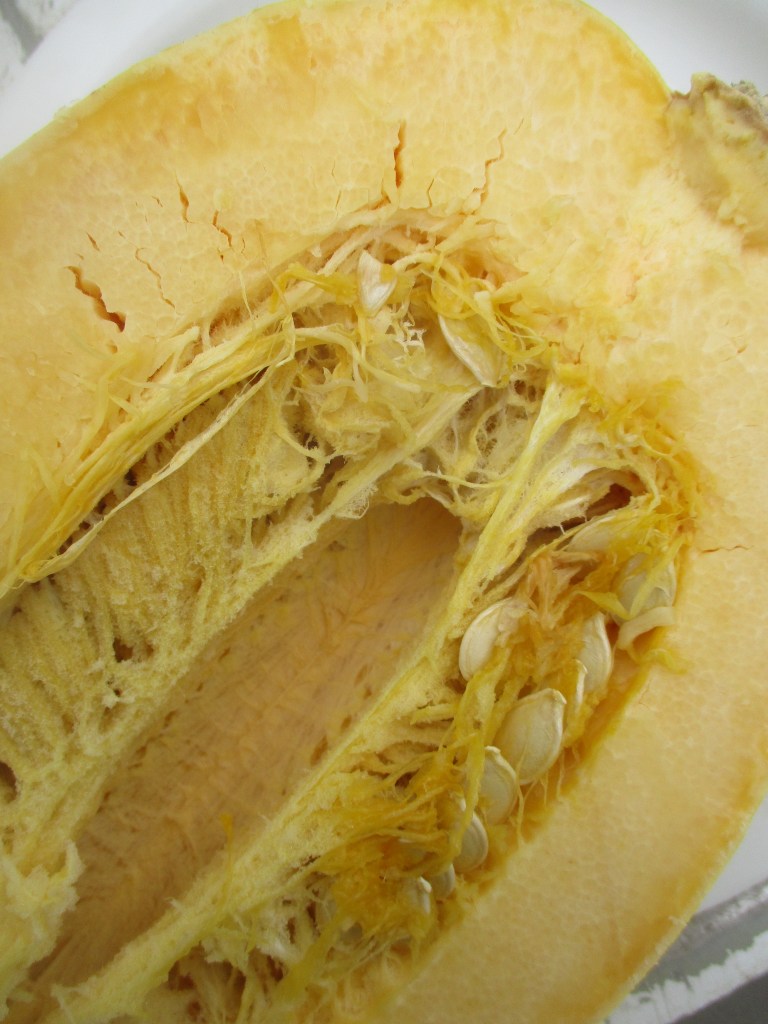
Winter squash grow through summer. This includes spaghetti squash, Cucurbita pepo subspecies pepo. They thrive with warmth, rich soil and steady watering, to mature in late summer or autumn. They store nicely through winter. Technically, spaghetti squash can ripen earlier in summer. However, flavor improves with a bit of age. Mature fruits can stay on their vines until the foliage gets crispy at the end of the season.
Spaghetti squash fruits resemble melons. Most types get about four inches wide and eight inches long. Color ranges through creamy white, pale tan, yellow and golden orange. Fruits with pale color tend to have milder flavor. After cooking, the otherwise solid flesh pulls apart into squiggly bits that resemble spaghetti. The big seeds within may not be true to type. Related squash hybridize freely, particularly with zucchini.
The long vines of spaghetti squash can be somewhat sloppy. This can actually be an advantage. Such vines can sneak about into otherwise unused areas, like pumpkin vines. Alternatively, they might like to climb trellises or shrubbery. They are happy to grow from mounds too, and wrap around the perimeters. Fruits on the ground benefit from occasional turning. Superfluous and fruitless male flowers are good for frying.
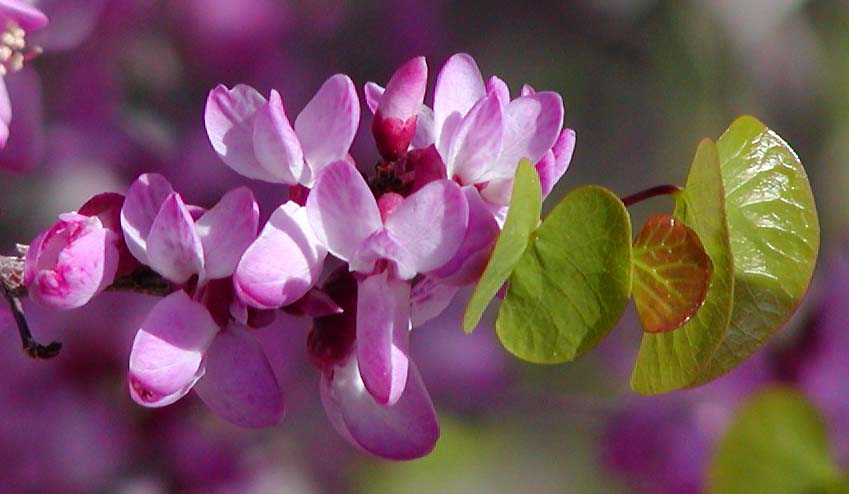
The thin stems of Western redbud, Cercis occidentalis, that had been bare through winter are now outfitted with an abundance of tiny but almost offensively bright magenta flowers. Rounded or nearly heart shaped leaves will become more prominent as bloom fades. As foliage yellows and falls later in autumn, coffee colored pods that are about two inches long remain until they get dislodged by winter weather. Pods can be very abundant on older or distressed plants, or scarce on young or vigorous plants.
Western redbud is typically grown as a large shrub or a small tree with multiple trunks. Mature trees may stay less than ten feet tall, and do not often get taller than fifteen feet, although they can get more than twice as tall where they need to compete with other trees. Once established, western redbud does not need to be watered, but seems to be happiest if occasionally watered through summer. Seedlings that appear around mature plants should be moved or potted while dormant through winter, and while young, since they will not want to be disturbed once they have dispersed roots.
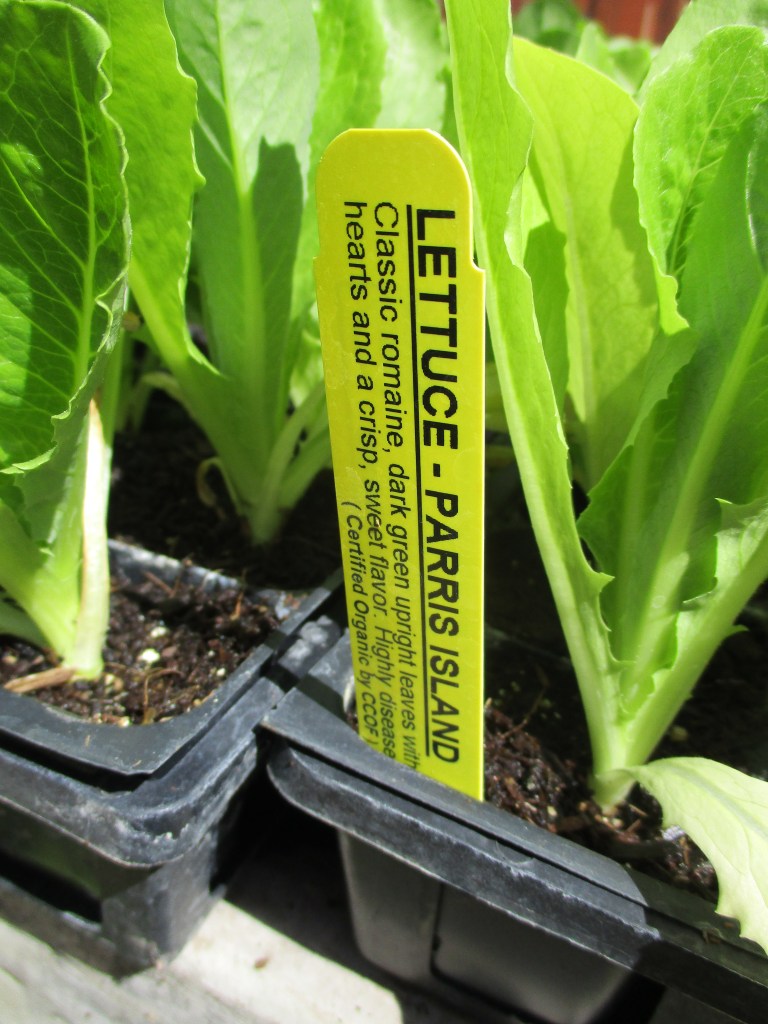
On the coast between Los Angeles and San Francisco, lettuce, Lactuca sativa, seems to grow throughout the year. None of it actually grows in every season. Some varieties merely produce late enough for varieties that produce earliest to replace them. Slightly farther inland, lettuce is really only a cool season vegetable of early spring and autumn. The last new plants should finish by May.
There are many varieties of lettuce. Some are more tolerant of warmth than others. They perform well both late in their early season, and early in their late season. Others are more tolerant of cool weather. They can start early in their early season, and continue late in their late season. No variety produces through the coldest part of winter. Warmth initiates bolting (bloom), which ruins flavor.
The three types of lettuce that are most popular here are leaf, head and romaine. Leaf lettuce is the most variable. It can be blotched, bronzed or reddish, with variably ruffly texture. Some types of leaf lettuce mature in about a month. Some of the more substantial varieties of head and romaine lettuce start early, and can take nearly four months to mature. They can get to a foot wide and tall.
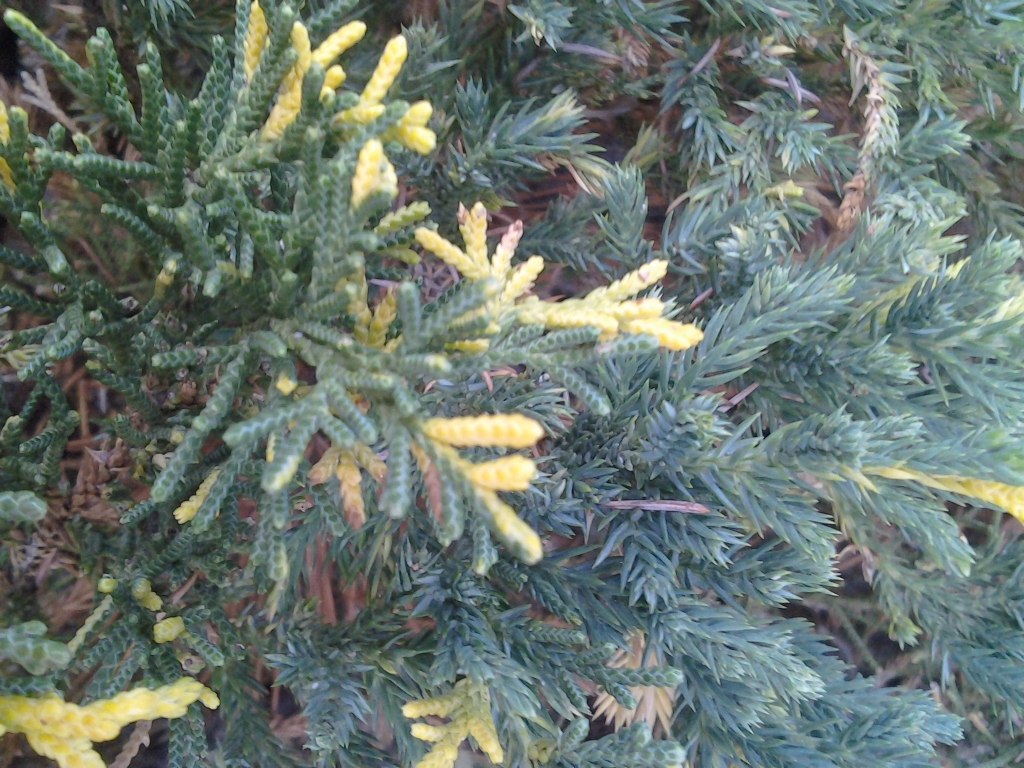
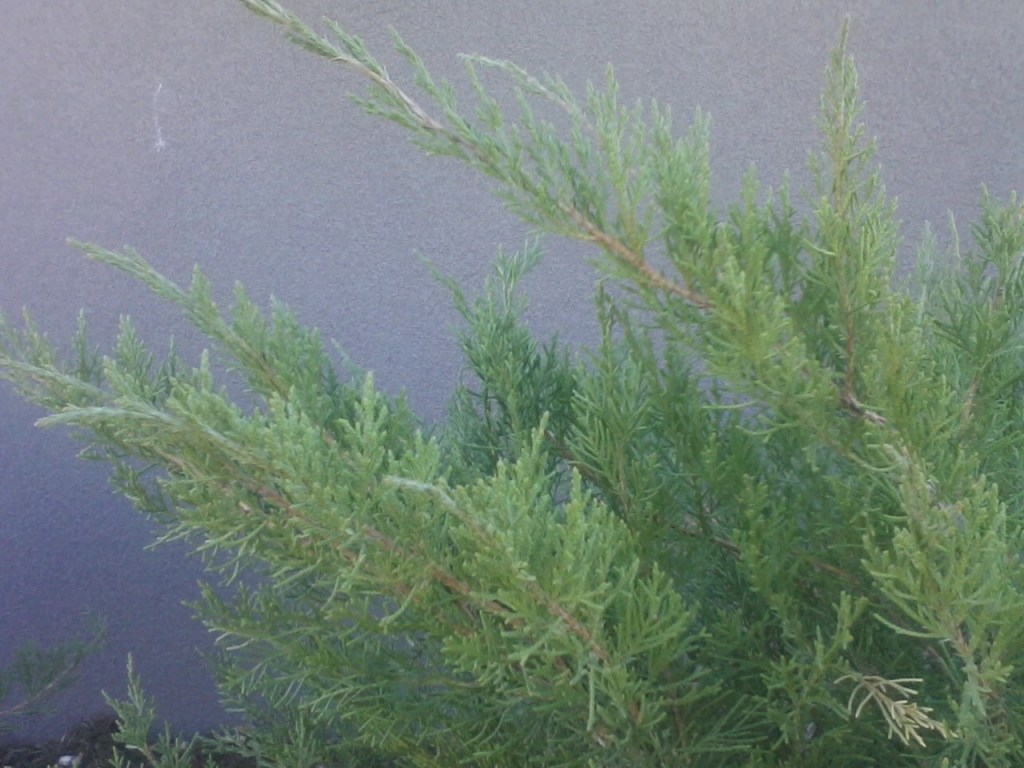
Juniper seedlings are initially outfitted with needle-like juvenile foliage. As they mature, most develop scale-like adult foliage. ‘San Jose’ juniper is the juniper that does not want to grow up. Even very old specimens exhibit odd tufts of juvenile foliage. Variegated ‘San Jose’ juniper has random cream colored blotches. The angular but sprawling stems can spread more than six feet wide without getting two feet deep.
Too much of a good thing eventually gets old. That is how so many of the good junipers that were so popular half a century ago became so unpopular. They became too common, and many were planted into situations that they were not appropriate for. As they matured, many became overgrown or disfigured. Only recently have a few newly introduced modern cultivars restored the appeal of both new and traditional junipers to a generation that is less familiar with their former stigma.
Even though all junipers are evergreen and somewhat similar in regard to foliar texture and their lack of interesting bloom, they demonstrate considerable diversity. Some are low and sprawling ground covers. Others are dense low shrubbery. A few develop as small trees. Branch structure may be densely compact, gracefully arching, rigidly upright, or sculpturally irregular.
Some junipers have yellowish new growth that eventually turns to a more typical deep green. Others are bluish gray throughout. A few rare types are variegated. Almost all junipers have scale-like leaves (like those of cypress). A few have needle-like leaves.
‘Blue Arrow’ and more traditional ‘Skyrocket’ junipers are like short and plump Italian cypress with bluish or gray foliage. ‘Wichita Blue’ juniper is even shorter and plumper, with more sculptural branch structure. However, it is not nearly as irregular and sculptural as the old fashioned ‘Hollywood’ juniper. Modern ‘Gold Star’ and the older ‘Old Gold’ junipers are shrubby types that exhibit arching stems with gold tips.
‘Icee Blue’ is like an improved version of the classic ‘Blue Rug’ juniper, that matures as a shallow bluish ground cover. ‘Blueberry Delight’ juniper is one of the few junipers known for conspicuous fruit, with pretty powdery blue berries against grayish needle-like foliage on trailing stems. ‘Limeglow’ juniper gets a bit deeper, and exhibits chartreuse new growth that turns rich green.
Just because junipers can be shorn certainly does not mean that they should be! Shearing deprives junipers of their naturally appealing texture and form. Instead, junipers should be selectively pruned only where necessary to eliminate growth that is beginning to become obtrusive. Stems should be cut back deeply into the main stems from which they originate, in order to avoid leaving stubs or disfigured stems. Tree junipers like ‘Hollywood’ juniper, as well as overgrown shrubby junipers, can be pruned to expose bare trunks and stems. The gnarly stems and shredding bark can be as appealing as the foliage that obscures them.
Otherwise, once established, junipers do not need much attention or water, and are remarkably resilient. They only rarely get infested with spider mites or scale insects, or get damaged by disease. They only want good sun exposure.
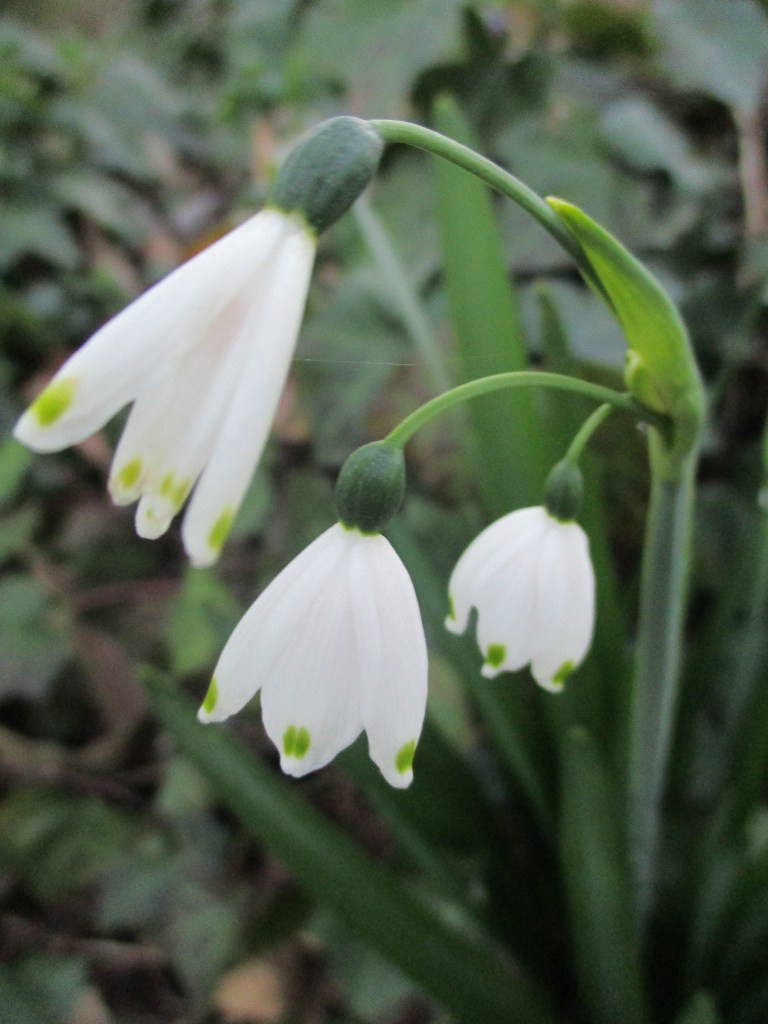
Some of us here on the West Coast know it incorrectly as ‘snowdrop’. That is actually the common name of the many cultivars of Galanthus that are so very popular in other regions. ‘Snowflake’ is the correct common name for Leucojum aestivum. Of course, most of us accept either name. The real snowdrop is not so popular here anyway. It blooms better with more chill than it gets locally.
Snowflake does not seem to need much chill at all. It performs so reliably here that it can slowly spread. A few may even self sow in damp situations. Leucojum vernum is another snowflake, with single or paired flowers instead of three or more on each arching stem. Leucojum vernum blooms before Leucojum aestivum. Both are supposed to bloom later in spring, but are in bloom now.
The somewhat rubbery foliage of snowflake resembles that of daffodil, but is a bit darker green. Individual leaves are about a foot tall and an inch wide, and stand rather vertically. Floral stems do not get much higher, but lean slightly outward with the weight of bloom. Their individual flowers are quite small and pendulous, with single yellowish or green dots near the tips of each of six tepals.
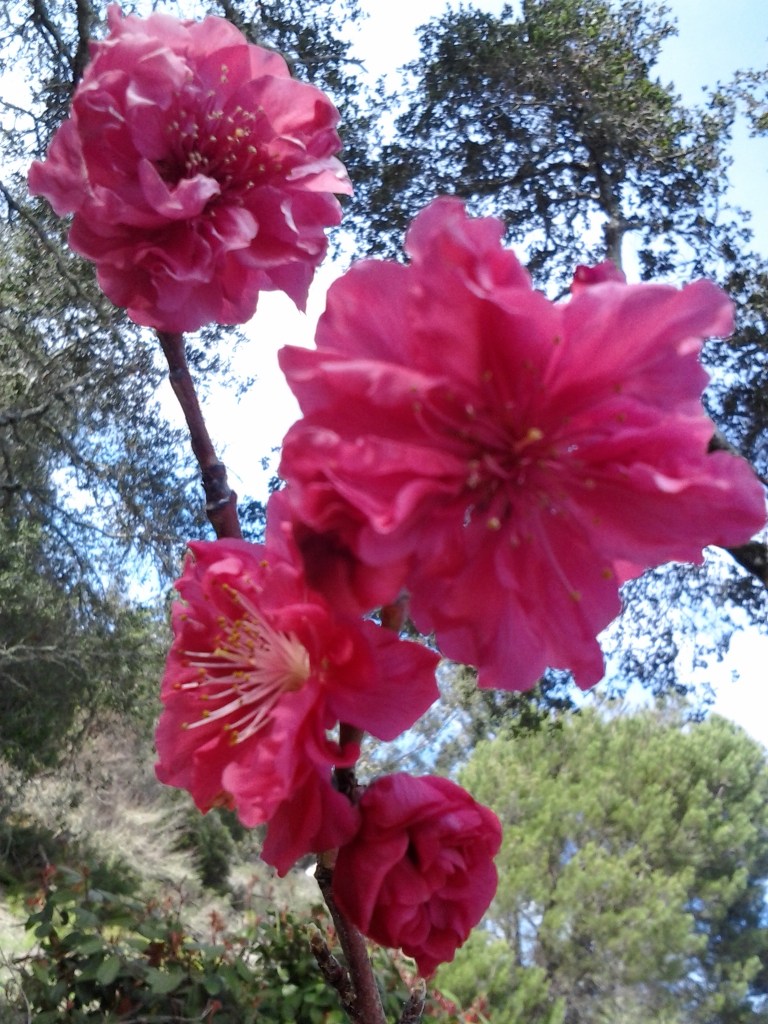
Since it does not produce an abundance of cumbersome fruit, flowering peach, Prunus persica, does not need the aggressive pruning while dormant through winter that fruiting peach requires, and can get significantly larger. However, tip pruning after bloom instead promotes shrubbier growth that blooms more prolifically the following spring. The fluffy double flowers are clear white, bright pink or rich pinkish red. ‘Peppermint’ flowering peach has red and white flowers, with a few flowers that are only white, and sometimes a few that are only red.
Almost everyone on the West Coast of California has encountered silver wattle, Acacia dealbata. Some of us know how resilient it is to most methods of eradication. The more fortunate enjoy its magnificently bloom from a distance. It is almost never planted intentionally. It is an aggressively naturalized exotic species. Most grows wild near roadside ditches. Some invades home gardens.
The profuse and bright yellow bloom of silver wattle is spectacular while most deciduous trees remain bare late in winter. Big and billowy trusses of smaller round floral structures obscure most of their slightly grayish foliage. The many individual staminate flowers within this impressive bloom are actually minute. Their hearty floral fragrance is appealing to some, but objectionable to others.
Silver wattle lives fast and dies young. Some trees are so vigorous while young that they are unable to support their own weight. Without appropriate pruning, they simply fall over. Even stable and structurally sound trees deteriorate after about thirty years. Few survive for fifty. They seed prolifically though! Mature trees can get forty feet tall. The finely textured foliage is bipinnately compound.
What is the difference between narcissus and daffodil? That is very open to interpretation. Daffodil is really only a particular type of narcissus that tends to bloom with larger and more colorful flowers that lack the rich fragrance of the smaller and commonly white flowers of other narcissus. Most daffodil bloom singly. Only a few bloom with a few flowers together. Other narcissus are outfitted with more individual flowers to each stem.
When they were buried in sunny spots last autumn, bare daffodil bulbs looked like pointed onions. They rested through much of winter so that they could be among the first flowers to bloom late in winter. The rather short and narrow bluish leaves stand vertically. The flaring flowers face outward with a bit of a downward or upward tilt. After bloom, deteriorating flowers should be plucked, but foliage should remain until it yellows and gets shed naturally.
The most familiar daffodil are bright yellow. Others can be white, various shades of orange or yellow, or a combination of these colors. Six outer petals (which are actually three petals and three sepals) radiate around a central trumpet.



 Tony Tomeo