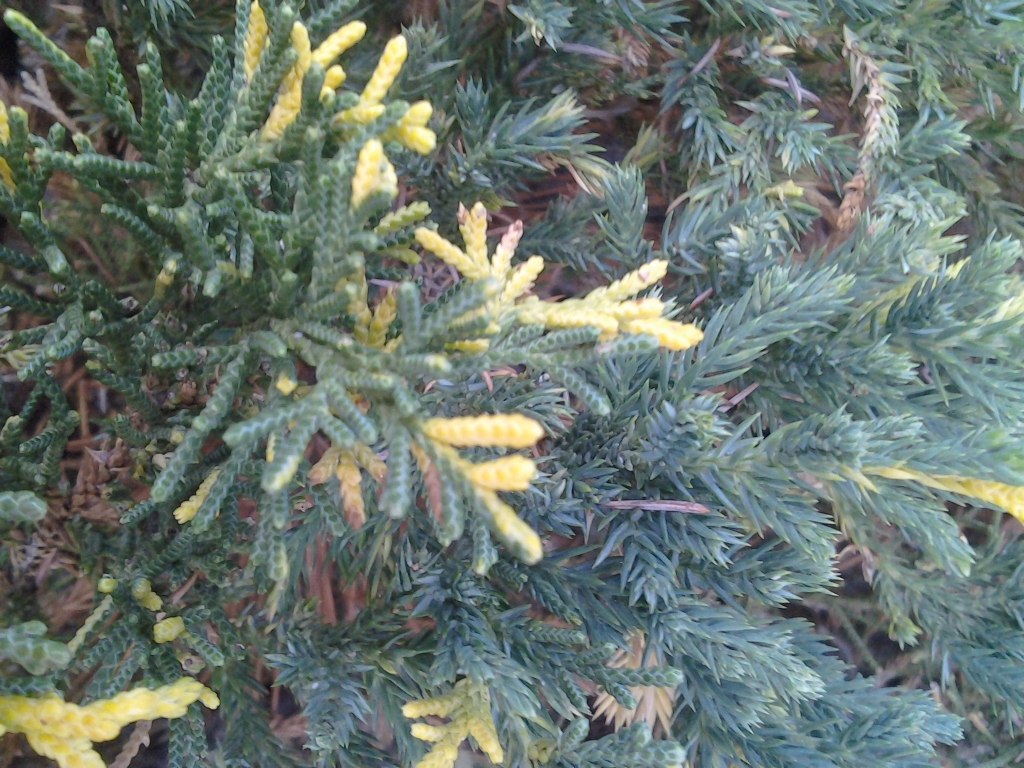
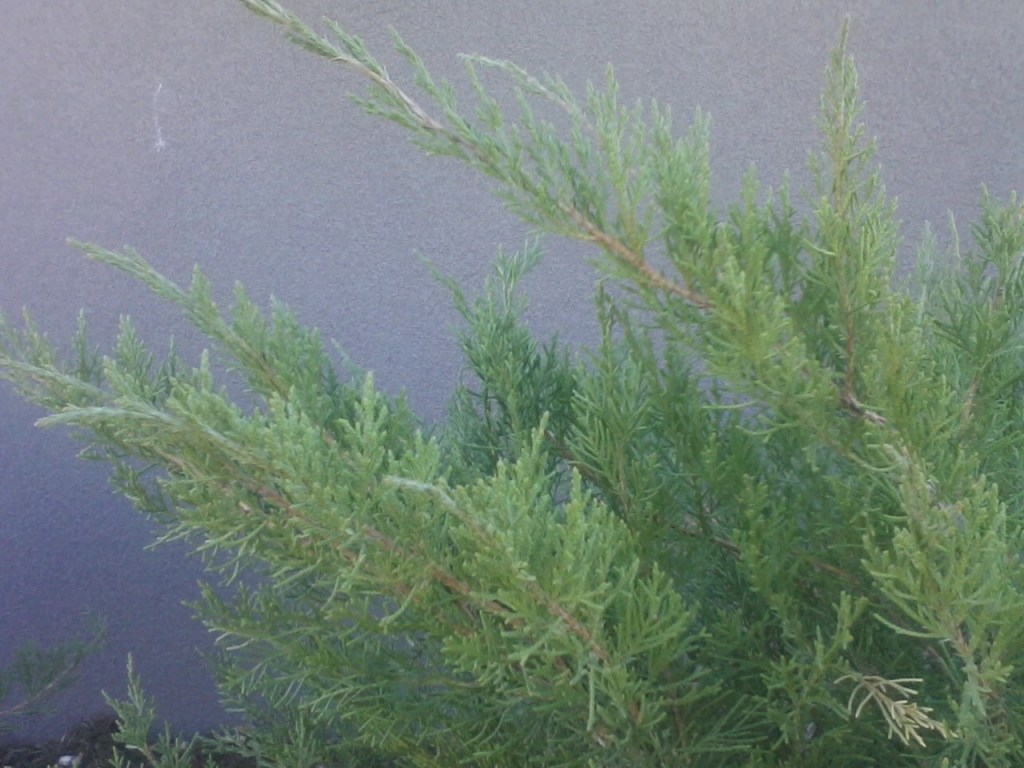
Juniper seedlings are initially outfitted with needle-like juvenile foliage. As they mature, most develop scale-like adult foliage. ‘San Jose’ juniper is the juniper that does not want to grow up. Even very old specimens exhibit odd tufts of juvenile foliage. Variegated ‘San Jose’ juniper has random cream colored blotches. The angular but sprawling stems can spread more than six feet wide without getting two feet deep.
Too much of a good thing eventually gets old. That is how so many of the good junipers that were so popular half a century ago became so unpopular. They became too common, and many were planted into situations that they were not appropriate for. As they matured, many became overgrown or disfigured. Only recently have a few newly introduced modern cultivars restored the appeal of both new and traditional junipers to a generation that is less familiar with their former stigma.
Even though all junipers are evergreen and somewhat similar in regard to foliar texture and their lack of interesting bloom, they demonstrate considerable diversity. Some are low and sprawling ground covers. Others are dense low shrubbery. A few develop as small trees. Branch structure may be densely compact, gracefully arching, rigidly upright, or sculpturally irregular.
Some junipers have yellowish new growth that eventually turns to a more typical deep green. Others are bluish gray throughout. A few rare types are variegated. Almost all junipers have scale-like leaves (like those of cypress). A few have needle-like leaves.
‘Blue Arrow’ and more traditional ‘Skyrocket’ junipers are like short and plump Italian cypress with bluish or gray foliage. ‘Wichita Blue’ juniper is even shorter and plumper, with more sculptural branch structure. However, it is not nearly as irregular and sculptural as the old fashioned ‘Hollywood’ juniper. Modern ‘Gold Star’ and the older ‘Old Gold’ junipers are shrubby types that exhibit arching stems with gold tips.
‘Icee Blue’ is like an improved version of the classic ‘Blue Rug’ juniper, that matures as a shallow bluish ground cover. ‘Blueberry Delight’ juniper is one of the few junipers known for conspicuous fruit, with pretty powdery blue berries against grayish needle-like foliage on trailing stems. ‘Limeglow’ juniper gets a bit deeper, and exhibits chartreuse new growth that turns rich green.
Just because junipers can be shorn certainly does not mean that they should be! Shearing deprives junipers of their naturally appealing texture and form. Instead, junipers should be selectively pruned only where necessary to eliminate growth that is beginning to become obtrusive. Stems should be cut back deeply into the main stems from which they originate, in order to avoid leaving stubs or disfigured stems. Tree junipers like ‘Hollywood’ juniper, as well as overgrown shrubby junipers, can be pruned to expose bare trunks and stems. The gnarly stems and shredding bark can be as appealing as the foliage that obscures them.
Otherwise, once established, junipers do not need much attention or water, and are remarkably resilient. They only rarely get infested with spider mites or scale insects, or get damaged by disease. They only want good sun exposure.
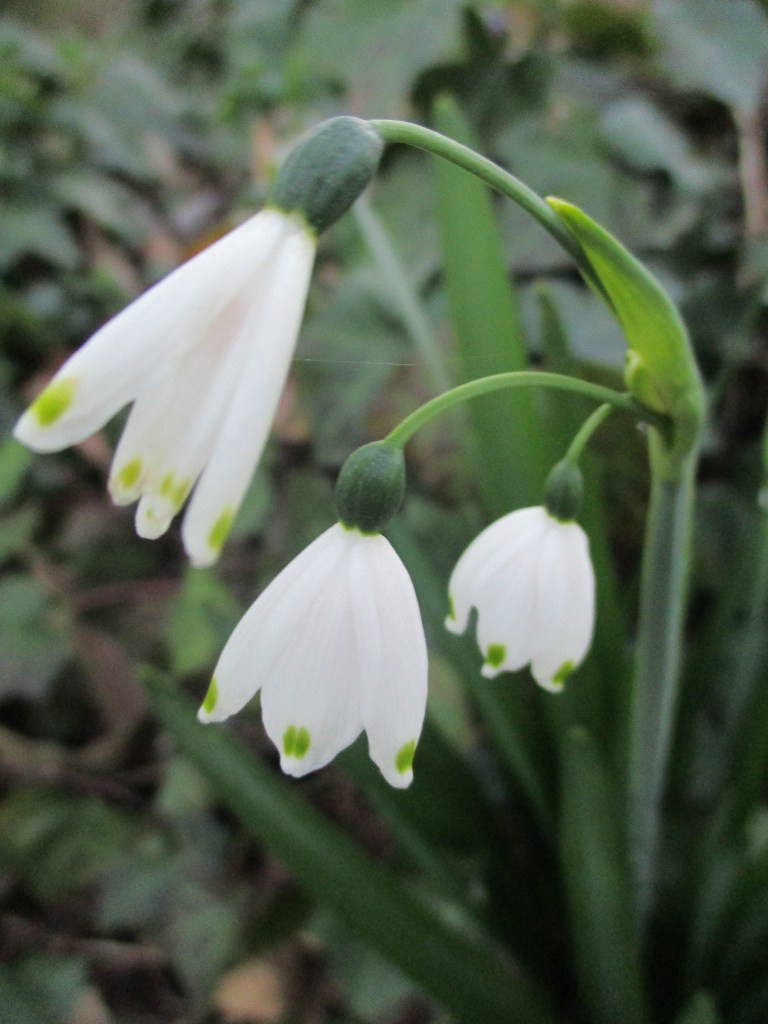
Some of us here on the West Coast know it incorrectly as ‘snowdrop’. That is actually the common name of the many cultivars of Galanthus that are so very popular in other regions. ‘Snowflake’ is the correct common name for Leucojum aestivum. Of course, most of us accept either name. The real snowdrop is not so popular here anyway. It blooms better with more chill than it gets locally.
Snowflake does not seem to need much chill at all. It performs so reliably here that it can slowly spread. A few may even self sow in damp situations. Leucojum vernum is another snowflake, with single or paired flowers instead of three or more on each arching stem. Leucojum vernum blooms before Leucojum aestivum. Both are supposed to bloom later in spring, but are in bloom now.
The somewhat rubbery foliage of snowflake resembles that of daffodil, but is a bit darker green. Individual leaves are about a foot tall and an inch wide, and stand rather vertically. Floral stems do not get much higher, but lean slightly outward with the weight of bloom. Their individual flowers are quite small and pendulous, with single yellowish or green dots near the tips of each of six tepals.
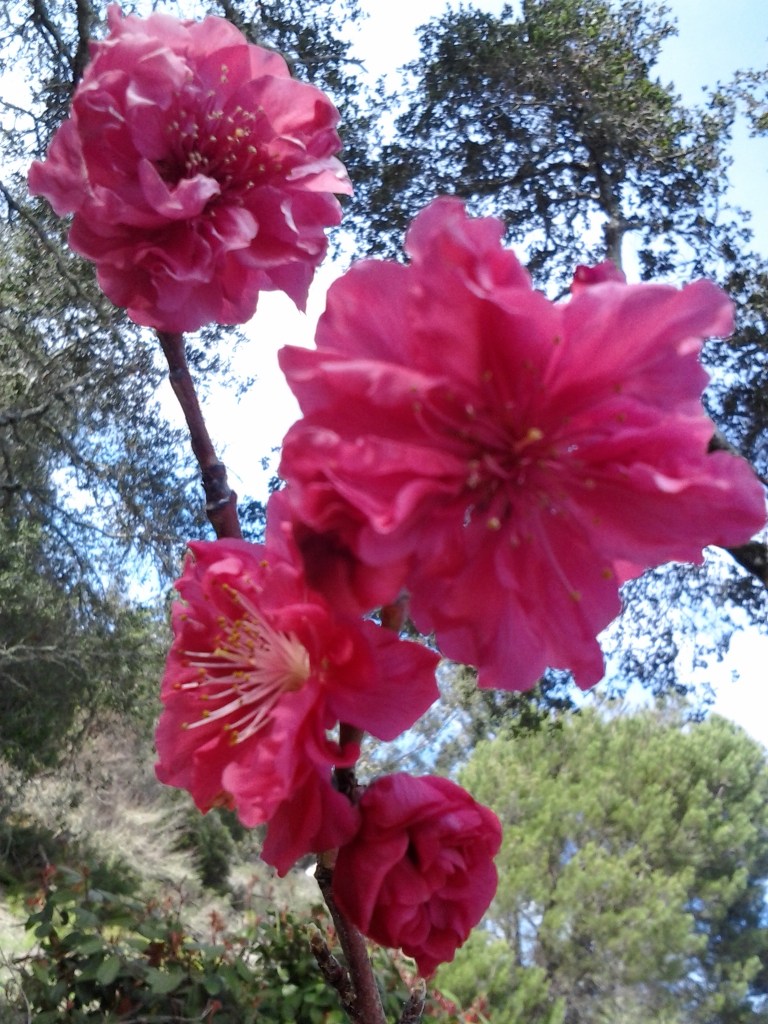
Since it does not produce an abundance of cumbersome fruit, flowering peach, Prunus persica, does not need the aggressive pruning while dormant through winter that fruiting peach requires, and can get significantly larger. However, tip pruning after bloom instead promotes shrubbier growth that blooms more prolifically the following spring. The fluffy double flowers are clear white, bright pink or rich pinkish red. ‘Peppermint’ flowering peach has red and white flowers, with a few flowers that are only white, and sometimes a few that are only red.
Almost everyone on the West Coast of California has encountered silver wattle, Acacia dealbata. Some of us know how resilient it is to most methods of eradication. The more fortunate enjoy its magnificently bloom from a distance. It is almost never planted intentionally. It is an aggressively naturalized exotic species. Most grows wild near roadside ditches. Some invades home gardens.
The profuse and bright yellow bloom of silver wattle is spectacular while most deciduous trees remain bare late in winter. Big and billowy trusses of smaller round floral structures obscure most of their slightly grayish foliage. The many individual staminate flowers within this impressive bloom are actually minute. Their hearty floral fragrance is appealing to some, but objectionable to others.
Silver wattle lives fast and dies young. Some trees are so vigorous while young that they are unable to support their own weight. Without appropriate pruning, they simply fall over. Even stable and structurally sound trees deteriorate after about thirty years. Few survive for fifty. They seed prolifically though! Mature trees can get forty feet tall. The finely textured foliage is bipinnately compound.
What is the difference between narcissus and daffodil? That is very open to interpretation. Daffodil is really only a particular type of narcissus that tends to bloom with larger and more colorful flowers that lack the rich fragrance of the smaller and commonly white flowers of other narcissus. Most daffodil bloom singly. Only a few bloom with a few flowers together. Other narcissus are outfitted with more individual flowers to each stem.
When they were buried in sunny spots last autumn, bare daffodil bulbs looked like pointed onions. They rested through much of winter so that they could be among the first flowers to bloom late in winter. The rather short and narrow bluish leaves stand vertically. The flaring flowers face outward with a bit of a downward or upward tilt. After bloom, deteriorating flowers should be plucked, but foliage should remain until it yellows and gets shed naturally.
The most familiar daffodil are bright yellow. Others can be white, various shades of orange or yellow, or a combination of these colors. Six outer petals (which are actually three petals and three sepals) radiate around a central trumpet.
All crabapple trees flower. Almost all subsequently produce fruit. Those designated as ‘flowering’ crabapples exhibit the most spectacular bloom, but generally produce inferior fruit. A few cultivars are nearly fruitless. Crabapples not designated as ‘flowering’ are not as bold in bloom, but generally produce larger fruit of better quality. Their fruit is useful for jelly and other culinary applications.
Almost all crabapple trees here are flowering crabapples. Fruiting crabapples are rare locally. Their fruit is not as popular as it is in other regions. However, flowering crabapples that produce big fruit are increasingly trendy. Their fruits can get as wide as an inch and a half, almost as big as fruits of fruiting crabapples. If not picked or eaten by birds, even typical berry sized fruits are messy.
White, pink or reddish pink bloom is impressively profuse, just prior to spring foliation. In fact, bloom is comparable to that of flowering cherries, and only a bit later. Most flowering crabapples get no taller than fifteen feet. Aggressive annual dormant pruning is not necessary as it is for trees that produce heavy apples. Instead, mature trees appreciate summer structure pruning and thinning.
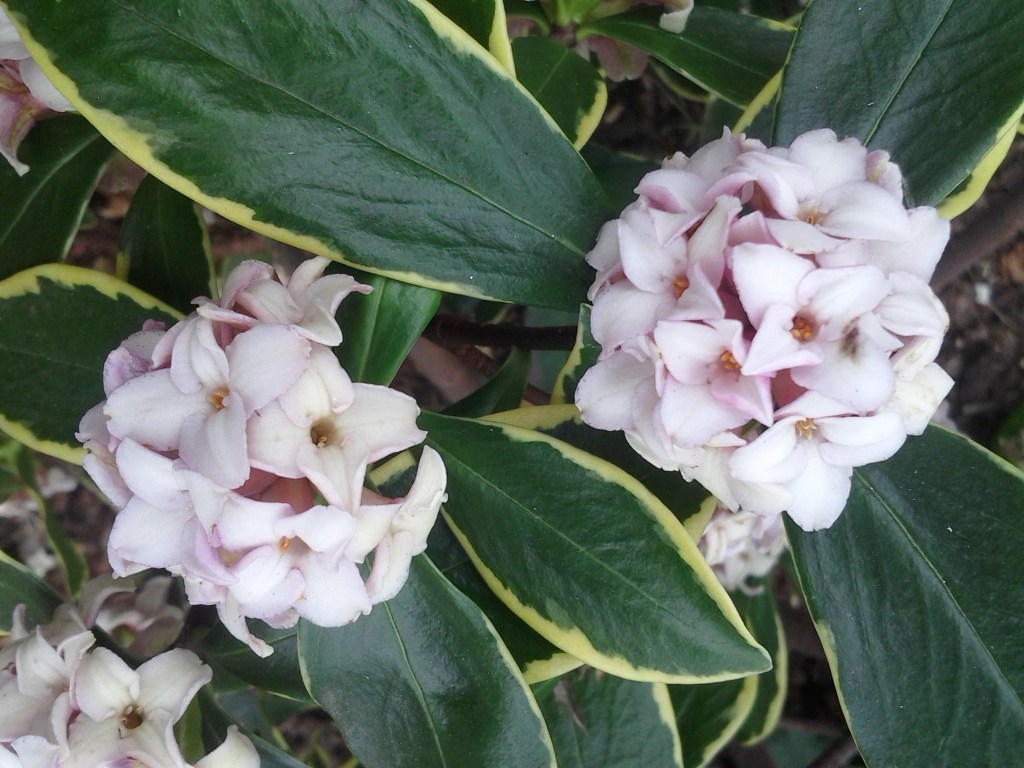
The small trusses of tiny, pale pink flowers of daphne, Daphne odora, really do not need to be too flashy with such powerful fragrance. Actually, the flowers might be considered to be less interesting than the glossy evergreen foliage. The most popular cultivar, ‘Marginata’, has a narrow ivory or pale yellow edge to each leaf. Each leaf is only about two or three inches long. Each domed flower truss is about as big as half of a ping pong ball. Daphne is sometimes grown to compliment and provide fragrance for boldly colorful but fragrantly deficient camellias.
Daphne is unfortunately notorious for being somewhat finicky. It likes rich soil and reasonably regular watering, but quickly rots if soil stays too damp or drains inadequately. The roots are quite sensitive to excavation. Partial shade is no problem. Yet, even the biggest and happiest specimens do not get much more than three feet high and five feet wide, and rarely live more than ten years. Daphne is toxic, and the sap can cause dermatitis.
Japanese maples get all the notoriety. They have such delightful texture and form. Many are proportionate to small spaces, such as atriums. Realistically though, they are overrated and overused. Meanwhile, other maples that work as larger shade trees remain obscure. Norway maple, Acer platanoides, gets broad enough to shade much of an urban garden, but rarely gets to forty feet tall.
Of course, Norway maple has innate limitations. It dislikes arid and harshly warm desert climates. Nor does it like to be too close to the coast. Los Angeles is about as far south as it wants to live. In the Pacific Northwest, it gets much bigger, and develops greedy roots. The non-cultivar species is invasive there. Norway maple defoliates neatly for winter, but then refoliates late in about April.
Almost all local Norway maples are cultivars. ‘Schwedleri’ has richly bronzed foliage. It is rare now, but was a popular street tree in the 1950s. ‘Crimson King’ has richer purplish foliage, but is less vigorous. ‘Drummondii’ displays delightful variegation. The deciduous foliage of Norway maple turns soft brownish yellow or gold for autumn. The palmately lobed leaves may be five inches wide.
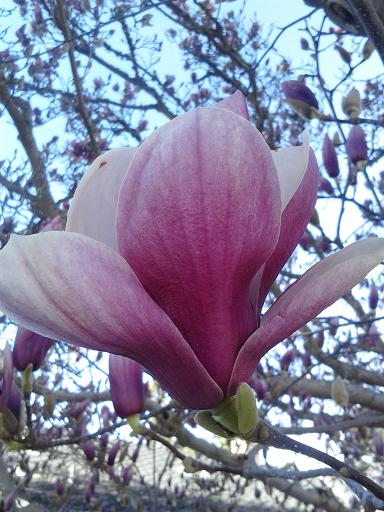
Before the deciduous foliage regenerates, saucer magnolia, Magnolia X soulangeana, is already completely overwhelmed with a profusion of big pastel pink and white flowers. Some of the many cultivars bloom white, paler pink or purplish. Some are more purple than pink. Individual flowers are about six inches wide. Some cultivars bloom with globular flowers that do not open quite so broadly. Others open even wider. The largest flowers can get almost a foot wide. Eventually, fading flowers will be replaced with big and soft lime green leaves. Most saucer magnolia trees are grown with several trunks and low branches to display the bloom more prominently, as well as to display the sculptural branch structure while bare through winter. The flat bark is strikingly light gray.