Incense Cedar

Incense cedar produces delightfully aromatic wood.

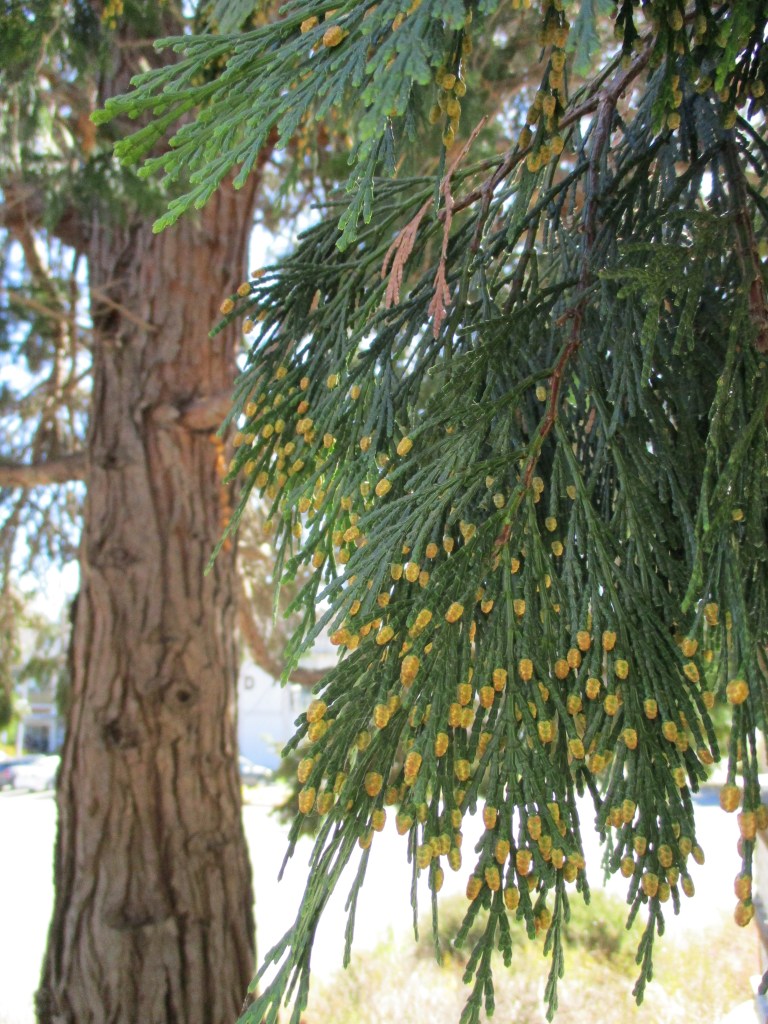
Nowadays, the delightfully aromatic foliage is familiar primarily in garlands at Christmas time. Most of the foliage of old trees is too high up for direct contact. Young trees with low foliage are rare. Incense cedar, Calocedrus decurrens, is unfortunately not as popular as it was a century ago. At that time, it was as utilitarian as it was appealing for spacious but minimally irrigated landscapes.

Incense cedar wood made good shingles and laminate for closets and cedar chests. The wood is aromatic enough to repel moths from woolens and furs, which were still popular then. It was less expensive to import than Eastern red cedar. It grows wild relatively nearby, in the Sierra Nevada and Cascade Mountains. Incense cedar fence posts might resist decay as well as redwood posts.

If the wild, where they compete with other trees for sunlight, old trees can get almost two hundred feet tall. However, well exposed old trees in Victorian gardens are less than half as tall after more than a century. Their canopies are generally conical. Large limbs can curve upward like extra trunks. Flat foliar sprays resemble those of arborvitae. The deeply furrowed bark is cinnamon brown.
Valley Oak

Valley oak is also known as ‘roble’.

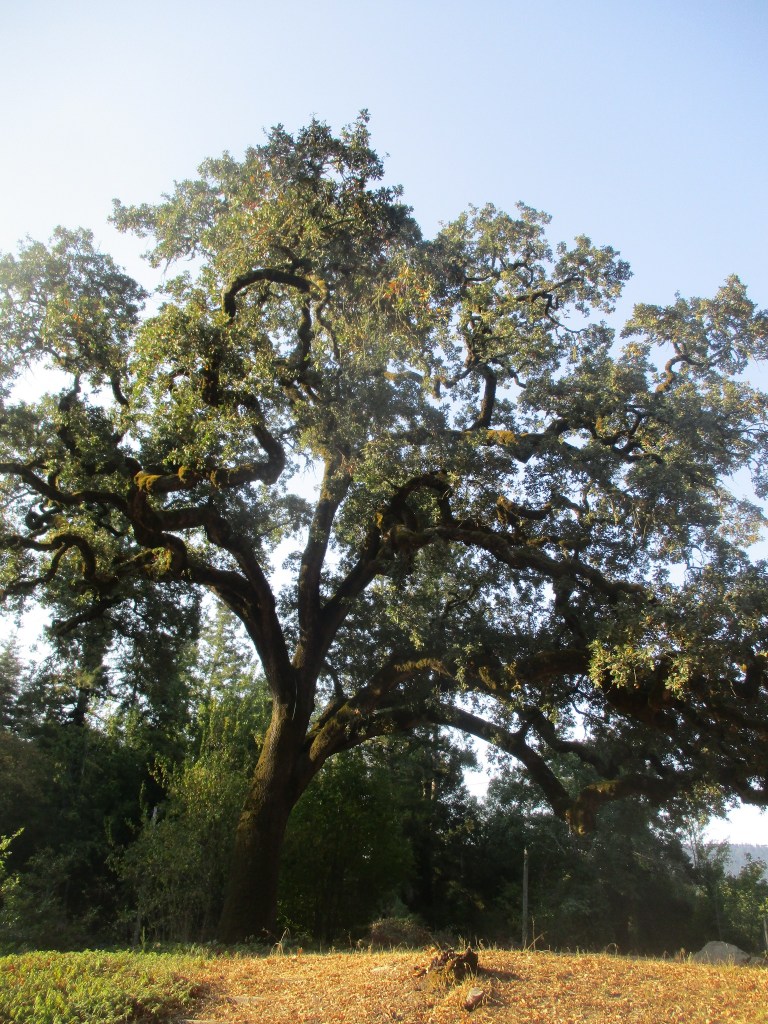
From the north end of the Sacramento Valley to the San Fernando Valley, the valley oak, Quercus lobata, is among the most familiar and distinctive of native oaks. It is the largest oak of North America, reaching more than a hundred feet tall with trunks as wide as ten feet, which is why it is rare in urban gardens. The hundred fifty foot tall ‘Henley Oak’ of Covelo is the tallest hardwood tree in North America. The oldest trees are about six centuries old.

The two or three inch long leaves have deep and round lobes. The foliage turns only dingy yellow and then brown in autumn, and can be messy as it continues to fall through early winter, particularly since the trees have such big canopies. The gnarly limbs are strikingly sculptural while bare through the rest of winter. The gray bark is evenly furrowed.

Incidentally, Oakland, Thousand Oaks, Paso Robles and various other communities within their range are named for valley oaks. (‘Roble’ is the Spanish name.)

Chrysanthemum

Chrysanthemum is famously diverse and colorful.

Chrysanthemum compensates for its lack of fragrance with rich color and variable form. Centuries of breeding have produced countless shades and tints within the yellow, orange and red range. This includes pink as a tint of red, cream as a tint of yellow, and bronze as a shade of orange. Some reds and pinks are precariously close to purple or lavender. There is, of course, white as well.

Flowers may be solitary big pom-poms, multiple small buttons, or anything in between. Many are daisy types, mostly with bright yellow centers. Spider chrysanthemums have strangely elongated and hooked ray florets, which are generally thought of as ‘petals’. Some chrysanthemums that would otherwise bloom with many small flowers can be groomed to bloom with fewer bigger flowers.

Chrysanthemums with compact growth and uniform bloom are popular as short term annuals for autumn. Their primary bloom phase is impressively profuse. Unfortunately, few get an opportunity to bloom again. Other cool season annuals replace most of them for winter. In ideal situation, with rich media and regular watering, chrysanthemums can actually perform as short term perennials.

Chrysanthemum

Chrysanthemums are just right for autumn.

Mild autumns and arid summers keep chrysanthemums on a different schedule here than in most other regions. They can get planted in spring to grow through summer and bloom through autumn; but because they can take a bit of work, they are more often planted while blooming in autumn. Although commonly grown as autumn annuals, they are perennials that can regenerate next spring, grow through summer, and bloom even better the following autumn.

Centuries of development in Japan have produced more varieties of chrysanthemums than can be documented. There are really some weird types grown for cut flowers or by hobbyists. Garden varieties are mostly limited to simpler flowers that do not need much thinning or staking. Color ranges through all sorts of hues and shades of yellow, orange, red, pink and bronze, as well as a few purplish colors, cream and white. Many have yellow centers. The aromatic foliage is alluring to some, but objectionable to others.

Ginkgo

Ginkgo is turning clear bright yellow.

Where autumn chill is minimal, the best and brightest yellow autumn color is that of the ginkgo, Ginkgo biloba. Some know it at the maidenhair tree. Except for older trees that produce messy and stinky fruit, it is a notably clean tree. Perhaps it is too clean. It drops nothing all year, but can defoliate too soon once it develops it striking autumn color. Minimal chill actually prolongs the process.

Ginkgo is dioecious, with separate genders. Modern cultivars for landscapes are male, so produce no obnoxious fruit. Female cultivars that produce nuts and fruits are not commonly available in nurseries locally. (As objectionable as their aroma is, the nuts and fruits are edible.) Some people may be allergic to the pollen of mature male trees. Many mature trees predate modern cultivars.

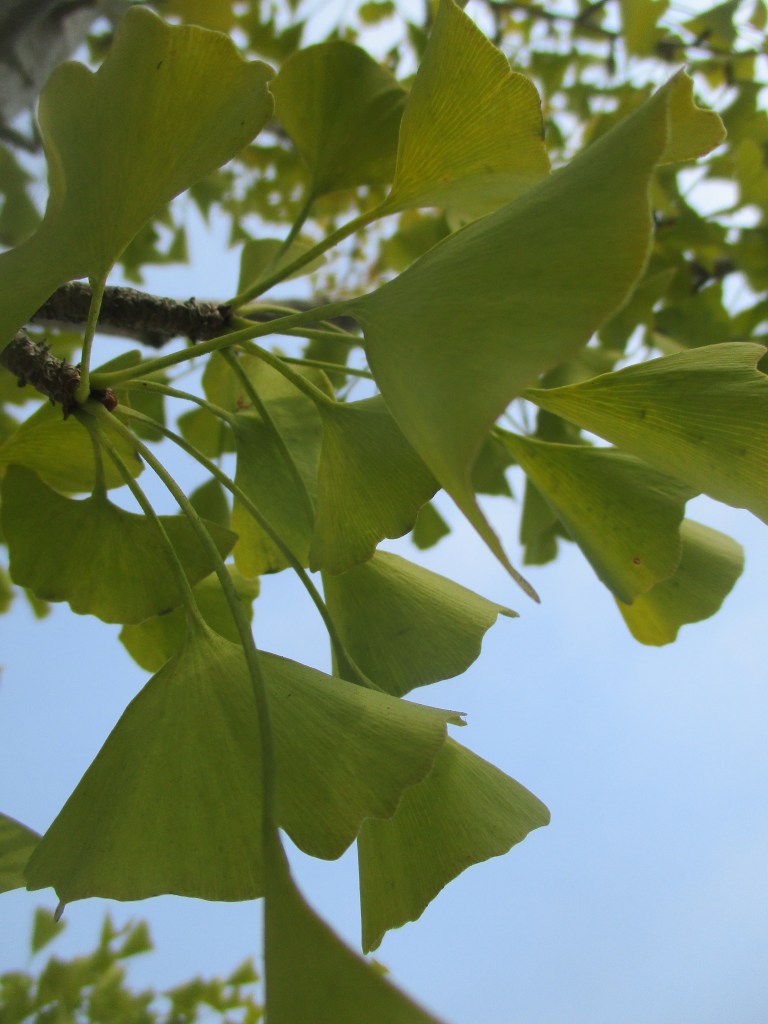
Trees are somewhat slender and perhaps sparse while young. They develop a broader canopy as they age. Trees can get more than fifty feet tall, with sculpturally irregular branch structure. Foliar venation radiates outward from the petioles. Leaves, which are about two or three inches long, therefore have the shape of fishtails. Leaves on current season stems are cloven into paired lobes.

Abyssinian Gladiolus

Abyssinian gladiolus might still be blooming.

Summer bulbs and bulb like perennials bloom after spring bulbs. They therefore prefer later planting. Abyssinian gladiolus, Gladiolus murielae, is likely unavailable in nurseries while spring bulbs are seasonable. Their bulbs should be obtainable and ready for planting later, while other summer bulbs are in season. Abyssinian gladiolus blooms late in summer, or may still be blooming now.

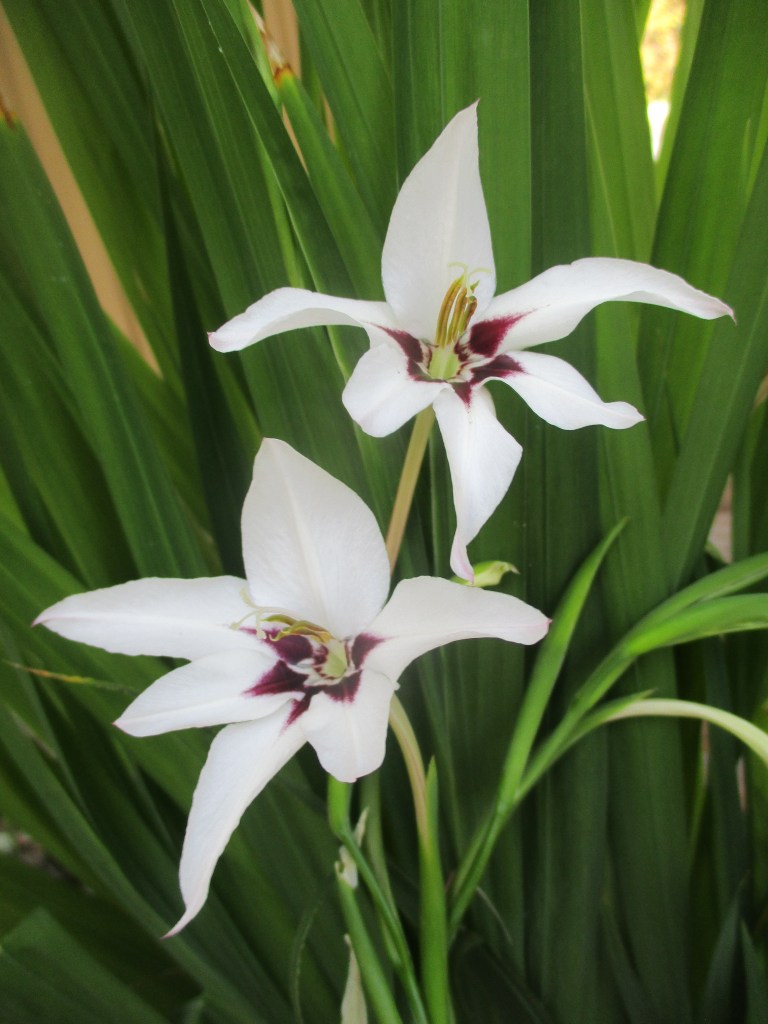
Abyssinian gladiolus is more discreet than the more common hybrid gladiolus. It is also more reliably perennial. In favorable conditions, bulbs might multiply enough to be somewhat invasive. The narrow leaves stand more than two feet tall. Floral stems can be three feet tall, to loosely suspend a few white flowers with garnet red centers. Each mildly fragrant flower is about two inches wide.

The bulbs, which are technically corms, prefer organically rich soil that drains well. Digging and storing them through the locally mild winters is unnecessary. After many years, established colonies of bulbs might migrate upward and closer to the surface of the soil. Digging dormant bulbs that have gotten too shallow to stand upright while foliated, and burying them deeper, improves stability.

Angelonia

This annual can actually be perennial.

Angelonia is one of those warm season annuals that can actually survive through winter as a pernnial to bloom again next spring. It may even want to continue to bloom untill frost. The flowers can be blue, purple, red, pink or white, and look something like small snapdragon flowers. Most have spots or stripes of an alternate color or two in their throats. Some modern varieties have fragrant flowers. Plants can get a foot or two tall, and almost as wide. In sheltered spots, angelonia can be cut back as soon as it starts to look tired in autumn. Exposed plants might be happier if cut back significantly later, as winter ends. Old growth may be unsightly for a while, but can protect interior stems and roots from frost. Besides, pruning stimulates new growth that will be more susceptible to subsequent frost.

Valley Oak

Valley oak is the grandest oak.

From the northern end of the Sacramento Valley to Santa Catalina Island, valley oak, Quercus lobata, is as Californian as Valley Girl. It inhabits mixed riparian forests and low hillsides up to about 2,000 feet, but prefers alluvial valley meadows in between. Although unpopular for landscaping, it sometimes self sows into home gardens. New landscapes sometimes develop around old trees.

Valley oak is one of the biggest of oaks, and the tallest oak of North America. Mature trees can be more than a hundred feet tall, and several centuries old. Trunks may be more than ten feet wide. Such big trees make big messes of acorns and deciduous foliage, which shed for weeks. Unfortunately, old valley oaks within new landscapes are susceptible to spontaneous limb failure and rot.

Where space is sufficient, new valley oaks are for future generations. They develop their distinctively sculptural branch structure slowly through several decades. If irrigation is not excessive, roots are remarkably complaisant. The evenly furrowed gray bark is rustically distinguished. The elegantly lobed leaves are about three inches long and half as wide. Yellowish autumn color is subdued.

Pumpkin

Brightly colored pumpkins ripen in autumn.

Actually, it is a fruit; a rather BIG fruit. It happens to be one of the more familiar of winter squash, but is not too commonly eaten. Although it makes excellent pie, and provides edible seeds and flowers, pumpkin is more popularly known as jack-o’-lanterns or Cinderella’s ride to the ball. Pumpkin is not for every garden, since each big and coarsely foliated annual vine needs regular watering, rich soil and considerable space to grow all through summer to produce only one or two big fruit in autumn.

Most pumpkins are big and round, and have smooth and bright orange skin. Those grown for jack-o’-lanterns are brighter orange, and not quite as meaty. Those grown for pie are often a bit smaller and meatier, with a rustier orange color. The biggest pumpkins get too huge to move easily, but lack flavor. The flavors and densities of many weird modern varieties are as variable as the green, red, pink, yellow and white hues of their skins. Some pumpkins have been developed specifically for their seeds, which are known as pepitas, or are used for production of pumpkin seed oil.

Kahili Ginger

Kahili ginger blooms as summer ends.

It is not the ginger that is so popular for culinary purposes, but it is the most popular for home gardens in the West. Kahili ginger, Hedychium gardnerianum, is so vigorous and easy to grow that it has potential to be invasive in ideal situations. Fortunately, it does not produce many of its sticky seeds locally. It therefore migrates primarily by dispersing rhizomes, which are not noxiously fast.

The delightfully fragrant bloom begins late in summer, and will finish soon. As many as forty small pale yellow and red flowers radiate from each cylindrical floral truss. Blooms stand neatly vertical, even if the stems supporting them lean. As cut flowers, they last only for a few days. Deadheading after bloom eliminates unwanted seed (if that is a concern), and unclutters the tidy foliage below.

However, with or without deadheading, the lush foliage is only temporary after bloom. It deteriorates as the weather cools through autumn. Cutting the herbaceous canes to the ground before they get too unsightly will expose some of the thick rhizomes. New canes will grow a few feet tall next spring and summer. On the canes, each leaf extends in the opposite direction of the leaf below it.