 This would be a good topic for one of my rants on Wednesday, except that it is too silly for that.
Many years ago, before I started writing my gardening column for our local newspapers, my colleague Brent and I used to exchange funny newspaper gardening articles. Some were obviously not written for local climates. Some were just very inaccurate. Back then, it was done by mail, so the articles were added to anything that we happened to be sending to each other at the time. If I sent him some seeds, I would add an article or a few from the San Jose Mercury News. If he sent my cuttings, he would add an article or a few from the Los Angeles Times. They eventually became the inspiration for my gardening column, when Brent and others told me that rather than making fun of the inaccuracies of the articles, I should provide accurate articles.
One of the silliest that Brent sent to me was an otherwise well written article about star jasmine. Most of the information about it was accurate, until it got to describing the colors of the exclusively white bloom. The article explained that star jasmine bloomed in vivid shades or blue, purple, red, orange and yellow; just about every color except for white!
Well, I topped that with an article about protecting Japanese maples from theft, which sounded crazy even before reading the article. There were three recommendations. The first was to surround the subject Japanese maple with razor wire. Ah, the ambiance! The second recommendation was to dig a hole about as big as a trash can and fill it with concrete with a curved piece of rebar to make an enclosed loop on top, and then chain the subject Japanese maple to it. How about we just do without a Japanese maple in the front yard in a neighborhood where we expect it to get stolen. The third recommendation was to plant poison oak around the subject Japanese maple. Yes, good old fashioned poison oak, Rhus diversiloba, which is also known by the more descriptive Latin name of Toxicodendron diversilobum, and commonly available at . . . . some nursery . . . . somewhere. . . . You know, one of those . . . . garden centers . . . . or something.
Silly? Yes! What is sillier is that poison oak really IS available from certain nurseries that sell native species! What is even SILLIER than that incredible degree of SILLINESS is that one of the so-called landscape companies that I worked for in about 2006 actually procured some for habitat restoration outside of, but adjacent to a newly landscaped area on the banks of where the Guadalupe River flows through San Jose. Poison oak and other native vegetation needed to be eradicated for the installation of the new poison oak and associated irrigation system, because nothing is more natural than supplemental irrigation! Then, the ‘gardeners’ had to conduct regularly scheduled weed abatement so that poison oak growing from seed tossed by the pre-existing poison oak did not grow up and compete with the new poison oak in the new ‘natural’ ‘landscape’. We certainly would not want poison oak taking over the poison oak.
Okay, this is not Wednesday, so I will finish this rant.
Poison oak happens to provide some of the best orange and red autumn foliar color in our region where almost all of such color is simple yellow. Where it is out of the way and not bothering anyone, it is sometimes left to climb high into trees, where it colors almost as well as flowering pear. Yes, it is pretty, but I will not be planting any of it.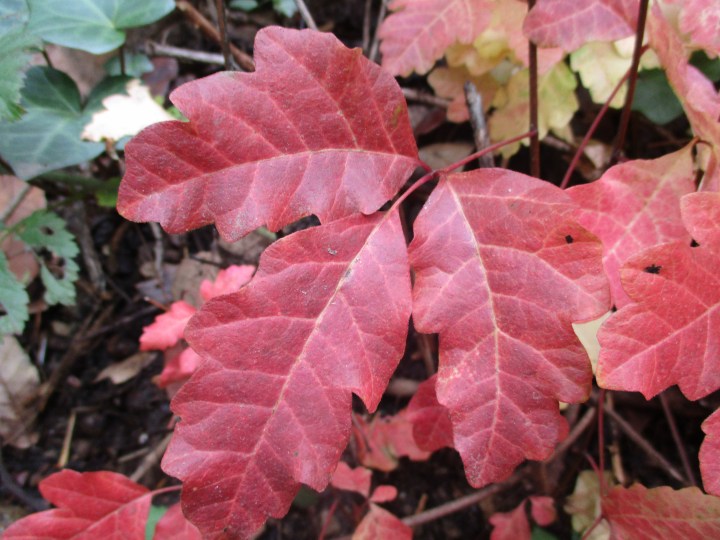
 The softest and laciest of the asparagus is the asparagus fern, Asparagus setaceus. The extremely small ‘leaves’ (or ‘cladodes’) are less than a quarter of an inch long. The tiny and mostly unnoticed pale white flowers that bloom sporadically in warm weather make it obvious that asparagus fern is not really a fern. (Ferns do not bloom.) If any green berries develop, they are toxic.
 It seems like not so long ago when the only African daisy that was commonly available was the trailing African daisy that makes such a nice relaxed ground cover for small spaces. The simple white flowers have navy blue centers, and are occasionally joined by mutant light purple flowers. The cultivar that blooms only in light purple was not as popular. Things have certainly changed!
 Boston ivy is not really ivy at all; but is more closely related to grape. Along with creeping fig, it is one of the two best vines for freeway sound-walls. It protects the walls from graffiti and muffles sound. Unlike creeping fig, which is evergreen, Boston ivy is surprisingly colorful through autumn. Unfortunately, it clings to whatever it climbs with holdfast discs, so ruins paint, stucco, and any other surface it gets a hold of.
 Some of us may remember deodar cedar, Cedrus deodara, from the opening scene of the Andy Griffith Show. They were in the background as Andy Taylor and his son Opie skipped stones on Myers Lake near Mayberry in North Carolina. Those well established and naturalized trees and the pond are actually in Franklin Canyon Park in the Santa Monica Mountains above Beverly Hills.
 Of all the colorful berries that ripen in autumn, firethorn, Pyracantha coccinea, is the most colorful, and also the most familiar. The berries are almost always bright red, deep red or reddish orange. Cultivars with orange berries have become rare. Those with yellow berries are even more rare, and are weaker plants anyway. The berries can linger through winter, but typically get eaten by birds half way through.
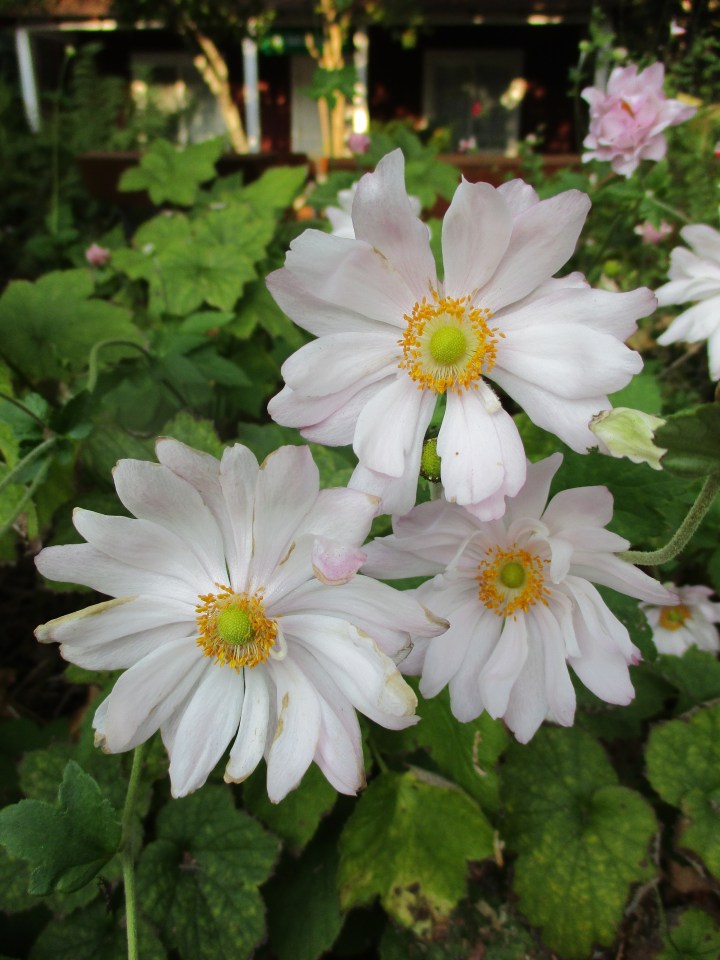 Here it is, three quarters of the way through November, and this Japanese anemone, Anemone hupehensis or Anemone X hybrida, is finally finishing bloom. It should have finished a month ago, but does not always stay on schedule here. Each cultivar exhibits a distinct responsiveness to the seasons, so others finished a while ago. The deciduous foliage will eventually succumb to frost.
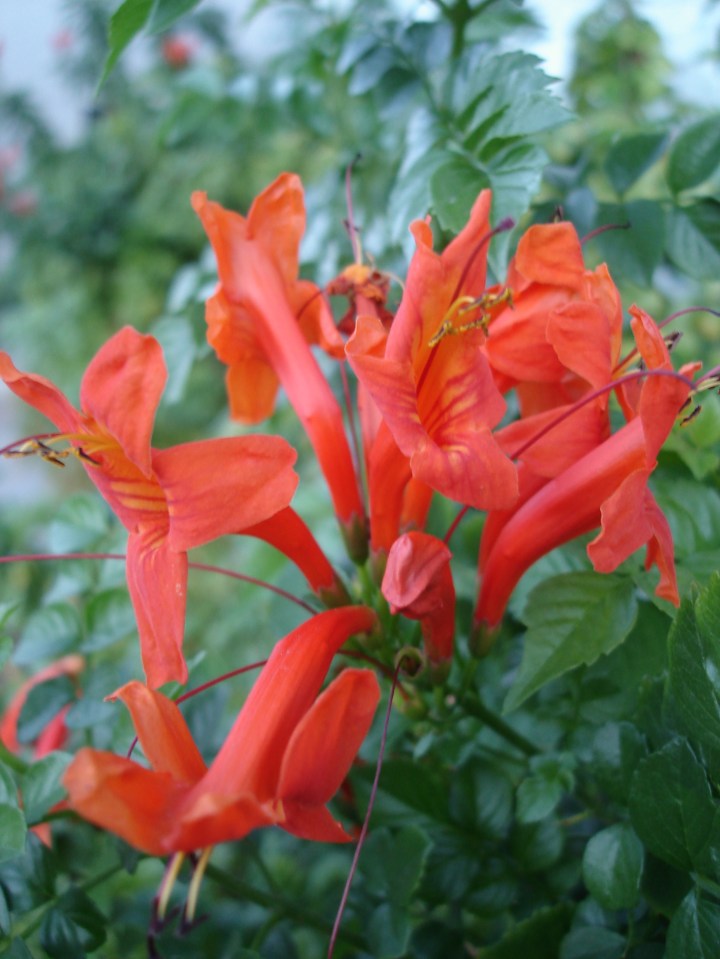 It may not bloom profusely, but cape honeysuckle, Tecoma capensis, blooms sporadically at random times throughout the year, and often while not much else is blooming. The bright reddish orange flowers contrast nicely against glossy evergreen foliage. Some blooms are slightly more reddish, while others are slightly more orangeish. A somewhat more compact cultivar blooms with light yellow flowers.
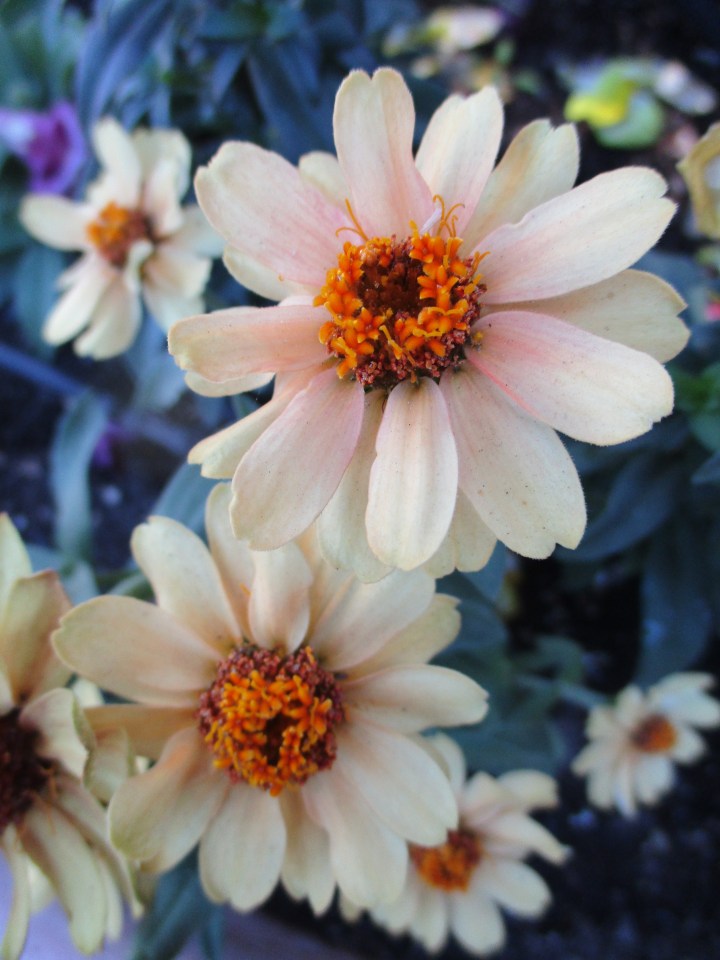 The same cooling weather that is initiating fall color is what finishes the zinnias that bloomed so colorfully through summer. Like tomatoes, they can stay out in the garden until they succumb frost if they continue to perform, and if the space they occupy is not needed for something else. There should be no guilt with replacing them sooner. After all, they are technically warm season annuals.
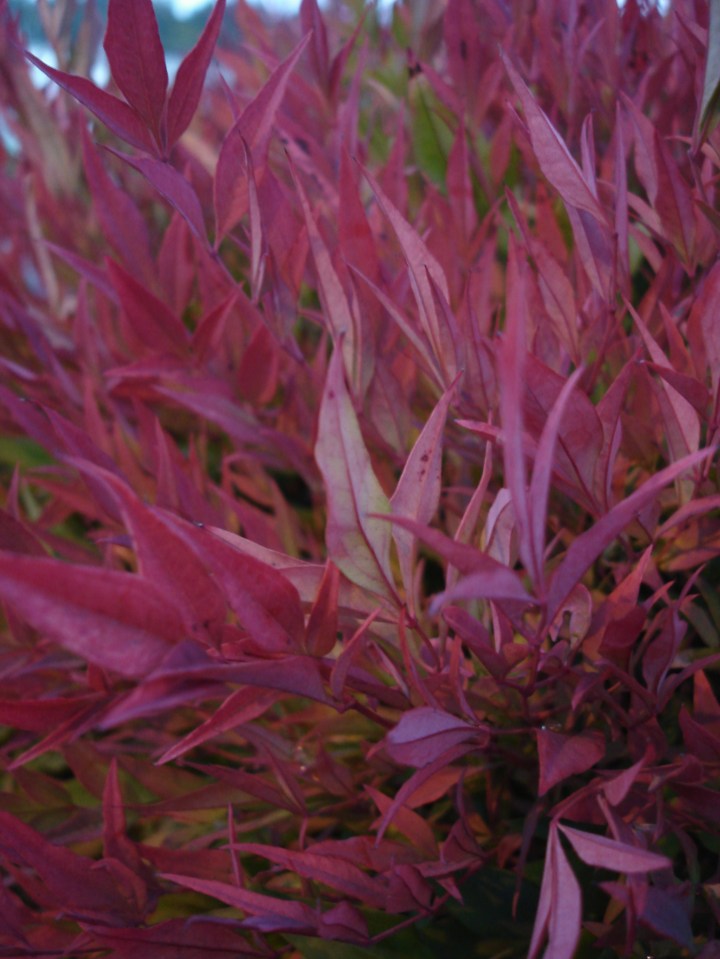 Good old-fashioned Heavenly bamboo, Nandina domestica, which can almost reach the eaves, can be difficult to obtain nowadays. More compact modern cultivars do not get much more than six feet tall, and some stay less than three feet tall. Foliage is airier in partial shade, but more colorful where more exposed.
