 The bright red berries of late cotoneaster, Cotoneaster lacteus, that ripen in autumn may not be as profuse or as bright red as those of firethorn, but they last longer, and even into winter. Birds strangely seem to avoid them. Although the clustered small berries can look just like firethorn berries, they are usually less shiny, and darker red. Clusters of tiny pale white flowers bloom in spring. The small evergreen leaves have a nice glossy and veined texture on top, with hazy gray or tan tomentum (fuzz) below. The grayish brown bark of old stems resembles that of apple or pear trees.
Tall arching stems can get just tall enough to reach first floor eaves, or taller if they happen to be shaded or leaning onto other larger shrubbery for support. In full sun, growth is more dense. Mature plants get a bit broader than tall. Unlike firethorn, late cotoneaster lacks thorns, which make it easier to work with as an espalier or informal hedge. Growth is a bit too irregular for a formal hedge.
Established plants do not need much water, and in some situations can do well without any watering. Unfortunately, late cotoneaster has naturalized as an invasive exotic weed in some regions.
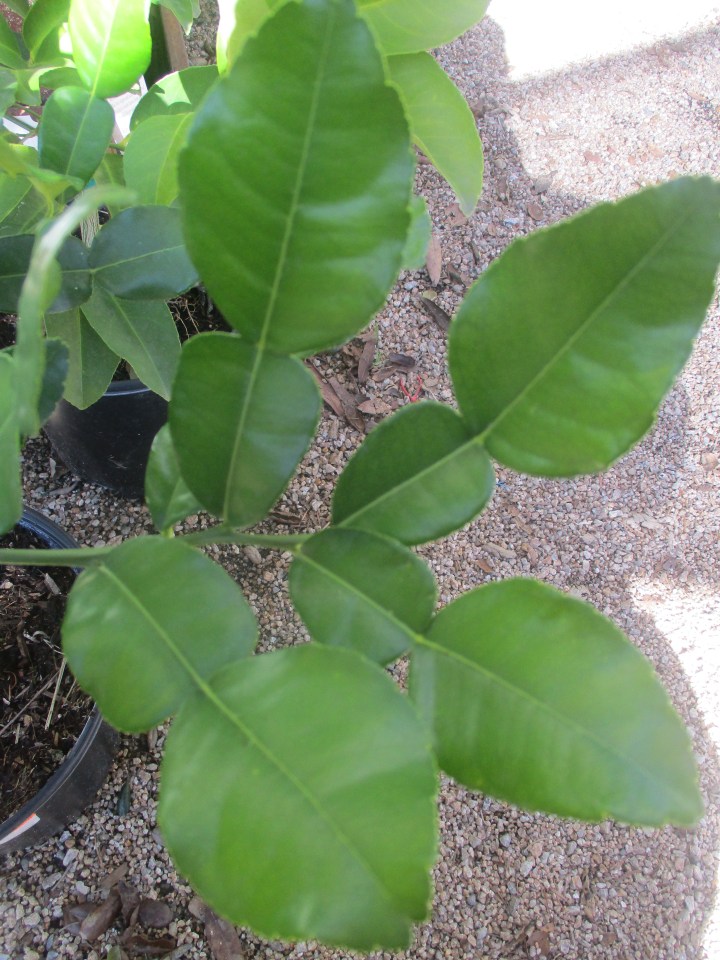 Of all the weird citruses available, this is one of the strangest. Makrut lime, Citrus hystrix, is not grown for its ugly wrinkled fruit. The rind and the juice are only rarely used for culinary or medicinal purposes. The important part of makrut lime is the aromatic foliage, particularly the modified petiole ‘wings’ that look like leaves. Fresh or dried, they are popular in the cuisine of Southeast Asia.
 Most of the brachyscome found in nurseries nowadays are the annual Brachyscome iberidifolia. Perennial species are rare. The name is still often spelled as ‘brachycome’, without the ‘s’, as it had been spelled for decades. Although it is a warm season annual, brachyscome is also popular now because it can bloom better through the locally mild winters than the warmth of mid summer.
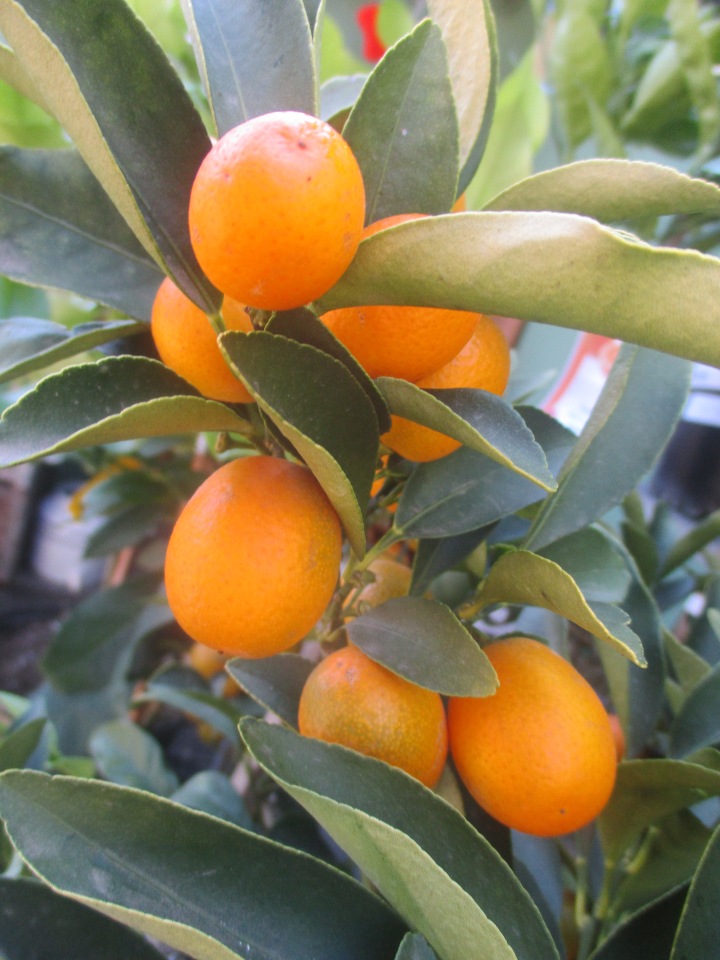 Tet, on February 16, will be the Vietnamese New Year’s Day for the Year of the Dog! Any year associated with the dog must be pretty excellent. Anyway, potted and fruited kumquat trees are very traditional decorations for Tet. Although less popular than orange and lemon trees, they are the most compact of the citrus trees, so are therefore the most adaptable to compact home gardens.
 Like euryops daisy, sweet pea shrub and New Zealand tea tree, the blue hibiscus, Alyogyne huegelii, blooms whenever it wants to, even if it wants to bloom sporadically through winter. It should bloom more abundantly in phases though spring and summer, but even that is difficult to predict. The three inch wide flowers are lavender blue, but can be rich purple or white. Pink is very rare.
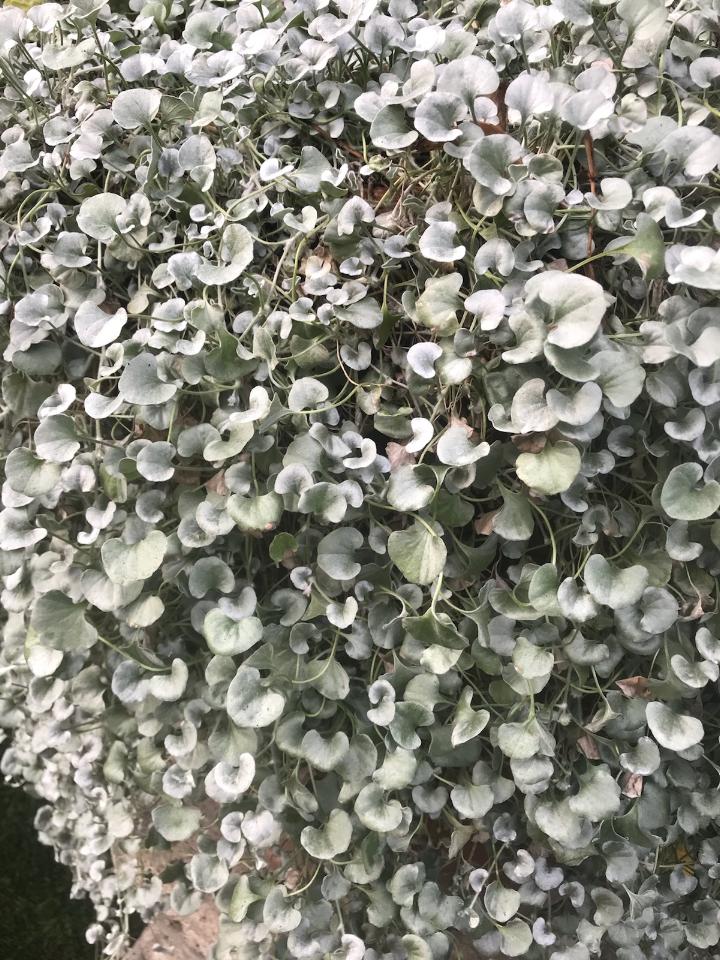 No one seems to know what ever happened to old fashioned dichondra lawns. Everyone seemed to like them, especially those of us who dislike turf grasses. Somehow, they became passe and very rare. The formerly common dichondra that such lawns were made of is now merely a resilient weed in turf lawns. But wait! We have not heard the last of this resilient and appealing perennial.
 It may not always bloom profusely, but sweet pea shrub, Polygala fruticosa, blooms sporadically through most of the year. Even when not much color is evident from a distance, a few flowers can likely be found on closer inspection. For some reason, bloom seems to be quite colorful now. Bloom phases should be more profuse in spring and summer. The pea flowers are soft purplish pink.
 This is no timid vine! Flame vine, Pyrostegia venusta, is related to the lavender trumpet vine and blood red trumpet vine, and is just as vigorous. Although it can not be recommended for tight spaces or small refined gardens, it excels at obscuring concrete walls. It only needs wires or stakes to be convinced to climb. If it gets too big, it can be cut back after bloom to regenerate quickly.
 What is it about Australian plants that makes them bloom in winter? Perhaps they think they are still in Australia where it is summer. Whatever the deal is, Geraldton waxflower, Chamaelaucium uncinatum, provides a scattering of small white, pale pink or lavender pink flowers from now until spring. It is no mistake that their bloom resembles that of New Zealand tea tree. They are related.
 Relative to other pines and evergreens that are commonly grown as living Christmas trees, the uncommon and even rare Austrian pine, Pinus nigra, would be a better option. If it gets planted too close to the home, as Christmas trees often do, it does not get big enough to cause major problems. Although much bigger in the wild, local trees may take decades to reach second story eaves.
