
In the lower right corner of this picture, next to the fenced garden gate, and just beyond the mown grass and what appears to be a walkway, there is a small clump of bearded iris foliage. No one knows where these iris came from, or for how long they had been there when this picture was taken in the summer of 1969. They were growing in the garden of my great grandmother, in Hoot Owl Creek, just south of Red Oak in Latimer County of Oklahoma. It is unlikely that my great grandmother purchased such non-utilitarian plant from a nursery. It was probably acquired from a friend or neighbor sometime during the half century that she tended the garden prior to 1969. It could have been around even earlier, since my great grandfather’s family first developed the farm as Oklahoma became a territory.
The flowers are an alluringly soft lavender blue, on elegantly tall and lean stems. They are relatively small for bearded iris, and lack any fancy frills or ruffles. In fact, they are quite neatly tailored, with a simple sweet and fruity fragrance that resembles that of grape pop. This iris is probably one of the prehistoric specie of iris that was used to breed modern cultivars. Some of these sorts of iris were known affectionately as ‘grape pop’ iris, but it is impossible to know if or how this particular iris is related.
Many years ago, probably in the early 1980s, my grandmother brought some of these iris back to her home garden in Santa Clara in California. They proliferated enough to share with friends and neighbors. A few went to my mother’s garden, where they also proliferated and were shared with friends and neighbors. Now, my mother’s great granddaughters play in a garden where these same iris will bloom next spring; only a few months from now, but at least six generations from that well outfitted homestead garden in Hoot Owl Creek.
Where will these iris go from here? It is impossible to say. Younger generations are not very interested in horticulture. However, I really doubt that my great grandmother could have imagined that they would have gotten this far. What is funny is that these iris are probably more interesting now to current generations than they were to my great grandmother when she planted them.
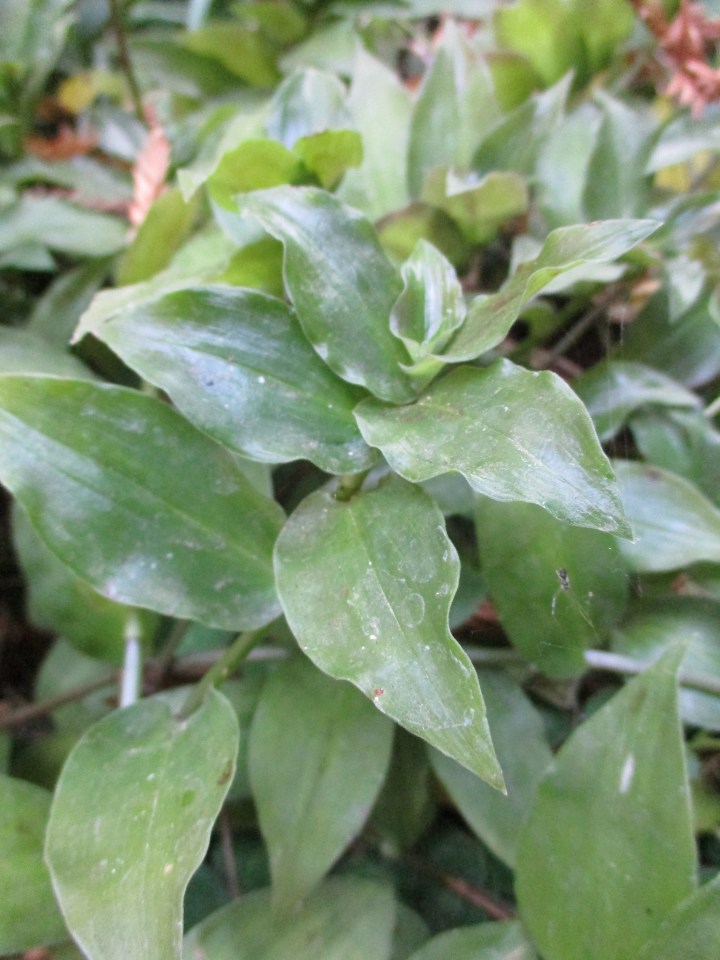 It could not have survived out in the desert for forty years. Wandering Jew, Tradescantia fluminensis, would have desiccated before its first summer. Well watered gardens are a completely different situation. Wandering Jew can become invasive and mix with other more desirable ground covers, only to die back and turn dark brown through winter. It starts over the following spring.
 After many centuries of cultivation, myrtle, Myrtus communis, has not changed much. It was one of the more traditional plants for formally shorn hedges in Victorian gardens. It functions somewhat like a drought tolerant boxwood. Unshorn plants can grow as gnarly small trees not much higher than the eaves. ‘Compacta’ gets only about three or four feet high and wide, even without pruning.
 No other big tree has trunks as sculptural as those of the California sycamore, Platanus racemosa. They bend and groove so irregularly, seemingly without direction, that it is a wonder that old trees in the wild eventually get a hundred feet tall. Some trees have a few trunks. The mottled beige bark is quite striking both in the shade of the broad canopy, and while trees are bare in winter.
 There seems to be some discrepancy about the correct spelling of crape myrtle, Lagerstroemia indica. Many of us spell it as ‘crepe’ myrtle, thinking that crepe is the thin colorful paper that the flowers resemble. It is actually a rolled up thin French pancake. The thin paper is actually spelled as ‘crape’. Of course those of us who dislike the commonness of crape myrtle might omit the ‘e’.
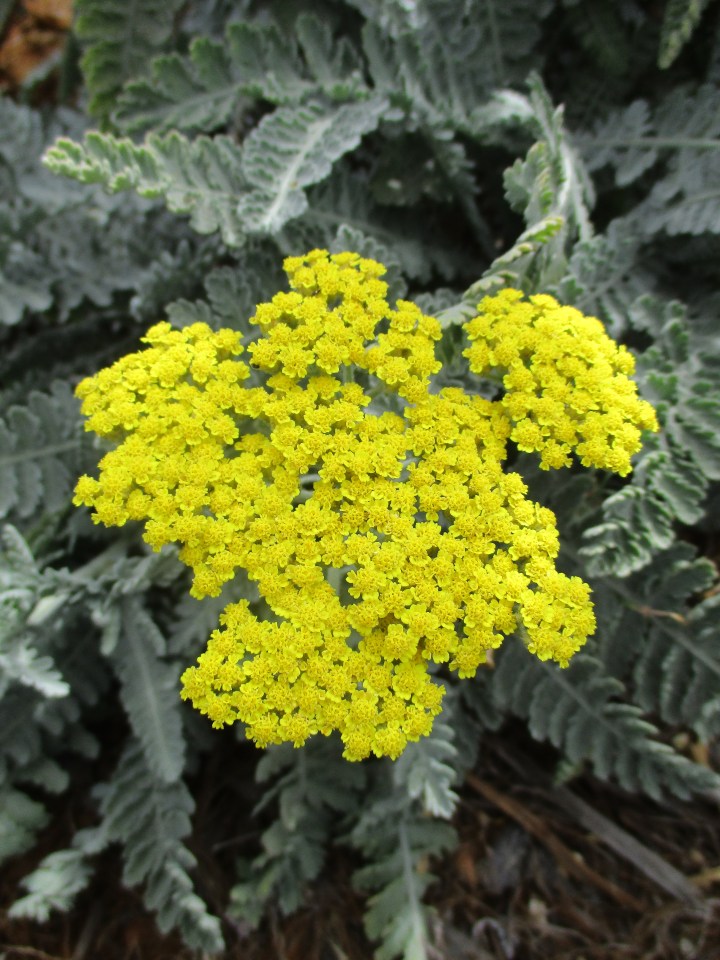 ‘Moonshine’ is probably the epitome of fernleaf yarrow, Achillea filipendulina, even though it is technically a hybrid. From the middle to the end of summer, its three inch wide corymbs (flat-topped trusses) of tiny bright yellow flowers stand as high as three feet above ferny and gray basal foliage. Bloom is best in full sun and warm exposure. Established plants do not need too much water.
