Yuccas (reblogged)


P71022+Yuccas are almost as useful as aloes are for gardening in chaparral or desert climates. I say ‘almost’ because most are not quite as friendly. The leaves are outfitted with nastily sharp tips. It is how they protect themselves from grazing animals in the wild, but it is not such an advantage in home gardens. Some actually have the potential to be dangerous where someone could bump into them. The leaves of Joshua tree can puncture leather. Some types of yucca get so big that they make it difficult to avoid their nasty leaves, even if planted in the background.

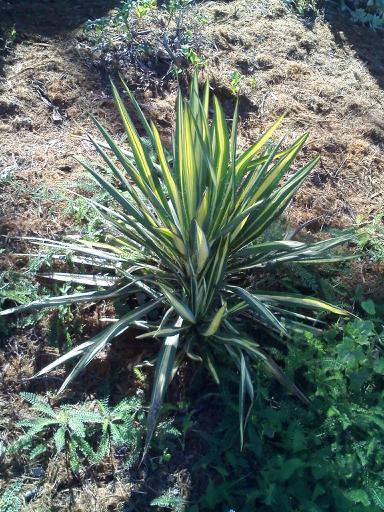
That being said, for those of us who do not need to worry about endangering children, dogs or anyone else out in our gardens, yuccas are very distinctive and handsome plants. Their striking foliage radiates outward from dense foliar rosettes. Large spikes of creamy white flowers that bloom in summer or autumn stand above the foliage quite boldly. Some yuccas produce remarkably tall floral spikes. Our Lord’s Candle, Yucca whipplei (Hesperoyucca whipplei), is a terrestrial yucca that sits low to the ground, but produces a huge flower stalk that stands ten feet tall! Modern garden varieties of Adam’s needle, Yucca filamentosa, are variegated.

Of the yuccas that develop sculptural trunks, only a few are available in nurseries. The giant yucca, Yucca elephantipes, is almost too common in mild climates, and unfortunately develops a massively distended trunk that is too big for some of the situations it gets into. Most other trunk forming yuccas that grow slower are uncommon because they are susceptible to rot in landscapes where they get watered through summer.

Except for a few tropical yuccas that are very rare, yuccas are very drought tolerant. Even in desert climates, some yuccas survive on annual rainfall. Others are happier if watered a few times through summer. Giant yucca happens to be a tropical yucca, but surprisingly does not need much water.

Giant yucca is very easy to propagate from cuttings of the big canes. Even big pieces can be cut and stuck as cuttings. However, most of the tree yuccas are difficult to propagate.

Terrestrial yuccas that do not develop trunks are generally easy to propagate by division of pups, although some are difficult to handle. Some terrestrial yuccas actually develop small trunks that creep along the ground, or maybe stand a few feet tall. They can be propagated as cuttings like giant yucca.
P71021

Aloes (and a Rant)

P71020We really should be growing more of what grows well here. This is as relevant in other regions as it is in the Santa Clara Valley. Some regions have a lot more to choose from. There are always limitations too. Tropical plants do not survive the winters of New England. Apples and pears want more winter chill than they can get in San Diego.
In California, we do not have enough water to go around. Well, that is not completely true. Much of that misconception is political, which is none of my business. Much of it is that there are just too many people living here and sharing a limited resource. Much of it is that many of the too many people living here waste water on, among other things, gardening.

Many of the urban areas of California are in chaparral climates, which means that there is not much rain. Los Angeles and some other urban areas are full blown desert, which means that rain is quite minimal. My former neighborhood in the western Santa Clara Valley got about a foot of rainfall annually. It was considered to be chaparral. Trona, in the Mojave Desert, gets about four inches of rain annually.

However, few people in chaparral or desert regions landscape their homes accordingly. Some limit their ornamental plants to natives. Others limit their choices to plants from chaparral or desert climates, even if not native. Yet, most of us grow plants and lawns that really have no business in chaparrals or deserts, and we do so excessively.

Well, enough of that rant. There are many plants that really should be more popular here.

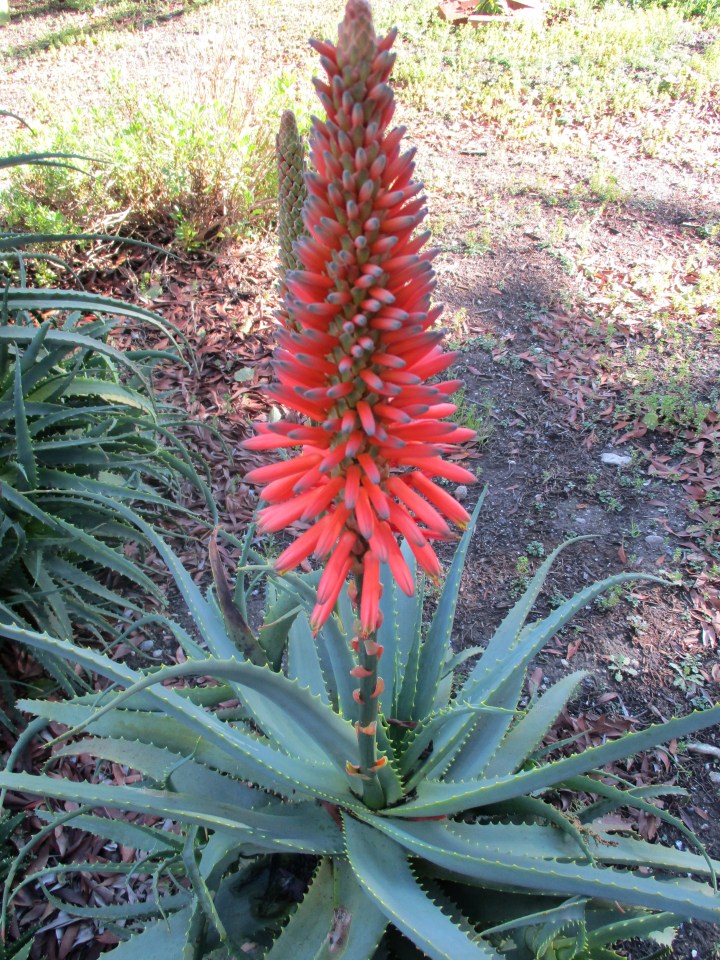
Aloes are a perfect example. Although many are from more tropical climates, most do not need to be watered too much. Some prefer minimal watering through summer. After winter rains, they produce fresh new succulent foliage in spring, and bloom reliably. Many have flashy orange or yellow flowers on striking vertical spikes. As plants grow, superfluous shoots can be separated and planted wherever more of the same plants are desired.

Smaller aloes are quite dense and mounding, with tight rosettes of stout leaves. Larger types with more open growth can get six feet tall. A few grow into small trees, with thick trunks that might be distended or buttressed at ground level. Leaves might have pronounced teeth along the margins, and most are spotted to some degree.

Everything about aloes is striking. They have prominent and colorful bloom. The distinctive succulent foliage is bold and unique. The larger aloes even have sculptural form.

Aloes are ideal for planters and pots because their roots are so complaisant and undemanding. They are rarely bothered by insects or disease. They are so easy to propagate that cuttings or pups can be acquired from friends or neighbors who are already growing them.

Society Garlic

71025Some flowers are better left in the garden rather than cut and brought in. Society garlic, Tulbaghia violacea, looks like it would be an ideal cut flower, with nice bare stems. The aroma suggests otherwise. It smells something like a strongly aromatic combination of onion and garlic. Even in the garden, it might be a good idea to keep it at a distance. Deer and rabbits do not mess with it.

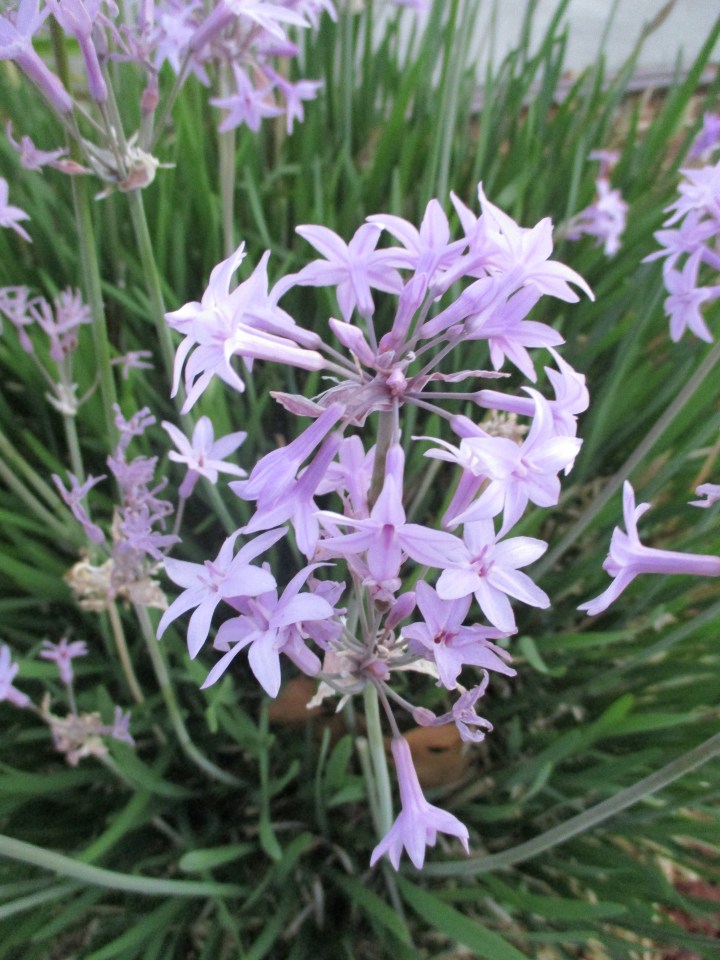
Society garlic is sometimes known as pink agapanthus because it has similar foliage and flowers, only much smaller. The tiny flowers are really more lavender pink than pink, and bloom in round clusters on stems about a foot and a half tall in late summer or early autumn. The narrow leaves are only about a quarter of an inch wide, almost grassy, but more rubbery like those of agapanthus.

Mature plants form dense clumps of foliage at least two feet wide. Variegated plants stay much smaller, but are also very likely to revert to green (non-variegated) growth, which if not removed, overwhelms and replaced variegated growth. Society garlic is very easy to divide for propagation. It likes full sun or slight shade. Although somewhat drought tolerant, it prefers regular watering.

Redwoods

P71014It is hard to beat redwoods. Seriously! There are only three specie, which are now three different genera; but one is the biggest tree in the world, one is the tallest tree in the world, and the third is one of only a few conifers that are deciduous. The biggest and the tallest are both native to California. The deciduous redwood is from China.

Dawn redwood, Metasequoia glyptostroboides, is the deciduous redwood from China. (See the picture above.) It was discovered relatively recently, in 1944, so is not nearly as popular in landscaping as the other two redwoods are. Ironically, it is actually better for urban gardens because it does not get as tall as other redwoods. The tallest forest trees (that need to compete with other tall trees) are a mere two hundred feet tall. More exposed urban trees rarely get half as tall. Also, dawn redwood is adaptable to a broader range of climates than the others are.

Giant redwood, Sequoiadendron giganteum, is the biggest tree in the world. It lives in isolated groves in the Sierra Nevada, where old trees can get to be more 3,500 years old. The tallest are more than two hundred and fifty feet tall, with trunks more than twenty five feet wide near the ground. The trees are so massive that they could not be harvested without shattering much of the wood within. Of course, wild trees are now protected from harvest. They protect themselves from wildfires with thick bark and by branching so high above other vegetation.

Coastal redwood, Sequoia sempervirens, gets about half as old, but about a hundred feet taller than the giant redwood. It lives on the coast of California, from Oregon to Monterey County. It has been extensively harvested because the wood is so resistant to rot and insects. Harvested trees regenerate quickly from roots, forming families of several genetically identical trees. Coastal redwood groves are dense enough to exclude other trees, and produce enough debris to prevent seeds of other specie from germinating. They are less combustible than other trees, and protect themselves from wildfires with thick bark. Their foliage regenerates efficiently if burned.

I grew up only a few miles outside of the natural range of coastal redwood, and now live amongst them. I never get tired of them. As majestic as they are, the trees that were harvested earlier were even bigger. I build an outhouse and a shower out of two hollow burned out stumps of coastal redwood. Another nearby stump is big enough build into a shed. It only needs a roof on top. Even after a century, the burned old growth stumps are still intact. They rot very slowly.

The area burned in the 1950s only because so many other more combustible trees grew back with the secondary growth after extensive harvesting of the old growth trees. Much of the secondary growth that was burned while only about half a century old recovered, and is now about a century old. Trees that grew after the fire are now about half a century old. As the forest thickens, firs, oaks, madrones, maples and bay trees get crowded out. Redwood really know how to manage their forest.

Bastards!

P71011Palm trees did not impress me much when I was young. Although striking in the right landscapes, they did not ‘do’ much. They made no fruit. They made no firewood. Only the big Canary Island date palms made any significant shade. What they did make was a big mess that was difficult to rake. They were expensive to maintain. They sheltered rats and pigeons. Their seedlings came up in the weirdest places.
Back then, the only two palms that I was really familiar with were the Canary Island date palm and the Mexican fan palm. Windmill palms were common too, but because they are so much less obtrusive, they did not get my attention. Queen palms had not yet become a fad, so were mostly in older neighborhoods outside of my world. I was aware that there was an odd type of Mexican fan palm, but never gave it much thought.

Then I went to college . . . and met Brent, from Southern California, where palms are more appreciated. I also met more palms that I had either ignored earlier, or had never seen before. After a while, Brent showed me around coastal Southern California, including the Pacific Coast Highway and Santa Monica, where I saw palm trees at their best.

I will never forget turning onto Bedford Drive in Beverly Hills, where the Beverly Hillbillies drove when they came to town. I had never seen Canary Island date palms and Mexican fan palms like that before. They were so majestic! They were so tall! They were so uniform! It did not change what I already knew about palms, but it did give me a different respect for them.

That odd Mexican fan palm that I mentioned earlier was actually the California fan palm, or the desert fan palm, which is classified as a distinct specie. It gets about half as tall, but twice as stout, with fluffier foliage. Because it is shorter and stouter, it stands straight, without bending like the taller and lankier Mexican fan palm does. It is also more genetically variable because it naturally grows in isolated oases rather than a contiguous range.

After seeing the California fan palm growing wild outside of Palm Springs, around the springs that Palm Springs is named for, it became my favorite palm. It is very stately in the right situations. It lines North First Street at Saint James Park in San Jose, and flanks the Palm Driveway at the Winchester House. Unfortunately, it really prefers to be out in the aridity and warmth of the desert. It looks rather sickly if it gets too much water.

While cruising around the Los Angeles area, Brent pointed out a few ‘bastards’, which are hybrids of California fan palm and Mexican fan palm. Apparently, they are not distinct specie, but rather subspecie. In other words, they hybridize freely. Each parent has attributes; and the bastards get the best of both.

Mexican fan palms, whether I like them or not, are very tall, elegant and graceful. They are exquisite skyline trees, with leaning or bowing trunks that can move casually in the wind. California fan palms are stout, stately and formal. If not watered too much, their straight and uniform trunks, and canopies of fluffy foliage, work nicely where conformity is desired. Bastards have trunks that are just thin enough to be elegant, but just stout and straight enough to be stately. Their canopies are more ‘lush’ than fluffy like those of the California fan palm.

Until recently, bastards were solitary trees that grew randomly from seed. They were not available in nurseries. If they had been, they would have been very variable because of their random breeding. However, someone took notice enough to cultivate what seems to be a cultivar known as Washingtonia X filibusta. (Washingtonia X filibusta is derived from the names of California fan palm, Washingtonia filifera, and Mexican fan palm, Washingtonia robusta. The ‘X’ designates it as a hybrid.) They are becoming the new alternative to the formerly all too common Mexican fan palm.P71011+

Dracaena Palm

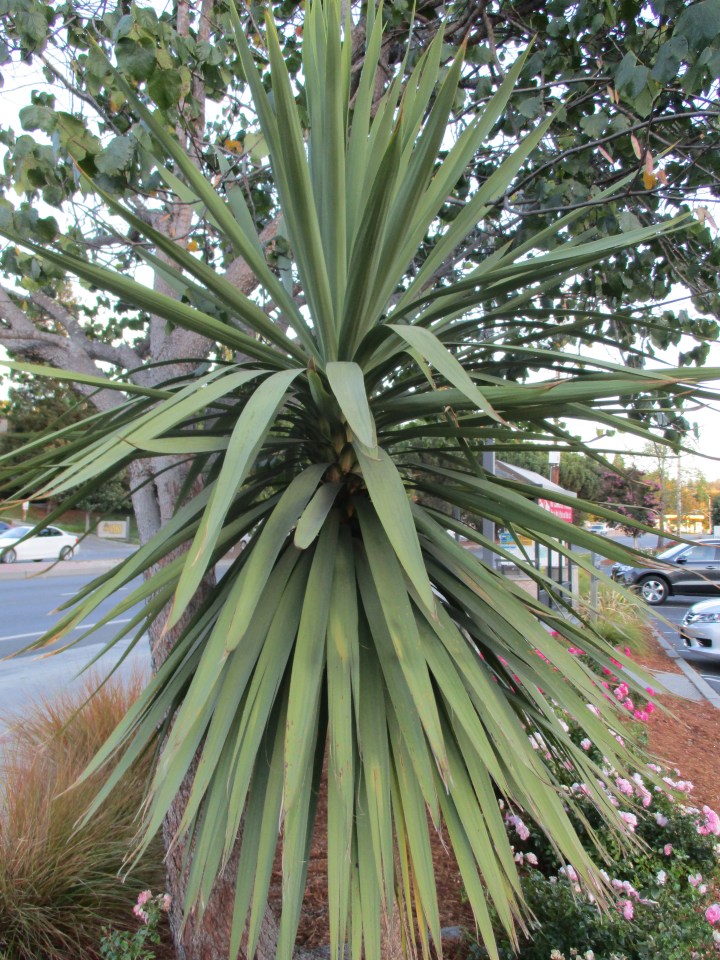
71018Dracaena palm, Cordyline australis, is not a palm at all. It is more closely related to yuccas. (Incidentally, a few yuccas are also inaccurately known as palms as well, but that is another story.) The simple specie that grows taller than a two story house is rare nowadays. It develops a high branched canopy of evergreen olive drab foliage. The three inch wide leaves are about three feet long.

Modern cultivars stay significantly shorter, with somewhat shorter and less pendulous leaves. Some are nicely bronzed or purplish. Others are variegated with creamy white, pale yellow or pinkish brown. Trusses of minute flowers that bloom in early summer are not much to look at, and drop sawdust-like frass as they deteriorate. Bloom might be greenish white or blushed, and then fades to tan. Most modern cultivars do not bloom much, or may not bloom at all. The gray trunks have an appealingly corky texture.

Politically Incorrect Horticulture

P71008Landscape Designer, Brent Green and I are both very professional at work. Brent is particularly well dressed, well groomed and well spoken. I happen to be simpler and plainer, but it works for the clients who respect my expertise. What our clients do not see is how we interact with each other. It would be very easy to be offended. Yet, we consult with each other almost daily, usually when Brent is driving somewhere . . . alone. We get loud, obnoxious, rude, crude, potty mouthed and just plain nasty!

Years ago, when Brent got his telephone connected to the stereo in the car, he made the mistake of driving up to a drive through window at a fast food establishment while talking to me. I listened to him place his order, and then shouted, “THIS IS A HOLDUP! GIVE ME ALL YOUR MONEY!”.

Last year, while stuck in traffic on southbound Highway 17 with the top down in the old Chrysler, I took a call from Brent. I was using some weird hands-free device at first; but when Brent started rapping about some very objectionable subject matter, I just had to share. I disconnected the device so that the call was coming through on the stereo, and turned the stereo up very loud. I just sat there calmly and tried to look as if I did not know where all the commotion was coming from, although it was obvious. I just didn’t care. Neither did Brent. He was 350 miles away.

However, not all of our nonsense is so senseless. We have developed quite a bit or our own private vocabulary and horticultural slang. It works for us because we share so much common experience. Much of the slang applies to ‘ethnic horticulture’, which refers to the gardening styles of particular ethnic groups. Brent’s favorite ethnic group to invent ethnic horticultural slang for is of course mine. Although I am only halfway of Italian descent, I can really identify with Brent’s observations of the gardening habits of people of Italian descent.

My ancestors have been here so long that the ‘old country’ refers to Sunnyvale (California). Yet, somehow, some traditions continue through many generations. My great grandfather grew many of the plants that are very stereotypical of Italian American gardening. My pa is more cosmopolitan, but he and I still enjoy some of what we learned from my great grandfather.

This is some of the slang that Brent developed for some of what I grow in my garden:

  • dago pansy – nasturtium
  • dago begonia – geranium
  • dago sunflower – dahlia
  • dago rhododendron – oleander
  • dago tomato – tomato (duh)
  • dago wisteria – grape
  • dago plum – fig
  • dago berry – olive
  • dago spruce – Italian cypress
  • dago firewood – any fruitless tree
  • dago ghetto grass – Astroturf (not in my garden)
  • dago groundcover – red lava rock or white moonrock

Dago Pansies

P71007You can say what you like about nasturtiums. My landscape designer colleague, Brent Green certainly did when he named them ‘dago pansies’. They are still one of my favorite flowers, and just might be my favorite, even though none are convincingly white. They were my first. I discovered them when I was very young. They were growing near an old English walnut tree in my great grandfather’s garden. He noticed that I liked them, so found some seeds underneath to send home with me.
I did not know what to do with seeds, so I poked holes into the ground and dropped the seeds into the holes just like my great grandfather showed me to do. A few days later, small round leaves appeared where I had put the seeds. The leaves expanded and looked just like those of the nasturtiums in my great grandfather’s garden. Yellow, orange and even a few red flowers were blooming within a month. I was so impressed when the flowers first appeared, but was then briefly saddened when the first flowers to bloom faded.

I say that I was ‘briefly’ saddened because of what happened next. Where the flowers had been, I discovered what appeared to be the same sort of seeds that my great grandfather had given me! I still did not understand how these things worked; but I took the seeds and stuck them into the ground in other areas . . . anywhere I thought nasturtiums would be nice. They grew, bloomed and provided more seeds, which I took and planted elsewhere . . . and everywhere! To this day, my pa considers nasturtiums to be invasive weeds because of how they overwhelmed the garden that he thought was his.

In my kindergarten classroom, we had ‘color boards’ on a wall. Red, yellow and blue were the tree primary colors. Orange, green and purple were the secondary colors. There were also boards for pink, brown, black, white and gray. We could bring small disposable artifacts from home for our teacher to tape to the various boards. The artifacts were mostly bits of fabric, colored paper, pictures from magazines, Legos, buttons, or really anything we could find that could be taped to a wall. Of course, I had to bring yellow, orange and red nasturtium flowers, and a green nasturtium leaf. Our teacher probably did not want to tape them to the wall, but did anyway. They turned brown, but stayed there. I bragged about them for the rest of the school year.

I still grow descendents of those old nasturtiums. I also try new varieties just because I enjoy them so much. I still like the classic ‘Jewels mix’ because they have every color. They are smaller than wild nasturtiums at first, but are more prolific. After a few years, they revert to the common yellow and orange. Renee’s Garden Seeds at https://www.reneesgarden.com/ has some very interesting varieties, including a few old classics. The climbing types do not bloom as much, but are fun anyway. I probably have not tried them all yet, but I would if I could. I have history with dago pansies.

‘Peaches and Cream’ Grevillea

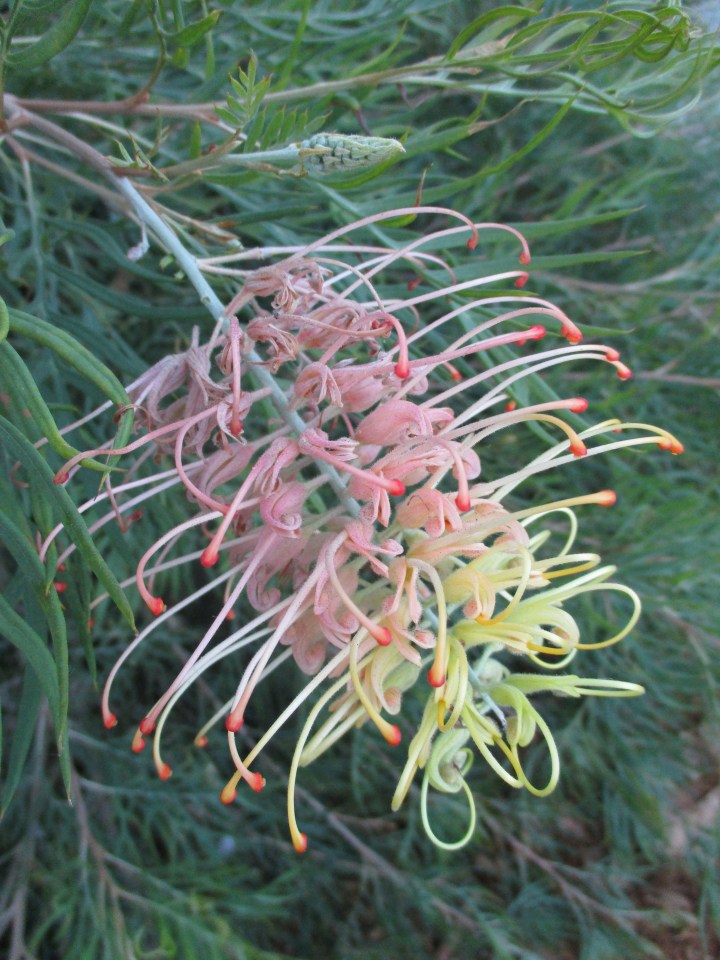
71011No one knows for certain who the parents were, so the hybrid Grevillea ‘Peaches and Cream’ lacks a species designation. (If it is important, the parent are most likely Grevillea banksii and Grevillea bipinnatifida.) It is an evergreen shrub that gets about four feet high and wide, with intricately lobed light green foliage. Individual leaves are about four inches long and two inches wide.
Four inch long floral trusses of tiny flowers can bloom at any time, attracting hummingbirds. Flowers bloom greenish yellow and then fade through a range of yellow, peachy orange and pink, from the bottom of the truss to the top. Warm and sunny exposure promotes bloom. Established plants do not need much water. Like other grevilleas, ‘Peaches and Cream’ grevillea can cause contact dermatitis. (It is best to know if one is allergic to it before planting it.)

Dwarf Pampas Grass

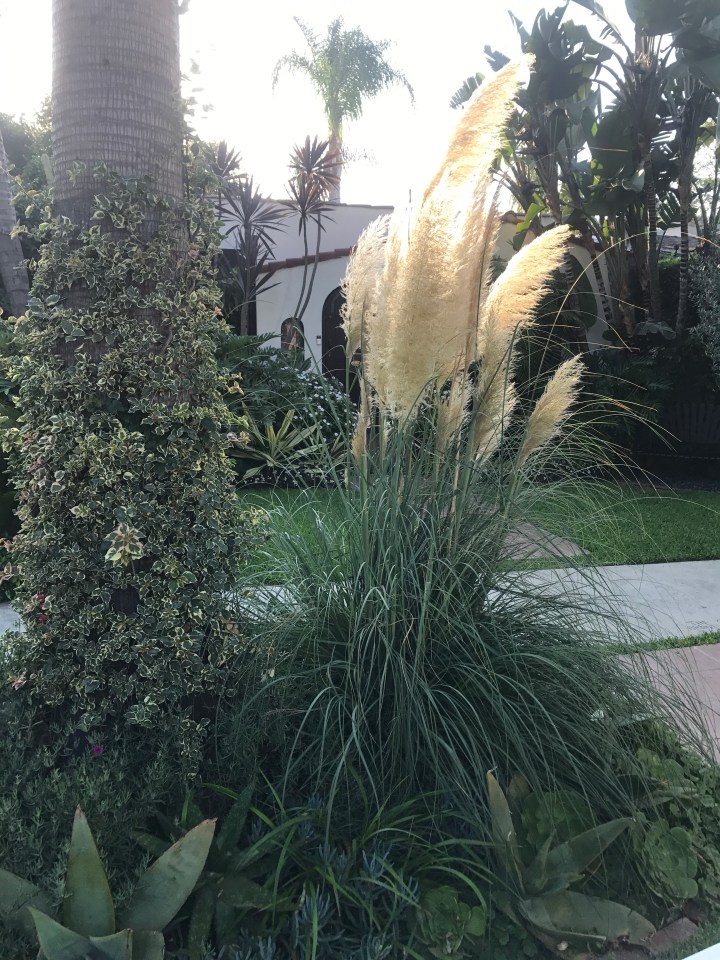
71004Modern garden varieties of pampas grass found in nurseries are generally non-invasive. Their flowers are described as ‘sterile’, and therefore unable to produce seed. What that really means is that they are exclusively female, and unable to produce seed without male pollinators. However, they have the potential to be pollinated by naturalized pampas grass, and sow a few hybrid seed.

Of course, if naturalized pampas grass (Cortaderia jubata) are already in the area, a few tame dwarf pampas grass, Cortaderia selloana ‘Pumila’ will not make much of a difference anyway. They have the same elegantly cascading foliage and boldly fluffy flowers in the middle of summer, but on a smaller scale. The long and narrow leaves might stay less than five feet tall. The white flowers might stay below eight feet tall. Unfortunately, the leaves can easily cause nasty paper cuts!