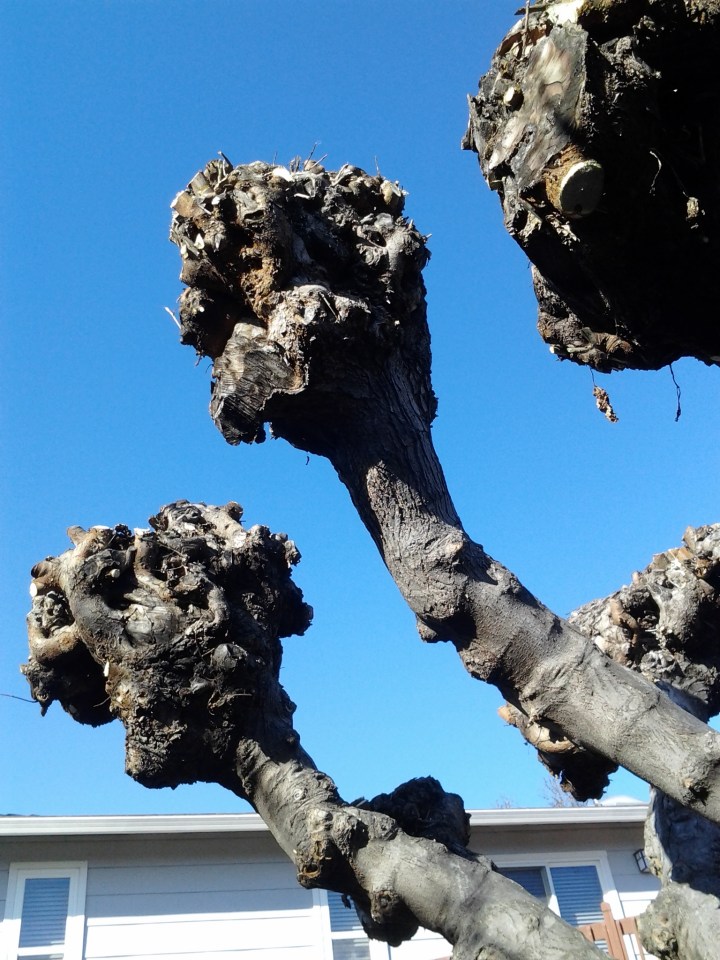
Very few arborists in America condone the extreme pruning techniques known as pollarding and coppicing. Both techniques essentially ruin trees, and deprive them of their natural form. Affected trees likely require such procedures to be repeated every few years or annually. Otherwise, they are likely to succumb to resulting structural deficiency. Restoration of such trees is rarely practical.
Pollarding is severe pruning to remove all except the main trunk and a few or perhaps several main limbs. Coppicing is even more severe, and leaves only a stump. Both are done while subjects are dormant through winter. Most or all new growth that develops is spring is concentrated around pruning wounds of the previous winter. Some coppiced stumps generate growth from the roots.
If pollarded or coppiced annually, all growth that developed during the previous season gets pruned cleanly away to where it grew from since the previous procedure. Distended ‘knuckles’ develop at the ends of pollarded limbs or coppiced stumps as the pruning is repeated for a few years. ‘English’ pollarding leaves a well oriented stub of any desired length to slowly elongate each knuckle.
Pruning wounds should be as flush to each knuckle as possible, without intrusive stubble. The many small pruning wounds left on each distended knuckle will compartmentalize (heal) efficiently as new growth develops during the following season. Pruning below a knuckle might seem to be more practical, but leaves a single but big wound that could decay before it gets compartmentalized.
Delaying pruning for a few years creates bigger wounds, and allows innately structurally compromised stems to get heavy.
Pollarding and coppicing were developed a long time ago to produce kindling, fence stakes, cane for basketry, and fodder for livestock, as well as silkworms. Nowadays, it is done to contain big trees, enhance the size and color of leaves, produce juvenile foliage, produce colorful twiggy growth, or prevent unwanted bloom or fruit. Not many trees are conducive to such severe techniques.




 The internet makes it possible to communicate with people who enjoy gardening all over the World. It can be amusing to hear what garden enthusiasts in Australia are doing now in early summer. Is it always summer in Ecuador? A common theme in much of America is that there is not much gardening to do right now. It might be more accurate to say that no one wants to go out in the cold.
 Roots hold up trees. That is part of their job. They grow along with the trees they support, and disperse as necessary to maintain stability. Trees grown within the confinement of cans (pots) or boxes, and then installed into a landscape, are typically staked temporarily until their roots adequately disperse and stabilize. Once unnecessary,

 Grafting compound is a thick sealant applied to a fresh graft union to limit desiccation while the graft knits. A bit more typically gets applied to the cut distal end of the scion. There are various formulations of grafting compound, ranging from something resembling roof patch to a something with the consistency of thick paint.
 The trees know what time of year it is. Even evergreen trees have shed some of their older foliage through late summer. Deciduous trees generally start later, but will be more blatant about their process as they defoliate completely through autumn to winter. Some get strikingly colorful first, as if to brag about it. Foliage is not so important during shorter days and dimmed sunlight anyway.
 Tony Tomeo